


Community hub
0 subscribers8 pages, 0 posts
Recent from talks
All channels
Be the first to start a discussion here.
Be the first to start a discussion here.
Be the first to start a discussion here.
Be the first to start a discussion here.
Contribute something
Welcome to the community hub built to collect knowledge and have discussions related to Pyroxmangite.
Nothing was collected or created yet.
Pyroxmangite
View on Wikipediafrom Wikipedia
| Pyroxmangite | |
|---|---|
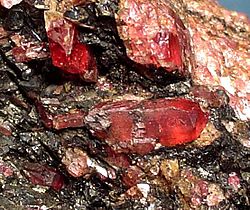
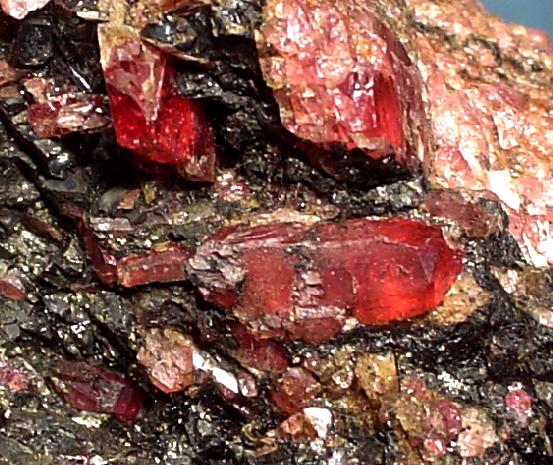
 Pyroxmangite from Chubu Region, Honshu Island, Japan | |
| General | |
| Category | Inosilicate minerals (single chain) |
| Group | Pyroxene group |
| Series | Pyroxferroite-Pyroxmangite series |
| Formula | MnSiO3 |
| IMA symbol | Pxm[1] |
| Strunz classification | 9.DO.05 |
| Crystal system | Triclinic |
| Crystal class | Pinacoidal (1) (same H-M symbol) |
| Space group | C1 |
| Unit cell | a = 9.69 Å, b = 10.5 Å, c = 17.39 Å; α = 112.17°, β = 102.85°, γ = 82.93°; V = 1,596.00 Å3; Z = 28 |
| Identification | |
| Color | pink, red, brown |
| Twinning | Lamellar on {010}, simple on {001} |
| Cleavage | Perfect on {110}, {110}, (110) ^ (110) = 92° poor on {010}, {001} |
| Fracture | hackly, uneven |
| Tenacity | brittle |
| Mohs scale hardness | 5+1⁄2 – 6 |
| Luster | vitreous, pearly |
| Streak | colorless |
| Diaphaneity | transparent, translucent |
| Specific gravity | 3.8 |
| Birefringence | δ=0.018 |
| Other characteristics | morphology: tabular crystals, granular massive, grainy |
| References | [2][3][4] |
Pyroxmangite has the general chemical formula of MnSiO3.[5] It is the high-pressure, low-temperature dimorph of rhodonite.[2]
It was first described in 1913 and named for the mineral group, pyroxenes, and is known as the manganese member.[6] It forms a series with pyroxferroite.
Pyroxmangite occurs in metamorphosed ore deposits rich in manganese. Associated minerals include spessartine, tephroite, alleghanyite, hausmannite, pyrophanite, alabandite, rhodonite and rhodochrosite.[4]
References
[edit]- ^ Warr, L.N. (2021). "IMA–CNMNC approved mineral symbols". Mineralogical Magazine. 85 (3): 291–320. Bibcode:2021MinM...85..291W. doi:10.1180/mgm.2021.43. S2CID 235729616.
- ^ a b Ralph, Jolyon, and Ida Chao. "Pyroxmangite: Pyroxmangite Mineral Information and Data." MinDat.org
- ^ Barthelmy, David. "The Mineral Pyroxmangite." minerals.net
- ^ a b Anthony, John W.; Bideaux, Richard A.; Bladh, Kenneth W.; Nichols, Monte C., eds. (1990). "Pyroxmangite". Handbook of Mineralogy (PDF). Vol. II (Silica, Silicates). Chantilly, VA, US: Mineralogical Society of America. ISBN 0962209716. Retrieved December 5, 2011.
- ^ Pinckney, Linda R, and Charles W Burnham. "High-Temperature crystal structure of pyroxmangite." American Mineralogist 73 (1988): 809–817. GeoScienceWorld. Web. 13 September 2010.
- ^ Ford, W.E. & Bradley, W.M. (1913). "Pyroxmangite, a new member of the pyroxene group and its alteration product, skemmatite". American Journal of Science. 36 (212): 169–174. Bibcode:1913AmJS...36..169F. doi:10.2475/ajs.s4-36.212.169.
 Media related to Pyroxmangite at Wikimedia Commons
 | This article about a specific silicate mineral is a stub. You can help Wikipedia by adding missing information. |