
Recent from talks
QAC Quickie Q2
Knowledge base stats:
Talk channels stats:
Members stats:
QAC Quickie Q2
The Quickie Q2 or Q2 is a two-seat version of the unique Rutan Quickie, produced in kit form by the Quickie Aircraft Corporation founded by Tom Jewett and Gene Sheehan. Canadian Garry LeGare was involved in the design.
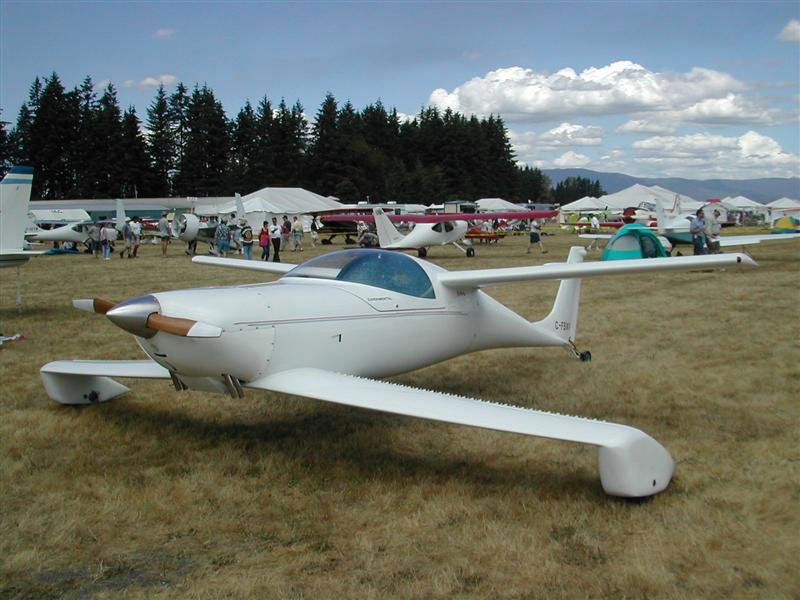
The Q2 is a tandem wing design, having one forward wing (canard) and one rear wing (instead of the more usual main wing and horizontal stabilizer). The elevators are fitted to the forward wing so that all pitch control comes from the forward wing, similar to the canard configuration.[citation needed] The Q2 is a "taildragger" with fixed (non-retractable) main wheels incorporated into integral streamlined wheel pants located at the tips of the forward wing.
As efficient as the original Q1 design,[citation needed] the Q2 is of composite construction.
The Q2 followed Jewett's and Sheehan's intention to design a two-seat homebuilt aircraft.[citation needed]
An amateur aircraft builder who had already built a Rutan VariEze, LeGare suggested a two-place side-by-side development of the Quickie equipped with a larger Volkswagen derived engine. At the time, Sheehan and Jewett were not interested so LeGare fabricated a single proof of concept prototype.
Unlike the original single-seat Quickie, Rutan was not involved with the design of the Q2, but it retains the Rutan tandem wing solution to the design challenges associated with low drag, high-efficiency design, with a fixed undercarriage and a useful center of gravity range. Pilot and passenger seating placement was close to the center of gravity, the integral wheel pants substantially reduced parasitic drag, and the tandem wing placement and decalage made for natural angle-of-attack limiting (i.e., natural stall recovery with a pitch buck onset). The aircraft was a point design, configured at a time of high fuel prices, increasing costs for the sport pilot, and in the wake of the Bede BD-5.[citation needed]
The Q2 was configured as a "taildragger" with fixed (non-retractable) integral wheel pants at the tips of a forward wing with a noticeable adhedral. The wheel pants acted as endplates (increasing effective aspect ratio) and constraining spanwise flow. As a result, the original aircraft configuration was an effective ekranoplan and exhibited surface effect phenomenon when within a half wingspan distance from the ground. The absence of separate landing gear in the original configurations (e.g. Q-1 through Q-200) reduced both weight and drag; however, much of the configurational advantage was lost in the Tri-Q modification. Propeller ground clearance was a problem in the early Quickie aircraft fabricated with highly flexible fiberglass spar caps... and those aircraft were susceptible to prop-strikes during hard landings. Subsequently, the use of full span, tapered, carbon fiber spars in the Q-200 added significant stiffness to the forward wing/canard. This development substantially reduced the tendency of the aircraft to porpoise and experience propeller damage.[citation needed]
Full-span elevators were fitted to the forward wing such that all pitch control came from the forward wing, similar to the canard configuration.[citation needed] The forward wing in this configuration provided about 60% of the lift. The close proximity of the engine/propeller to the forward wing made for a powered lift effect with instantaneous climb response to power inputs. The ailerons were located inboard on the aft wing, which was shoulder-mounted centrally, just aft of the pilot. This aileron placement reduced any tendency to aileron induced yaw; a properly built aircraft would enter a coordinated turn with the pilots feet off the rudder pedals. The canard layout provided positive lift from both pairs of wings, whereas a conventional tailplane supplies negative lift. However, the principal advantage to the Q2/Q200 configuration was probably[weasel words] the reduced size and, therefore, reduced flat plate, wetted area and drag associated with the airframe integration.
Hub AI
QAC Quickie Q2 AI simulator
(@QAC Quickie Q2_simulator)
QAC Quickie Q2
The Quickie Q2 or Q2 is a two-seat version of the unique Rutan Quickie, produced in kit form by the Quickie Aircraft Corporation founded by Tom Jewett and Gene Sheehan. Canadian Garry LeGare was involved in the design.
The Q2 is a tandem wing design, having one forward wing (canard) and one rear wing (instead of the more usual main wing and horizontal stabilizer). The elevators are fitted to the forward wing so that all pitch control comes from the forward wing, similar to the canard configuration.[citation needed] The Q2 is a "taildragger" with fixed (non-retractable) main wheels incorporated into integral streamlined wheel pants located at the tips of the forward wing.
As efficient as the original Q1 design,[citation needed] the Q2 is of composite construction.
The Q2 followed Jewett's and Sheehan's intention to design a two-seat homebuilt aircraft.[citation needed]
An amateur aircraft builder who had already built a Rutan VariEze, LeGare suggested a two-place side-by-side development of the Quickie equipped with a larger Volkswagen derived engine. At the time, Sheehan and Jewett were not interested so LeGare fabricated a single proof of concept prototype.
Unlike the original single-seat Quickie, Rutan was not involved with the design of the Q2, but it retains the Rutan tandem wing solution to the design challenges associated with low drag, high-efficiency design, with a fixed undercarriage and a useful center of gravity range. Pilot and passenger seating placement was close to the center of gravity, the integral wheel pants substantially reduced parasitic drag, and the tandem wing placement and decalage made for natural angle-of-attack limiting (i.e., natural stall recovery with a pitch buck onset). The aircraft was a point design, configured at a time of high fuel prices, increasing costs for the sport pilot, and in the wake of the Bede BD-5.[citation needed]
The Q2 was configured as a "taildragger" with fixed (non-retractable) integral wheel pants at the tips of a forward wing with a noticeable adhedral. The wheel pants acted as endplates (increasing effective aspect ratio) and constraining spanwise flow. As a result, the original aircraft configuration was an effective ekranoplan and exhibited surface effect phenomenon when within a half wingspan distance from the ground. The absence of separate landing gear in the original configurations (e.g. Q-1 through Q-200) reduced both weight and drag; however, much of the configurational advantage was lost in the Tri-Q modification. Propeller ground clearance was a problem in the early Quickie aircraft fabricated with highly flexible fiberglass spar caps... and those aircraft were susceptible to prop-strikes during hard landings. Subsequently, the use of full span, tapered, carbon fiber spars in the Q-200 added significant stiffness to the forward wing/canard. This development substantially reduced the tendency of the aircraft to porpoise and experience propeller damage.[citation needed]
Full-span elevators were fitted to the forward wing such that all pitch control came from the forward wing, similar to the canard configuration.[citation needed] The forward wing in this configuration provided about 60% of the lift. The close proximity of the engine/propeller to the forward wing made for a powered lift effect with instantaneous climb response to power inputs. The ailerons were located inboard on the aft wing, which was shoulder-mounted centrally, just aft of the pilot. This aileron placement reduced any tendency to aileron induced yaw; a properly built aircraft would enter a coordinated turn with the pilots feet off the rudder pedals. The canard layout provided positive lift from both pairs of wings, whereas a conventional tailplane supplies negative lift. However, the principal advantage to the Q2/Q200 configuration was probably[weasel words] the reduced size and, therefore, reduced flat plate, wetted area and drag associated with the airframe integration.
Recent media