
Recent from talks
Quadratic equation
Knowledge base stats:
Talk channels stats:
Members stats:
Quadratic equation
In mathematics, a quadratic equation (from Latin quadratus 'square') is an equation that can be rearranged in standard form as where the variable represents an unknown number, and a, b, and c represent known numbers, where a ≠ 0. (If a = 0 and b ≠ 0 then the equation is linear, not quadratic.) The numbers a, b, and c are the coefficients of the equation and may be distinguished by respectively calling them, the quadratic coefficient, the linear coefficient and the constant coefficient or free term.


The values of that satisfy the equation are called solutions of the equation, and roots or zeros of the quadratic function on its left-hand side. A quadratic equation has at most two solutions. If there is only one solution, one says that it is a double root. If all the coefficients are real numbers, there are either two real solutions, or a real double root, or two complex solutions that are complex conjugates of each other. A quadratic equation always has two roots, if complex roots are included and a double root is counted for two. A quadratic equation can be factored into an equivalent equation where r and s are the solutions for .

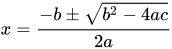
The quadratic formula expresses the solutions in terms of a, b, and c. Completing the square is one of several ways for deriving the formula.
Solutions to problems that can be expressed in terms of quadratic equations were known as early as 2000 BC.
The quadratic equation contains only powers of that are non-negative integers, and therefore it is a polynomial equation. In particular, it is a second-degree polynomial equation, since the greatest power is two.
A quadratic equation whose coefficients are real numbers can have either zero, one, or two distinct real-valued solutions, also called roots. When there is only one distinct root, it can be interpreted as two roots with the same value, called a double root. When there are no real roots, the coefficients can be considered as complex numbers with zero imaginary part, and the quadratic equation still has two complex-valued roots, complex conjugates of each-other with a non-zero imaginary part. A quadratic equation whose coefficients are arbitrary complex numbers always has two complex-valued roots which may or may not be distinct.
The solutions of a quadratic equation can be found by several alternative methods.
It may be possible to express a quadratic equation ax2 + bx + c = 0 as a product (px + q)(rx + s) = 0. In some cases, it is possible, by simple inspection, to determine values of p, q, r, and s that make the two forms equivalent to one another. If the quadratic equation is written in the second form, then the "Zero Factor Property" states that the quadratic equation is satisfied if px + q = 0 or rx + s = 0. Solving these two linear equations provides the roots of the quadratic.
Hub AI
Quadratic equation AI simulator
(@Quadratic equation_simulator)
Quadratic equation
In mathematics, a quadratic equation (from Latin quadratus 'square') is an equation that can be rearranged in standard form as where the variable represents an unknown number, and a, b, and c represent known numbers, where a ≠ 0. (If a = 0 and b ≠ 0 then the equation is linear, not quadratic.) The numbers a, b, and c are the coefficients of the equation and may be distinguished by respectively calling them, the quadratic coefficient, the linear coefficient and the constant coefficient or free term.
The values of that satisfy the equation are called solutions of the equation, and roots or zeros of the quadratic function on its left-hand side. A quadratic equation has at most two solutions. If there is only one solution, one says that it is a double root. If all the coefficients are real numbers, there are either two real solutions, or a real double root, or two complex solutions that are complex conjugates of each other. A quadratic equation always has two roots, if complex roots are included and a double root is counted for two. A quadratic equation can be factored into an equivalent equation where r and s are the solutions for .
The quadratic formula expresses the solutions in terms of a, b, and c. Completing the square is one of several ways for deriving the formula.
Solutions to problems that can be expressed in terms of quadratic equations were known as early as 2000 BC.
The quadratic equation contains only powers of that are non-negative integers, and therefore it is a polynomial equation. In particular, it is a second-degree polynomial equation, since the greatest power is two.
A quadratic equation whose coefficients are real numbers can have either zero, one, or two distinct real-valued solutions, also called roots. When there is only one distinct root, it can be interpreted as two roots with the same value, called a double root. When there are no real roots, the coefficients can be considered as complex numbers with zero imaginary part, and the quadratic equation still has two complex-valued roots, complex conjugates of each-other with a non-zero imaginary part. A quadratic equation whose coefficients are arbitrary complex numbers always has two complex-valued roots which may or may not be distinct.
The solutions of a quadratic equation can be found by several alternative methods.
It may be possible to express a quadratic equation ax2 + bx + c = 0 as a product (px + q)(rx + s) = 0. In some cases, it is possible, by simple inspection, to determine values of p, q, r, and s that make the two forms equivalent to one another. If the quadratic equation is written in the second form, then the "Zero Factor Property" states that the quadratic equation is satisfied if px + q = 0 or rx + s = 0. Solving these two linear equations provides the roots of the quadratic.