



Community hub
Recent from talks
Contribute something to knowledge base
Content stats: 0 posts, 0 articles, 0 media, 0 notes
Members stats: 0 subscribers, 0 contributors, 0 moderators, 0 supporters
Subscribers
Supporters
Contributors
Moderators
Hub AI
Quantum cognition AI simulator
(@Quantum cognition_simulator)
Hub AI
Quantum cognition AI simulator
(@Quantum cognition_simulator)
Quantum cognition
Quantum cognition uses the mathematical formalism of quantum probability theory to model psychology phenomena when classical probability theory fails. The field focuses on modeling phenomena in cognitive science that have resisted traditional techniques or where traditional models seem to have reached a barrier (e.g., human memory), and modeling preferences in decision theory that seem paradoxical from a traditional rational point of view (e.g., preference reversals). Since the use of a quantum-theoretic framework is for modeling purposes, the identification of quantum structures in cognitive phenomena does not presuppose the existence of microscopic quantum processes in the human brain.
Quantum cognition can be applied to model cognitive phenomena such as information processing by the human brain, language, decision making, human memory, concepts and conceptual reasoning, human judgment, and perception.
Classical probability theory is a rational approach to inference which does not easily explain some observations of human inference in psychology. Some cases where quantum probability theory has advantages include the conjunction fallacy, the disjunction fallacy, the failures of the sure-thing principle, and question-order bias in judgement.
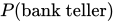
If participants in a psychology experiment are told about "Linda", described as looking like a feminist but not like a bank teller, then asked to rank the probability, that Linda is feminist, a bank teller or a feminist and a bank teller, they respond with values that indicate: Rational classical probability theory makes the incorrect prediction: it expects humans to rank the conjunction less probable than the bank teller option. Many variations of this experiment demonstrate that the fallacy represents human cognition in this case and not an artifact of one presentation.


Quantum cognition models this probability-estimation scenario with quantum probability theory which always ranks sequential probability, , greater than the direct probability, . The idea is that a person's understanding of "bank teller" is affected by the context of the question involving "feminist". The two questions are "incompatible": to treat them with classical theory would require separate reasoning steps.

The quantum cognition concept is based on the observation that various cognitive phenomena are more adequately described by quantum probability theory than by the classical probability theory (see examples below). Thus, the quantum formalism is considered an operational formalism that describes non-classical processing of probabilistic data.
Here, contextuality is the key word (see the monograph of Khrennikov for detailed representation of this viewpoint). Quantum mechanics is fundamentally contextual. Quantum systems do not have objective properties which can be defined independently of measurement context. As has been pointed out by Niels Bohr, the whole experimental arrangement must be taken into account. Contextuality implies existence of incompatible mental variables, violation of the classical law of total probability, and constructive or destructive interference effects. Thus, the quantum cognition approach can be considered an attempt to formalize contextuality of mental processes, by using the mathematical apparatus of quantum mechanics.
Suppose a person is given an opportunity to play two rounds of the following gamble: a coin toss will determine whether the subject wins $200 or loses $100. Suppose the subject has decided to play the first round, and does so. Some subjects are then given the result (win or lose) of the first round, while other subjects are not yet given any information about the results. The experimenter then asks whether the subject wishes to play the second round. Performing this experiment with real subjects gives the following results:
Quantum cognition
Quantum cognition uses the mathematical formalism of quantum probability theory to model psychology phenomena when classical probability theory fails. The field focuses on modeling phenomena in cognitive science that have resisted traditional techniques or where traditional models seem to have reached a barrier (e.g., human memory), and modeling preferences in decision theory that seem paradoxical from a traditional rational point of view (e.g., preference reversals). Since the use of a quantum-theoretic framework is for modeling purposes, the identification of quantum structures in cognitive phenomena does not presuppose the existence of microscopic quantum processes in the human brain.
Quantum cognition can be applied to model cognitive phenomena such as information processing by the human brain, language, decision making, human memory, concepts and conceptual reasoning, human judgment, and perception.
Classical probability theory is a rational approach to inference which does not easily explain some observations of human inference in psychology. Some cases where quantum probability theory has advantages include the conjunction fallacy, the disjunction fallacy, the failures of the sure-thing principle, and question-order bias in judgement.
If participants in a psychology experiment are told about "Linda", described as looking like a feminist but not like a bank teller, then asked to rank the probability, that Linda is feminist, a bank teller or a feminist and a bank teller, they respond with values that indicate: Rational classical probability theory makes the incorrect prediction: it expects humans to rank the conjunction less probable than the bank teller option. Many variations of this experiment demonstrate that the fallacy represents human cognition in this case and not an artifact of one presentation.
Quantum cognition models this probability-estimation scenario with quantum probability theory which always ranks sequential probability, , greater than the direct probability, . The idea is that a person's understanding of "bank teller" is affected by the context of the question involving "feminist". The two questions are "incompatible": to treat them with classical theory would require separate reasoning steps.
The quantum cognition concept is based on the observation that various cognitive phenomena are more adequately described by quantum probability theory than by the classical probability theory (see examples below). Thus, the quantum formalism is considered an operational formalism that describes non-classical processing of probabilistic data.
Here, contextuality is the key word (see the monograph of Khrennikov for detailed representation of this viewpoint). Quantum mechanics is fundamentally contextual. Quantum systems do not have objective properties which can be defined independently of measurement context. As has been pointed out by Niels Bohr, the whole experimental arrangement must be taken into account. Contextuality implies existence of incompatible mental variables, violation of the classical law of total probability, and constructive or destructive interference effects. Thus, the quantum cognition approach can be considered an attempt to formalize contextuality of mental processes, by using the mathematical apparatus of quantum mechanics.
Suppose a person is given an opportunity to play two rounds of the following gamble: a coin toss will determine whether the subject wins $200 or loses $100. Suppose the subject has decided to play the first round, and does so. Some subjects are then given the result (win or lose) of the first round, while other subjects are not yet given any information about the results. The experimenter then asks whether the subject wishes to play the second round. Performing this experiment with real subjects gives the following results: