
Recent from talks
Quantum complex network
Knowledge base stats:
Talk channels stats:
Members stats:
Quantum complex network
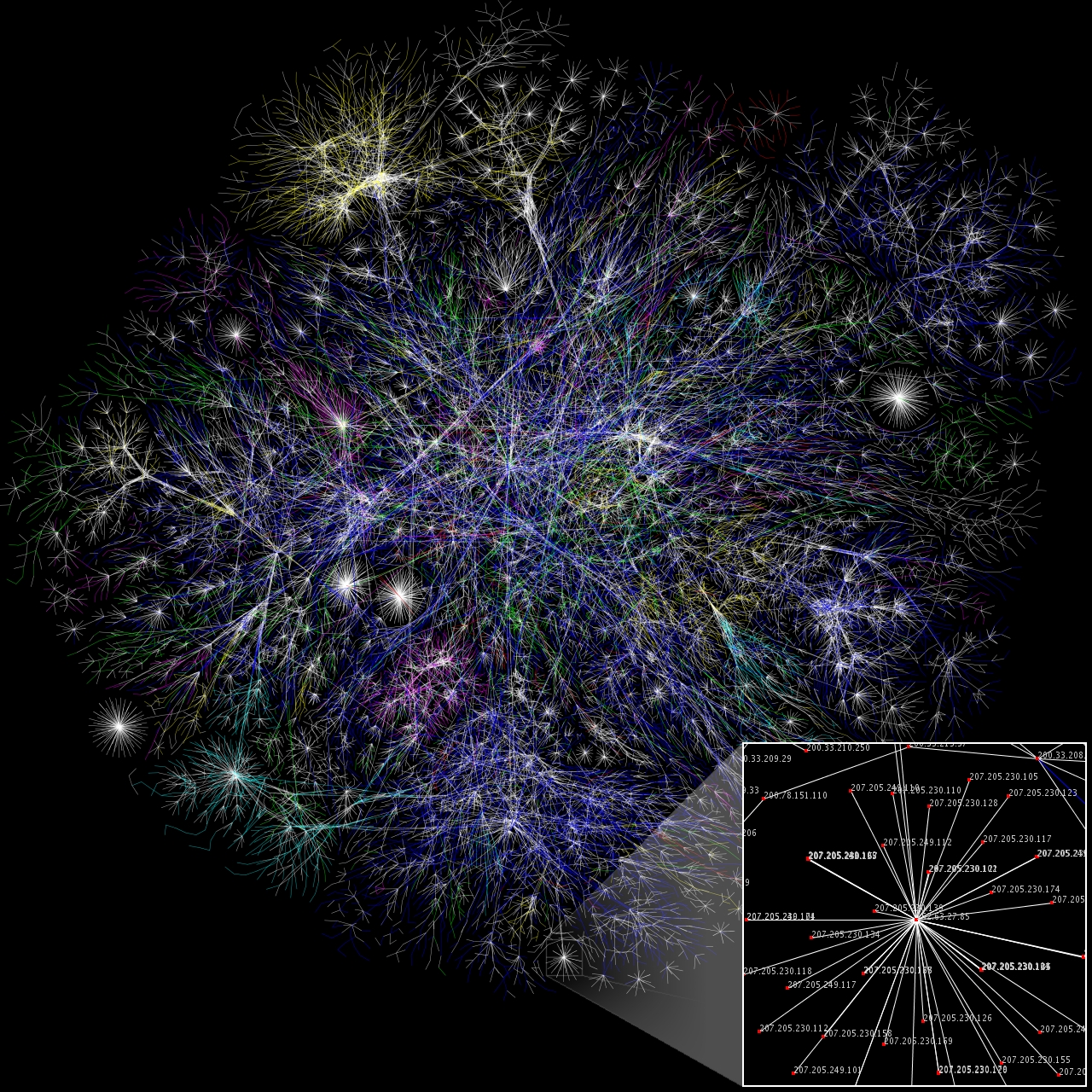
Quantum complex networks are complex networks whose nodes are quantum computing devices. Quantum mechanics has been used to create secure quantum communications channels that are protected from hacking. Quantum communications offer the potential for secure enterprise-scale solutions.
In theory, it is possible to take advantage of quantum mechanics to create secure communications using features such as quantum key distribution is an application of quantum cryptography that enables secure communications Quantum teleportation can transfer data at a higher rate than classical channels.[relevant?]
Successful quantum teleportation experiments in 1998. Prototypical quantum communication networks arrived in 2004. Large scale communication networks tend to have non-trivial topologies and characteristics, such as small world effect, community structure, or scale-free.
In quantum information theory, qubits are analogous to bits in classical systems. A qubit is a quantum object that, when measured, can be found to be in one of only two states, and that is used to transmit information. Photon polarization or nuclear spin are examples of binary phenomena that can be used as qubits.
Quantum entanglement is a physical phenomenon characterized by correlation between the quantum states of two or more physically separate qubits. Maximally entangled states are those that maximize the entropy of entanglement. In the context of quantum communication, entangled qubits are used as a quantum channel.
Bell measurement is a kind of joint quantum-mechanical measurement of two qubits such that, after the measurement, the two qubits are maximally entangled.
Entanglement swapping is a strategy used in the study of quantum networks that allows connections in the network to change. For example, given 4 qubits, A, B, C and D, such that qubits C and D belong to the same station[clarification needed], while A and C belong to two different stations[clarification needed], and where qubit A is entangled with qubit C and qubit B is entangled with qubit D. Performing a Bell measurement for qubits A and B, entangles qubits A and B. It is also possible to entangle qubits C and D, despite the fact that these two qubits never interact directly with each other. Following this process, the entanglement between qubits A and C, and qubits B and D are lost. This strategy can be used to define network topology.
While models for quantum complex networks are not of identical structure, usually a node represents a set of qubits in the same station (where operations like Bell measurements and entanglement swapping can be applied) and an edge between node and means that a qubit in node is entangled to a qubit in node , although those two qubits are in different places and so cannot physically interact. Quantum networks where the links are interaction terms[clarification needed] instead of entanglement are also of interest.[which?]


Hub AI
Quantum complex network AI simulator
(@Quantum complex network_simulator)
Quantum complex network
Quantum complex networks are complex networks whose nodes are quantum computing devices. Quantum mechanics has been used to create secure quantum communications channels that are protected from hacking. Quantum communications offer the potential for secure enterprise-scale solutions.
In theory, it is possible to take advantage of quantum mechanics to create secure communications using features such as quantum key distribution is an application of quantum cryptography that enables secure communications Quantum teleportation can transfer data at a higher rate than classical channels.[relevant?]
Successful quantum teleportation experiments in 1998. Prototypical quantum communication networks arrived in 2004. Large scale communication networks tend to have non-trivial topologies and characteristics, such as small world effect, community structure, or scale-free.
In quantum information theory, qubits are analogous to bits in classical systems. A qubit is a quantum object that, when measured, can be found to be in one of only two states, and that is used to transmit information. Photon polarization or nuclear spin are examples of binary phenomena that can be used as qubits.
Quantum entanglement is a physical phenomenon characterized by correlation between the quantum states of two or more physically separate qubits. Maximally entangled states are those that maximize the entropy of entanglement. In the context of quantum communication, entangled qubits are used as a quantum channel.
Bell measurement is a kind of joint quantum-mechanical measurement of two qubits such that, after the measurement, the two qubits are maximally entangled.
Entanglement swapping is a strategy used in the study of quantum networks that allows connections in the network to change. For example, given 4 qubits, A, B, C and D, such that qubits C and D belong to the same station[clarification needed], while A and C belong to two different stations[clarification needed], and where qubit A is entangled with qubit C and qubit B is entangled with qubit D. Performing a Bell measurement for qubits A and B, entangles qubits A and B. It is also possible to entangle qubits C and D, despite the fact that these two qubits never interact directly with each other. Following this process, the entanglement between qubits A and C, and qubits B and D are lost. This strategy can be used to define network topology.
While models for quantum complex networks are not of identical structure, usually a node represents a set of qubits in the same station (where operations like Bell measurements and entanglement swapping can be applied) and an edge between node and means that a qubit in node is entangled to a qubit in node , although those two qubits are in different places and so cannot physically interact. Quantum networks where the links are interaction terms[clarification needed] instead of entanglement are also of interest.[which?]
Recent media