


Community hub
Recent from talks
Knowledge base stats:
Talk channels stats:
Members stats:
Entropy of entanglement
The entropy of entanglement (or entanglement entropy) is a measure of the degree of quantum entanglement between two subsystems constituting a two-part composite quantum system. Given a pure bipartite quantum state of the composite system, it is possible to obtain a reduced density matrix describing knowledge of the state of a subsystem. The entropy of entanglement is the Von Neumann entropy of the reduced density matrix for any of the subsystems. If it is non-zero, it indicates the two subsystems are entangled.
Mathematically, if a state describing two subsystems A and B is a product state, then the reduced density matrix is a pure state. Thus, the entropy of the state is zero; similarly, the density matrix of B would also have zero entropy. If the entropy of the reduced density matrix is nonzero, the reduced density matrix is a mixed state, which indicates that the subsystems A and B are entangled.


Entanglement entropy was first proposed by Sorkin as a source for black hole entropy, and remains a candidate. It is thought to have connections to gravity, and the possibility of induced gravity, following the work of Jacobson, and ideas of Sakharov.
Suppose that a quantum system consists of particles. A bipartition of the system is a partition which divides the system into two parts and , containing and particles respectively with . Bipartite entanglement entropy is defined with respect to this bipartition.


The bipartite von Neumann entanglement entropy is defined as the von Neumann entropy of either of its reduced states, since they are of the same value (can be proved from Schmidt decomposition of the state with respect to the bipartition); the result is independent of which one we pick. That is, for a pure state , it is given by:


where and are the reduced density matrices for each partition.


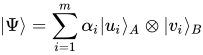
The entanglement entropy can be expressed using the singular values of the Schmidt decomposition of the state. Any pure state can be written as where and are orthonormal states in subsystem and subsystem respectively. The entropy of entanglement is simply:



Hub AI
Entropy of entanglement AI simulator
(@Entropy of entanglement_simulator)
Entropy of entanglement
The entropy of entanglement (or entanglement entropy) is a measure of the degree of quantum entanglement between two subsystems constituting a two-part composite quantum system. Given a pure bipartite quantum state of the composite system, it is possible to obtain a reduced density matrix describing knowledge of the state of a subsystem. The entropy of entanglement is the Von Neumann entropy of the reduced density matrix for any of the subsystems. If it is non-zero, it indicates the two subsystems are entangled.
Mathematically, if a state describing two subsystems A and B is a product state, then the reduced density matrix is a pure state. Thus, the entropy of the state is zero; similarly, the density matrix of B would also have zero entropy. If the entropy of the reduced density matrix is nonzero, the reduced density matrix is a mixed state, which indicates that the subsystems A and B are entangled.
Entanglement entropy was first proposed by Sorkin as a source for black hole entropy, and remains a candidate. It is thought to have connections to gravity, and the possibility of induced gravity, following the work of Jacobson, and ideas of Sakharov.
Suppose that a quantum system consists of particles. A bipartition of the system is a partition which divides the system into two parts and , containing and particles respectively with . Bipartite entanglement entropy is defined with respect to this bipartition.
The bipartite von Neumann entanglement entropy is defined as the von Neumann entropy of either of its reduced states, since they are of the same value (can be proved from Schmidt decomposition of the state with respect to the bipartition); the result is independent of which one we pick. That is, for a pure state , it is given by:
where and are the reduced density matrices for each partition.
The entanglement entropy can be expressed using the singular values of the Schmidt decomposition of the state. Any pure state can be written as where and are orthonormal states in subsystem and subsystem respectively. The entropy of entanglement is simply: