


Community hub
Recent from talks
Contribute something to knowledge base
Content stats: 0 posts, 0 articles, 1 media, 0 notes
Members stats: 0 subscribers, 0 contributors, 0 moderators, 0 supporters
Subscribers
Supporters
Contributors
Moderators
Hub AI
Quantum harmonic oscillator AI simulator
(@Quantum harmonic oscillator_simulator)
Hub AI
Quantum harmonic oscillator AI simulator
(@Quantum harmonic oscillator_simulator)
Quantum harmonic oscillator
The quantum harmonic oscillator is the quantum-mechanical analog of the classical harmonic oscillator. Because an arbitrary smooth potential can usually be approximated as a harmonic potential at the vicinity of a stable equilibrium point, it is one of the most important model systems in quantum mechanics. Furthermore, it is one of the few quantum-mechanical systems for which an exact, analytical solution is known.
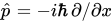
The Hamiltonian of the particle is: where m is the particle's mass, k is the force constant, is the angular frequency of the oscillator, is the position operator (given by x in the coordinate basis), and is the momentum operator (given by in the coordinate basis). The first term in the Hamiltonian represents the kinetic energy of the particle, and the second term represents its potential energy, as in Hooke's law.



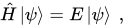
The time-independent Schrödinger equation (TISE) is, where denotes a real number (which needs to be determined) that will specify a time-independent energy level, or eigenvalue, and the solution denotes that level's energy eigenstate.


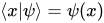
Then solve the differential equation representing this eigenvalue problem in the coordinate basis, for the wave function , using a spectral method. It turns out that there is a family of solutions. In this basis, they amount to Hermite functions,

The functions Hn are the physicists' Hermite polynomials,

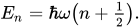
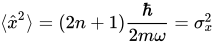
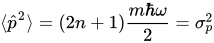
The corresponding energy levels are The expectation values of position and momentum combined with variance of each variable can be derived from the wavefunction to understand the behavior of the energy eigenkets. They are shown to be and owing to the symmetry of the problem, whereas:


Quantum harmonic oscillator
The quantum harmonic oscillator is the quantum-mechanical analog of the classical harmonic oscillator. Because an arbitrary smooth potential can usually be approximated as a harmonic potential at the vicinity of a stable equilibrium point, it is one of the most important model systems in quantum mechanics. Furthermore, it is one of the few quantum-mechanical systems for which an exact, analytical solution is known.
The Hamiltonian of the particle is: where m is the particle's mass, k is the force constant, is the angular frequency of the oscillator, is the position operator (given by x in the coordinate basis), and is the momentum operator (given by in the coordinate basis). The first term in the Hamiltonian represents the kinetic energy of the particle, and the second term represents its potential energy, as in Hooke's law.
The time-independent Schrödinger equation (TISE) is, where denotes a real number (which needs to be determined) that will specify a time-independent energy level, or eigenvalue, and the solution denotes that level's energy eigenstate.
Then solve the differential equation representing this eigenvalue problem in the coordinate basis, for the wave function , using a spectral method. It turns out that there is a family of solutions. In this basis, they amount to Hermite functions,
The functions Hn are the physicists' Hermite polynomials,
The corresponding energy levels are The expectation values of position and momentum combined with variance of each variable can be derived from the wavefunction to understand the behavior of the energy eigenkets. They are shown to be and owing to the symmetry of the problem, whereas:
Recent media
Recent media