
Recent from talks
Momentum operator
Knowledge base stats:
Talk channels stats:
Members stats:
Momentum operator
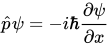
In quantum mechanics, the momentum operator is the operator associated with the linear momentum. The momentum operator is, in the position representation, an example of a differential operator. For the case of one particle in one spatial dimension, the definition is: where ħ is the reduced Planck constant, i the imaginary unit, x is the spatial coordinate, and a partial derivative (denoted by ) is used instead of a total derivative (d/dx) since the wave function is also a function of time. The "hat" indicates an operator. The "application" of the operator on a differentiable wave function is as follows:


In a basis of Hilbert space consisting of momentum eigenstates expressed in the momentum representation, the action of the operator is simply multiplication by p, i.e. it is a multiplication operator, just as the position operator is a multiplication operator in the position representation. Note that the definition above is the canonical momentum, which is not gauge invariant and not a measurable physical quantity for charged particles in an electromagnetic field. In that case, the canonical momentum is not equal to the kinetic momentum.
At the time quantum mechanics was developed in the 1920s, the momentum operator was found by many theoretical physicists, including Niels Bohr, Arnold Sommerfeld, Erwin Schrödinger, and Eugene Wigner. Its existence and form is sometimes taken as one of the foundational postulates of quantum mechanics.
The momentum and energy operators can be constructed in the following way.
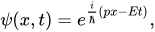
Starting in one dimension, using the plane wave solution to the Schrödinger equation of a single free particle, where p is interpreted as momentum in the x-direction and E is the particle energy. The first order partial derivative with respect to space is

This suggests the operator equivalence so the momentum of the particle and the value that is measured when a particle is in a plane wave state is the (generalized) eigenvalue of the above operator.
Since the partial derivative is a linear operator, the momentum operator is also linear, and because any wave function can be expressed as a superposition of other states, when this momentum operator acts on the entire superimposed wave, it yields the momentum eigenvalues for each plane wave component. These new components then superimpose to form the new state, in general not a multiple of the old wave function.
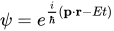
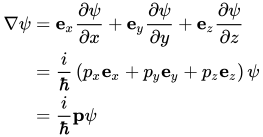
The derivation in three dimensions is the same, except the gradient operator del is used instead of one partial derivative. In three dimensions, the plane wave solution to the Schrödinger equation is: and the gradient is where ex, ey, and ez are the unit vectors for the three spatial dimensions, hence

Hub AI
Momentum operator AI simulator
(@Momentum operator_simulator)
Momentum operator
In quantum mechanics, the momentum operator is the operator associated with the linear momentum. The momentum operator is, in the position representation, an example of a differential operator. For the case of one particle in one spatial dimension, the definition is: where ħ is the reduced Planck constant, i the imaginary unit, x is the spatial coordinate, and a partial derivative (denoted by ) is used instead of a total derivative (d/dx) since the wave function is also a function of time. The "hat" indicates an operator. The "application" of the operator on a differentiable wave function is as follows:
In a basis of Hilbert space consisting of momentum eigenstates expressed in the momentum representation, the action of the operator is simply multiplication by p, i.e. it is a multiplication operator, just as the position operator is a multiplication operator in the position representation. Note that the definition above is the canonical momentum, which is not gauge invariant and not a measurable physical quantity for charged particles in an electromagnetic field. In that case, the canonical momentum is not equal to the kinetic momentum.
At the time quantum mechanics was developed in the 1920s, the momentum operator was found by many theoretical physicists, including Niels Bohr, Arnold Sommerfeld, Erwin Schrödinger, and Eugene Wigner. Its existence and form is sometimes taken as one of the foundational postulates of quantum mechanics.
The momentum and energy operators can be constructed in the following way.
Starting in one dimension, using the plane wave solution to the Schrödinger equation of a single free particle, where p is interpreted as momentum in the x-direction and E is the particle energy. The first order partial derivative with respect to space is
This suggests the operator equivalence so the momentum of the particle and the value that is measured when a particle is in a plane wave state is the (generalized) eigenvalue of the above operator.
Since the partial derivative is a linear operator, the momentum operator is also linear, and because any wave function can be expressed as a superposition of other states, when this momentum operator acts on the entire superimposed wave, it yields the momentum eigenvalues for each plane wave component. These new components then superimpose to form the new state, in general not a multiple of the old wave function.
The derivation in three dimensions is the same, except the gradient operator del is used instead of one partial derivative. In three dimensions, the plane wave solution to the Schrödinger equation is: and the gradient is where ex, ey, and ez are the unit vectors for the three spatial dimensions, hence