
Recent from talks
Quantum noise
Knowledge base stats:
Talk channels stats:
Members stats:
Quantum noise
Quantum noise is a type of noise in a quantum system due to quantum mechanical phenomena such as quantized fields and the uncertainty principle. This principle says that some observables cannot simultaneously be known with arbitrary precision. This indeterminate state of matter introduces a fluctuation in the value of properties of a quantum system, even at zero temperature. These fluctuations in the absence of thermal noise are known as zero-point energy fluctuations.
Quantum noise can also come from the discrete nature of the small quantum constituents such as electrons and quantum effects, such as photocurrents. An example of this form of quantum noise is shot noise as coined by J. Verdeyen which comes from the discrete arrival of photons or electrons in a detector. Because these quanta arrive randomly in time, even a perfectly steady current or light beam exhibits fluctuations in the detected signal.
In most systems, classical noise dominates over quantum noise, because classical fluctuations are several orders of magnitude larger, and it masks the effects of quantum noise. Quantum noise generally only becomes visible after suppressing the effects of conventional noise sources such as thermal fluctuations, mechanical vibrations, and industrial noise by cooling a system to a millikelvin range and using extremely low-noise electronics. This is why quantum noise is present in superconducting circuits and in the LIGO gravitational wave observatory, but not in many conventional settings.
At absolute zero temperature, classical noise vanishes. However, unlike classical noise, quantum noise cannot be completely eliminated as it arises directly from fundamental tenets of quantum mechanics. The uncertainty principle requires any amplifier or detector to have some noise, setting a fundamental limit on the accuracy of these instruments. Despite this fact, experimental physicists still define an "ideal" amplifier or detector as one that optimizes the fundamental quantum noise inequality, known as a "quantum-limited detector".
Noise is of practical concern for precision engineering and engineered systems approaching the standard quantum limit. Typical engineered consideration of quantum noise is for quantum nondemolition measurement and quantum point contact. So quantifying noise is useful.
The term "quantum noise" is often used in the fields of quantum information and quantum computing as an umbrella term for unwanted environmental disturbances that affect quantum systems and cause decoherence. An isolated quantum system, such as a qubit, has a state that will evolve deterministically. But in an open system, such as those found in nature, the qubit interacts with uncontrolled degrees of freedom in its environment, introducing fluctuations which are commonly referred to as quantum noise. This is distinct from the above definition, which specifically concerns intrinsic noise due to the nature of quantum mechanics, not all environmental sources of noise and decoherence. In practice, however, definitions of quantum noise often include environmental or external disturbances affecting quantum systems.
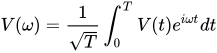
A signal's noise is quantified as the Fourier transform of its autocorrelation. The autocorrelation of a signal is given as which measures when our signal is positively, negatively or not correlated at different times and . The time average, , is zero and our is a voltage signal. Its Fourier transform is because we measure a voltage over a finite time window. The Wiener–Khinchin theorem generally states that a noise's power spectrum is given as the autocorrelation of a signal, i.e., The above relation is sometimes called the power spectrum or spectral density. In the above outline, we assumed that




One can show that an ideal "top-hat" signal, which may correspond to a finite measurement of a voltage over some time, will produce noise across its entire spectrum as a sinc function. Even in the classical case, noise is produced.
Hub AI
Quantum noise AI simulator
(@Quantum noise_simulator)
Quantum noise
Quantum noise is a type of noise in a quantum system due to quantum mechanical phenomena such as quantized fields and the uncertainty principle. This principle says that some observables cannot simultaneously be known with arbitrary precision. This indeterminate state of matter introduces a fluctuation in the value of properties of a quantum system, even at zero temperature. These fluctuations in the absence of thermal noise are known as zero-point energy fluctuations.
Quantum noise can also come from the discrete nature of the small quantum constituents such as electrons and quantum effects, such as photocurrents. An example of this form of quantum noise is shot noise as coined by J. Verdeyen which comes from the discrete arrival of photons or electrons in a detector. Because these quanta arrive randomly in time, even a perfectly steady current or light beam exhibits fluctuations in the detected signal.
In most systems, classical noise dominates over quantum noise, because classical fluctuations are several orders of magnitude larger, and it masks the effects of quantum noise. Quantum noise generally only becomes visible after suppressing the effects of conventional noise sources such as thermal fluctuations, mechanical vibrations, and industrial noise by cooling a system to a millikelvin range and using extremely low-noise electronics. This is why quantum noise is present in superconducting circuits and in the LIGO gravitational wave observatory, but not in many conventional settings.
At absolute zero temperature, classical noise vanishes. However, unlike classical noise, quantum noise cannot be completely eliminated as it arises directly from fundamental tenets of quantum mechanics. The uncertainty principle requires any amplifier or detector to have some noise, setting a fundamental limit on the accuracy of these instruments. Despite this fact, experimental physicists still define an "ideal" amplifier or detector as one that optimizes the fundamental quantum noise inequality, known as a "quantum-limited detector".
Noise is of practical concern for precision engineering and engineered systems approaching the standard quantum limit. Typical engineered consideration of quantum noise is for quantum nondemolition measurement and quantum point contact. So quantifying noise is useful.
The term "quantum noise" is often used in the fields of quantum information and quantum computing as an umbrella term for unwanted environmental disturbances that affect quantum systems and cause decoherence. An isolated quantum system, such as a qubit, has a state that will evolve deterministically. But in an open system, such as those found in nature, the qubit interacts with uncontrolled degrees of freedom in its environment, introducing fluctuations which are commonly referred to as quantum noise. This is distinct from the above definition, which specifically concerns intrinsic noise due to the nature of quantum mechanics, not all environmental sources of noise and decoherence. In practice, however, definitions of quantum noise often include environmental or external disturbances affecting quantum systems.
A signal's noise is quantified as the Fourier transform of its autocorrelation. The autocorrelation of a signal is given as which measures when our signal is positively, negatively or not correlated at different times and . The time average, , is zero and our is a voltage signal. Its Fourier transform is because we measure a voltage over a finite time window. The Wiener–Khinchin theorem generally states that a noise's power spectrum is given as the autocorrelation of a signal, i.e., The above relation is sometimes called the power spectrum or spectral density. In the above outline, we assumed that
One can show that an ideal "top-hat" signal, which may correspond to a finite measurement of a voltage over some time, will produce noise across its entire spectrum as a sinc function. Even in the classical case, noise is produced.