
Recent from talks
Quantum nonlocality
Knowledge base stats:
Talk channels stats:
Members stats:
Quantum nonlocality
In theoretical physics, quantum nonlocality refers to the phenomenon by which the measurement statistics of a multipartite quantum system do not allow an interpretation with local realism. Quantum nonlocality has been experimentally verified under a variety of physical assumptions.
Quantum nonlocality does not allow for faster-than-light communication, and hence is compatible with special relativity and its universal speed limit of objects. Thus, quantum theory is local in the strict sense defined by special relativity and, as such, the term "quantum nonlocality" is sometimes considered a misnomer. Still, it prompts many of the foundational discussions concerning quantum theory.
In the 1935 EPR paper, Albert Einstein, Boris Podolsky and Nathan Rosen described "two spatially separated particles which have both perfectly correlated positions and momenta" as a direct consequence of quantum theory. They intended to use the classical principle of locality to challenge the idea that the quantum wavefunction was a complete description of reality, but instead they sparked a debate on the nature of reality. Afterwards, Einstein presented a variant of these ideas in a letter to Erwin Schrödinger, which is the version that is presented here. The state and notation used here are more modern, and akin to David Bohm's take on EPR. The quantum state of the two particles prior to measurement can be written as where .

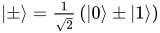
Here, subscripts "A" and "B" distinguish the two particles, though it is more convenient and usual to refer to these particles as being in the possession of two experimentalists called Alice and Bob. The rules of quantum theory give predictions for the outcomes of measurements performed by the experimentalists. Alice, for example, will measure her particle to be spin-up in an average of fifty percent of measurements. However, according to the textbook quantum mechanics, Alice's measurement causes the state of the two particles to collapse, so that if Alice performs a measurement of spin in the z-direction, that is with respect to the basis , then Bob's system will be left in one of the states . Likewise, if Alice performs a measurement of spin in the x-direction, that is, with respect to the basis , then Bob's system will be left in one of the states . Schrödinger referred to this phenomenon as "steering". This steering occurs in such a way that no signal can be sent by performing such a state update; quantum nonlocality cannot be used to send messages instantaneously and is therefore not in direct conflict with causality concerns in special relativity.


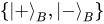
In the orthodox view of this experiment, Alice's measurement—and particularly her measurement choice—has a direct effect on Bob's state. However, under the assumption of locality, actions on Alice's system do not affect the "true", or "ontic" state of Bob's system. We see that the ontic state of Bob's system must be compatible with one of the quantum states or , since Alice can make a measurement that concludes with one of those states being the quantum description of his system. At the same time, it must also be compatible with one of the quantum states or for the same reason. Therefore, the ontic state of Bob's system must be compatible with at least two quantum states; the quantum state is therefore not a complete descriptor of his system. Einstein, Podolsky and Rosen saw this as evidence of the incompleteness of quantum theory, since the wavefunction is explicitly not a complete description of a quantum system under this assumption of locality. Their paper concludes:


While we have thus shown that the wave function does not provide a complete description of the physical reality, we left open the question of whether or not such a description exists. We believe, however, that such a theory is possible.
Although various authors (most notably Niels Bohr) criticised the ambiguous terminology of the EPR paper, the thought experiment nevertheless generated a great deal of interest. Their notion of a "complete description" was later formalised by the suggestion of hidden variables that determine the statistics of measurement results, but to which an observer does not have access. Bohmian mechanics provides such a completion of quantum mechanics, with the introduction of hidden variables; however the theory is explicitly nonlocal. The interpretation therefore does not give an answer to Einstein's question, which was whether or not a complete description of quantum mechanics could be given in terms of local hidden variables in keeping with the "Principle of Local Action".
In 1964 John Bell answered Einstein's question by showing that such local hidden variables can never reproduce the full range of statistical outcomes predicted by quantum theory. Bell showed that a local hidden variable hypothesis leads to restrictions on the strength of correlations of measurement results. If the Bell inequalities are violated experimentally as predicted by quantum mechanics, then reality cannot be described by local hidden variables and the mystery of quantum nonlocal causation remains. However, Bell notes that the non-local hidden variable model of Bohm are different:
Hub AI
Quantum nonlocality AI simulator
(@Quantum nonlocality_simulator)
Quantum nonlocality
In theoretical physics, quantum nonlocality refers to the phenomenon by which the measurement statistics of a multipartite quantum system do not allow an interpretation with local realism. Quantum nonlocality has been experimentally verified under a variety of physical assumptions.
Quantum nonlocality does not allow for faster-than-light communication, and hence is compatible with special relativity and its universal speed limit of objects. Thus, quantum theory is local in the strict sense defined by special relativity and, as such, the term "quantum nonlocality" is sometimes considered a misnomer. Still, it prompts many of the foundational discussions concerning quantum theory.
In the 1935 EPR paper, Albert Einstein, Boris Podolsky and Nathan Rosen described "two spatially separated particles which have both perfectly correlated positions and momenta" as a direct consequence of quantum theory. They intended to use the classical principle of locality to challenge the idea that the quantum wavefunction was a complete description of reality, but instead they sparked a debate on the nature of reality. Afterwards, Einstein presented a variant of these ideas in a letter to Erwin Schrödinger, which is the version that is presented here. The state and notation used here are more modern, and akin to David Bohm's take on EPR. The quantum state of the two particles prior to measurement can be written as where .
Here, subscripts "A" and "B" distinguish the two particles, though it is more convenient and usual to refer to these particles as being in the possession of two experimentalists called Alice and Bob. The rules of quantum theory give predictions for the outcomes of measurements performed by the experimentalists. Alice, for example, will measure her particle to be spin-up in an average of fifty percent of measurements. However, according to the textbook quantum mechanics, Alice's measurement causes the state of the two particles to collapse, so that if Alice performs a measurement of spin in the z-direction, that is with respect to the basis , then Bob's system will be left in one of the states . Likewise, if Alice performs a measurement of spin in the x-direction, that is, with respect to the basis , then Bob's system will be left in one of the states . Schrödinger referred to this phenomenon as "steering". This steering occurs in such a way that no signal can be sent by performing such a state update; quantum nonlocality cannot be used to send messages instantaneously and is therefore not in direct conflict with causality concerns in special relativity.
In the orthodox view of this experiment, Alice's measurement—and particularly her measurement choice—has a direct effect on Bob's state. However, under the assumption of locality, actions on Alice's system do not affect the "true", or "ontic" state of Bob's system. We see that the ontic state of Bob's system must be compatible with one of the quantum states or , since Alice can make a measurement that concludes with one of those states being the quantum description of his system. At the same time, it must also be compatible with one of the quantum states or for the same reason. Therefore, the ontic state of Bob's system must be compatible with at least two quantum states; the quantum state is therefore not a complete descriptor of his system. Einstein, Podolsky and Rosen saw this as evidence of the incompleteness of quantum theory, since the wavefunction is explicitly not a complete description of a quantum system under this assumption of locality. Their paper concludes:
While we have thus shown that the wave function does not provide a complete description of the physical reality, we left open the question of whether or not such a description exists. We believe, however, that such a theory is possible.
Although various authors (most notably Niels Bohr) criticised the ambiguous terminology of the EPR paper, the thought experiment nevertheless generated a great deal of interest. Their notion of a "complete description" was later formalised by the suggestion of hidden variables that determine the statistics of measurement results, but to which an observer does not have access. Bohmian mechanics provides such a completion of quantum mechanics, with the introduction of hidden variables; however the theory is explicitly nonlocal. The interpretation therefore does not give an answer to Einstein's question, which was whether or not a complete description of quantum mechanics could be given in terms of local hidden variables in keeping with the "Principle of Local Action".
In 1964 John Bell answered Einstein's question by showing that such local hidden variables can never reproduce the full range of statistical outcomes predicted by quantum theory. Bell showed that a local hidden variable hypothesis leads to restrictions on the strength of correlations of measurement results. If the Bell inequalities are violated experimentally as predicted by quantum mechanics, then reality cannot be described by local hidden variables and the mystery of quantum nonlocal causation remains. However, Bell notes that the non-local hidden variable model of Bohm are different: