Hubbry Logo
Pilot wave theoryPilot wave theoryMain
Open search
Pilot wave theory
Community hub
Pilot wave theory
logo
8 pages, 0 posts
0 subscribers
Be the first to start a discussion here.
Pilot wave theory
Pilot wave theory
from Wikipedia

Couder's disputed[1] experiments,[2][3] purportedly "materializing" the pilot wave model.

In theoretical physics, the pilot wave theory, also known as Bohmian mechanics, was the first known example of a hidden-variable theory, presented by Louis de Broglie in 1927. Its more modern version, the de Broglie–Bohm theory, interprets quantum mechanics as a deterministic theory, and avoids issues such as wave function collapse, and the paradox of Schrödinger's cat by being inherently nonlocal.

The de Broglie–Bohm pilot wave theory is one of several interpretations of (non-relativistic) quantum mechanics.

History

[edit]

Louis de Broglie's early results on the pilot wave theory were presented in his thesis (1924) in the context of atomic orbitals where the waves are stationary. Early attempts to develop a general formulation for the dynamics of these guiding waves in terms of a relativistic wave equation were unsuccessful until in 1926 Schrödinger developed his non-relativistic wave equation. He further suggested that since the equation described waves in configuration space, the particle model should be abandoned.[4] Shortly thereafter,[5] Max Born suggested that the wave function of Schrödinger's wave equation represents the probability density of finding a particle. Following these results, de Broglie developed the dynamical equations for his pilot wave theory.[6] Initially, de Broglie proposed a double solution approach, in which the quantum object consists of a physical wave (u-wave) in real space which has a spherical singular region that gives rise to particle-like behaviour; in this initial form of his theory he did not have to postulate the existence of a quantum particle.[7] He later formulated it as a theory in which a particle is accompanied by a pilot wave.

De Broglie presented the pilot wave theory at the 1927 Solvay Conference.[8] However, Wolfgang Pauli raised an objection to it at the conference, saying that it did not deal properly with the case of inelastic scattering. De Broglie was not able to find a response to this objection, and he abandoned the pilot-wave approach. Unlike David Bohm years later, de Broglie did not complete his theory to encompass the many-particle case.[7] The many-particle case shows mathematically that the energy dissipation in inelastic scattering could be distributed to the surrounding field structure by a yet-unknown mechanism of the theory of hidden variables.[clarification needed]

In 1932, John von Neumann published a book,[9] part of which claimed to prove that all hidden variable theories were impossible. This result was found to be flawed by Grete Hermann[10][11] three years later, though for a variety of reasons this went unnoticed by the physics community for over fifty years.

In 1952, David Bohm, dissatisfied with the prevailing orthodoxy, rediscovered de Broglie's pilot wave theory. Bohm developed pilot wave theory into what is now called the de Broglie–Bohm theory.[12][13] The de Broglie–Bohm theory itself might have gone unnoticed by most physicists, if it had not been championed by John Bell, who also countered the objections to it. In 1987, John Bell rediscovered Grete Hermann's work,[14] and thus showed the physics community that Pauli's and von Neumann's objections only showed that the pilot wave theory did not have locality.

The pilot wave theory

[edit]

Principles

[edit]
(a) A walker in a circular corral. Trajectories of increasing length are colour-coded according to the droplet's local speed (b) The probability distribution of the walker's position corresponds roughly to the amplitude of the corral's Faraday wave mode.[15]

The pilot wave theory is a hidden-variable theory. Consequently:

  • the theory has realism (meaning that its concepts exist independently of the observer);
  • the theory has determinism.

The positions of the particles are considered to be the hidden variables. The observer doesn't know the precise values of these variables; they cannot know them precisely because any measurement disturbs them. On the other hand, the observer is defined not by the wave function of their own atoms but by the atoms' positions. So what one sees around oneself are also the positions of nearby things, not their wave functions.

A collection of particles has an associated matter wave which evolves according to the Schrödinger equation. Each particle follows a deterministic trajectory, which is guided by the wave function; collectively, the density of the particles conforms to the magnitude of the wave function. The wave function is not influenced by the particle and can exist also as an empty wave function.[16]

The theory brings to light nonlocality that is implicit in the non-relativistic formulation of quantum mechanics and uses it to satisfy Bell's theorem. These nonlocal effects can be shown to be compatible with the no-communication theorem, which prevents use of them for faster-than-light communication, and so is empirically compatible with relativity.[17]

Macroscopic analog

[edit]

Couder, Fort, et al. claimed[18] that macroscopic oil droplets on a vibrating fluid bath can be used as an analogue model of pilot waves; a localized droplet creates a periodical wave field around itself. They proposed that resonant interaction between the droplet and its own wave field exhibits behaviour analogous to quantum particles: interference in double-slit experiment,[19] unpredictable tunneling[20] (depending in a complicated way on a practically hidden state of field), orbit quantization[21] (that a particle has to 'find a resonance' with field perturbations it creates—after one orbit, its internal phase has to return to the initial state) and Zeeman effect.[22] While attempts to reproduce these experiments have shown some aspects to be questionable[23] and the interpretation with respect to quantum mechanics has been challenged,[24] work on the concept has continued with some success.[25]

Mathematical foundations

[edit]

To derive the de Broglie–Bohm pilot-wave for an electron, the quantum Lagrangian
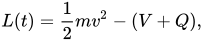
where is the potential energy, is the velocity and is the potential associated with the quantum force (the particle being pushed by the wave function), is integrated along precisely one path (the one the electron actually follows). This leads to the following formula for the Bohm propagator[citation needed]:

This propagator allows one to precisely track the electron over time under the influence of the quantum potential .

Derivation of the Schrödinger equation

[edit]

Pilot wave theory is based on Hamilton–Jacobi dynamics,[26] rather than Lagrangian or Hamiltonian dynamics. Using the Hamilton–Jacobi equation

it is possible to derive the Schrödinger equation:

Consider a classical particle – the position of which is not known with certainty. We must deal with it statistically, so only the probability density is known. Probability must be conserved, i.e. for each . Therefore, it must satisfy the continuity equation

where is the velocity of the particle.

In the Hamilton–Jacobi formulation of classical mechanics, velocity is given by where is a solution of the Hamilton-Jacobi equation
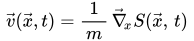
and can be combined into a single complex equation by introducing the complex function then the two equations are equivalent to

with
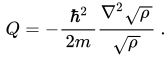
The time-dependent Schrödinger equation is obtained if we start with the usual potential with an extra quantum potential . The quantum potential is the potential of the quantum force, which is proportional (in approximation) to the curvature of the amplitude of the wave function.
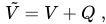
Note this potential is the same one that appears in the Madelung equations, a classical analog of the Schrödinger equation.

Mathematical formulation for a single particle

[edit]

The matter wave of de Broglie is described by the time-dependent Schrödinger equation:

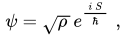
The complex wave function can be represented as:
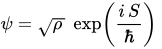
By plugging this into the Schrödinger equation, one can derive two new equations for the real variables. The first is the continuity equation for the probability density [12]

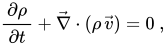
where the velocity field is determined by the “guidance equation”

According to pilot wave theory, the point particle and the matter wave are both real and distinct physical entities (unlike standard quantum mechanics, which postulates no physical particle or wave entities, only observed wave-particle duality). The pilot wave guides the motion of the point particles as described by the guidance equation.

Ordinary quantum mechanics and pilot wave theory are based on the same partial differential equation. The main difference is that in ordinary quantum mechanics, the Schrödinger equation is connected to reality by the Born postulate, which states that the probability density of the particle's position is given by Pilot wave theory considers the guidance equation to be the fundamental law, and sees the Born rule as a derived concept.

The second equation is a modified Hamilton–Jacobi equation for the action S:
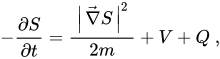
where Q is the quantum potential defined by
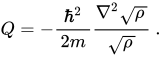
If we choose to neglect Q, our equation is reduced to the Hamilton–Jacobi equation of a classical point particle.[a] So, the quantum potential is responsible for all the mysterious effects of quantum mechanics.

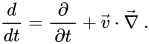
One can also combine the modified Hamilton–Jacobi equation with the guidance equation to derive a quasi-Newtonian equation of motion
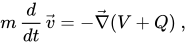
where the hydrodynamic time derivative is defined as
Mathematical formulation for multiple particles

[edit]

The Schrödinger equation for the many-body wave function is given by

The complex wave function can be represented as:
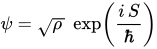
The pilot wave guides the motion of the particles. The guidance equation for the jth particle is:

The velocity of the jth particle explicitly depends on the positions of the other particles. This means that the theory is nonlocal.

Relativity

[edit]

An extension to the relativistic case with spin has been developed since the 1990s.[27][28][29][30][31][32]

Empty wave function

[edit]

Lucien Hardy[33] and John Stewart Bell[16] have emphasized that in the de Broglie–Bohm picture of quantum mechanics there can exist empty waves, represented by wave functions propagating in space and time but not carrying energy or momentum,[34] and not associated with a particle. The same concept was called ghost waves (or "Gespensterfelder", ghost fields) by Albert Einstein.[34] The empty wave function notion has been discussed controversially.[35][36][37] In contrast, the many-worlds interpretation of quantum mechanics does not call for empty wave functions.[16]

See also

[edit]

Notes

[edit]

References

[edit]
[edit]
Revisions and contributorsEdit on WikipediaRead on Wikipedia
from Grokipedia
Pilot wave theory, also known as the or Bohmian mechanics, is a deterministic and nonlocal interpretation of that describes particles as having well-defined positions and velocities at all times, with their trajectories guided by a physical pilot wave represented by the wave function in configuration space. The theory posits that the wave function evolves according to the standard , while particle motion follows a guidance equation derived from the phase of the wave function, ensuring that the theory reproduces all empirical predictions of conventional quantum mechanics under the assumption of quantum equilibrium, where the particle probability density matches the squared modulus of the wave function. Originally proposed by in 1927 during the Solvay Congress, the theory envisioned matter waves directing particle paths but was largely overlooked after initial critiques, only to be independently revived and reformulated by in 1952 as a causal interpretation incorporating a quantum potential in a Hamilton-Jacobi framework. Bohm's version emphasized the objective reality of particle trajectories without wave function collapse, addressing foundational issues like the by treating the wave function as a guiding field rather than a complete description of reality. Unlike the , which relies on probabilistic outcomes and observer-induced collapse, pilot wave theory provides a realist, hidden-variable approach that is fully deterministic yet nonlocal, consistent with and experiments violating Bell inequalities. It has been extended to relativistic , cosmology, and phenomena like quantum tunneling and double-slit interference, where computational simulations reveal particle paths influenced by the pilot wave. Despite early criticisms regarding nonlocality and perceived lack of new predictions, renewed interest since the late —spurred by John Bell's work and weak measurement experiments—has highlighted its conceptual clarity and potential for exploring nonequilibrium scenarios beyond standard quantum statistics, with ongoing research as of 2025 focusing on hydrodynamic analogs and the detectability of trajectories.

Historical Development

de Broglie's Original Proposal

Louis de Broglie's foundational ideas on the wave nature of matter originated in his 1924 doctoral thesis, Recherches sur la théorie des quanta, where he extended the wave-particle duality of —initially proposed by Einstein in 1905—to electrons and other particles. Drawing inspiration from and the quantization rules of Bohr's atomic model, de Broglie hypothesized that particles possess an associated wave with wavelength λ=h/p\lambda = h/p, where hh is Planck's constant and pp is the particle's , allowing electrons to exhibit wave-like interference while maintaining particle-like localization. This precursor framework posited that the particle's motion could be influenced by its accompanying wave, setting the stage for a deterministic interpretation of quantum phenomena. Building on this thesis, de Broglie formally introduced the pilot wave theory at the Fifth in October 1927, presenting it as a causal, deterministic alternative to the emerging probabilistic . In his address, he proposed that a physical "pilot wave"—a real, periodic wave associated with the particle—guides and modulates the particle's trajectory, ensuring synchronization between the wave's and the particle's motion. For the simpler case of one dimension, de Broglie outlined initial equations describing this wave-particle harmony, where the particle propagates at the of the wave packet, preserving the corpuscular nature of the particle while accounting for effects. This concept aimed to reconcile relativity's emphasis on continuous fields with quantum discreteness, viewing the pilot wave as a tangible entity that directs particle behavior without invoking inherent randomness. The proposal garnered initial interest among attendees for its elegant resolution of wave-particle duality, but it faced swift criticism and dismissal shortly thereafter. Wolfgang Pauli objected during the conference discussions, highlighting inconsistencies in multi-particle scenarios, such as inelastic collisions where the pilot wave failed to conserve energy and in a way compatible with quantum stationary states. Erwin Schrödinger and others expressed reservations, noting difficulties in extending the theory relativistically, particularly for many-body systems, where the pilot wave's formulation in configuration space appeared non-physical and incompatible with Lorentz invariance. These perceived flaws led de Broglie to temporarily abandon the pilot wave approach in favor of Niels Bohr's complementarity principle, though the idea would later be revived and formalized by David Bohm in the 1950s.

Bohm's Reformulation and Reception

In 1952, David Bohm published two papers in Physical Review that revived and formalized Louis de Broglie's earlier pilot wave concept by reinterpreting the Schrödinger equation as describing a wave function that guides the motion of particles possessing definite positions at all times. This approach treated particle configurations as hidden variables, yielding a fully deterministic theory where quantum outcomes arise from initial conditions rather than inherent randomness. Bohm's framework explicitly rejected the probabilistic indeterminism central to the , instead positing an ontological realism in which quantum entities exist objectively and evolve , independent of observation or measurement. By restoring to , it aimed to resolve foundational paradoxes like those in the Einstein-Podolsky-Rosen argument, offering a realist alternative aligned with classical intuitions of physical reality. The immediate academic reception was polarized. , in a 1952 critique, dismissed the theory as introducing an unnecessary asymmetry between position and momentum—contrary to the symmetric formalism of —and as relying on unobservable hidden variables that amounted to "artificial metaphysics" without empirical advantage. In contrast, expressed sympathy for Bohm's hidden variables as a step toward a complete, realist quantum theory, corresponding with Bohm on its potential to address incompleteness in standard , though he questioned certain mechanistic details. , after initial reservations about priority and unresolved issues from his 1927 proposal, came to endorse Bohm's development, viewing it as a viable extension of his own ideas. Bohm's personal circumstances further hindered the theory's uptake in the United States. Amid the McCarthy-era anticommunist purges, Bohm—suspected of communist affiliations due to his political activism—was subpoenaed by the in 1950, refused to testify against colleagues, and was subsequently dismissed from his Princeton position in 1951, forcing him into exile first in and then before settling in the . This political persecution marginalized his work during its formative years, limiting its dissemination and discussion within mainstream American physics circles. In 1957, Bohm elaborated on the philosophical underpinnings of his approach in the book Causality and Chance in Modern Physics, defending the pilot wave theory as a causal, realist counter to the "irrational" acceptance of in quantum orthodoxy and arguing that physics should prioritize objective mechanisms over subjective probabilities. Foreworded by de Broglie, the book positioned the theory within broader debates on and realism, influencing subsequent ontological discussions in despite ongoing skepticism.

Core Principles

Particle Trajectories and the Guiding Wave

In pilot wave theory, particles are treated as point-like entities possessing well-defined positions and continuous trajectories at all times, in stark contrast to the probabilistic of standard . The motion of these particles is deterministic, governed by the evolution of the guiding , which directs their paths without introducing inherent . This approach posits that the apparent in quantum measurements arises from of precise conditions rather than fundamental chance. The velocity of a particle is determined by the guidance equation, which for a single particle of mass mm is given by dxdt=mIm(ψψ),\frac{d\mathbf{x}}{dt} = \frac{\hbar}{m} \mathrm{Im} \left( \frac{\nabla \psi}{\psi} \right), where x\mathbf{x} is the particle's position, \hbar is the reduced Planck's constant, ψ\psi is the wave function, and Im\mathrm{Im} denotes the imaginary part. This equation can be expressed more intuitively in terms of the polar form of the wave function, ψ=ReiS/\psi = R e^{iS/\hbar}, where RR is the real amplitude and SS is the phase; here, the particle velocity simplifies to dxdt=1mS\frac{d\mathbf{x}}{dt} = \frac{1}{m} \nabla S, aligning the trajectory with the local gradient of the phase. For systems involving multiple particles, the theory extends to the full configuration space, an abstract 3N3N-dimensional space representing the positions x1,x2,,xN\mathbf{x}_1, \mathbf{x}_2, \dots, \mathbf{x}_N of NN particles. Each particle's velocity is then guided by the corresponding component of the gradient in this space, ensuring that the entire configuration evolves deterministically according to initial positions distributed in accordance with the wave function. These initial conditions fully specify the future trajectories, underscoring the theory's causal completeness. Despite its deterministic nature, pilot wave theory reproduces the statistical predictions of standard . The probability density for finding particles at a given configuration is ψ2|\psi|^2, interpreted as an ensemble measure reflecting the distribution of initial conditions in a large collection of systems, rather than a probability inherent to individual measurements. This equivalence holds under the assumption of quantum equilibrium, where the initial positions align with ψ2|\psi|^2.

The Quantum Potential

In pilot wave theory, the quantum potential QQ emerges as a key dynamical entity that modifies the classical motion of particles. It is defined as Q=22m2RR,Q = -\frac{\hbar^2}{2m} \frac{\nabla^2 R}{R}, where RR is the amplitude of the wave function ψ=ReiS/\psi = R e^{iS/\hbar}, mm is the particle mass, and \hbar is the reduced Planck's constant. This expression arises from the polar form of the and encapsulates the influence of the wave function's spatial variation on the particle's acceleration. The quantum potential enters the theory through the Hamilton-Jacobi equation, which governs the evolution of the phase SS of the wave function: St+(S)22m+V+Q=0,\frac{\partial S}{\partial t} + \frac{(\nabla S)^2}{2m} + V + Q = 0, where VV is the classical potential. Here, V+QV + Q acts as the total , transforming the standard classical dynamics into a modified form that accounts for quantum effects while preserving a deterministic description. The gradient of QQ provides a force-like term Q/m-\nabla Q / m in the particle's equation of motion, interacting with the velocity field derived from the guidance equation v=S/m\mathbf{v} = \nabla S / m. Physically, the quantum potential represents a non-local influence from the entire configuration of the guiding wave on the local motion of the particle, conveying information about distant parts of the system without direct interaction. Unlike classical potentials, QQ depends solely on the amplitude RR and vanishes in the where RR varies slowly compared to the de Broglie wavelength. This non-locality enables quantum phenomena by effectively "steering" particles toward regions of high probability density, as determined by R2R^2. In bound states, the quantum potential modifies the effective potential such that V+Q=EV + Q = E (constant energy), resulting in zero net force and stationary particle positions distributed according to ψ2|\psi|^2. For the hydrogen atom ground state, QQ provides the outward force balancing the inward Coulomb attraction, preventing classical collapse to the nucleus. In states with angular momentum, it also balances the centrifugal barrier alongside the Coulomb potential. In quantum tunneling, QQ effectively lowers the barrier in classically forbidden regions, allowing particle trajectories to penetrate and emerge on the other side, as seen in rectangular barrier problems where the potential gradient drives the motion through the barrier. For interference, as in the , the quantum potential causes deflections in particle trajectories after passing the slits, guiding them to produce the characteristic interference pattern on the detection screen without invoking . The non-local nature of QQ ensures that contributions from both slits influence the path, even for individual particles, leading to constructive and destructive interference solely through the amplitude variations of the guiding wave.

Mathematical Foundations

Derivation from the

The provide a hydrodynamic interpretation of by recasting the time-dependent in terms of fluid-like variables. To derive them, consider the single-particle : iψt=22m2ψ+Vψ,i \hbar \frac{\partial \psi}{\partial t} = -\frac{\hbar^2}{2m} \nabla^2 \psi + V \psi, where ψ\psi is the wave function, VV is the classical potential, mm is the particle , and \hbar is the reduced Planck's constant. Substituting the polar form ψ=ReiS/\psi = R e^{i S / \hbar}, with real-valued RR and phase SS, into this equation separates the real and imaginary parts, yielding two coupled equations. The imaginary part gives the continuity equation for the probability density ρ=R2\rho = R^2: ρt+(ρv)=0,\frac{\partial \rho}{\partial t} + \nabla \cdot (\rho \mathbf{v}) = 0, where the velocity field is v=Sm\mathbf{v} = \frac{\nabla S}{m}. This equation describes the conservation of probability in a fluid dynamical picture, with ρ\rho acting as a and ρv\rho \mathbf{v} as a . The real part produces the momentum equation: vt+(v)v=1m(V+Q),\frac{\partial \mathbf{v}}{\partial t} + (\mathbf{v} \cdot \nabla) \mathbf{v} = -\frac{1}{m} \nabla (V + Q), which resembles the Euler equation for an ideal fluid, but includes an additional quantum potential Q=22m2RRQ = -\frac{\hbar^2}{2m} \frac{\nabla^2 R}{R}. This QQ term introduces a "quantum pressure" that accounts for the non-classical behavior of , influencing the flow beyond classical forces. This hydrodynamic formulation was first derived independently by Erwin Madelung in 1927, who transformed the using a similar ψ=αeiβ\psi = \alpha e^{i \beta} (with β\beta related to a ) and obtained equivalent continuity and equations, including a term analogous to QQ interpreted as an internal force in a quantum continuum. later adapted this approach in 1952 to develop the pilot wave theory, emphasizing the guidance of particle trajectories by the phase SS and the role of QQ in a deterministic framework. The extend naturally to many-particle systems by applying the to the multi-particle , though the resulting quantum potential becomes explicitly nonlocal.

Single-Particle Dynamics

In single-particle Bohmian mechanics, the evolution of the system is determined by a coupled set of equations involving the wave function ψ(x,t)\psi(\mathbf{x}, t) and the particle position X(t)\mathbf{X}(t). The wave function obeys the time-dependent , iψt=22m2ψ+V(x,t)ψ,i \hbar \frac{\partial \psi}{\partial t} = -\frac{\hbar^2}{2m} \nabla^2 \psi + V(\mathbf{x}, t) \psi, where mm is the particle mass, \hbar is the reduced Planck's constant, and V(x,t)V(\mathbf{x}, t) is the potential. The particle trajectory is governed by the guidance equation, dXdt=mIm(ψ(X,t)ψ(X,t)),\frac{d\mathbf{X}}{dt} = \frac{\hbar}{m} \operatorname{Im} \left( \frac{\nabla \psi(\mathbf{X}, t)}{\psi(\mathbf{X}, t)} \right), which defines the velocity field induced by the wave function at the particle's position. Given an initial position X(0)\mathbf{X}(0), this equation uniquely determines the entire deterministic path X(t)\mathbf{X}(t), ensuring that the motion is non-relativistic and local for isolated single particles. The statistical predictions of quantum mechanics arise from the quantum equilibrium hypothesis, which posits that the probability density for the initial particle positions follows the P(x,0)=ψ(x,0)2P(\mathbf{x}, 0) = |\psi(\mathbf{x}, 0)|^2. Due to the equivariance theorem, if the initial distribution matches ψ2|\psi|^2, the ensemble of trajectories at any later time tt maintains the distribution P(x,t)=ψ(x,t)2P(\mathbf{x}, t) = |\psi(\mathbf{x}, t)|^2, reproducing standard quantum probabilities without invoking inherent . This equilibrium state is hypothesized to emerge dynamically through subquantum relaxation processes, where deviations from the ψ2|\psi|^2 distribution decay over time toward the equilibrium measure, analogous to thermalization in classical . A illustrative example is the double-slit interference experiment, where the guidance equation yields particle trajectories that pass definitively through one slit or the other, yet are collectively deflected by the interfering to form the characteristic interference pattern on the detection screen. Numerical solutions show smooth, non-crossing paths that weave according to the phase gradients of ψ\psi, avoiding the "surreal" backward-in-time or multi-slit-crossing trajectories that arise in certain weak-measurement reconstructions of standard quantum paths. These dynamics stem from the Madelung formulation as a fluid-like description but emphasize the deterministic guidance for individual particles.

Many-Particle Systems

In pilot wave theory, the description of systems consisting of NN particles generalizes the single-particle formalism by introducing a wave function Ψ(x1,,xN,t)\Psi(\mathbf{x}_1, \dots, \mathbf{x}_N, t) defined over the 3N3N-dimensional configuration space, where xk\mathbf{x}_k denotes the position of the kk-th particle. This wave function evolves according to the multi-particle Schrödinger equation, incorporating interactions through a potential V(x1,,xN,t)V(\mathbf{x}_1, \dots, \mathbf{x}_N, t). The particles' trajectories are determined by the guidance equation, which specifies the velocity of the kk-th particle as dxkdt=mkIm(kΨΨ),\frac{d\mathbf{x}_k}{dt} = \frac{\hbar}{m_k} \mathrm{Im} \left( \frac{\nabla_k \Psi}{\Psi} \right), evaluated at the actual configuration (x1(t),,xN(t))(\mathbf{x}_1(t), \dots, \mathbf{x}_N(t)), assuming masses mkm_k. This formulation builds on the single-particle case but emphasizes the collective evolution in high-dimensional space. A hallmark of the many-particle extension is its inherent non-locality: the velocity of any particle kk depends instantaneously on the positions of all other particles through the global Ψ\Psi, enabling correlations that persist even at large separations. This mechanism accounts for without invoking , as the shared Ψ\Psi coordinates the trajectories deterministically across the system. For instance, in entangled states like the EPR-Bohm singlet, measuring one particle's position influences the guidance for distant partners via the wave function's form. The quantum potential for the multi-particle system is given by Q=k22mkk2RR,Q = -\sum_k \frac{\hbar^2}{2m_k} \frac{\nabla_k^2 R}{R}, where Ψ=Rexp(iS/)\Psi = R \exp(iS/\hbar) is the polar decomposition, and R=ΨR = |\Psi| is the . This potential acts globally, incorporating non-local effects from the entire configuration into each particle's effective force, distinct from classical interactions. For identical particles, the wave function must be symmetrized—symmetric for bosons and antisymmetric for fermions—to comply with quantum statistics, ensuring that the probability density Ψ2|\Psi|^2 and trajectories respect permutation invariance. In this approach, configurations are treated as unordered sets in the , with particle labels emerging only through the guiding wave, preserving indistinguishability without additional postulates.

Extensions and Limitations

Relativistic Formulations

Early efforts to extend pilot wave theory to relativistic regimes focused on single-particle systems in the . proposed formulations using the Klein-Gordon equation for spin-0 particles and the for particles, where the particle's velocity is determined by the gradient of the phase of the wave function, analogous to the non-relativistic guiding equation. In these models, the from the relativistic serves as the guidance for particle trajectories, aiming to reproduce the predictions of standard while maintaining . However, the Klein-Gordon equation yields a probability density that is not positive-definite, leading to interpretational challenges for the pilot wave guidance. These early relativistic extensions encounter significant problems when generalized to multi-particle systems. The inherent non-locality of pilot wave theory, where distant particles influence each other instantaneously through the wave function, can permit superluminal signaling in cases of quantum non-equilibrium distributions, conflicting with the no-signaling principle of . Moreover, no manifestly covariant formulation exists, as the theory relies on a preferred of to define simultaneous configurations across space, breaking Lorentz invariance at a fundamental level. Modern approaches have sought to address these issues through refined models. The Dirac-Bohm theory adapts the to pilot wave dynamics with an emphasis on positive-definite probability densities, but it struggles with solutions and effects that complicate interpretations. Bohm-Dirac models introduce a Lorentz-invariant structure by evolving configurations along spacelike hypersurfaces, though they still require a physical preferred frame for multi-particle guidance. extensions incorporate random fluctuations to approximate relativistic invariance while preserving in the mean, but these remain exploratory. As of 2025, no fully satisfactory relativistic many-body pilot wave theory has been developed, particularly one compatible with , due to persistent challenges in achieving without introducing ambiguities in particle creation or field configurations. This limits the theory's applicability beyond non-relativistic domains, though ongoing research continues to explore covariant guidance equations derived from conserved currents.

Empty Waves and Nonlocality

In pilot wave theory, the universal ψ\psi encompasses the entire configuration , including regions where the R=ψR = |\psi| is very low or negligible, meaning no particles are present in those portions according to the R2R^2. These "empty waves" represent particle-less components of ψ\psi that propagate independently yet contribute to the overall dynamics. Although devoid of particles, empty waves influence distant particle trajectories through the quantum potential QQ, which depends on the full ψ\psi and encodes nonlocal dependencies across . The quantum potential's role in empty regions exemplifies the theory's inherent nonlocality, as changes in ψ\psi at one location instantaneously affect and thus particle velocities elsewhere, without any mediating field or signal. This nonlocal guidance ensures that particle motions are determined holistically by the entire wave, even in scenarios where particles never enter certain wave branches. For instance, in a double-slit interference setup, empty waves from one slit can steer particles passing through the other slit via , leading to interference patterns despite the deterministic nature of individual paths. Despite this nonlocality, pilot wave theory upholds the no-signaling theorem, preventing superluminal information transfer between distant observers. The velocities of particles depend on ψ\psi, which evolves unitarily and symmetrically for all subsystems, ensuring that measurement statistics match standard quantum predictions without allowing controllable signaling. This compatibility arises from the theory's equivariance , where the distribution of particle positions remains governed by ψ2|\psi|^2 at all times, preserving relativistic in outcomes. A striking feature of these nonlocal influences appears in interference experiments, where Bohmian trajectories often seem "surreal" from a classical perspective—particles follow paths that avoid regions of high probability or appear to respond to hypothetical measurements they never encounter. Early analyses of double-slit setups revealed such trajectories, which curve dramatically due to QQ from empty waves, defying intuitive locality while remaining fully deterministic. These paths, visualized in the 1980s, highlight how the guiding wave enforces global consistency without violating quantum statistics. Philosophically, empty waves underscore the holistic of pilot wave theory, where the universal ψ\psi acts as an indivisible guide for all particles, challenging the classical notion of separable systems. This interconnected implies a unified, implicate order underlying , with nonlocality reflecting the inseparability of the quantum whole rather than mere . Such implications suggest a profound departure from atomistic views, portraying the as a single, enfolded process. In 2025, an experiment using an optical microcavity reported in observed an energy-speed relationship for quantum particles that disagrees with predictions from the Bohmian guiding equation, challenging the validity of the theory's particle dynamics. Responses and further analyses have been published, with the challenge reaffirmed as of September 2025.

Analog Models and Empirical Support

Hydrodynamic Analogs

In 2005, Yves Couder and colleagues developed a macroscopic hydrodynamic system consisting of millimetric droplets sustained on the surface of a vertically vibrated bath of the same oil. When the bath's vibration amplitude surpasses a critical threshold, the droplet undergoes periodic bouncing and generates a coherent wave field of Faraday waves with λF=2πκ1\lambda_F = 2\pi \kappa^{-1}, where κ\kappa is the wave number. The interaction between the droplet and the slope of its self-generated waves propels the droplet horizontally at constant , creating a self-propelled "walker" that remains coupled to and guided by its pilot wave. This setup provides an intuitive classical analog to pilot wave theory, where the droplet represents the particle and the surface waves act as the guiding pilot wave. Experimental observations reveal quantum-like behaviors in the walkers' dynamics. For instance, in double-slit configurations, the statistical distribution of multiple droplet trajectories exhibits interference patterns, arising from the pilot wave passing through both slits while the droplet traverses only one. Similarly, walkers demonstrate tunneling over submerged repulsive barriers, with the probability of penetration decaying exponentially with barrier width and height, analogous to quantum tunneling. In circular cavities, the walkers settle into stable quantized orbits, with permissible radii corresponding to integer multiples of λF/2\lambda_F / 2, reflecting wave-mediated stabilization. Despite these parallels, the hydrodynamic system differs fundamentally from quantum pilot wave dynamics. Operating at millimeter scales, it features strictly local wave-particle coupling, unlike the instantaneous non-local guidance in de Broglie-Bohm theory. The walkers follow deterministic trajectories determined by the current wave field, without true quantum superposition; any apparent stochasticity emerges from chaotic sensitivity to initial conditions rather than inherent uncertainty. The governing integro-differential equation for the droplet motion also shows mathematical similarities to the Madelung equations of quantum hydrodynamics, highlighting the analogy's theoretical depth. Advancements in the refined the experimental apparatus, incorporating controlled bath geometries and vibration parameters to explore more . These studies uncovered path-memory effects, where the pilot wave field accumulates and retains information from the droplet's prior trajectory over timescales up to thousands of bounces, influencing subsequent motion and enabling emergent complexity. regimes were further investigated, revealing how nonlinear wave-droplet interactions produce multimodal statistical distributions that mimic quantum probability densities, providing insights into the origins of wave-mediated guidance.

Quantum Experiments and Tests

Attempts to empirically test pilot wave theory at quantum scales have primarily relied on indirect methods, such as weak measurements, due to fundamental constraints on direct observation. Weak measurements, introduced by Aharonov et al. in 1988, allow for the extraction of approximate information about quantum systems without significantly disturbing them, enabling the reconstruction of average trajectories over ensembles of particles. These techniques have been applied to verify whether observed paths align with the deterministic trajectories predicted by pilot wave theory, also known as Bohmian mechanics. A seminal experiment by Kocsis et al. in 2011 used weak measurements on photons in a two-slit interferometer to reconstruct the average trajectories of an ensemble. By performing multiple weak position measurements along the photon's path and combining them with post-selection on final positions, the researchers obtained trajectories that closely matched the Bohmian paths guided by the from the wave function. This provided supportive evidence for pilot wave predictions, as the average paths avoided the slits and curved toward the interference fringes, consistent with the theory's guidance equation. Subsequent work, such as that by Mahler et al. in 2016, extended this approach to photons in an interference setup, again finding average trajectories in agreement with Bohmian mechanics through weak measurements. Further experiments have explored nonlocal aspects of pilot wave theory using entangled particles. In 2016, Mahler et al. demonstrated "surrealistic" Bohmian trajectories with entangled pairs, where weak s revealed paths that appeared to depend on distant measurement choices, affirming the theory's nonlocality while matching quantum predictions. Bell inequality tests, such as those by Aspect et al. in 1982, confirm but are fully compatible with pilot wave theory, as its deterministic guidance incorporates instantaneous influences across space. However, direct observation of individual Bohmian trajectories remains impossible due to the Heisenberg , which enforces a between position and precision, preventing simultaneous exact knowledge of both along a path. No-go theorems, including those from hidden-variable critiques like Kochen-Specker (1967), further constrain surreptitious tracking of particle positions without altering the system's evolution. Recent numerical simulations of Bohmian dynamics in complex systems, up to 2025, continue to reproduce standard quantum outcomes without falsification, though they highlight challenges in probing sub-femtosecond scales. A notable 2025 experiment by Sharoglazova et al. examined tunneling between coupled waveguides, measuring energy-speed relations that reportedly mismatched Bohmian velocity predictions, suggesting a potential challenge to the theory. However, subsequent analyses argue that the results align with pilot wave mechanics when accounting for the full guidance, maintaining compatibility with . Despite these efforts, the ontological equivalence of pilot wave theory to standard limits unique empirical confirmation, as both yield identical statistical predictions, and individual trajectories evade direct detection due to measurement backaction.

References

Add your contribution
Related Hubs
User Avatar
No comments yet.