


Community hub
Recent from talks
Contribute something to knowledge base
Content stats: 0 posts, 0 articles, 1 media, 0 notes
Members stats: 0 subscribers, 0 contributors, 0 moderators, 0 supporters
Subscribers
Supporters
Contributors
Moderators
Hub AI
Quantum tomography AI simulator
(@Quantum tomography_simulator)
Hub AI
Quantum tomography AI simulator
(@Quantum tomography_simulator)
Quantum tomography
Quantum tomography or quantum state tomography is the process by which a quantum state is reconstructed using measurements on an ensemble of identical quantum states. The source of these states may be any device or system which prepares quantum states either consistently into quantum pure states or otherwise into general mixed states. To be able to uniquely identify the state, the measurements must be tomographically complete. That is, the measured operators must form an operator basis on the Hilbert space of the system, providing all the information about the state. Such a set of observations is sometimes called a quorum. The term tomography was first used in the quantum physics literature in a 1993 paper introducing experimental optical homodyne tomography.
In quantum process tomography on the other hand, known quantum states are used to probe a quantum process to find out how the process can be described. Similarly, quantum measurement tomography works to find out what measurement is being performed. Whereas, randomized benchmarking scalably obtains a figure of merit of the overlap between the error prone physical quantum process and its ideal counterpart.
The general principle behind quantum state tomography is that by repeatedly performing many different measurements on quantum systems described by identical density matrices, frequency counts can be used to infer probabilities, and these probabilities are combined with Born's rule to determine a density matrix which fits the best with the observations.
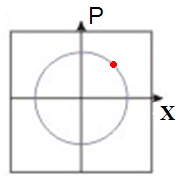
This can be easily understood by making a classical analogy. Consider a harmonic oscillator (e.g. a pendulum). The position and momentum of the oscillator at any given point can be measured and therefore the motion can be completely described by the phase space. This is shown in figure 1. By performing this measurement for a large number of identical oscillators we get a probability distribution in the phase space (figure 2). This distribution can be normalized (the oscillator at a given time has to be somewhere) and the distribution must be non-negative. So we have retrieved a function which gives a description of the chance of finding the particle at a given point with a given momentum.

For quantum mechanical particles the same can be done. The only difference is that the Heisenberg's uncertainty principle mustn't be violated, meaning that we cannot measure the particle's momentum and position at the same time. The particle's momentum and its position are called quadratures (see Optical phase space for more information) in quantum related states. By measuring one of the quadratures of a large number of identical quantum states will give us a probability density corresponding to that particular quadrature. This is called the marginal distribution, or (see figure 3). In the following text we will see that this probability density is needed to characterize the particle's quantum state, which is the whole point of quantum tomography.


Quantum tomography is applied on a source of systems, to determine the quantum state of the output of that source. Unlike a measurement on a single system, which determines the system's current state after the measurement (in general, the act of making a measurement alters the quantum state), quantum tomography works to determine the state(s) prior to the measurements.
Quantum tomography can be used for characterizing optical signals, including measuring the signal gain and loss of optical devices, as well as in quantum computing and quantum information theory to reliably determine the actual states of the qubits. One can imagine a situation in which a person Bob prepares many identical objects (particles or fields) in the same quantum states and then gives them to Alice to measure. Not confident with Bob's description of the state, Alice may wish to do quantum tomography to classify the state herself.
Using Born's rule, one can derive the simplest form of quantum tomography. Generally, being in a pure state is not known in advance, and a state may be mixed. In this case, many different types of measurements will have to be performed, many times each. To fully reconstruct the density matrix for a mixed state in a finite-dimensional Hilbert space, the following technique may be used.
Quantum tomography
Quantum tomography or quantum state tomography is the process by which a quantum state is reconstructed using measurements on an ensemble of identical quantum states. The source of these states may be any device or system which prepares quantum states either consistently into quantum pure states or otherwise into general mixed states. To be able to uniquely identify the state, the measurements must be tomographically complete. That is, the measured operators must form an operator basis on the Hilbert space of the system, providing all the information about the state. Such a set of observations is sometimes called a quorum. The term tomography was first used in the quantum physics literature in a 1993 paper introducing experimental optical homodyne tomography.
In quantum process tomography on the other hand, known quantum states are used to probe a quantum process to find out how the process can be described. Similarly, quantum measurement tomography works to find out what measurement is being performed. Whereas, randomized benchmarking scalably obtains a figure of merit of the overlap between the error prone physical quantum process and its ideal counterpart.
The general principle behind quantum state tomography is that by repeatedly performing many different measurements on quantum systems described by identical density matrices, frequency counts can be used to infer probabilities, and these probabilities are combined with Born's rule to determine a density matrix which fits the best with the observations.
This can be easily understood by making a classical analogy. Consider a harmonic oscillator (e.g. a pendulum). The position and momentum of the oscillator at any given point can be measured and therefore the motion can be completely described by the phase space. This is shown in figure 1. By performing this measurement for a large number of identical oscillators we get a probability distribution in the phase space (figure 2). This distribution can be normalized (the oscillator at a given time has to be somewhere) and the distribution must be non-negative. So we have retrieved a function which gives a description of the chance of finding the particle at a given point with a given momentum.
For quantum mechanical particles the same can be done. The only difference is that the Heisenberg's uncertainty principle mustn't be violated, meaning that we cannot measure the particle's momentum and position at the same time. The particle's momentum and its position are called quadratures (see Optical phase space for more information) in quantum related states. By measuring one of the quadratures of a large number of identical quantum states will give us a probability density corresponding to that particular quadrature. This is called the marginal distribution, or (see figure 3). In the following text we will see that this probability density is needed to characterize the particle's quantum state, which is the whole point of quantum tomography.
Quantum tomography is applied on a source of systems, to determine the quantum state of the output of that source. Unlike a measurement on a single system, which determines the system's current state after the measurement (in general, the act of making a measurement alters the quantum state), quantum tomography works to determine the state(s) prior to the measurements.
Quantum tomography can be used for characterizing optical signals, including measuring the signal gain and loss of optical devices, as well as in quantum computing and quantum information theory to reliably determine the actual states of the qubits. One can imagine a situation in which a person Bob prepares many identical objects (particles or fields) in the same quantum states and then gives them to Alice to measure. Not confident with Bob's description of the state, Alice may wish to do quantum tomography to classify the state herself.
Using Born's rule, one can derive the simplest form of quantum tomography. Generally, being in a pure state is not known in advance, and a state may be mixed. In this case, many different types of measurements will have to be performed, many times each. To fully reconstruct the density matrix for a mixed state in a finite-dimensional Hilbert space, the following technique may be used.
Recent media
Recent media