Hubbry Logo
TomographyTomographyMain
Open search
Tomography
Community hub
Tomography
logo
8 pages, 0 posts
0 subscribers
Be the first to start a discussion here.
Contribute something
Tomography
Tomography
from Wikipedia
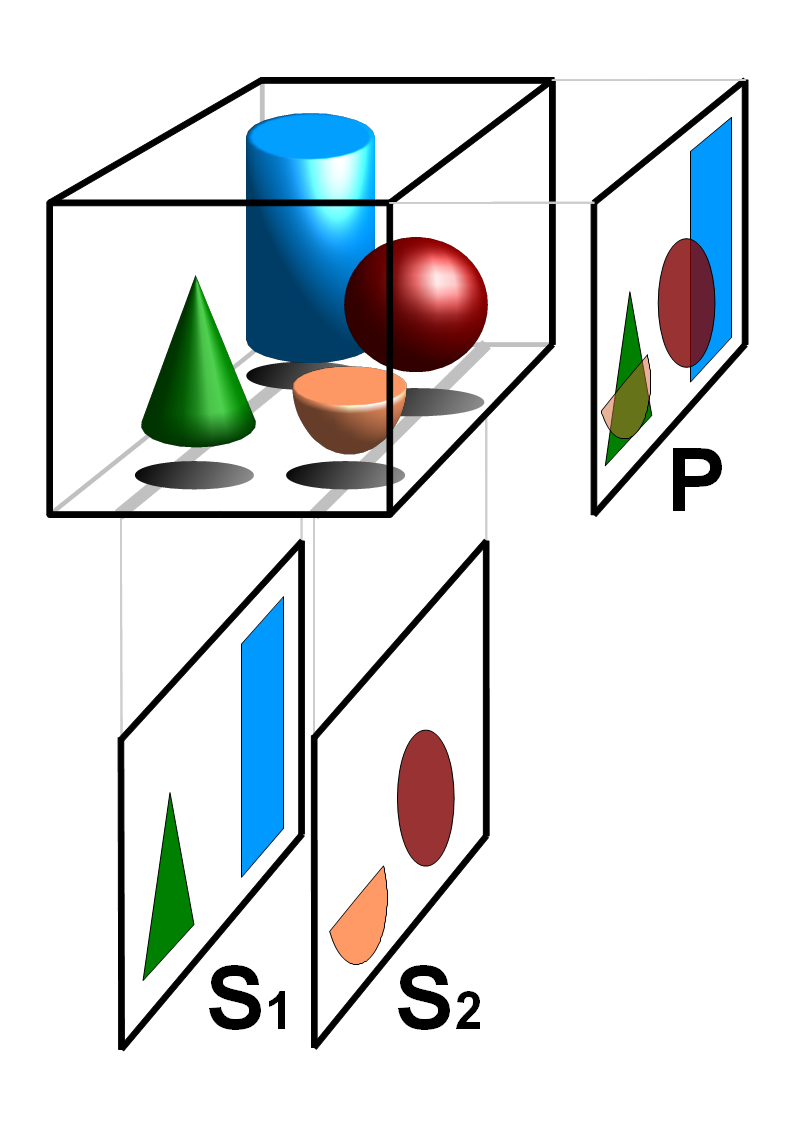
Fig.1: Basic principle of tomography: superposition free tomographic cross sections S1 and S2 compared with the (not tomographic) projected image P
Median plane sagittal tomography of the head by magnetic resonance imaging

Tomography is imaging by sections or sectioning that uses any kind of penetrating wave. The method is used in radiology, archaeology, biology, atmospheric science, geophysics, oceanography, plasma physics, materials science, cosmochemistry, astrophysics, quantum information, and other areas of science.

The word tomography is derived from Ancient Greek τόμος tomos, "slice, section" and γράφω graphō, "to write" or, in this context as well, "to describe." A device used in tomography is called a tomograph, while the image produced is a tomogram.

In many cases, the production of these images is based on the mathematical procedure tomographic reconstruction, such as X-ray computed tomography technically being produced from multiple projectional radiographs. Many different reconstruction algorithms exist. Most algorithms fall into one of two categories: filtered back projection (FBP) and iterative reconstruction (IR). These procedures give inexact results: they represent a compromise between accuracy and computation time required. FBP demands fewer computational resources, while IR generally produces fewer artifacts (errors in the reconstruction) at a higher computing cost.[1]

Although MRI (magnetic resonance imaging), optical coherence tomography and ultrasound are transmission methods, they typically do not require movement of the transmitter to acquire data from different directions. In MRI, both projections and higher spatial harmonics are sampled by applying spatially varying magnetic fields; no moving parts are necessary to generate an image. On the other hand, since ultrasound and optical coherence tomography uses time-of-flight to spatially encode the received signal, it is not strictly a tomographic method and does not require multiple image acquisitions.

Types of tomography

[edit]
Name Source of data Abbreviation Year of introduction
Aerial tomography Electromagnetic radiation AT 2020
Array tomography[2] Correlative light and electron microscopy AT 2007
Atom probe tomography Atom probe APT 1986
Computed tomography imaging spectrometer[3] Visible light spectral imaging CTIS 2001
Computed tomography of chemiluminescence[4][5] Chemiluminescence Flames CTC 2009
Confocal microscopy (laser scanning confocal microscopy) Laser scanning confocal microscopy LSCM
Cryogenic electron tomography Cryogenic transmission electron microscopy CryoET
Electrical capacitance tomography Electrical capacitance ECT 1988[6]
Electrical capacitance volume tomography Electrical capacitance ECVT
Electrical resistivity tomography Electrical resistivity ERT
Electrical impedance tomography Electrical impedance EIT 1984
Atomic Mineral Resonance Tomography Atomic Mineral Resonance Frequency AMRT
Electron tomography[7] Transmission electron microscopy ET 1968[8][9]
Focal plane tomography X-ray 1930s
Functional magnetic resonance imaging Magnetic resonance fMRI 1992
Gamma-ray emission tomography ("Tomographic Gamma Scanning") Gamma ray TGS or ECT
Gamma-ray transmission tomography Gamma ray TCT
Hydraulic tomography fluid flow HT 2000
Infrared microtomographic imaging[10] Mid-infrared 2013
Laser Ablation Tomography Laser ablation & fluorescent microscopy LAT 2013
Magnetic induction tomography Magnetic induction MIT
Magnetic particle imaging Superparamagnetism MPI 2005
Magnetic resonance imaging or nuclear magnetic resonance tomography Nuclear magnetic moment MRI or MRT
Multi-source tomography[11][12] X-ray
Muon tomography Muon
Microwave tomography[13] Microwave
Neutron tomography Neutron
Neutron stimulated emission computed tomography
Ocean acoustic tomography Sonar OAT
Optical coherence tomography Interferometry OCT
Optical diffusion tomography Absorption of light ODT
Optical projection tomography Optical microscope OPT
Photoacoustic imaging in biomedicine Photoacoustic spectroscopy PAT
Photoemission orbital tomography Angle-resolved photoemission spectroscopy POT 2009[14]
Positron emission tomography Positron emission PET
Positron emission tomography - computed tomography Positron emission & X-ray PET-CT
Quantum tomography Quantum state QST
Single-photon emission computed tomography Gamma ray SPECT
Seismic tomography Seismic waves
Terahertz tomography Terahertz radiation THz-CT
Thermoacoustic imaging Photoacoustic spectroscopy TAT
Ultrasound-modulated optical tomography Ultrasound UOT
Ultrasound computer tomography Ultrasound USCT
Ultrasound transmission tomography Ultrasound
X-ray computed tomography X-ray CT, CAT scan 1971
X-ray microtomography[15] X-ray microCT
Zeeman-Doppler imaging Zeeman effect

Some recent advances rely on using simultaneously integrated physical phenomena, e.g. X-rays for both CT and angiography, combined CT/MRI and combined CT/PET.

Discrete tomography and Geometric tomography, on the other hand, are research areas[citation needed] that deal with the reconstruction of objects that are discrete (such as crystals) or homogeneous. They are concerned with reconstruction methods, and as such they are not restricted to any of the particular (experimental) tomography methods listed above.

Synchrotron X-ray tomographic microscopy

[edit]

A new technique called synchrotron X-ray tomographic microscopy (SRXTM) allows for detailed three-dimensional scanning of fossils.[16][17]

The construction of third-generation synchrotron sources combined with the tremendous improvement of detector technology, data storage and processing capabilities since the 1990s has led to a boost of high-end synchrotron tomography in materials research with a wide range of different applications, e.g. the visualization and quantitative analysis of differently absorbing phases, microporosities, cracks, precipitates or grains in a specimen. Synchrotron radiation is created by accelerating free particles in high vacuum. By the laws of electrodynamics this acceleration leads to the emission of electromagnetic radiation (Jackson, 1975). Linear particle acceleration is one possibility, but apart from the very high electric fields one would need it is more practical to hold the charged particles on a closed trajectory in order to obtain a source of continuous radiation. Magnetic fields are used to force the particles onto the desired orbit and prevent them from flying in a straight line. The radial acceleration associated with the change of direction then generates radiation.[18]

Volume rendering

[edit]
Multiple X-ray computed tomographs (with quantitative mineral density calibration) stacked to form a 3D model

Volume rendering is a set of techniques used to display a 2D projection of a 3D discretely sampled data set, typically a 3D scalar field. A typical 3D data set is a group of 2D slice images acquired, for example, by a CT, MRI, or MicroCT scanner. These are usually acquired in a regular pattern (e.g., one slice every millimeter) and usually have a regular number of image pixels in a regular pattern. This is an example of a regular volumetric grid, with each volume element, or voxel represented by a single value that is obtained by sampling the immediate area surrounding the voxel.

To render a 2D projection of the 3D data set, one first needs to define a camera in space relative to the volume. Also, one needs to define the opacity and color of every voxel. This is usually defined using an RGBA (for red, green, blue, alpha) transfer function that defines the RGBA value for every possible voxel value.

For example, a volume may be viewed by extracting isosurfaces (surfaces of equal values) from the volume and rendering them as polygonal meshes or by rendering the volume directly as a block of data. The marching cubes algorithm is a common technique for extracting an isosurface from volume data. Direct volume rendering is a computationally intensive task that may be performed in several ways.

History

[edit]

Focal plane tomography was developed in the 1930s by the radiologist Alessandro Vallebona, and proved useful in reducing the problem of superimposition of structures in projectional radiography.

In a 1953 article in the medical journal Chest, B. Pollak of the Fort William Sanatorium described the use of planography, another term for tomography.[19]

Focal plane tomography remained the conventional form of tomography until being largely replaced by mainly computed tomography in the late 1970s.[20] Focal plane tomography uses the fact that the focal plane appears sharper, while structures in other planes appear blurred. By moving an X-ray source and the film in opposite directions during the exposure, and modifying the direction and extent of the movement, operators can select different focal planes which contain the structures of interest.

See also

[edit]

References

[edit]
[edit]
Revisions and contributorsEdit on WikipediaRead on Wikipedia
from Grokipedia
Tomography is an technique that uses penetrating waves, such as X-rays, gamma rays, , or , to generate cross-sectional representations of the internal structures of an object, solid or biological, by acquiring data from multiple angles and reconstructing it computationally or mechanically. The term originates from the words tomos (meaning "slice" or "section") and graphē (meaning "" or "writing"), reflecting its focus on creating detailed "slices" or sectional views of subjects ranging from human anatomy to materials. This method enables non-invasive visualization of three-dimensional internal compositions, distinguishing it from traditional two-dimensional by providing depth-resolved without physical sectioning. The fundamental principle of tomography involves projecting waves through the object from various directions, measuring their attenuation or interaction, and applying mathematical algorithms—such as filtered back-projection or —to form images of specific planes or volumes. In early forms, like linear tomography developed in , mechanical movement of the source and detector blurred out-of-plane structures to sharpen the focal plane, but this was limited in resolution and contrast. Modern tomographic systems, particularly since the , rely on digital computation to handle large datasets from detectors, allowing for high-resolution reconstructions that account for noise, scattering, and partial volume effects. These principles extend beyond radiation-based methods to include non-ionizing modalities, ensuring versatility across applications while minimizing risks like . Tomography encompasses diverse types tailored to specific needs, including computed tomography (CT) for detailed anatomical imaging, (PET) for functional and metabolic assessment, magnetic resonance tomography (MRT or MRI) for soft tissue contrast without radiation, optical coherence tomography (OCT) for micron-scale biological structures, and ultrasound tomography for real-time, portable evaluations. Key applications span clinical diagnostics—such as detecting tumors, fractures, and vascular issues—preclinical research for monitoring disease progression in animal models, and non-medical fields like industrial for defect detection in materials or geophysical surveys for subsurface mapping. Advances in hybrid systems, like PET-CT or photoacoustic tomography, combine modalities for enhanced diagnostic accuracy, while emerging techniques in electrical and cryo-electron tomography push boundaries in process monitoring and molecular imaging.

Fundamentals

Definition and Scope

Tomography is an technique used to generate detailed representations of internal structures within an object or body by acquiring and reconstructing from multiple projections or cross-sectional slices. This method enables the visualization of features that are obscured in traditional approaches, providing clearer insights into three-dimensional arrangements without invasive procedures. The term "tomography" originates from words tomos, meaning "slice" or "section," and graphe, meaning "" or "writing," reflecting its focus on creating slice-like images. The scope of tomography includes both two-dimensional (planar) , which produces cross-sectional slices, and three-dimensional (volumetric) , which reconstructs full spatial volumes from stacked slices or integrated projections. This distinguishes tomography from projection radiography, a conventional method that captures a single two-dimensional shadowgram where structures overlap and depth information is lost, whereas tomography employs data from multiple angles to resolve such overlaps and yield spatially resolved . Historically, the concept of tomography emerged in with the development of linear tomography, a mechanical technique that used synchronized motion of the source and detector to blur structures outside a selected plane, allowing focused imaging of specific layers. This early form evolved significantly in subsequent decades to include computed tomography, which relies on digital processing of projection data for more precise reconstructions. At its core, tomography requires the collection of projection data, which in X-ray-based systems consists of line integrals measuring the of along paths through the imaged object, serving as the foundational input for subsequent . These projections, gathered from various orientations, provide the necessary information to infer internal variations without mathematical derivation of reconstruction processes.

Core Principles

At its core, tomography involves reconstructing the internal distribution of properties within an object from measurements obtained from multiple viewpoints or encodings, typically formulated as an . Tomography relies on the acquisition of projection data from multiple angles to reconstruct cross-sectional images of an object. In transmission tomography, such as computed tomography, a source emits that passes through the object, and detectors measure the transmitted intensity from various orientations, typically achieved by rotating the source and detector assembly around the subject. In emission tomography, like , radionuclides within the object emit , which is detected by stationary or rotating detector arrays to capture projections from different viewpoints. In transmission modes, the projection data arise from the attenuation of along paths through the object, governed by the Beer-Lambert law, where the projection data p=ln(I/I0)=μ(s)dsp = -\ln(I/I_0) = \int \mu(s) \, ds along the ray path, with μ(s)\mu(s) the position-dependent linear . This provides the line integral measurements needed for image reconstruction, with higher attenuation indicating denser materials. Projection geometries influence data collection efficiency and reconstruction complexity. Parallel-beam geometry uses rays perpendicular to the projection direction, simplifying acquisition but requiring more rotations for full coverage, as each projection consists of evenly spaced, . In contrast, fan-beam geometry diverges rays from a in a fan shape toward a curved detector , enabling faster scans with fewer rotations—often 180° to 360°—at the cost of increased computational demands for rebinning to parallel projections. Signal detection captures the attenuated or emitted radiation to form projection data. In nuclear emission tomography, scintillation detectors convert gamma rays into visible light via inorganic crystals, such as or oxyorthosilicate, which is then amplified by tubes to produce measurable electrical signals. In magnetic resonance tomography, radiofrequency (RF) coils detect the weak electromagnetic signals induced by precessing nuclear spins, with designs like surface or volume coils optimizing sensitivity to specific regions. The projections acquired in transmission and emission tomography relate to the , which mathematically represents the line integrals of the object's distribution along rays of sight.

Historical Development

Early Concepts and Foundations

The theoretical foundations of tomography were laid in 1917 by Austrian mathematician , who introduced the in his seminal paper, providing a mathematical framework for reconstructing a function from its line integrals along various directions. This transform, which maps a two-dimensional function to the set of its projections, included an explicit inversion formula that enabled the recovery of cross-sectional images from multiple viewpoints, establishing the core principle underlying later tomographic reconstructions. In the and , the primary medical motivation for developing tomographic techniques stemmed from the limitations of conventional , where overlapping anatomical structures obscured detailed visualization of internal tissues, necessitating non-invasive methods to isolate specific planes for improved . This era's analog approaches were constrained by mechanical and photographic technologies, focusing on blurring extraneous planes to enhance focal layer clarity without digital . A pivotal advancement occurred in 1930 when Italian radiologist Alessandro Vallebona invented linear tomography, constructing a prototype device that synchronized and film movement to sharpen images in a selected plane while defocusing others through relative motion. Key contributions in the late 1940s and 1950s further bridged theoretical and practical aspects of image reconstruction. In 1948, Hungarian-British physicist developed as a means to reconstruct wavefronts from interference patterns, offering conceptual parallels to tomographic projection-reconstruction by capturing both and phase information for three-dimensional imaging recovery. Concurrently, during the 1950s, Australian-American engineer Ronald Bracewell advanced Fourier-based methods in at , adapting transform techniques to synthesize images from one-dimensional scans, which provided foundational tools for frequency-domain analysis in early tomographic applications.

Key Inventions and Milestones

The invention of the computed tomography (CT) scanner marked a pivotal breakthrough in , enabling cross-sectional visualization of the human body without invasive procedures. In 1971, British engineer developed the first prototype CT scanner while working at Laboratories in Hayes, , building on earlier theoretical ideas to create a practical device that used X-ray projections processed by computer algorithms to reconstruct images. The prototype's inaugural clinical use occurred on October 1, 1971, when it produced the first of a human patient—a woman with a suspected —at Atkinson Morley's Hospital in London, under the supervision of radiologist James Ambrose; this scan revealed a cyst, demonstrating the technology's diagnostic potential. Parallel to Hounsfield's engineering efforts, South African physicist Allan Cormack independently advanced the mathematical foundations of tomography in the 1960s, developing algorithms based on Radon transforms and Fourier methods to reconstruct images from projection data, which he validated through experiments on phantoms composed of materials like aluminum and Lucite. Cormack's work, published in key papers such as his 1963 article in the , provided the theoretical framework essential for accurate image reconstruction, though it remained largely unrecognized until the clinical success of CT. In recognition of their complementary contributions—Hounsfield's practical implementation and Cormack's theoretical innovations—the 1979 in or was jointly awarded to both for "the development of computer assisted tomography." This accolade underscored the transformative impact of CT on diagnostics, shifting from two-dimensional projections to volumetric and spurring rapid technological refinement. The 1970s saw the swift clinical adoption of CT, transitioning from experimental prototypes to widespread hospital use; by 1973, the first CT scanner in was installed at , enabling routine brain imaging and expanding to body scans by the decade's end, with third-generation scanners featuring rotating sources achieving scan times under 20 seconds. The 1980s brought advancements in emission tomography, including the maturation of (PET) for metabolic imaging—first demonstrated in humans in 1975 but refined with multi-ring detectors and better cyclotrons for clinical viability—and (SPECT), which evolved from 1960s prototypes into commercial systems using gamma cameras for functional cardiac and brain studies. In the , (MRI) solidified its role as a tomographic modality, with the introduction of functional MRI (fMRI) leveraging blood-oxygen-level-dependent contrast to map brain activity noninvasively, alongside early explorations of hybrid PET/MRI systems to combine anatomical and molecular data. The 2000s accelerated CT's evolution through multi-slice and helical (spiral) scanning, introduced in the late but optimized in this era with 16- to 64-slice detectors allowing whole-body coverage in seconds and isotropic sub-millimeter resolution for detailed vascular and . In 2021, the U.S. FDA approved the first photon-counting CT scanner, enabling higher resolution imaging with reduced radiation doses. These milestones were enabled by key technological enablers, particularly the advent of affordable in the , such as the EMI's custom systems based on General minicomputer architectures, which performed the intensive back-projection calculations required for real-time image reconstruction on scanner hardware rather than remote mainframes. Concurrently, improvements in detectors—from scintillators in early units offering 1-2 mm resolution to multi-element solid-state arrays in later generations—enhanced to sub-millimeter levels, reducing artifacts and enabling thinner slices for multimodal integration.

Major Modalities

X-ray Computed Tomography

X-ray computed tomography (CT), also known as computed axial tomography (), is a technique that uses to create cross-sectional images of the body, allowing for detailed visualization of internal structures. It operates on the principle of transmission tomography, where a rotating X-ray source emits photons that pass through the patient and are detected on the opposite side, with variations in providing information. This modality revolutionized diagnostic by enabling non-invasive, three-dimensional reconstruction of anatomical features, first demonstrated in clinical practice in the early 1970s. The physics of X-ray CT relies on the attenuation of X-ray photons as they interact with tissues, primarily through photoelectric absorption and Compton scattering, which depend on tissue electron density and atomic number. Attenuation is quantified using the linear attenuation coefficient, but for standardization, images are displayed in Hounsfield units (HU), a scale where water is assigned 0 HU, air is -1000 HU, and bone ranges from +300 to +1000 HU or higher, reflecting relative radiodensity. This scaling, introduced by Godfrey Hounsfield, facilitates consistent interpretation across scanners, with soft tissues typically ranging from -100 to +100 HU. Hardware in X-ray CT systems centers on a rotating gantry housing an and an opposing detector , which captures transmitted photons to generate projection data. Early first-generation scanners used a pencil beam and translate-rotate mechanism, while subsequent generations evolved for efficiency: second-generation employed multiple detectors with partial rotation, third-generation utilized a fan beam with both tube and detector rotating together, and fourth-generation featured a stationary ring of detectors with a rotating fan-beam tube. Modern systems often incorporate multi-slice detectors with up to 320 rows, enabling rapid volumetric imaging. Scan types in X-ray CT include axial (step-and-shoot) acquisitions, where the patient table moves incrementally between rotations for sequential slices, and helical (spiral) scanning, which continuously rotates the gantry while the table advances, producing uninterrupted volumetric data for faster and artifact-reduced imaging. Iodine-based contrast agents are commonly administered intravenously to enhance vascular and soft-tissue structures by increasing in those regions, improving detection in applications like . Radiation dose in CT is a key consideration due to the ionizing nature of X-rays, with the Computed Tomography Dose Index (CTDI) measuring in a phantom to standardize scanner output, typically expressed in mGy. Effective dose, which accounts for tissue sensitivity, ranges from 1 to 10 mSv per scan depending on protocol—such as low-dose for screening (around 1.5 mSv) versus higher for multiphase abdominal exams (up to 20 mSv)—comparable to or exceeding annually. Dose reduction techniques, like , have mitigated risks while preserving image quality.

Emission Tomography

Emission tomography encompasses nuclear medicine imaging techniques that detect gamma rays emitted from radioactive tracers administered to patients, enabling of physiological processes rather than anatomical structure. These methods rely on the principle of detecting gamma radiation originating from within the body, where (PET) captures pairs of 511 keV photons produced by positron-electron , and (SPECT) detects individual gamma photons using collimators to determine their directionality. In PET, a positron-emitting decays, releasing a that travels a short before annihilating with an , producing two oppositely directed gamma photons of 511 keV each, which are detected in by ring-shaped scintillation detectors to localize the emission along a line of response without the need for physical collimation. SPECT, in contrast, employs collimators—typically lead apertures with parallel holes—to restrict gamma rays to specific directions, allowing reconstruction of the three-dimensional distribution from projections acquired at multiple angles. PET systems utilize cyclotron-produced short-lived isotopes, such as fluorine-18 in 2-[18F]fluoro-2-deoxy-D-glucose (FDG), which serves as an analog for glucose to visualize metabolic activity, particularly elevated glucose uptake in tumors due to the Warburg effect. Coincidence detection circuits in PET scanners record only simultaneous events within a narrow time window (typically nanoseconds), rejecting scattered or random photons to improve image quality and quantitative accuracy. This setup achieves spatial resolutions of approximately 5-7 mm in clinical systems, enabling detailed functional mapping of organs like the brain and heart. SPECT imaging, often performed with rotating gamma cameras equipped with one or more detector heads that orbit the patient, uses longer-lived isotopes such as technetium-99m or thallium-201, which emit single gamma photons at energies around 140 keV for technetium and 69-80 keV for thallium, commonly for myocardial perfusion or tumor assessment. Due to collimator limitations and lower photon energies, SPECT resolutions are coarser, typically 10-14 mm, though it offers advantages in availability and cost for routine clinical use. Quantitative analysis in emission tomography, particularly PET, employs metrics like the standardized uptake value (), calculated as the ratio of tracer concentration in the to the injected dose normalized by body weight, to assess tumor viability and treatment response in . For instance, values greater than 2.5 often indicate malignant lesions with FDG, providing a semi-quantitative measure of metabolic activity that correlates with and guides therapeutic decisions. While SPECT can also derive uptake ratios, its quantification is less precise due to and scatter effects, making PET the preferred modality for absolute metabolic quantification in applications like staging.

Magnetic Resonance Tomography

Magnetic Resonance Tomography, also known as Magnetic Resonance Imaging (MRI), utilizes the principles of to produce cross-sectional images of the body without . This technique exploits the magnetic properties of protons, primarily in and molecules, to generate signals that are spatially encoded and reconstructed into tomographic images. MRI provides exceptional detail for anatomical structures, particularly soft tissues, and forms a of modern due to its non-invasive nature and versatility in clinical applications. The physics of MRI begins with (NMR), where atomic nuclei with non-zero spin, such as hydrogen-1, align with a strong external static (B0), typically 1.5 to 3 Tesla in clinical settings. Radiofrequency (RF) pulses, tuned to the Larmor (proportional to B0 strength), are applied to tip these spins away from alignment, creating a transient transverse that induces a detectable signal in receiver coils. Spatial encoding is achieved through gradients applied along the , and z axes, which impose linear variations in the to select specific slices and encode positional information via and phase shifts. Image contrast primarily derives from differences in T1 (longitudinal, spin-lattice) and T2 (transverse, spin-spin) relaxation times: T1 reflects the recovery of along B0, with shorter times in fat yielding brighter signals on T1-weighted images, while T2 captures due to spin interactions, prolonging signals in fluids like for brighter appearance on T2-weighted images. MRI hardware centers on superconducting magnets, cooled to near with , to generate homogeneous B0 fields ranging from 1.5 T for routine clinical use to 7 T for applications offering higher signal-to-noise ratios. These magnets enable the precise control needed for high-resolution . RF coils transmit s and receive signals, while coils rapidly switch to create the varying fields for spatial localization. Common sequences include spin-echo, which uses a 90° RF followed by a 180° refocusing to mitigate field inhomogeneities and produce T2-weighted contrast, and gradient-echo, which employs partial flip angles and reversal for faster T1-weighted or susceptibility-sensitive , facilitating slice selection through combined RF and application. In , MRI data is acquired in k-space, the domain, where raw signals are sampled to fill a grid representing Fourier components of the image; central k-space encodes low-frequency contrast, while periphery captures high-frequency edges. 3D volume acquisition extends 2D slice imaging by applying phase-encoding gradients in the slice direction, allowing comprehensive volumetric data collection for isotropic resolution without gaps. Functional MRI (fMRI) builds on this by detecting blood-oxygen-level-dependent (BOLD) signals, which reflect hemodynamic changes tied to neuronal activity, enabling 3D mapping of function during tasks. Key advantages of MRI include its lack of , permitting safe, repeated scans without cumulative dose risks, unlike X-ray-based methods. Additionally, its superior soft-tissue contrast, driven by T1 and T2 differences, excels at delineating pathologies such as (hyperintense on T2 due to prolonged relaxation) from tumors (variable enhancement patterns), enhancing diagnostic accuracy in and .

Other Modalities

Ultrasound tomography utilizes , including reflection and transmission modes, to reconstruct quantitative images of tissue properties, with applications in and musculoskeletal imaging. In , transmission-based methods generate sound-speed tomograms that quantify tissue for cancer and lesion characterization, where malignant tissues typically exhibit elevated sound speeds of approximately 1548 ± 17 m/s compared to 1513 ± 27 m/s in benign s. These tomograms leverage bent-ray tracing and regularization techniques to handle nonlinear wave paths, improving lesion edge definition by 2.1- to 3.4-fold over simpler models. For musculoskeletal applications, emerging computed tomography addresses limitations of conventional 2D by providing volumetric maps of speed-of-sound and , aiding of conditions like tendinopathies despite challenges from limited apertures and heterogeneous bone interfaces. A key challenge across these uses is spatial variations in speed-of-sound, which introduce phase aberrations and distort paths, necessitating advanced corrections to maintain image fidelity. Optical coherence tomography (OCT) employs near-infrared light to produce high-resolution cross-sectional images of tissue microstructures through optical backscattering detection. Introduced in 1991, the technique uses low-coherence akin to ultrasonic ranging, achieving axial resolutions of a few micrometers and detecting reflected signals as faint as 10^{-10} of the incident power, enabling noninvasive imaging in both transparent and turbid media. In , OCT provides micron-scale visualization of retinal layers, facilitating early detection of pathologies such as and macular holes by quantifying nerve fiber layer thickness. In , it offers en face and cross-sectional views to depths of 0.4-2.0 mm at 3-15 μm resolution, supporting non-invasive evaluation of skin tumors, inflammatory conditions, and nail disorders by delineating epidermal-dermal boundaries and vascular patterns. Electron tomography, integrated with cryo-electron microscopy (cryo-EM), generates 3D reconstructions of macromolecular assemblies within cellular contexts using transmission electron microscopes. Specimens are rapidly frozen in vitreous ice to preserve native hydration and structure, followed by acquisition of tilt-series—typically 100 or more 2D projections over tilt angles up to ±65°—to compute tomograms via back-projection or iterative methods at resolutions approaching 4 nm. This approach has revealed the architecture of molecular complexes, such as bacterial cytoskeletal rings, flagellar motors, and distributions, elucidating their spatial organization and functional interactions without isolation artifacts. Synchrotron X-ray tomography exploits the intense, coherent beams from high-brilliance synchrotron sources to perform micro- and nano-scale 3D imaging of materials, particularly through phase-contrast modalities that enhance contrast for low-density features. In phase-contrast modes, such as propagation-based imaging, X-ray wavefront interference via Fresnel diffraction yields edge-enhanced projections, enabling resolutions down to 50 nm after tomographic reconstruction and phase retrieval. These techniques are pivotal in materials science for non-destructively mapping internal microstructures, including void evolution in composites and phase distributions in alloys, with examples achieving 1.5 μm voxel sizes for dynamic studies of deformation in biological materials like wood.

Reconstruction and Processing

Mathematical Foundations

The mathematical foundations of tomography revolve around the inversion of projection data to reconstruct the internal structure of an object, primarily through integral transforms that model the acquisition process. The serves as the cornerstone, providing a mathematical representation of how line integrals through an object function correspond to measured projections. For a two-dimensional object with function f(x,y)f(x, y), the R(θ,s)R(\theta, s) at angle and distance ss from the origin is defined as the along the line to the direction θ\theta: R(θ,s)=f(x,y)δ(xcosθ+ysinθs)dxdy,R(\theta, s) = \int_{-\infty}^{\infty} f(x, y) \, \delta(x \cos \theta + y \sin \theta - s) \, dx \, dy, where δ\delta is the Dirac delta function. This equation links the object's function ff to its projections, enabling the formulation of tomography as an inverse problem to recover ff from multiple R(θ,s)R(\theta, s). The transform was originally introduced by Johann Radon in 1917, and its application to imaging was later formalized in the context of computed tomography. A key insight for efficient reconstruction is the central slice theorem, also known as the Fourier slice theorem, which establishes a direct relationship in the frequency domain between projections and the object's Fourier transform. Specifically, the one-dimensional Fourier transform of the projection R(θ,s)R(\theta, s) with respect to ss yields a central slice through the two-dimensional Fourier transform of f(x,y)f(x, y) at the same angle θ\theta. Mathematically, if R^(θ,ω)\hat{R}(\theta, \omega) denotes the Fourier transform of R(θ,s)R(\theta, s), then R^(θ,ω)=f^(ωcosθ,ωsinθ),\hat{R}(\theta, \omega) = \hat{f}(\omega \cos \theta, \omega \sin \theta), where f^\hat{f} is the Fourier transform of ff. This theorem implies that collecting projections over a range of angles fills the frequency space of the object, allowing reconstruction via inverse Fourier transform, provided sufficient angular coverage to avoid gaps. The theorem was pivotal in early developments of Fourier-based methods for tomography, as detailed in foundational analyses of projection data. Tomographic inversion presents inherent challenges as an ill-posed problem in the sense of Hadamard, characterized by sensitivity to noise, instability under perturbations, and non-uniqueness without additional constraints. Incomplete data, such as limited angular sampling, exacerbates these issues, leading to artifacts like aliasing—where high-frequency components are misrepresented as low-frequency ones due to undersampling in the projection domain—and reduced spatial resolution, which is fundamentally limited by the detector aperture and the number of projections. Resolution in reconstructed images is quantified by the modulation transfer function, influenced by the sampling density in Radon space, while aliasing arises from violations of the Nyquist criterion in angular and radial directions. These challenges necessitate regularization techniques to stabilize solutions, though the core ill-posedness stems from the compact operator nature of the Radon transform. One of the earliest and most analytically tractable inversion methods is filtered backprojection, which addresses the blurring inherent in simple backprojection by applying a frequency-domain filter to the projections before summation. The filtered projections g(θ,s)g(\theta, s) are obtained by convolving the with a ramp filter h(t)=14π21t2h(t) = \frac{1}{4\pi^2} \frac{1}{t^2} (in continuous form): g(θ,s)=R(θ,t)h(st)dt.g(\theta, s) = \int_{-\infty}^{\infty} R(\theta, t) \, h(s - t) \, dt. The reconstructed image f(x,y)f(x, y) is then formed by backprojecting these filtered projections over all angles: f(x,y)=12π0πg(θ,xcosθ+ysinθ)dθ.f(x, y) = \frac{1}{2\pi} \int_{0}^{\pi} g(\theta, x \cos \theta + y \sin \theta) \, d\theta. This approach inverts the Radon transform exactly under ideal conditions, with the ramp filter compensating for the 1/ω1/|\omega| decay in the Fourier domain to restore high frequencies. Derived from the central slice theorem, filtered backprojection provides a direct, non-iterative solution that has become a benchmark for tomographic reconstruction.

Algorithms and Techniques

Analytical methods for tomographic reconstruction, such as filtered backprojection (FBP), enable exact image recovery in parallel-beam geometry by applying a ramp filter to projection data followed by backprojection to accumulate contributions across angles. This approach inverts the Radon transform efficiently, producing high-quality images when sufficient projections are available and noise is moderate. In three-dimensional cone-beam configurations, extensions like the Feldkamp-Davis-Kress (FDK) algorithm adapt FBP for circular trajectories, though they introduce approximation errors and artifacts near the edges of the field of view due to incomplete data coverage. These methods remain computationally fast and are widely implemented in clinical scanners for their speed in full-dose scenarios. Iterative methods offer greater flexibility for handling incomplete or noisy data compared to analytical techniques. The algebraic reconstruction technique (), introduced in 1970, formulates reconstruction as solving a large from projections and iteratively updates pixel values to satisfy each ray sum sequentially. converges to a solution that minimizes inconsistencies but can amplify without constraints, making it suitable for sparse-view tomography when combined with regularization. For emission tomography like positron emission tomography (PET), the expectation-maximization (EM) algorithm, developed by Shepp and Vardi in 1982, maximizes the likelihood of observed counts under a Poisson model, incorporating attenuation correction through iterative updates that preserve positivity and reduce bias. These iterative approaches excel in low-dose by statistically modeling propagation, yielding superior contrast and detail recovery over FBP at reduced levels. Compressed sensing techniques leverage the sparsity of tomographic images in transform domains to enable reconstruction from fewer projections than traditionally required. By minimizing sparsity-promoting priors, such as (TV), these methods solve an that recovers accurate images while suppressing artifacts from , facilitating faster scans and lower doses. For instance, TV minimization enforces piecewise smoothness, allowing high-fidelity CT images from 20-30 views where FBP would fail due to . This , rooted in foundational work on sparse recovery, has been adapted for cone-beam CT to maintain resolution in clinical applications. Deep learning-based methods have emerged as a transformative approach in , particularly since the late , enabling further reductions in dose and scan time while preserving or enhancing image quality. These techniques employ neural networks, such as convolutional neural networks (CNNs) and generative adversarial networks (GANs), to learn mappings from noisy or undersampled projections to high-quality images, often outperforming traditional methods in low-dose scenarios. Unrolled iterative networks combine with physics-based models, unfolding optimization algorithms like ADMM into learnable layers for end-to-end reconstruction. As of 2025, reconstruction (DLR) algorithms are commercially available in CT scanners from major vendors, demonstrating reduced noise and improved detectability of low-contrast features without altering . Noise reduction in tomographic processing often incorporates statistical models and regularization tailored to the imaging modality. In X-ray computed tomography, projection data exhibit Poisson-distributed noise due to photon counting statistics, which becomes prominent at low doses and leads to streaking artifacts in reconstructions. Tikhonov regularization addresses this by adding a quadratic penalty term to the least-squares objective, promoting smooth solutions that suppress high-frequency noise while preserving edges, particularly effective in iterative frameworks for ill-posed problems. Such techniques balance fidelity to measurements with stability, improving signal-to-noise ratios in low-flux regimes without excessive blurring.

Visualization Methods

Visualization methods in tomography transform reconstructed volumetric data into interpretable 2D or 3D representations, enabling clinicians and researchers to explore internal structures without invasive procedures. These techniques operate on voxel-based datasets obtained from tomographic scans, allowing for interactive manipulation to reveal spatial relationships and anomalies. Key approaches include direct for translucent views, multi-planar slicing for orthogonal inspections, and surface extraction for solid models, each tailored to highlight specific features like tissue density or boundaries. Volume rendering generates photorealistic 3D images by simulating light propagation through the volumetric data, avoiding the need for intermediate geometric models. Ray-casting, a foundational method, traces rays from the viewpoint through the volume, accumulating color and opacity at each to compose the final image; this approach was pioneered for displaying surfaces from computed tomography data, supporting high-quality visualizations of complex anatomies. Texture-based accelerates this process by leveraging graphics hardware to map 3D textures onto proxy geometries, such as stacks of 2D slices, enabling real-time rendering of large datasets through efficient sampling and compositing. Transfer functions play a crucial role in both techniques, mapping scalar values (e.g., Hounsfield units in CT) to optical properties like color and opacity, allowing selective emphasis of structures such as vessels or tumors while suppressing noise. Multi-planar reconstruction (MPR) provides interactive 2D views by resampling the volume along arbitrary planes, typically the orthogonal axial, coronal, and sagittal orientations, to offer comprehensive spatial context. This method facilitates precise measurements and localization of pathologies, as demonstrated in abdominal CT where stacked MPR images enhance depiction of lesions and compared to standard axial slices alone. Users can rotate or curve planes for oblique views, making MPR a staple for preoperative planning and follow-up assessments. Surface rendering extracts and displays from the volume, focusing on boundaries defined by threshold values to model solid objects like organs or bones. The algorithm, a widely adopted technique, divides the volume into cubic cells and generates triangular meshes at edges where the crosses the , producing smooth, high-resolution surfaces suitable for segmentation tasks such as isolating skeletal structures in CT data. This method supports applications requiring geometric analysis, though it can introduce topological ambiguities in ambiguous cell configurations, which later variants address. Advanced visualization techniques extend these foundations for specialized interpretations, such as virtual endoscopy, which simulates endoscopic fly-throughs by rendering interior surfaces from CT volumes along a virtual path. Introduced as a non-invasive alternative to traditional , this approach uses perspective volume rendering to depict luminal views of the colon or airways, aiding in polyp detection and evaluation. Handling large tomographic datasets benefits from GPU acceleration, which parallelizes ray-casting or to achieve interactive frame rates, as seen in hardware-optimized pipelines that render million-voxel volumes in real time.

Applications and Impacts

Medical Diagnostics and Treatment

Tomography plays a pivotal role in medical diagnostics by enabling non-invasive visualization of internal structures, facilitating early detection and accurate characterization of diseases. In trauma and cases, computed tomography (CT) serves as the primary imaging modality in acute settings, rapidly identifying fractures, hemorrhages, hematomas, and contusions that require immediate intervention. This capability allows for prompt neurosurgical decisions, reducing the risk of secondary . For , tomography-computed tomography (PET-CT) enhances staging by detecting occult metastases and improving tumor-node-metastasis (TNM) classification, particularly in , head and neck, and colorectal cancers, where it outperforms CT alone in nodal and distant staging accuracy. In , (MRI) perfusion techniques, such as dynamic susceptibility contrast or arterial spin labeling, aid in detection by quantifying cerebral blood flow deficits, identifying salvageable tissue (penumbra) up to 48 hours post-onset, and distinguishing stroke mimics from true ischemia. Beyond diagnostics, tomography guides therapeutic interventions, minimizing risks associated with invasive approaches. CT-guided biopsies, for instance, use real-time imaging to precisely target lesions in the lungs, liver, or other organs, achieving high diagnostic accuracy while avoiding open surgery. In radiation oncology, CT is integral to intensity-modulated (IMRT) planning, providing three-dimensional anatomical data for dose optimization, conformal targeting of tumors, and sparing of surrounding healthy tissues like in or head-and-neck cancers. Quantitative metrics derived from tomographic imaging further inform clinical management. Volumetric CT measurements assess tumor burden by calculating total lesion volumes, offering superior prognostic value over unidimensional metrics in monitoring treatment response for solid tumors like lung or colorectal cancers. In cardiology, perfusion imaging via MRI or CT evaluates myocardial viability by mapping blood flow and identifying hibernating myocardium in , guiding decisions on with sensitivity up to 89% and specificity of 80%. The clinical impact of tomography is profound, with over 375 million CT scans performed worldwide annually as of the early 2020s, reaching 375-450 million by 2025 and reflecting its widespread adoption. By enabling precise diagnostics and guidance, it has reduced the need for invasive procedures, such as replacing diagnostic coronary angiography in low-to-intermediate risk patients and shortening overall treatment times while improving patient satisfaction and outcomes.

Industrial and Scientific Uses

In industrial applications, computed tomography (CT) serves as a critical tool for non-destructive testing (NDT) to detect internal flaws such as welds, cracks, and voids in components, enabling comprehensive inspection without disassembly. For instance, CT scanning identifies defects in composite materials and metallic structures used in , improving and reducing the risk of structural failures during . Similarly, in screening, CT systems analyze baggage by generating 3D images to detect prohibited items like explosives, enhancing threat identification accuracy while allowing higher throughput at . These systems compute material density and shape from multiple projections, flagging anomalies for further manual review. In scientific research, tomography enables non-invasive analysis of specimens across disciplines. In paleontology, micro-CT imaging reveals the internal structures of fossils, such as bone microstructures and remnants, without physical damage, facilitating comparative studies of evolutionary morphology. High-resolution scans, often enhanced by for segmentation, produce detailed 3D models from CT data embedded in surrounding matrix rock. In geology, CT quantifies and pore networks in core samples, providing insights into rock permeability and fluid storage crucial for resource exploration. By measuring Hounsfield units to differentiate mineral grains from voids, researchers assess total with sub-millimeter precision, complementing traditional methods like helium porosimetry. Materials science leverages tomography to examine microstructures in advanced components, particularly batteries, where 3D imaging tracks electrode evolution during charging cycles. Synchrotron-based nano-CT reveals particle degradation and void formation in lithium-ion cathodes at sub-micron scales, informing design improvements for longevity. Operando techniques capture dynamic changes, such as lithium plating, to optimize without destructive sectioning. Synchrotron radiation enhances tomography for time-resolved 4D imaging (3D spatial plus time) of dynamic processes, such as multiphase fluid flow in porous media, revealing capillary fingering and at the pore scale. These ultrafast scans, achieving sub-second , quantify flow velocities and saturation distributions in real-time, advancing models of subsurface and . Resolution capabilities span scales: nano-CT achieves sub-micron sizes (down to 400 nm) for semiconductors, visualizing defects like voids in micro-bumps and through-silicon vias during . Conversely, industrial CT systems handle meter-scale objects, such as large blades or assemblies, using high-energy sources to penetrate dense materials up to several meters in dimension while maintaining millimeter accuracy.

Societal and Ethical Considerations

Tomography, particularly modalities involving ionizing radiation such as computed tomography (CT), raises significant societal concerns regarding radiation exposure and associated health risks. Repeated CT scans can lead to cumulative radiation doses that increase the lifetime attributable risk of cancer, with models estimating that current annual CT usage in the United States could result in approximately 42,000 future cancers, based on projections from the Biological Effects of Ionizing Radiation (BEIR) VII report. The BEIR VII framework, developed by the National Academy of Sciences, provides comprehensive risk estimates for low-level ionizing radiation exposure, indicating a linear no-threshold relationship where even small doses elevate cancer incidence, particularly for solid tumors and leukemia. To mitigate these risks, the ALARA (As Low As Reasonably Achievable) principle guides clinical practice in CT, emphasizing dose optimization through techniques like iterative reconstruction and protocol adjustments to minimize exposure while preserving diagnostic quality. Accessibility to tomographic imaging remains uneven globally, exacerbating health disparities in low- and middle-income countries (LMICs) where high equipment costs and maintenance expenses limit widespread adoption. In many LMICs, the scarcity of CT and MRI scanners—often fewer than one per million people—results in delayed diagnoses and poorer outcomes for conditions like trauma and cancer, creating a "radiology divide" compared to high-income regions with abundant resources. Emerging AI integration offers promise for improving accessibility by accelerating image interpretation; for instance, AI algorithms can reduce radiologist workload and processing time for CT scans by approximately 25-30%. However, without targeted interventions like mobile imaging units or subsidized AI tools, these disparities persist, underscoring the need for international policies to enhance equitable distribution. Ethical challenges in tomography include the overuse of CT for screening, which can lead to incidental findings—unexpected abnormalities detected without clinical suspicion—that trigger unnecessary follow-up procedures, increasing anxiety, costs, and potential harms. Such overuse, driven by factors like defensive medicine and low tolerance for diagnostic uncertainty, has been linked to a 20-30% rate of incidentalomas in routine scans, often resulting in benign outcomes but avoidable interventions. Additionally, the growing use of large-scale databases for and AI training amplifies risks, as techniques may fail to fully anonymize sensitive information, potentially leading to breaches or misuse under regulations like HIPAA. Ethical frameworks stress beneficence and autonomy, advocating for on incidental finding management and robust safeguards to balance innovation with rights. Looking ahead, AI-driven reconstruction techniques are poised to reduce scan times in magnetic tomography by 20-30%, allowing for lower doses in CT through enhanced low-dose protocols and broader applicability without compromising image quality, as demonstrated in screening. Furthermore, integrating tomography with robotic systems enhances precision in procedures like prostatectomies, where real-time fusion enables automated and reduced invasiveness. These advancements, including 2025 developments in AI for real-time image guidance, could democratize access and improve outcomes, but they necessitate ethical oversight to address biases in AI datasets and ensure equitable societal benefits.

References

Add your contribution
Related Hubs
Contribute something
User Avatar
No comments yet.