
Recent from talks
Density matrix
Knowledge base stats:
Talk channels stats:
Members stats:
Density matrix
In quantum mechanics, a density matrix (or density operator) is a matrix used in calculating the probabilities of the outcomes of measurements performed on physical systems. It is a generalization of the state vectors or wavefunctions: while those can only represent pure states, density matrices can also represent mixed ensembles of states. These arise in quantum mechanics in two different situations:
Density matrices are thus crucial tools in areas of quantum mechanics that deal with mixed states (not to be confused with superposed states), such as quantum statistical mechanics, open quantum systems and quantum information.
The density matrix is a representation of a linear operator called the density operator. The density matrix is obtained from the density operator by a choice of an orthonormal basis in the underlying space. In practice, the terms density matrix and density operator are often used interchangeably.
Pick a basis with states , in a two-dimensional Hilbert space, then the density operator is represented by the matrix where the diagonal elements are real numbers that sum to one (also called populations of the two states , ). The off-diagonal elements are complex conjugates of each other (also called coherences); they are restricted in magnitude by the requirement that be a positive semi-definite operator, see below.




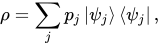
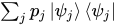
A density operator is a positive semi-definite, self-adjoint operator of trace one acting on the Hilbert space of the system. This definition can be motivated by considering a situation where some pure states (which are not necessarily orthogonal) are prepared with probability each. This is known as an ensemble of pure states. The probability of obtaining projective measurement result when using projectors is given by which makes the density operator, defined as a convenient representation for the state of this ensemble. It is easy to check that this operator is positive semi-definite, self-adjoint, and has trace one. Conversely, it follows from the spectral theorem that every operator with these properties can be written as for some states and coefficients that are non-negative and add up to one. However, this representation will not be unique, as shown by the Schrödinger–HJW theorem.


![{\displaystyle p(m)=\sum _{j}p_{j}\left\langle \psi _{j}\right|\Pi _{m}\left|\psi _{j}\right\rangle =\operatorname {tr} \left[\Pi _{m}\left(\sum _{j}p_{j}\left|\psi _{j}\right\rangle \left\langle \psi _{j}\right|\right)\right],}](https://wikimedia.org/api/rest_v1/media/math/render/svg/c302e5b2430a05203a91c6855cb186b9f782b98d)

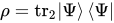
Another motivation for the definition of density operators comes from considering local measurements on entangled states. Let be a pure entangled state in the composite Hilbert space . The probability of obtaining measurement result when measuring projectors on the Hilbert space alone is given by where denotes the partial trace over the Hilbert space . This makes the operator a convenient tool to calculate the probabilities of these local measurements. It is known as the reduced density matrix of on subsystem 1. It is easy to check that this operator has all the properties of a density operator. Conversely, the Schrödinger–HJW theorem implies that all density operators can be written as for some state .


![{\displaystyle p(m)=\left\langle \Psi \right|\left(\Pi _{m}\otimes I\right)\left|\Psi \right\rangle =\operatorname {tr} \left[\Pi _{m}\left(\operatorname {tr} _{2}\left|\Psi \right\rangle \left\langle \Psi \right|\right)\right],}](https://wikimedia.org/api/rest_v1/media/math/render/svg/8df6a8788eaa095599c0bded811f8b4844a1a8eb)




A pure quantum state is a state that can not be written as a probabilistic mixture, or convex combination, of other quantum states. There are several equivalent characterizations of pure states in the language of density operators. A density operator represents a pure state if and only if:
It is important to emphasize the difference between a probabilistic mixture (i.e. an ensemble) of quantum states and the superposition of two states. If an ensemble is prepared to have half of its systems in state and the other half in , it can be described by the density matrix:


Hub AI
Density matrix AI simulator
(@Density matrix_simulator)
Density matrix
In quantum mechanics, a density matrix (or density operator) is a matrix used in calculating the probabilities of the outcomes of measurements performed on physical systems. It is a generalization of the state vectors or wavefunctions: while those can only represent pure states, density matrices can also represent mixed ensembles of states. These arise in quantum mechanics in two different situations:
Density matrices are thus crucial tools in areas of quantum mechanics that deal with mixed states (not to be confused with superposed states), such as quantum statistical mechanics, open quantum systems and quantum information.
The density matrix is a representation of a linear operator called the density operator. The density matrix is obtained from the density operator by a choice of an orthonormal basis in the underlying space. In practice, the terms density matrix and density operator are often used interchangeably.
Pick a basis with states , in a two-dimensional Hilbert space, then the density operator is represented by the matrix where the diagonal elements are real numbers that sum to one (also called populations of the two states , ). The off-diagonal elements are complex conjugates of each other (also called coherences); they are restricted in magnitude by the requirement that be a positive semi-definite operator, see below.
A density operator is a positive semi-definite, self-adjoint operator of trace one acting on the Hilbert space of the system. This definition can be motivated by considering a situation where some pure states (which are not necessarily orthogonal) are prepared with probability each. This is known as an ensemble of pure states. The probability of obtaining projective measurement result when using projectors is given by which makes the density operator, defined as a convenient representation for the state of this ensemble. It is easy to check that this operator is positive semi-definite, self-adjoint, and has trace one. Conversely, it follows from the spectral theorem that every operator with these properties can be written as for some states and coefficients that are non-negative and add up to one. However, this representation will not be unique, as shown by the Schrödinger–HJW theorem.
Another motivation for the definition of density operators comes from considering local measurements on entangled states. Let be a pure entangled state in the composite Hilbert space . The probability of obtaining measurement result when measuring projectors on the Hilbert space alone is given by where denotes the partial trace over the Hilbert space . This makes the operator a convenient tool to calculate the probabilities of these local measurements. It is known as the reduced density matrix of on subsystem 1. It is easy to check that this operator has all the properties of a density operator. Conversely, the Schrödinger–HJW theorem implies that all density operators can be written as for some state .
A pure quantum state is a state that can not be written as a probabilistic mixture, or convex combination, of other quantum states. There are several equivalent characterizations of pure states in the language of density operators. A density operator represents a pure state if and only if:
It is important to emphasize the difference between a probabilistic mixture (i.e. an ensemble) of quantum states and the superposition of two states. If an ensemble is prepared to have half of its systems in state and the other half in , it can be described by the density matrix: