



Community hub
Recent from talks
Knowledge base stats:
Talk channels stats:
Members stats:
Quantum superposition
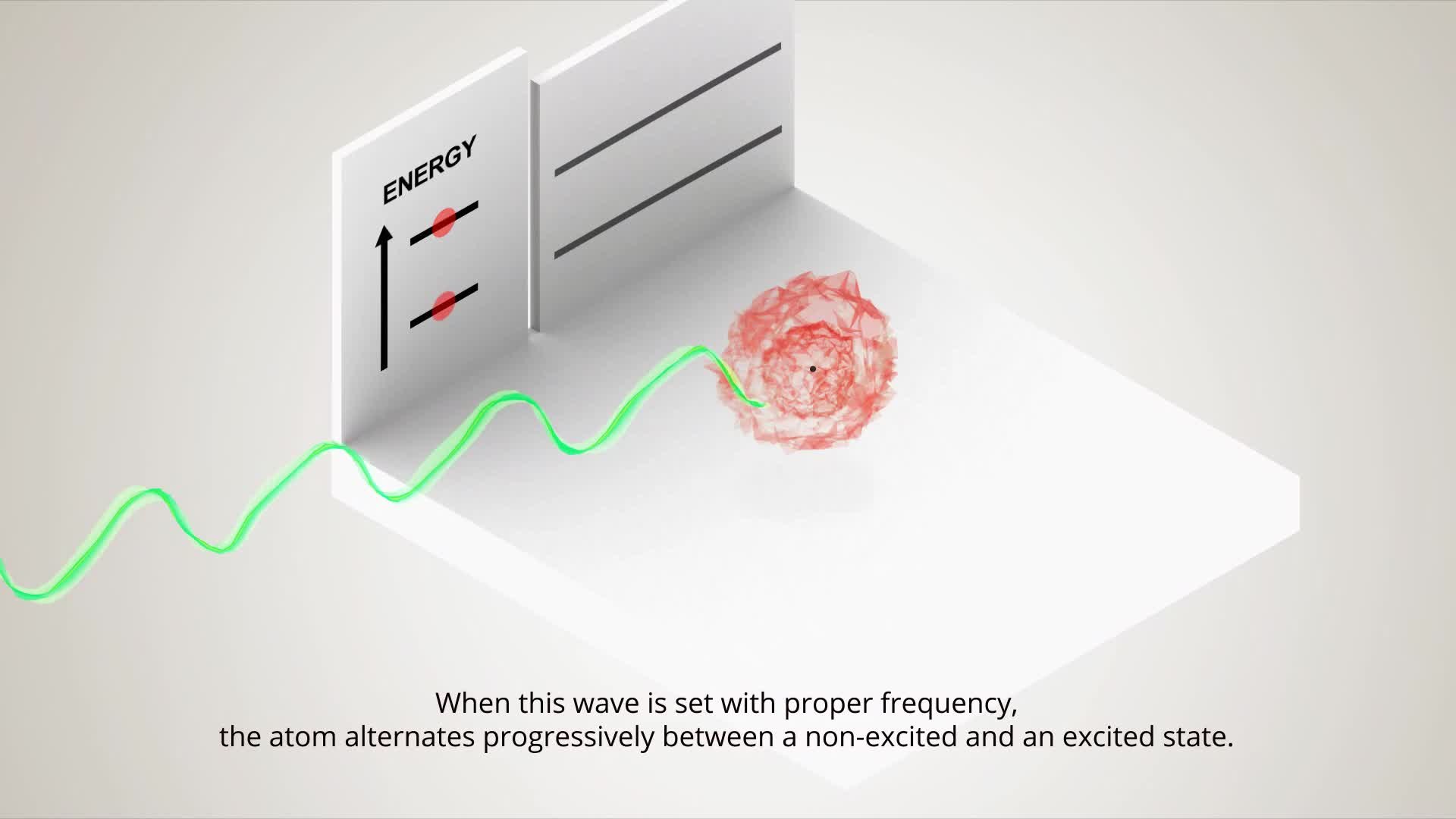
Quantum superposition is a fundamental principle of quantum mechanics that states that linear combinations of solutions to the Schrödinger equation are also solutions of the Schrödinger equation. This follows from the fact that the Schrödinger equation is a linear differential equation in time and position. More precisely, the state of a system is given by a linear combination of all the eigenfunctions of the Schrödinger equation governing that system.
An example is a qubit used in quantum information processing. A qubit state is most generally a superposition of the basis states and :


where is the quantum state of the qubit, and , denote particular solutions to the Schrödinger equation in Dirac notation weighted by the two probability amplitudes and that both are complex numbers. Here corresponds to the classical 0 bit, and to the classical 1 bit. The probabilities of measuring the system in the or state are given by and respectively (see the Born rule). Before the measurement occurs the qubit is in a superposition of both states.


The interference fringes in the double-slit experiment provide another example of the superposition principle.
The theory of quantum mechanics postulates that a wave equation completely determines the state of a quantum system at all times. Furthermore, this differential equation is restricted to be linear and homogeneous. These conditions mean that for any two solutions of the wave equation, and , a linear combination of those solutions also solve the wave equation: for arbitrary complex coefficients and . If the wave equation has more than two solutions, combinations of all such solutions are again valid solutions.


The quantum wave equation can be solved using functions of position, , or using functions of momentum, and consequently the superposition of momentum functions are also solutions: The position and momentum solutions are related by a linear transformation, a Fourier transformation. This transformation is itself a quantum superposition and every position wave function can be represented as a superposition of momentum wave functions and vice versa. These superpositions involve an infinite number of component waves.


Other transformations express a quantum solution as a superposition of eigenvectors, each corresponding to a possible result of a measurement on the quantum system. An eigenvector for a mathematical operator, , has the equation where is one possible measured quantum value for the observable . A superposition of these eigenvectors can represent any solution: The states like are called basis states.


Important mathematical operations on quantum system solutions can be performed using only the coefficients of the superposition, suppressing the details of the superposed functions. This leads to quantum systems expressed in the Dirac bra-ket notation: This approach is especially effective for systems like quantum spin with no classical coordinate analog. Such shorthand notation is very common in textbooks and papers on quantum mechanics, and superposition of basis states is a fundamental tool in quantum mechanics.

Hub AI
Quantum superposition AI simulator
(@Quantum superposition_simulator)
Quantum superposition
Quantum superposition is a fundamental principle of quantum mechanics that states that linear combinations of solutions to the Schrödinger equation are also solutions of the Schrödinger equation. This follows from the fact that the Schrödinger equation is a linear differential equation in time and position. More precisely, the state of a system is given by a linear combination of all the eigenfunctions of the Schrödinger equation governing that system.
An example is a qubit used in quantum information processing. A qubit state is most generally a superposition of the basis states and :
where is the quantum state of the qubit, and , denote particular solutions to the Schrödinger equation in Dirac notation weighted by the two probability amplitudes and that both are complex numbers. Here corresponds to the classical 0 bit, and to the classical 1 bit. The probabilities of measuring the system in the or state are given by and respectively (see the Born rule). Before the measurement occurs the qubit is in a superposition of both states.
The interference fringes in the double-slit experiment provide another example of the superposition principle.
The theory of quantum mechanics postulates that a wave equation completely determines the state of a quantum system at all times. Furthermore, this differential equation is restricted to be linear and homogeneous. These conditions mean that for any two solutions of the wave equation, and , a linear combination of those solutions also solve the wave equation: for arbitrary complex coefficients and . If the wave equation has more than two solutions, combinations of all such solutions are again valid solutions.
The quantum wave equation can be solved using functions of position, , or using functions of momentum, and consequently the superposition of momentum functions are also solutions: The position and momentum solutions are related by a linear transformation, a Fourier transformation. This transformation is itself a quantum superposition and every position wave function can be represented as a superposition of momentum wave functions and vice versa. These superpositions involve an infinite number of component waves.
Other transformations express a quantum solution as a superposition of eigenvectors, each corresponding to a possible result of a measurement on the quantum system. An eigenvector for a mathematical operator, , has the equation where is one possible measured quantum value for the observable . A superposition of these eigenvectors can represent any solution: The states like are called basis states.
Important mathematical operations on quantum system solutions can be performed using only the coefficients of the superposition, suppressing the details of the superposed functions. This leads to quantum systems expressed in the Dirac bra-ket notation: This approach is especially effective for systems like quantum spin with no classical coordinate analog. Such shorthand notation is very common in textbooks and papers on quantum mechanics, and superposition of basis states is a fundamental tool in quantum mechanics.