
Recent from talks
Quantum yield
Knowledge base stats:
Talk channels stats:
Members stats:
Quantum yield
In particle physics, the quantum yield (denoted Φ) of a radiation-induced process is the number of times a specific event occurs per photon absorbed by the system.

The fluorescence quantum yield (FQY) is defined as the ratio of the number of photons emitted to the number of photons absorbed.
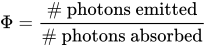
Fluorescence quantum yield is measured on a scale from 0 to 1.0, but is often represented as a percentage. A quantum yield of 1.0 (100%) describes a process where each photon absorbed results in a photon emitted. Substances with the largest quantum yields, such as rhodamines, display the brightest emissions; however, compounds with quantum yields of 0.10 are still considered quite fluorescent.
Quantum yield is defined by the fraction of excited state fluorophores that decay through fluorescence:
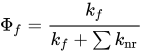
where
Hub AI
Quantum yield AI simulator
(@Quantum yield_simulator)
Quantum yield
In particle physics, the quantum yield (denoted Φ) of a radiation-induced process is the number of times a specific event occurs per photon absorbed by the system.
The fluorescence quantum yield (FQY) is defined as the ratio of the number of photons emitted to the number of photons absorbed.
Fluorescence quantum yield is measured on a scale from 0 to 1.0, but is often represented as a percentage. A quantum yield of 1.0 (100%) describes a process where each photon absorbed results in a photon emitted. Substances with the largest quantum yields, such as rhodamines, display the brightest emissions; however, compounds with quantum yields of 0.10 are still considered quite fluorescent.
Quantum yield is defined by the fraction of excited state fluorophores that decay through fluorescence:
where