Hubbry Logo
Latin Quarter, ParisLatin Quarter, ParisMain
Open search
Latin Quarter, Paris
Community hub
Latin Quarter, Paris
logo
8 pages, 0 posts
0 subscribers
Be the first to start a discussion here.
Latin Quarter, Paris
from Wikipedia

The Latin Quarter of Paris (French: Quartier latin, IPA: [kaʁtje latɛ̃]) is a district in Paris on the left bank of the Seine, around the Sorbonne. Located in the city's 5th and the 6th arrondissements, it is known for its concentration of universities.

Key Information

Although there has been some exodus, new schools have appeared, and the Latin Quarter continues to be the heart of the universities, and Grandes écoles that succeeded the University of Paris, including the Sorbonne University, Panthéon-Sorbonne University, Paris Cité University, PSL University, Panthéon-Assas University, and Sciences Po.

The area gets its name from the Latin language, which was widely spoken in and around the University during the Middle Ages, after the twelfth century philosopher Pierre Abélard and his students took up residence there.[1]

Academic institutions

[edit]

Universities, libraries, and other academic institutions in the Latin Quarter of Paris include:

The Latin Quarter is also home to the largest university libraries in Paris, such as the Sainte-Geneviève Library, the Sorbonne Library, the Sainte-Barbe Library, the Assas Law Library and the Cujas Law Library.

University administrative buildings are also located in the district, such as the presidency of Sorbonne University in the Cordeliers Convent or the headquarters of Paris Cité University in the former École de Médecine. Grandes écoles such as the École polytechnique have relocated in recent times to more spacious settings, notably in Paris-Saclay.

Other academic institutions in the Latin Quarter include:

Community life

[edit]
View of Rue de la Huchette (October 2003)
[edit]

The Latin Quarter is the setting of Puccini's tragic opera, La Bohème.

See also

[edit]

References

[edit]

Further reading

[edit]
[edit]
Revisions and contributorsEdit on WikipediaRead on Wikipedia
from Grokipedia
The Latin Quarter (French: Quartier Latin) is a historic neighborhood principally comprising the 5th arrondissement of Paris on the Left Bank of the Seine, distinguished by its medieval origins as a scholarly enclave where Latin served as the common tongue among students and clergy until the modern era. Centered on the Montagne Sainte-Geneviève hill, it encompasses the University of Paris's Sorbonne foundation, established around 1257, which fostered an enduring tradition of intellectual inquiry and debate that attracted thinkers from across Europe. This district's significance extends from its Roman antecedents as part of Lutetia—evidenced by archaeological remnants like the Cluny Baths—to its role as a crucible for philosophical and artistic ferment, housing institutions such as the Collège de France and the Panthéon, the latter repurposed from a church to honor secular luminaries including Voltaire and Rousseau. The area's narrow, winding streets teem with bookstores, cafés, and markets, sustaining a vibrant pedestrian culture that blends academic pursuits with tourism, though it has witnessed pivotal unrest, notably the 1968 student-led protests originating from university occupations. Today, it remains a nexus for higher education, with multiple grandes écoles and faculties drawing international scholars amid preserved Haussmann-era architecture and green spaces like the Jardin du Luxembourg.

History

Ancient Origins and Medieval Foundations

The region encompassing the modern Latin Quarter, situated on Paris's Left Bank along the Seine, traces its ancient origins to the Gallo-Roman settlement of Lutetia, established following the Roman conquest of the Parisii tribe in 52 BC under Julius Caesar. The city's core expanded southward from the Île de la Cité into the Left Bank, particularly around the Montagne Sainte-Geneviève—known to Romans as Mons Lucotitius—where a grid-planned urban layout emerged with monumental structures rising in tiers up the hill. Key remnants include the Arènes de Lutèce, a 1st-century AD amphitheater in the 5th arrondissement capable of seating up to 15,000 spectators for gladiatorial contests and venationes, and traces of Roman baths and an aqueduct uncovered in the area. After the decline of Roman Lutetia in the 5th century amid barbarian invasions, the Left Bank area depopulated but retained significance as a Christian pilgrimage site, with the construction of the Basilica of Sainte Geneviève around 512 AD honoring the patron saint credited with protecting Paris from the Huns in 451 AD. Medieval foundations solidified in the 12th century as the Montagne Sainte-Geneviève became a nexus for scholastic activity, drawing teachers and students to informal schools that coalesced into the University of Paris, formally chartered by King Philip II in 1200 and papal bull-recognized in 1215. The College of Sorbonne, founded in 1257 by theologian Robert de Sorbon—chaplain to King Louis IX—as a residence for 16 poor theology students, anchored the quarter's intellectual role, emphasizing dialectical reasoning and canon law amid growing enrollment of thousands of clerics who conducted discourse in Latin, whence the district's enduring name. This scholarly migration from the overcrowded Right Bank fostered a dense network of colleges and hostels by the 13th century, establishing the area as Europe's premier center for theological and philosophical study under the mendicant orders' influence.

Early Modern Period and Enlightenment Hub

In the early modern period, the Latin Quarter emerged as a vital center for humanist scholarship with the establishment of the Collège de France in 1530 by King Francis I, who appointed royal lecturers to teach Hebrew, Greek, and mathematics, thereby challenging the University of Paris's scholastic dominance and promoting Renaissance learning through public, tuition-free instruction. Located amid the quarter's colleges, this institution drew scholars seeking innovative approaches to ancient texts and sciences, fostering an environment of intellectual exchange distinct from the Sorbonne's theological focus. The Sorbonne, as the theological faculty of the University of Paris, played a central role in 16th-century religious controversies, serving as a bastion of Catholic orthodoxy amid Protestant challenges and engaging in Europe-wide debates on doctrine and reform. By the 17th century, under Cardinal Richelieu's patronage—himself a former student and principal from 1622—the institution underwent major reconstruction starting in 1626, including new buildings designed by Jacques Lemercier, a library completed in 1647, and a chapel finished in 1653 that housed Richelieu's tomb, solidifying the quarter's architectural and academic prominence. During the 18th-century Enlightenment, the Latin Quarter intensified as a hub for philosophical and scientific , with the expanding to professorships by across and sciences, and initiating a new building in that reflected growing emphasis on empirical . The Sorbonne adapted to Enlightenment influences through faculty involvement in scientific advancements and reformist thought, as seen in figures like Jacques Turgot, while Jansenist disputes highlighted tensions between tradition and emerging rationalism. The quarter's dense network of institutions, public lectures, and scholarly residences facilitated causal links to broader intellectual movements, enabling the dissemination of ideas that critiqued absolutism and advanced secular learning.

19th Century Transformations and Haussmannization

In the mid-19th century, Paris experienced profound urban renewal under Napoleon III, who appointed Baron Georges-Eugène Haussmann as prefect of the Seine department in 1853 to oversee transformations addressing overcrowding, epidemics like cholera, and the risk of revolutionary barricades following the 1848 uprisings. Haussmann's program, spanning 1853 to 1870, involved demolishing over 20,000 buildings across the city, constructing 137 kilometers of new sewers, and building aqueducts to supply fresh water, fundamentally improving sanitation and circulation. In the Latin Quarter, these efforts targeted insalubrious medieval alleys in the 5th arrondissement, where dense housing exacerbated disease transmission, but the area's academic institutions limited the scope of demolitions compared to commercial zones. A flagship project in the Latin Quarter was the Boulevard Saint-Michel, decreed for construction in 1855 and progressively opened through the 1860s, stretching 1.3 kilometers from the Seine near Place Saint-Michel southward to the Jardin du Luxembourg. This north-south artery replaced narrow, congested streets like parts of Rue Saint-André-des-Arts extensions, displacing working-class residents and enabling faster troop movement while enhancing pedestrian and vehicular flow amid the student population. Accompanying features included the Fontaine Saint-Michel, completed between 1858 and 1860 at the boulevard's northern terminus, symbolizing the era's emphasis on monumental public spaces. These interventions boosted property values through speculation but contributed to social stratification, as lower-income tenants were pushed to peripheral developments like those in Belleville. Extensions of the Boulevard Saint-Germain also pierced the quarter's eastern edges in the 1860s, demolishing streets such as Rue du Jardinet to create a east-west link, further integrating the area into Haussmann's grid of wide avenues averaging 24 meters across. While medieval fabric persisted in pockets protected by institutions like the Sorbonne—preserving winding lanes for scholarly continuity—these changes eradicated many overcrowded insulae, reducing mortality from poor hygiene; Paris's overall death rate from waterborne diseases dropped markedly post-aqueduct completions in 1865. Haussmann's approach, financed by loans totaling 2.5 billion francs, prioritized causal fixes like ventilation and drainage over preservation, yielding a healthier but less egalitarian urban core.

20th Century Developments and Post-War Changes

The Latin Quarter maintained its status as Paris's premier intellectual enclave in the early 20th century, driven by the Sorbonne's advancements in linguistics, history via the École des Annales, and nuclear physics, which yielded Nobel Prizes for Pierre and Marie Curie in 1903 and 1911, Jean Perrin in 1926, and Irène and Frédéric Joliot-Curie in 1935. Student numbers at the University of Paris doubled between 1921 and 1926 before tripling in the 1930s to 14,500, with 41% female enrollment and 30% foreign students reflecting growing internationalization. Interwar expansion included the 1925 establishment of the Cité Internationale Universitaire nearby, accommodating the influx post-World War I. World War II brought severe hardships under Nazi occupation and Vichy policies, with Jewish professors like Marc Bloch and Louis Halbwachs persecuted or executed, and the university disrupted. Yet the quarter emerged as an early resistance hub, where students daubed "V" for victory symbols and initiated protests, culminating in the first organized anti-occupation demonstration on November 11, 1940—Armistice Day—starting amid Latin Quarter gatherings before marching to the Champs-Élysées. Postwar reconstruction during the Trente Glorieuses amplified demographic pressures, with University of Paris enrollment surging to 61,400 by 1965 amid broader democratization of higher education. This overcrowding contributed to the May 1968 uprisings, originating at Nanterre but rapidly centering on the Sorbonne's occupation—repeated multiple times—and transforming the Latin Quarter into a battleground of over 600 barricades, uprooted paving stones, torched vehicles, and clashes that left streets in ruins. The unrest, evacuated by June 16, spurred the Faure Law later that year, dissolving the monolithic University of Paris into 13 independent entities to decentralize and modernize amid infrastructure strains. While broader Parisian urbanization introduced highways and high-rises elsewhere, the quarter's historic core largely evaded such alterations, preserving medieval street patterns but shifting socially toward intensified tourism by century's end.

Geography and Urban Layout

Boundaries and Topography

The Latin Quarter, or Quartier Latin, constitutes an informally delimited historic district centered in the 5th arrondissement of Paris, on the Left Bank (Rive Gauche) of the Seine River, with marginal extension into the northern portion of the 6th arrondissement. Lacking rigid administrative boundaries, it conventionally encompasses the core area around the Sorbonne, spanning roughly from Place Saint-Michel and the Boulevard Saint-Germain westward to the vicinity of Place Jussieu eastward, the Seine quays northward, and Boulevard de Port-Royal southward. This extent aligns with the administrative sub-quarters of the Sorbonne and Saint-Geneviève within the 5th arrondissement, reflecting its evolution from medieval scholastic hubs rather than modern cadastral lines. Topographically, the district occupies the Montagne Sainte-Geneviève, a prominent hill that rises to a maximum elevation of 61 meters above sea level near the Panthéon, significantly higher than the surrounding Seine floodplain averaging 25–30 meters. This elevation, the highest natural feature on the Left Bank within central Paris, results from sedimentary deposits in the Paris Basin and imparts a sloped terrain that shapes the neighborhood's street grid, with ascending thoroughfares like Rue de la Montagne Sainte-Geneviève facilitating drainage toward the river while enabling panoramic vistas from hilltop sites. The hill's contours, overlaid by Roman-era quarrying and medieval construction, contribute to a compact urban fabric of stepped alleys and elevated plateaus, contrasting the flatter expanses of adjacent arrondissements.

Architectural Features and Landmarks

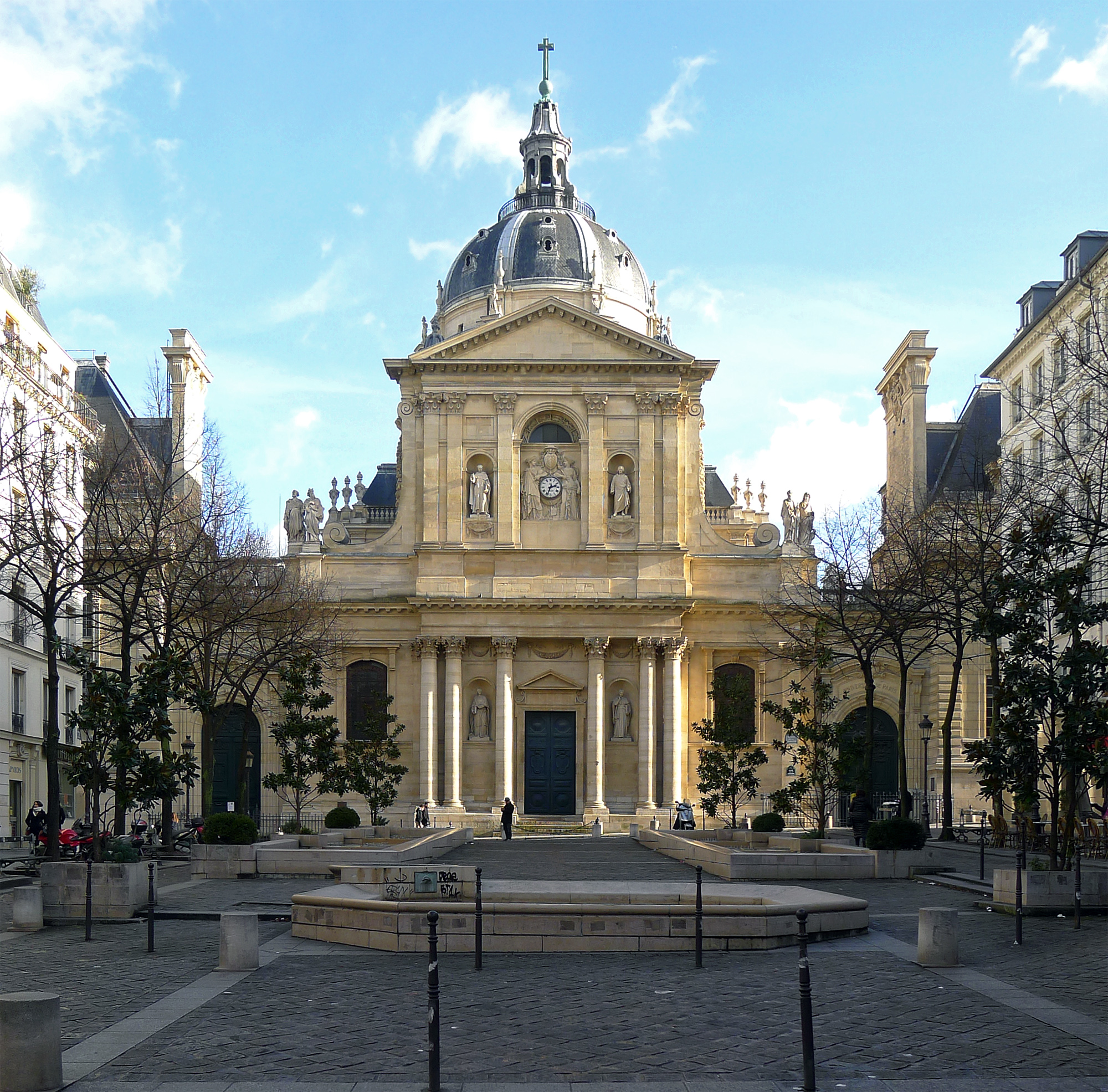
The Panthéon stands as a prominent neoclassical landmark in the Latin Quarter, constructed from 1758 to 1790 by architect Jacques-Germain Soufflot on the orders of King Louis XV as a church dedicated to Sainte-Geneviève. Its design features a Greek-cross plan with a massive portico of Corinthian columns drawing from Roman precedents, paired with an interior dome echoing Gothic structural techniques for height and light. The building's facade and proportions aimed to combine classical lightness with medieval grandeur, though construction delays arose from engineering challenges in supporting the expansive dome. The Sorbonne University buildings form another core architectural ensemble, with the chapel erected between 1635 and 1642 under architect Jacques Lemercier in a restrained classical style featuring a dome and ornate interior decorations. The primary facade and courtyard, rebuilt in 1884–1889 by Henri-Paul Nénot, adopt an eclectic neo-Renaissance aesthetic blending French Renaissance elements with classical symmetry to evoke the site's scholarly heritage. These structures, centered around Place de la Sorbonne, incorporate courtyards, amphitheaters, and galleries that have hosted academic functions since the 13th century, preserving a mix of historical layers despite 19th-century renovations. Medieval Gothic elements persist in landmarks like the Église Saint-Séverin, where construction began around 1230 and culminated in a 15th-century flamboyant Gothic nave with a distinctive twisted pillar and ribbed vaulting. Roman remnants, such as the Arènes de Lutèce—a 1st-to-2nd-century amphitheater with elliptical arena and seating for up to 15,000—highlight the quarter's ancient foundations amid later urban overlays. The Collège de France, established in 1530 with buildings from the 16th century onward, adds Renaissance influences through its lecture halls and facades designed for intellectual discourse. Overall, the Latin Quarter's architecture contrasts narrow, irregular medieval streets with monumental landmarks, largely spared from Baron Haussmann's 19th-century boulevards, fostering a dense, layered built environment tied to its role as an enduring academic hub.

Demographics and Social Composition

Historical Population Shifts

The Latin Quarter, encompassing much of Paris's 5th arrondissement, originated as a sparsely populated area during the Roman era, with settlement concentrated around the forum on the Montagne Sainte-Geneviève; permanent residents were limited to a few thousand, primarily administrators and merchants, supplemented by transient scholars following the establishment of early schools in the 12th century. The founding of the University of Paris around 1150 drew international students and faculty, swelling the transient population to several thousand by the 13th century, though census-equivalent records indicate resident numbers remained under 10,000, dominated by clergy, artisans, and low-wage laborers in narrow medieval streets. By the , industrialization and rural migration drove across central , with the 5th arrondissement's reaching extremes to subdivided and insalubrious tenements workers alongside students; estimates place the arrondissement's at approximately 100,000 by mid-century, reflecting Paris's overall expansion from 546,856 in 1801 to over 1 million by 1846, fueled by exceeding increase. Baron Haussmann's renovations from 1853 to 1870 demolished overcrowded blocks, widened boulevards like the , and displaced tens of thousands, reducing intra-muros densities by 20% in affected central zones through eviction and relocation to suburbs, though 5th arrondissement figures pre-1900 censuses are sparse. Post-World War II censuses reveal a marked decline in permanent , from 96,031 in 1962 to 83,721 in 1968, continuing to 67,668 by 1975 and 58,841 by 1999, driven by , conversions, and outflows amid Paris's broader depopulation from a 1921 peak of 2.9 million citywide. This trend persisted into the 21st century, with the population falling to 55,925 by 2022—a 32% drop since 1968—despite university expansions boosting transient students to over 50,000 annually; causal factors include high property costs converting residences to tourist accommodations and commercial uses, alongside a shift toward smaller, higher-income households. Density stabilized at around 22,000 inhabitants per km², but the resident profile evolved from mixed working-class and bohemian to predominantly affluent professionals and academics, with reduced presence.

Current Resident Profile and Diversity

The 5th arrondissement of Paris, encompassing much of the Latin Quarter, had a resident population of 55,925 as of 2022. This figure reflects a slight decline from 58,850 in 2017, consistent with trends in central Paris districts amid high housing costs and urban pressures. The demographic profile is markedly youthful, driven by the concentration of universities such as the Sorbonne. Approximately 31.3% of residents were aged 15-29 in 2022, with only 10.6% under 15 and 10.3% over 75, yielding a skewed age distribution toward young adults. Women comprise 54.3% of the population, a ratio influenced by higher female enrollment in higher education and longevity among retirees. A substantial portion of the 15-29 cohort consists of students, as the arrondissement hosts around 48,400 higher education enrollees, many of whom reside locally in student housing or rentals. Socio-professionally, the area features an overrepresentation of educated professionals: 33.8% of those aged 15 and over are in managerial or higher intellectual occupations, far exceeding national averages and reflecting the academic ecosystem. Retirees account for 19.4%, often former academics or professionals drawn to the cultural amenities. Household incomes are elevated, with 2020 data indicating 25,782 tax households supporting 47,668 individuals, though precise medians are not disaggregated; the professional skew suggests above-average earnings tied to knowledge-sector employment. Diversity stems primarily from the influx of international students and academics rather than broad-scale immigration patterns seen in Paris's outer arrondissements. Around 20% of Paris residents overall are foreign-born, with the 5th arrondissement aligning closely due to its appeal to educated migrants from and . French law prohibits ethnic tracking in censuses, but the resident base remains predominantly of European origin, augmented by transient populations from over 100 nationalities via university exchanges; non-EU immigrants constitute about 9-10% based on birthplace data, lower than in migrant-heavy suburbs. This yields a cosmopolitan yet profile, with limited low-skilled diversity compared to Paris's 20.3% immigrant share citywide.

Academic Institutions and Intellectual Legacy

Key Universities and Educational Centers

The Latin Quarter serves as a historic hub for higher education in , hosting institutions that trace their origins to the of . Sorbonne University, founded in 1257 under royal as a theological within the nascent , occupies a central position in the 5th arrondissement, embodying the district's enduring academic legacy. Its campus, including the iconic Sorbonne building, features neoclassical architecture and facilities like the amphitheater, supporting disciplines from humanities to sciences across approximately 55,000 students as of recent mergers in 2018. Panthéon-Assas University (Paris II), established in 1971 following the division of the University of Paris, specializes in law, economics, and political science, with its primary campus at Place du Panthéon in the Latin Quarter. This institution, often ranked among France's top for legal studies, enrolls over 18,000 students and maintains multiple sites in the 5th and 6th arrondissements, including the Panthéon Centre. Paris Cité University, formed in 2020 from prior entities like Paris Descartes and Paris Diderot, operates key facilities in the Latin Quarter, such as the Odéon head office and the École de Médecine for health sciences, integrating research in medicine and humanities. The École Normale Supérieure (ENS Paris), a selective grande école founded in 1794 and part of PSL University, is situated at 45 rue d'Ulm in the heart of the Latin Quarter, training elite researchers and civil servants through a rigorous curriculum emphasizing sciences and letters.) With around 2,300 students, it fosters interdisciplinary work in a compact campus environment. Adjacent, the Collège de France, established in 1530 as a royal lectureship series, functions as a advanced research institute without degree programs, hosting chairs in humanities, sciences, and philosophy at 11 Place Marcelin Berthelot, drawing global scholars for public lectures.

Libraries, Museums, and Scholarly Resources


The Bibliothèque Sainte-Geneviève, situated at 10 Place du Panthéon, stands as a cornerstone scholarly library in the Latin Quarter, with roots tracing to the 6th-century Abbey of Sainte-Geneviève founded under Clovis I. Its current structure, designed by Henri Labrouste and completed in 1851, features an innovative iron-framed reading room spanning 60 meters in length, exemplifying early industrial architecture adapted for cultural preservation. The collection encompasses over 3 million volumes, including 1.1 million monographs, 12,800 periodicals, and significant holdings of manuscripts, printed books from the 15th century onward, and specialized materials in philosophy, history, and sciences, serving researchers from affiliated universities like Sorbonne Nouvelle. Access is granted to the public afternoons and to enrolled scholars, facilitating ongoing academic inquiry amid the quarter's intellectual heritage.
The Musée de Cluny, officially the Musée national du Moyen Âge at 28 Rue du Sommerard, functions as a key repository for medieval artifacts, integrating scholarly resources within its exhibition spaces. Established in 1843 via the donation of antiquarian Alexandre Du Sommerard's collection to the state, it opened to the public in 1846 and was fully inaugurated in 1866. Housed in the 15th-century Gothic Hôtel de Cluny—built around 1485 for the abbots of Cluny—and the adjacent 3rd-century Roman Thermes de Cluny, the museum curates over 23,000 objects spanning Gallo-Roman antiquity to the Renaissance, including the six famous Lady and the Unicorn tapestries (circa 1500), medieval ivories, enamels, and architectural fragments. These holdings support specialized research through on-site consultations, publications, and digital archives, drawing historians focused on European Middle Ages material culture. Additional scholarly venues include the university-affiliated libraries of institutions like the Sorbonne, which maintain restricted-access collections integral to advanced study, though public engagement centers on sites like Sainte-Geneviève. The Musée Curie at 11 Rue Pierre et Marie Curie preserves laboratory equipment and documents from radioactivity research conducted there from 1914 to 1927, offering niche resources for science history scholars. These facilities collectively underpin the Latin Quarter's role as a hub for empirical historical and cultural analysis, with collections verified through institutional inventories and peer-reviewed catalogs rather than anecdotal accounts.

Cultural and Bohemian Life

Literary and Artistic Traditions

The Latin Quarter's literary traditions originated in the medieval period, when the establishment of the Sorbonne around 1257 by Robert de Sorbon transformed the area into a hub for theological and scholastic discourse conducted primarily in Latin, earning the district its name. Scholars and students from across Europe gathered here, fostering an intellectual environment that persisted through the Renaissance, exemplified by the founding of the Collège de France in 1530 by King Francis I to promote humanistic studies beyond traditional theology. This academic concentration drew early modern thinkers, with the quarter's narrow streets and emerging bookshops along the Boulevard Saint-Michel serving as venues for debate and manuscript exchange. By the Enlightenment, the area solidified its role as a cradle for philosophical and literary innovation, housing figures whose works reshaped European thought; Voltaire and Jean-Jacques Rousseau, both interred in the Panthéon after their deaths in 1778, engaged with the quarter's vibrant salons and libraries. The 19th century saw Romantic and realist authors like Victor Hugo (d. 1885) and Émile Zola (d. 1902), also honored in the Panthéon, draw inspiration from the district's evolving urban fabric, including its student cafes and proximity to printing presses that facilitated the dissemination of their novels and essays. These traditions were supported by institutions like the Sainte-Geneviève Library, which by the early 19th century held extensive collections aiding literary research. In the 20th century, the Latin Quarter became a nexus for modernist expatriate literature, anchored by Sylvia Beach's Shakespeare and Company bookstore at 12 Rue de l'Odéon, opened in 1919 as an English-language lending library and publisher. The shop hosted the "Lost Generation," including Ernest Hemingway, James Joyce—who serialized parts of Ulysses there before its 1922 publication under Beach's imprint—and Gertrude Stein, whose gatherings advanced experimental prose amid the quarter's affordable rents and intellectual ferment. Post-World War II, the area's cafes and universities sustained existentialist currents, with Jean-Paul Sartre and Simone de Beauvoir frequenting nearby venues that extended the district's bohemian legacy, though visual arts traditions remained secondary to literary pursuits compared to neighboring Montparnasse. This enduring milieu, rooted in empirical scholarly migration and causal links to institutional patronage, underscores the quarter's causal role in privileging textual innovation over transient artistic fads.

Cafes, Bookstores, and Intellectual Gatherings

Le Procope, established in 1686 by Sicilian entrepreneur Francesco Procopio dei Coltelli at 13 Rue de l'Ancienne Comédie in the Latin Quarter, holds the distinction of being Paris's oldest continuously operating café and served as a pivotal venue for Enlightenment intellectuals. Frequented by figures such as Voltaire, who reportedly drank 40 to 50 cups of coffee daily there, Jean-Jacques Rousseau, Denis Diderot, and later Napoleon Bonaparte—who allegedly left his hat as payment for a meal—the café facilitated debates on philosophy, politics, and science amid its introduction of coffee, ice cream, and theatrical ambiance near the Comédie-Française. Bookstores in the Latin Quarter have long anchored literary and communities, with Shakespeare and emerging as a . Founded in 1951 by American at 37 Rue de la Bûcherie—initially named Le Mistral and renamed in 1964 to honor Shakespeare's quatercentenary—the shop revived the spirit of Sylvia Beach's original 1919 establishment, which had closed in 1941 after publishing James Joyce's Ulysses in 1922. dubbed it a "socialist utopia masquerading as a bookstore," offering aspiring writers lodging in exchange for work and fostering gatherings of authors like Allen Ginsberg, Anaïs Nin, and Henry Miller, alongside a lending library that has issued over 30,000 free books since 1951. These venues historically converged to host intellectual gatherings, from 18th-century salons at Le Procope where philosophes challenged absolutism through rational discourse to 20th-century literary circles at Shakespeare and Company that sustained modernist experimentation amid post-war displacement. Student-dominated cafés near the Sorbonne, such as those along Rue de la Huchette, continue to draw philosophers and debaters, though commercialization has diluted some authenticity, with chains supplanting independent spots frequented by mid-century existentialists like Jean-Paul Sartre during overlapping Left Bank activities. The district's narrow streets still host informal assemblies, including poetry readings and book launches, underscoring its role as Paris's enduring nexus for unscripted intellectual exchange despite tourism pressures.

Economy, Commerce, and Tourism

Traditional and Modern Commercial Activities

The Latin Quarter has long been a hub for and , rooted in its medieval academic heritage when streets like Rue Saint-Jacques housed scribes, parchment sellers, and early printers following the introduction of the in around 1470. By the 19th century, the area concentrated numerous bookstores and publishers, supplying the Sorbonne's scholars; today, establishments like Shakespeare and Company, revived in 1951 by George Whitman, continue this as independent English-language bookshops opposite Notre-Dame, hosting literary and lending libraries. In 2016, the Librairie Avant-Garde introduced on-demand printing technology, allowing customers to produce books from digital catalogs in minutes, blending historical craft with modern efficiency. Traditional markets and persist, exemplified by Rue Mouffetard, a medieval transformed into an open-air market by the , where vendors sell fresh , cheeses, and daily, preserving a pre-tourism Parisian neighborhood feel amid the 5th arrondissement's residential core. Historic cafes, such as those dating to the , facilitated through and ; Le Procope, established in 1686 near the Sorbonne, served as an early hub for writers and revolutionaries, evolving into a site for literary transactions and cultural exchange. Modern commercial activities increasingly revolve around tourism and diversified retail, with over 100 bookstores remaining in the vicinity as of recent counts, though many now cater to international visitors alongside students. Boutiques and fashion shops along Boulevard Saint-Germain offer avant-garde and unique apparel, drawing from the area's bohemian legacy while competing with chains; meanwhile, the influx of 47.5 million tourists to the Île-de-France region in 2023 amplifies commerce in souvenirs, ethnic eateries, and fusion restaurants, shifting Rue Mouffetard's traditional stalls toward tourist-oriented crepes and global cuisines like Lebanese and Japanese. This evolution reflects causal pressures from rising visitor numbers, which boosted Paris's tourism-dependent economy but strained local authenticity, as evidenced by the persistence of family-run patisseries amid chain encroachments.

Tourism Dynamics and Economic Impacts

The Latin Quarter functions as a primary tourist magnet in Paris, appealing to visitors through its confluence of intellectual history, medieval architecture, and lively ambulatory commerce. Annually, millions of tourists traverse the district, concentrating around sites like the Panthéon, Sorbonne courtyards, and the Seine-adjacent boulevards, where guided group tours and self-directed wanderers dominate daytime flows. Peak dynamics emerge in summer months and during events such as the Fête de la Musique on June 21, amplifying pedestrian density along Rue de la Huchette and Boulevard Saint-Michel, while off-peak periods see a blend of academic footfall and residual evening patronage at brasseries. This pattern fosters a diurnal rhythm: intense influxes from 10 a.m. to 7 p.m., tapering to student-centric activity thereafter, with short-term rentals exacerbating overnight stays amid broader Parisian trends of 48.7 million regional visitors in 2024. Tourism underpins the district's economic vitality, serving as the dominant revenue stream in Paris's central arrondissements, including the 5th where the Latin Quarter resides. Local enterprises—encompassing over 1,000 restaurants, hotels, and boutiques—derive substantial income from visitor spending on meals, souvenirs, and accommodations, aligning with Paris's tourism sector generating €71 billion in 2024 revenue and supporting 2.93 million national jobs. In the Latin Quarter, this manifests in heightened commercial turnover, particularly from falafel vendors to upscale eateries catering to international palates, bolstering tax revenues like the city's €83 million in 2018 séjour fees, scaled upward in recent recovery years. Yet, these dynamics impose costs, including inflationary pressures on real estate and commerce. Residential and shop rents in the Latin Quarter rose 6-10% in recent years, attributable to hotel reconversions of historic structures and short-term rental proliferation, which prioritize tourist yields over long-term local tenancy. Such shifts have displaced artisanal trades like bookstores and bakeries in favor of chain outlets and luxury lodging, as seen in a 2025 transformation of a Quartier Latin edifice into a high-end hotel, underscoring causal trade-offs where tourism-driven appreciation erodes affordability for residents and independent operators.

Notable Events, Protests, and Controversies

Major Student Movements and Riots

The Latin Quarter's role as a hub for higher education, particularly the historic Sorbonne, has positioned it as a recurring epicenter of student dissent against institutional and societal constraints. The most prominent episode unfolded during the events of May 1968, triggered initially by protests at Nanterre University over dormitory visitation rules and university overcrowding, which spilled into the Latin Quarter as students demanded broader reforms including curriculum modernization and opposition to the Vietnam War. On May 3, 1968, approximately 600 students gathered at the Sorbonne courtyard in solidarity with Nanterre protesters, leading to police entry and mass arrests that ignited street clashes in the surrounding streets. Escalation peaked on the night of May 10–11, known as the "Night of the Barricades," when thousands of students and sympathizers constructed over 60 barricades using uprooted paving stones, overturned cars, and debris across key Latin Quarter avenues like Boulevard Saint-Michel. Police deployed tear gas and charged with batons, resulting in fierce hand-to-hand combat that injured around 400 protesters and officers combined, with over 400 arrests and widespread property damage including burned vehicles. The Sorbonne was occupied by students until late May, serving as a command center for distributing leaflets and coordinating actions that blended Marxist, anarchist, and Situationist influences critiquing consumer capitalism and authoritarian governance. These riots extended beyond students, drawing workers into sympathy strikes that paralyzed France with 10 million participants by mid-May, though the Latin Quarter remained the symbolic heart of the upheaval due to its density of faculties and cafes turned into strategy hubs. The government's response included conceding university reopenings and wage hikes via the Grenelle Accords, but the events exposed deep generational fractures, with de Gaulle's regime nearly toppling before elections restored stability. While romanticized by some as liberating, critics noted the protests' chaotic demands—epitomized in graffiti like "Be realistic, demand the impossible"—lacked coherent policy alternatives, contributing to short-term social disruption without structural overhauls beyond cultural liberalization. Earlier student agitations in the Quarter, such as anti-colonial demonstrations during the Algerian War in the early 1960s, involved clashes but did not match 1968's scale or international resonance.

Gentrification, Overcrowding, and Urban Decay

The Latin Quarter has undergone significant gentrification since the early 2000s, driven by rising property values and an influx of upscale commercial developments that have displaced traditional residents and small independent businesses. Average property prices in the 5th arrondissement reached €11,700 per square meter by 2025, reflecting annual increases tied to the area's desirability among affluent buyers and investors. This process has accelerated the replacement of historic bookstores and intellectual hubs with fashion chains and fast-food outlets, eroding the neighborhood's bohemian character as noted by local observers. Students, once the quarter's defining demographic, face displacement due to escalating rents, with Paris-wide apartment rents climbing 3.3% from 2024 to 2025 amid limited affordable housing stock. Overcrowding has intensified from a surge in tourism, with Paris hosting 48.7 million visitors in 2024—a 2% rise from pre-pandemic levels—concentrating foot traffic in the Latin Quarter's narrow streets and landmarks. This has transformed areas like Rue de la Huchette into congested zones dominated by souvenir shops and international eateries, reducing livability for locals and exacerbating infrastructure strain during peak seasons. Short-term rentals and post-Olympics demand have further prioritized transient visitors over permanent residents, contributing to a perceived "Disneyfication" where authentic cultural spaces yield to tourist-oriented commerce. While physical urban decay remains minimal compared to Paris's outer suburbs, the socioeconomic shifts have fostered a form of cultural decay, with the erosion of low-cost intellectual venues and student enclaves undermining the quarter's historic role as a hub for radical thought and affordable living. Gentrification's economic benefits, such as revitalized commerce, coexist with criticisms from residents who argue it homogenizes the area, prioritizing high-end tourism over diverse, working-class vitality. Empirical data on displacement shows low-income groups, including young academics, relocating to peripheral banlieues, as central Paris rents outpace wage growth.

Immigration, Crime, and Social Tensions

The , home to the Latin Quarter, recorded 9,603 immigrants among its of approximately 56,841 as of 2021, representing about 16.9% of the total—a figure lower than the city-wide of around 18-20% foreign-born individuals. This demographic includes students and professionals from as well as African and Asian origins, reflecting the area's academic and tourist draw rather than large-scale settlement of low-skilled migrants seen in outer arrondissements or suburbs. French , which avoid ethnic breakdowns due to republican principles, indicate stable migration rates near zero for the arrondissement, with birth and death rates at 8.0‰ and 6.0‰ respectively in recent years. Crime in the Latin Quarter primarily involves property offenses such as pickpocketing and vandalism, driven by high tourist volumes, with Paris's overall crime index rated at 58.09 (moderate) and property crime concerns at 67.84 (high) per user-reported data up to 2025. Violent crimes, including assaults, score lower at around 56.73 city-wide, and the 5th arrondissement ranks among safer central districts for violent theft per 2022 police data, though central tourist zones like the 1st and 8th report higher violence rates from escalating thefts (up to 26.6% of acts). France's national intentional homicide rate stood at 1.14 per 100,000 in 2021, with urban increases noted but no arrondissement-specific spikes for the 5th in official SSMSI reports; petty crimes rose across Paris, with a 73.14% perceived increase in offenses by 2025. Such incidents often occur near metro stations and crowded sites, sometimes involving organized groups including unaccompanied minors from migrant backgrounds, though attribution remains anecdotal absent ethnic data collection. Social tensions in the Latin Quarter linked to immigration are less pronounced than in Paris's banlieues, where riots in 2005 and recurring unrest stem from integration failures and poverty among second-generation North African and sub-Saharan youth. The area's historic role as a hub for Third World students and activists since the mid-20th century has fostered intellectual exchanges rather than overt conflict, though recent pressures include overcrowding from migrant street vendors and occasional clashes over public space. Broader Parisian issues, such as rising anti-immigrant sentiment amid national debates on asylum and jihadist risks post-2015 attacks, indirectly affect perceptions, with central districts like the 5th experiencing vigilantism fears less than peripheral zones. Official data show no major immigrant-driven riots in the arrondissement, but tourism-related strains exacerbate local frustrations with unregulated vending by recent arrivals from Africa and Eastern Europe.

Literature, Film, and Media Depictions

The Latin Quarter has been depicted in as a cradle of bohemian and ferment, particularly during the 19th and early 20th centuries. Murger's Scènes de la vie de bohème (1845–1849), a series of vignettes published in Le Corsaire and later compiled as a novel, portrays the Quarter as a haven for struggling artists, poets, and musicians enduring poverty amid lively street scenes and communal garrets, drawing from Murger's own observations of student life around the Sorbonne. This romanticized view influenced subsequent works, emphasizing the area's narrow alleys, cheap bistros, and tolerant atmosphere for nonconformists. , residing at 74 Rue du Cardinal Lemoine from 1922 to 1923, evoked similar themes in his posthumously published memoir A Moveable Feast (1964), recounting the Quarter's modest apartments, market stalls on Rue Mouffetard, and cafes that facilitated encounters among expatriate writers during the "Lost Generation" era. In the 20th century, depictions shifted toward existential and postwar introspection, with and frequenting the Quarter's establishments like Café de Flore—though on the adjacent Saint-Germain-des-Prés border—while her novel (1943) reflects the philosophical debates and romantic entanglements in Left Bank intellectual circles, including the Latin Quarter's student milieu. , living nearby on Rue de l'Odéon from 1920, incorporated the area's multicultural vibrancy into Ulysses (1922), with characters wandering its streets amid multilingual chatter from students and immigrants. These portrayals underscore the Quarter's role as a microcosm of Parisian cultural dynamism, though later works like Paula McLain's The Paris Wife (2011) highlight its material hardships alongside inspiration. Film representations often capture the Latin Quarter's picturesque chaos and historic allure. Woody Allen's Midnight in Paris (2011) features nocturnal strolls through its cobblestone lanes and cafes, using the area to evoke 1920s artistic nostalgia, with scenes filmed near Place de la Contrescarpe to blend contemporary tourism with period fantasy. Stanley Donen's Charade (1963) showcases pursuit sequences amid its winding streets and fountains, portraying the Quarter as a quintessentially romantic yet labyrinthine Parisian backdrop for thriller elements. Jacques Rivette's Paris Belongs to Us (1961) sets avant-garde theater intrigue in the district's bohemian apartments and rehearsal spaces, reflecting mid-century anxieties about cultural decline. In media, the Latin Quarter appears in anthology formats like Paris, je t'aime (2006), where the "14th Arrondissement" segment—filmed in adjacent areas but evoking the broader Left Bank—depicts transient encounters in student-filled cafes, reinforcing its image as a youthful, transient hub. Documentaries and news coverage frequently highlight its in like the protests, with of on symbolizing radicalism, though popular media tends to sanitize this for touristic appeal, focusing on timeless charm over contemporary tensions.

Musical and Artistic Influences

The Latin Quarter's bohemian milieu in the mid-19th century, characterized by impoverished artists, writers, and musicians sharing cramped garrets amid intellectual fervor, profoundly shaped cultural representations of creative struggle. Henri Murger's Scènes de la vie de bohème (1845–1849), drawn from his experiences in the quarter's attics and cafés, depicted this world of youthful aspiration and hardship, establishing the archetype of the starving artist in garrets near the Sorbonne. This narrative directly inspired Giacomo Puccini's opera La Bohème (premiered 1896), set in a Latin Quarter attic on Christmas Eve 1830, where protagonists Rodolfo and Marcello embody the quarter's romanticized poverty and passion, influencing subsequent operas, ballets, and films on bohemian themes. In visual arts, the quarter's proximity to institutions like the Sorbonne fostered a hub for avant-garde experimentation, contributing to early 20th-century movements. Surrealism emerged partly from gatherings in the Latin Quarter around 1919, when André Breton and Philippe Soupault collaborated on automatic writing amid the area's cafés, laying groundwork for Breton's 1924 manifesto that revolutionized artistic expression by prioritizing subconscious imagery over rationalism. The district's student-artist demographic also drew expatriates, embedding its chaotic vitality into paintings and sketches romanticizing urban intellectual life, though primary hubs like Montparnasse later overshadowed it for figures such as Picasso. Musically, the Latin Quarter solidified as a jazz epicenter post-World War II, when wartime restrictions shifted venues from southward, offering American expatriates racial tolerance absent in the U.S. , a 16th-century cellar converted to a jazz club in 1946, hosted pioneers like —whose 1949 residency popularized New Orleans-style jazz in France—and later Lionel Hampton and Count Basie, embedding the quarter's improvisational energy into Europe's jazz canon. This legacy persists in ongoing performances, while cabarets like Paradis Latin (opened 1889, claiming Napoleonic roots) blended chanson and revue traditions, evoking the quarter's festive undercurrents in compositions by figures influenced by its nightlife.

References

Add your contribution
Related Hubs
User Avatar
No comments yet.