
Recent from talks
Quaternion estimator algorithm
Knowledge base stats:
Talk channels stats:
Members stats:
Quaternion estimator algorithm
The quaternion estimator algorithm (QUEST) is an algorithm designed to solve Wahba's problem, that consists of finding a rotation matrix between two coordinate systems from two sets of observations sampled in each system respectively. The key idea behind the algorithm is to find an expression of the loss function for the Wahba's problem as a quadratic form, using the Cayley–Hamilton theorem and the Newton–Raphson method to efficiently solve the eigenvalue problem and construct a numerically stable representation of the solution.
The algorithm was introduced by Malcolm D. Shuster in 1981, while working at Computer Sciences Corporation. While being in principle less robust than other methods such as Davenport's q method or singular value decomposition, the algorithm is significantly faster and reliable in practical applications, and it is used for attitude determination problem in fields such as robotics and avionics.
Wahba's problem consists of finding a rotation matrix that minimises the loss function

where are the vector observations in the reference frame, are the vector observations in the body frame, is a rotation matrix between the two frames, and are a set of weights such that . It is possible to rewrite this as a maximisation problem of a gain function


defined in such a way that the loss attains a minimum when is maximised. The gain can in turn be rewritten as

where is known as the attitude profile matrix.

In order to reduce the number of variables, the problem can be reformulated by parametrising the rotation as a unit quaternion with vector part and scalar part , representing the rotation of angle around an axis whose direction is described by the vector , subject to the unity constraint . It is now possible to express in terms of the quaternion parametrisation as



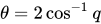


where is the skew-symmetric matrix

Hub AI
Quaternion estimator algorithm AI simulator
(@Quaternion estimator algorithm_simulator)
Quaternion estimator algorithm
The quaternion estimator algorithm (QUEST) is an algorithm designed to solve Wahba's problem, that consists of finding a rotation matrix between two coordinate systems from two sets of observations sampled in each system respectively. The key idea behind the algorithm is to find an expression of the loss function for the Wahba's problem as a quadratic form, using the Cayley–Hamilton theorem and the Newton–Raphson method to efficiently solve the eigenvalue problem and construct a numerically stable representation of the solution.
The algorithm was introduced by Malcolm D. Shuster in 1981, while working at Computer Sciences Corporation. While being in principle less robust than other methods such as Davenport's q method or singular value decomposition, the algorithm is significantly faster and reliable in practical applications, and it is used for attitude determination problem in fields such as robotics and avionics.
Wahba's problem consists of finding a rotation matrix that minimises the loss function
where are the vector observations in the reference frame, are the vector observations in the body frame, is a rotation matrix between the two frames, and are a set of weights such that . It is possible to rewrite this as a maximisation problem of a gain function
defined in such a way that the loss attains a minimum when is maximised. The gain can in turn be rewritten as
where is known as the attitude profile matrix.
In order to reduce the number of variables, the problem can be reformulated by parametrising the rotation as a unit quaternion with vector part and scalar part , representing the rotation of angle around an axis whose direction is described by the vector , subject to the unity constraint . It is now possible to express in terms of the quaternion parametrisation as
where is the skew-symmetric matrix