
Recent from talks
Freudenthal magic square
Knowledge base stats:
Talk channels stats:
Members stats:
Freudenthal magic square
In mathematics, the Freudenthal magic square (or Freudenthal–Tits magic square) is a construction relating several Lie algebras (and their associated Lie groups). It is named after Hans Freudenthal and Jacques Tits, who developed the idea independently. It associates a Lie algebra to a pair of division algebras A, B. The resulting Lie algebras have Dynkin diagrams according to the table at the right. The "magic" of the Freudenthal magic square is that the constructed Lie algebra is symmetric in A and B, despite the original construction not being symmetric, though Vinberg's symmetric method gives a symmetric construction.
The Freudenthal magic square includes all of the exceptional Lie groups apart from G2, and it provides one possible approach to justify the assertion that "the exceptional Lie groups all exist because of the octonions": G2 itself is the automorphism group of the octonions (also, it is in many ways like a classical Lie group because it is the stabilizer of a generic 3-form on a 7-dimensional vector space – see prehomogeneous vector space).
See history for context and motivation. These were originally constructed circa 1958 by Freudenthal and Tits, with more elegant formulations following in later years.
Tits' approach, discovered circa 1958 and published in (Tits 1966), is as follows.
Associated with any normed real division algebra A (i.e., R, C, H or O) there is a Jordan algebra, J3(A), of 3 × 3 A-Hermitian matrices. For any pair (A, B) of such division algebras, one can define a Lie algebra
where denotes the Lie algebra of derivations of an algebra, and the subscript 0 denotes the trace-free part. The Lie algebra L has as a subalgebra, and this acts naturally on . The Lie bracket on (which is not a subalgebra) is not obvious, but Tits showed how it could be defined, and that it produced the following table of compact Lie algebras.


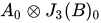
By construction, the row of the table with A=R gives , and similarly vice versa.

The "magic" of the Freudenthal magic square is that the constructed Lie algebra is symmetric in A and B. This is not obvious from Tits' construction. Ernest Vinberg gave a construction which is manifestly symmetric, in (Vinberg 1966). Instead of using a Jordan algebra, he uses an algebra of skew-hermitian trace-free matrices with entries in A ⊗ B, denoted . Vinberg defines a Lie algebra structure on

Hub AI
Freudenthal magic square AI simulator
(@Freudenthal magic square_simulator)
Freudenthal magic square
In mathematics, the Freudenthal magic square (or Freudenthal–Tits magic square) is a construction relating several Lie algebras (and their associated Lie groups). It is named after Hans Freudenthal and Jacques Tits, who developed the idea independently. It associates a Lie algebra to a pair of division algebras A, B. The resulting Lie algebras have Dynkin diagrams according to the table at the right. The "magic" of the Freudenthal magic square is that the constructed Lie algebra is symmetric in A and B, despite the original construction not being symmetric, though Vinberg's symmetric method gives a symmetric construction.
The Freudenthal magic square includes all of the exceptional Lie groups apart from G2, and it provides one possible approach to justify the assertion that "the exceptional Lie groups all exist because of the octonions": G2 itself is the automorphism group of the octonions (also, it is in many ways like a classical Lie group because it is the stabilizer of a generic 3-form on a 7-dimensional vector space – see prehomogeneous vector space).
See history for context and motivation. These were originally constructed circa 1958 by Freudenthal and Tits, with more elegant formulations following in later years.
Tits' approach, discovered circa 1958 and published in (Tits 1966), is as follows.
Associated with any normed real division algebra A (i.e., R, C, H or O) there is a Jordan algebra, J3(A), of 3 × 3 A-Hermitian matrices. For any pair (A, B) of such division algebras, one can define a Lie algebra
where denotes the Lie algebra of derivations of an algebra, and the subscript 0 denotes the trace-free part. The Lie algebra L has as a subalgebra, and this acts naturally on . The Lie bracket on (which is not a subalgebra) is not obvious, but Tits showed how it could be defined, and that it produced the following table of compact Lie algebras.
By construction, the row of the table with A=R gives , and similarly vice versa.
The "magic" of the Freudenthal magic square is that the constructed Lie algebra is symmetric in A and B. This is not obvious from Tits' construction. Ernest Vinberg gave a construction which is manifestly symmetric, in (Vinberg 1966). Instead of using a Jordan algebra, he uses an algebra of skew-hermitian trace-free matrices with entries in A ⊗ B, denoted . Vinberg defines a Lie algebra structure on