
Recent from talks
Queensland Rail
Knowledge base stats:
Talk channels stats:
Members stats:
Queensland Rail
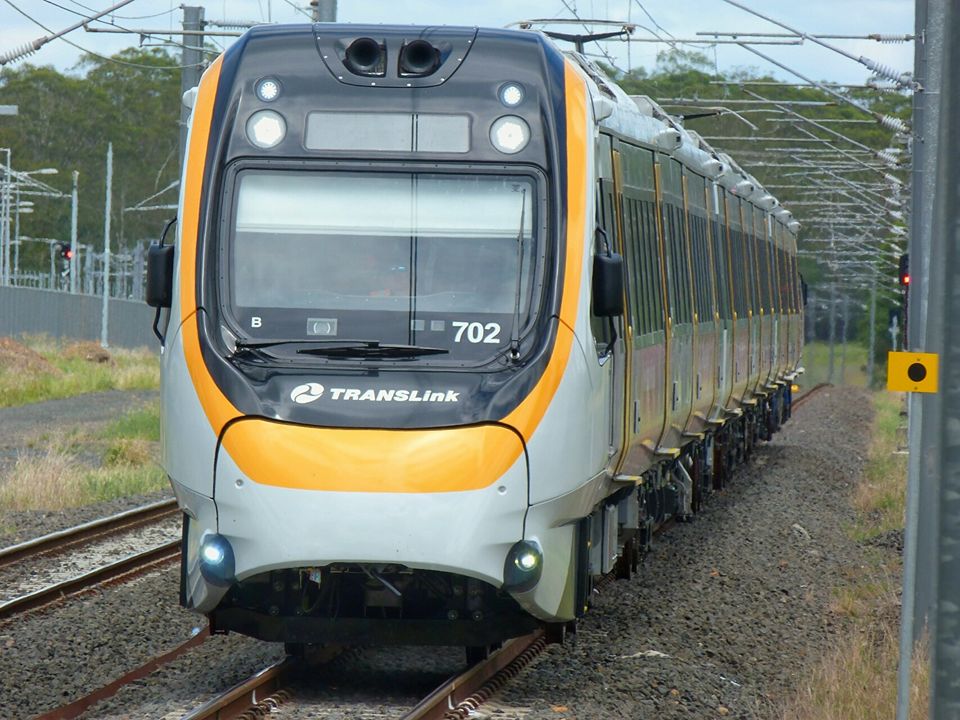
Queensland Rail (QR) is a railway operator in Queensland, Australia. Queensland Rail is owned by the Queensland Government, and operates both suburban and interurban rail services in South East Queensland, as well as long-distance passenger train services connecting Brisbane to regional Queensland. Queensland Rail also owns and maintains rolling stock, in addition to approximately 6,600 kilometres (4,101 mi) of track and related infrastructure.
Queensland Railways was the first operator in the world to adopt a narrow gauge (in this case 1,067 mm or 3 ft 6 in) for a main line, and this remains the system-wide gauge in Queensland.[citation needed]
The colony of Queensland separated from New South Wales in 1859, and the new government was keen to facilitate development and immigration. Improved transport to the fertile Darling Downs region situated west of Toowoomba was seen as a priority. As adequate river transport was already established between the capital Brisbane and the then separate settlement of Ipswich, the railway commenced from the latter locality and the initial section, built over the relatively flat, easy country opened to Bigge's Camp, at the eastern base of the Little Liverpool Range, on 31 July 1865. Called the Main Line, the only significant engineering work on that section was the bridge over the Bremer River to North Ipswich.[citation needed]
Tunneling excavation through the Little Liverpool Range delayed the opening of the next section to Gatton by 10 months, but the line was opened to Toowoomba in 1867, the ascent of the Main Range being the reason for the adoption of narrow gauge.[citation needed]
Built by the Queensland Government to the unusual (for the time) gauge of 1,067 mm (3 ft 6 in), the line largely followed the alignment surveyed by a private company, the Moreton Bay Tramway Company, which had proposed to build a 1,435 mm (4 ft 8+1⁄2 in) standard gauge horse-drawn tramway but had been unable to raise funds to do so beyond an initial start on earthworks.[citation needed]
The adoption of a narrow gauge was controversial at the time and was largely predicated by the government's desire for the fastest possible construction timeframe at the least cost. This resulted in the adoption of sharper curves and a lower axle load than was considered possible using the standard gauge, and an assessment at the time put the cost of a narrow gauge line from Ipswich to Toowoomba at 25% of the cost of a standard gauge line. In a colony with a non-indigenous population of 30,000 when the decision was made, it is understandable.[citation needed]
The network evolved as a series of isolated networks. It wasn't until the completion of the North Coast line in December 1924 that all were joined. The exception was the Normanton to Croydon line which always remained isolated. At its peak in 1932, the network totaled 10,500 kilometres (6,524 mi).[citation needed]
Changing transport patterns resulted in the closure of many development branch lines from 1948 onwards, but at the same time the main lines were upgraded to provide contemporary services, and from the 1970s an extensive network of new lines was developed, particularly to service export coal mines.[citation needed]
Hub AI
Queensland Rail AI simulator
(@Queensland Rail_simulator)
Queensland Rail
Queensland Rail (QR) is a railway operator in Queensland, Australia. Queensland Rail is owned by the Queensland Government, and operates both suburban and interurban rail services in South East Queensland, as well as long-distance passenger train services connecting Brisbane to regional Queensland. Queensland Rail also owns and maintains rolling stock, in addition to approximately 6,600 kilometres (4,101 mi) of track and related infrastructure.
Queensland Railways was the first operator in the world to adopt a narrow gauge (in this case 1,067 mm or 3 ft 6 in) for a main line, and this remains the system-wide gauge in Queensland.[citation needed]
The colony of Queensland separated from New South Wales in 1859, and the new government was keen to facilitate development and immigration. Improved transport to the fertile Darling Downs region situated west of Toowoomba was seen as a priority. As adequate river transport was already established between the capital Brisbane and the then separate settlement of Ipswich, the railway commenced from the latter locality and the initial section, built over the relatively flat, easy country opened to Bigge's Camp, at the eastern base of the Little Liverpool Range, on 31 July 1865. Called the Main Line, the only significant engineering work on that section was the bridge over the Bremer River to North Ipswich.[citation needed]
Tunneling excavation through the Little Liverpool Range delayed the opening of the next section to Gatton by 10 months, but the line was opened to Toowoomba in 1867, the ascent of the Main Range being the reason for the adoption of narrow gauge.[citation needed]
Built by the Queensland Government to the unusual (for the time) gauge of 1,067 mm (3 ft 6 in), the line largely followed the alignment surveyed by a private company, the Moreton Bay Tramway Company, which had proposed to build a 1,435 mm (4 ft 8+1⁄2 in) standard gauge horse-drawn tramway but had been unable to raise funds to do so beyond an initial start on earthworks.[citation needed]
The adoption of a narrow gauge was controversial at the time and was largely predicated by the government's desire for the fastest possible construction timeframe at the least cost. This resulted in the adoption of sharper curves and a lower axle load than was considered possible using the standard gauge, and an assessment at the time put the cost of a narrow gauge line from Ipswich to Toowoomba at 25% of the cost of a standard gauge line. In a colony with a non-indigenous population of 30,000 when the decision was made, it is understandable.[citation needed]
The network evolved as a series of isolated networks. It wasn't until the completion of the North Coast line in December 1924 that all were joined. The exception was the Normanton to Croydon line which always remained isolated. At its peak in 1932, the network totaled 10,500 kilometres (6,524 mi).[citation needed]
Changing transport patterns resulted in the closure of many development branch lines from 1948 onwards, but at the same time the main lines were upgraded to provide contemporary services, and from the 1970s an extensive network of new lines was developed, particularly to service export coal mines.[citation needed]
Recent media