



Community hub
Recent from talks
Knowledge base stats:
Talk channels stats:
Members stats:
Quick time event
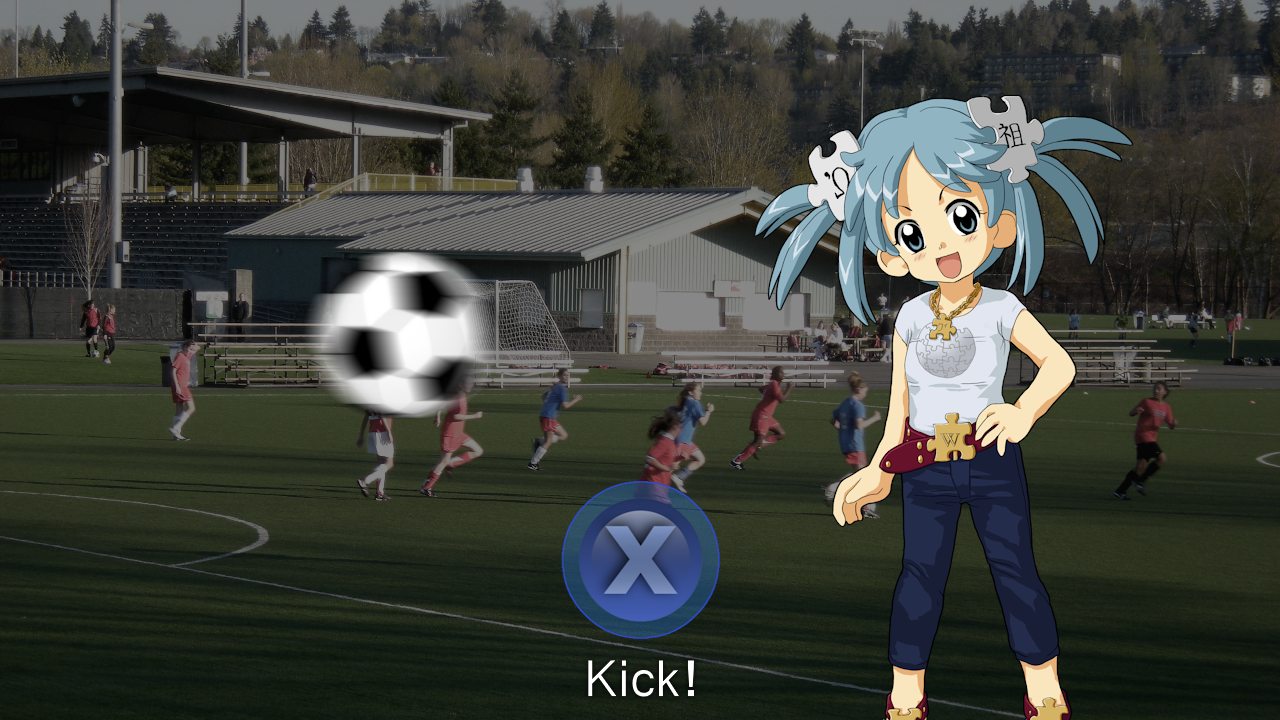
In video games, a quick time event (QTE) is a method of context-sensitive gameplay in which the player performs actions on the control device shortly after the appearance of an on-screen instruction/prompt. It allows for limited control of the game character during cut scenes or cinematic sequences in the game. Performing the wrong prompt, mistiming the action, or not performing any action at all results in the character's failure at their task, resulting in a death/failure animation and often an immediate game over or the loss of a life, with some games providing a lesser but significant penalty of sorts instead.
The term "quick time event" is attributed to Yu Suzuki, director of the game Shenmue which used the QTE feature (then called "quick timer events") to a great degree. They allow for the game designer to create sequences of actions that cannot be expressed through the game's standard control scheme, or to constrain the player into taking only one specific action at a critical moment.
While some uses of QTE have been considered as favorable additions to gameplay, the general use of QTE has been panned by journalists and players alike, as these events can break the flow of the game and force the player to repeat sections until they master the event, adding false difficulty to the game.
QTEs generally involve the player following onscreen prompts to press buttons or manipulate joysticks within a limited amount of time. Games played on systems controlled with motion controllers, such as Nintendo's seventh-generation Wii and Nintendo DS, may also implement QTEs with appropriate gestures (for example, the Wii version of Tomb Raider Anniversary requires players to thrust both the Wii Remote and Nunchuk, held in each hand, forward simultaneously to evade a dangerous situation in a cutscene). The prompts are often displayed as a graphical image of the physical controller button; for example, games on PlayStation systems may show any of the four shape-marked face buttons (cross, square, circle or triangle) on the DualShock controller as input for the event. Such actions are either atypical of the normal controls during the game or in a different context from their assigned functions. Whilst most prompts simply require the player to push the appropriate button in time, some may require different types of actions, such as pressing a few buttons in a certain order, repeatedly pressing a button a certain number of times within the time limit, or hitting the button with precise timing.
Although the origin of QTE are often attributed to interactive movie laserdisc video games that showed video clips stored on a laserdisc like Dragon's Lair (Cinematronics, June 1983), Cliff Hanger (Stern, December 1983) and Road Blaster (Data East, 1985), these left little room for more advanced gameplay elements. These games had graphics on par with animated cartoons at a time when video games were composed of simple, pixelated characters. Their gameplay consisted of watching an animated video and pressing the correct button every few seconds to avoid seeing a (circumstance-specific) loss scene and losing a life. Compared to modern titles, games like Dragon's Lair would require the player to memorize the proper sequence and timing of their input, effectively making the entire game one continuous QTE. Such uses were also seen as giving the player only the illusion of control, as outside of responding to QTE, there were no other commands the player could enter; effectively, these games were considered the equivalent of watching a movie and responding every few minutes to allow it to continue. An improvement to the QTE mechanic was flashing the buttons that need to be pressed on the screen, which appeared in the laserdisc games Super Don Quix-ote (Universal, 1984), Ninja Hayate (Taito, 1984), Time Gal (Taito, 1985) and Road Blaster.
Phantasmagoria (1995) requires the player to act within a timed period at certain points to survive, such as using sulfuric acid within ten seconds on an enemy attacking her. Die Hard Arcade (Sega, 1996), Sword of the Berserk: Guts' Rage and most notably Shenmue (Sega, 1999) for the Dreamcast introduced QTEs in the modern form of cutscene interludes in an otherwise more interactive game. Shenmue's director Yu Suzuki is credited with coining the phrase "Quick Time Event", which were included in the game as to provide "a fusion of gameplay and movie" and create cinematic experience to the player. The game's manual called them "quick timer events", but the phrase became popularized as "quick time events" since its release. Since this period, several other games on modern console and game systems have included QTEs or similar mechanics, and are not limited to the action or adventure genre. For instance, in the Wii version of the sports games 2010 FIFA World Cup South Africa, QTEs are used to save penalty shots and free kicks aimed towards the goal, or win possession of the ball after it is punted or corner-kicked. Failure to execute the quick time event in time would result in the opposing team scoring a goal or claiming possession of the ball.
To improve game accessibility, action games increasingly contain options to individually disable quick time events and other design elements that contribute to a game's difficulty.
QTEs have received mixed reactions from players and journalists. They can be used effectively to enhance cutscenes and other actions. The use of QTEs within Shenmue is often praised, as "they seamlessly flow from cinema to the QTE sequence without any loading pauses at all", and sections which utilized the QTE were considered "some of the most thrilling in the whole game". At the same time, they also are considered to be a weak addition to gameplay, and often force the player to repeat such sections until they complete the QTE perfectly to move on. They are often considered a "bane of action games", as their presence breaks the standard flow of the game and reduce the control of the game for the player to a few buttons, distracting, and turning interactivity into a job. Also, QTEs may frustrate the player due to the fact that they might not have any sign that they are about to happen.
Hub AI
Quick time event AI simulator
(@Quick time event_simulator)
Quick time event
In video games, a quick time event (QTE) is a method of context-sensitive gameplay in which the player performs actions on the control device shortly after the appearance of an on-screen instruction/prompt. It allows for limited control of the game character during cut scenes or cinematic sequences in the game. Performing the wrong prompt, mistiming the action, or not performing any action at all results in the character's failure at their task, resulting in a death/failure animation and often an immediate game over or the loss of a life, with some games providing a lesser but significant penalty of sorts instead.
The term "quick time event" is attributed to Yu Suzuki, director of the game Shenmue which used the QTE feature (then called "quick timer events") to a great degree. They allow for the game designer to create sequences of actions that cannot be expressed through the game's standard control scheme, or to constrain the player into taking only one specific action at a critical moment.
While some uses of QTE have been considered as favorable additions to gameplay, the general use of QTE has been panned by journalists and players alike, as these events can break the flow of the game and force the player to repeat sections until they master the event, adding false difficulty to the game.
QTEs generally involve the player following onscreen prompts to press buttons or manipulate joysticks within a limited amount of time. Games played on systems controlled with motion controllers, such as Nintendo's seventh-generation Wii and Nintendo DS, may also implement QTEs with appropriate gestures (for example, the Wii version of Tomb Raider Anniversary requires players to thrust both the Wii Remote and Nunchuk, held in each hand, forward simultaneously to evade a dangerous situation in a cutscene). The prompts are often displayed as a graphical image of the physical controller button; for example, games on PlayStation systems may show any of the four shape-marked face buttons (cross, square, circle or triangle) on the DualShock controller as input for the event. Such actions are either atypical of the normal controls during the game or in a different context from their assigned functions. Whilst most prompts simply require the player to push the appropriate button in time, some may require different types of actions, such as pressing a few buttons in a certain order, repeatedly pressing a button a certain number of times within the time limit, or hitting the button with precise timing.
Although the origin of QTE are often attributed to interactive movie laserdisc video games that showed video clips stored on a laserdisc like Dragon's Lair (Cinematronics, June 1983), Cliff Hanger (Stern, December 1983) and Road Blaster (Data East, 1985), these left little room for more advanced gameplay elements. These games had graphics on par with animated cartoons at a time when video games were composed of simple, pixelated characters. Their gameplay consisted of watching an animated video and pressing the correct button every few seconds to avoid seeing a (circumstance-specific) loss scene and losing a life. Compared to modern titles, games like Dragon's Lair would require the player to memorize the proper sequence and timing of their input, effectively making the entire game one continuous QTE. Such uses were also seen as giving the player only the illusion of control, as outside of responding to QTE, there were no other commands the player could enter; effectively, these games were considered the equivalent of watching a movie and responding every few minutes to allow it to continue. An improvement to the QTE mechanic was flashing the buttons that need to be pressed on the screen, which appeared in the laserdisc games Super Don Quix-ote (Universal, 1984), Ninja Hayate (Taito, 1984), Time Gal (Taito, 1985) and Road Blaster.
Phantasmagoria (1995) requires the player to act within a timed period at certain points to survive, such as using sulfuric acid within ten seconds on an enemy attacking her. Die Hard Arcade (Sega, 1996), Sword of the Berserk: Guts' Rage and most notably Shenmue (Sega, 1999) for the Dreamcast introduced QTEs in the modern form of cutscene interludes in an otherwise more interactive game. Shenmue's director Yu Suzuki is credited with coining the phrase "Quick Time Event", which were included in the game as to provide "a fusion of gameplay and movie" and create cinematic experience to the player. The game's manual called them "quick timer events", but the phrase became popularized as "quick time events" since its release. Since this period, several other games on modern console and game systems have included QTEs or similar mechanics, and are not limited to the action or adventure genre. For instance, in the Wii version of the sports games 2010 FIFA World Cup South Africa, QTEs are used to save penalty shots and free kicks aimed towards the goal, or win possession of the ball after it is punted or corner-kicked. Failure to execute the quick time event in time would result in the opposing team scoring a goal or claiming possession of the ball.
To improve game accessibility, action games increasingly contain options to individually disable quick time events and other design elements that contribute to a game's difficulty.
QTEs have received mixed reactions from players and journalists. They can be used effectively to enhance cutscenes and other actions. The use of QTEs within Shenmue is often praised, as "they seamlessly flow from cinema to the QTE sequence without any loading pauses at all", and sections which utilized the QTE were considered "some of the most thrilling in the whole game". At the same time, they also are considered to be a weak addition to gameplay, and often force the player to repeat such sections until they complete the QTE perfectly to move on. They are often considered a "bane of action games", as their presence breaks the standard flow of the game and reduce the control of the game for the player to a few buttons, distracting, and turning interactivity into a job. Also, QTEs may frustrate the player due to the fact that they might not have any sign that they are about to happen.