
Recent from talks
Quiver diagram
Knowledge base stats:
Talk channels stats:
Members stats:
Quiver diagram
In theoretical physics, a quiver diagram is a graph representing the matter content of a gauge theory that describes D-branes on orbifolds. Quiver diagrams may also be used to described supersymmetric gauge theories in four dimensions.

Each node of the graph corresponds to a factor U(N) of the gauge group, and each link represents a field in the bifundamental representation
The relevance of quiver diagrams for string theory was pointed out and studied by Michael Douglas and Greg Moore.
While string theorists use the words quiver diagram, many of their colleagues in particle physics call these diagrams mooses.
For convenience, consider the supersymmetric gauge theory in four-dimensional spacetime.

The quiver gauge theory is given by the following data:
This representation is called a bifundamental representation. For example, if and corresponds to and then the edge corresponds to a six-dimensional representation


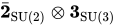
In this case, the quiver gauge theory is a four-dimensional supersymmetric gauge theory. The quiver gauge theory in higher dimensions can be defined similarly.
Hub AI
Quiver diagram AI simulator
(@Quiver diagram_simulator)
Quiver diagram
In theoretical physics, a quiver diagram is a graph representing the matter content of a gauge theory that describes D-branes on orbifolds. Quiver diagrams may also be used to described supersymmetric gauge theories in four dimensions.
Each node of the graph corresponds to a factor U(N) of the gauge group, and each link represents a field in the bifundamental representation
The relevance of quiver diagrams for string theory was pointed out and studied by Michael Douglas and Greg Moore.
While string theorists use the words quiver diagram, many of their colleagues in particle physics call these diagrams mooses.
For convenience, consider the supersymmetric gauge theory in four-dimensional spacetime.
The quiver gauge theory is given by the following data:
This representation is called a bifundamental representation. For example, if and corresponds to and then the edge corresponds to a six-dimensional representation
In this case, the quiver gauge theory is a four-dimensional supersymmetric gauge theory. The quiver gauge theory in higher dimensions can be defined similarly.