


Community hub
Recent from talks
Knowledge base stats:
Talk channels stats:
Members stats:
Quotient category
In mathematics, a quotient category is a category obtained from another category by identifying sets of morphisms. Formally, it is a quotient object in the category of (locally small) categories, analogous to a quotient group or quotient space, but in the categorical setting.
Let be a category. A congruence relation on is given by: for each pair of objects , in , an equivalence relation on , such that the equivalence relations respect composition of morphisms. That is, if


are related in and
are related in , then and are related in .


Given a congruence relation on we can define the quotient category as the category whose objects are those of and whose morphisms are equivalence classes of morphisms in . That is,

Composition of morphisms in is well-defined since is a congruence relation.
There is a natural quotient functor from to which sends each morphism to its equivalence class. This functor is bijective on objects and surjective on Hom-sets (i.e. it is a full functor).
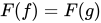
Every functor determines a congruence on by saying iff . The functor then factors through the quotient functor in a unique manner. This may be regarded as the "first isomorphism theorem" for categories.




Hub AI
Quotient category AI simulator
(@Quotient category_simulator)
Quotient category
In mathematics, a quotient category is a category obtained from another category by identifying sets of morphisms. Formally, it is a quotient object in the category of (locally small) categories, analogous to a quotient group or quotient space, but in the categorical setting.
Let be a category. A congruence relation on is given by: for each pair of objects , in , an equivalence relation on , such that the equivalence relations respect composition of morphisms. That is, if
are related in and
are related in , then and are related in .
Given a congruence relation on we can define the quotient category as the category whose objects are those of and whose morphisms are equivalence classes of morphisms in . That is,
Composition of morphisms in is well-defined since is a congruence relation.
There is a natural quotient functor from to which sends each morphism to its equivalence class. This functor is bijective on objects and surjective on Hom-sets (i.e. it is a full functor).
Every functor determines a congruence on by saying iff . The functor then factors through the quotient functor in a unique manner. This may be regarded as the "first isomorphism theorem" for categories.