


Community hub
Recent from talks
Contribute something to knowledge base
Content stats: 0 posts, 0 articles, 1 media, 0 notes
Members stats: 0 subscribers, 0 contributors, 0 moderators, 0 supporters
Subscribers
Supporters
Contributors
Moderators
Hub AI
Bicester Airfield AI simulator
(@Bicester Airfield_simulator)
Hub AI
Bicester Airfield AI simulator
(@Bicester Airfield_simulator)
Bicester Airfield
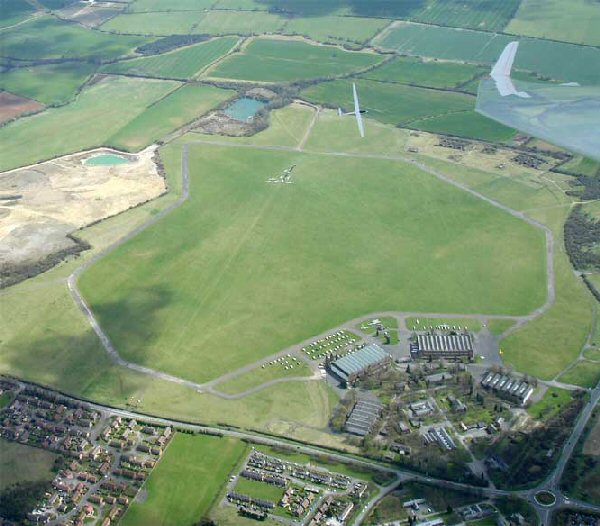
Bicester Aerodrome, formerly RAF Bicester, is a private airfield on the outskirts of Bicester, Oxfordshire, England.
The location of the first flight of the prototype Handley Page Halifax in 1939, it was used by the Royal Air Force until 2004. Originally built as a bomber station as part of the 1920s Home Defence Expansion Scheme, the airfield consists of 400 acres (160 ha) of well-drained short-mown grass, with two mown grass runways of 06/24 (650 m (2,133 ft)) and 16/34 (790 m (2,592 ft)) long. The surface is bumpy in places, due to collapsing field drains, requiring care on the part of pilots operating aircraft in those areas.
In 1911 Captain H. P. P. Reynolds flew from Oxford in a Bristol Boxkite biplane and touched down near Launton. His rural landing is thought to be the first time an aircraft skimmed the grass at this location.
Organised flying began in 1916 when a Training Depot was established. In January 1917, the Royal Flying Corps (RFC) moved into the site, then 180 acres (0.73 km2), with the arrival of 118 night bomber squadron. Canvas-covered Bessonneau hangars were used until more substantial aircraft sheds were built.
In November 1918, No. 44 Training Station Depot arrived, followed in 1919 by 5 Squadron, flying Bristol F.2 Fighters returning from France, having flown in the First World War. All the squadrons disbanded by 1920, and the airfield was closed in 1920 after being used briefly as a clearing centre for repatriated soldiers.
In 1925, work began on redeveloping the site as a bomber station, and flying began again in January 1928. Various large RAF bombers operated from the field, including the Vickers Virginia. Other aircraft included Hawker Horsleys and, in 1935, Hawker Harts arrived. In November 1932, the only RAF squadron of Boulton Paul Sidestrands arrived, replaced by Overstrands n 1936.
Development of the station continued throughout this period, with many new buildings being erected. This included the construction of a connection from the nearby 'Varsity Line' railway to supply the airfield.
In 1937/1938, two squadrons of the new Bristol Blenheim bomber arrived, followed in 1939 by two more squadrons with Supermarine Spitfires and Avro Anson support aircraft, forming the No. 1 Camouflage Unit RAF. The aircraft were used for training, with no operational sorties being flown from the field.
Bicester Airfield
Bicester Aerodrome, formerly RAF Bicester, is a private airfield on the outskirts of Bicester, Oxfordshire, England.
The location of the first flight of the prototype Handley Page Halifax in 1939, it was used by the Royal Air Force until 2004. Originally built as a bomber station as part of the 1920s Home Defence Expansion Scheme, the airfield consists of 400 acres (160 ha) of well-drained short-mown grass, with two mown grass runways of 06/24 (650 m (2,133 ft)) and 16/34 (790 m (2,592 ft)) long. The surface is bumpy in places, due to collapsing field drains, requiring care on the part of pilots operating aircraft in those areas.
In 1911 Captain H. P. P. Reynolds flew from Oxford in a Bristol Boxkite biplane and touched down near Launton. His rural landing is thought to be the first time an aircraft skimmed the grass at this location.
Organised flying began in 1916 when a Training Depot was established. In January 1917, the Royal Flying Corps (RFC) moved into the site, then 180 acres (0.73 km2), with the arrival of 118 night bomber squadron. Canvas-covered Bessonneau hangars were used until more substantial aircraft sheds were built.
In November 1918, No. 44 Training Station Depot arrived, followed in 1919 by 5 Squadron, flying Bristol F.2 Fighters returning from France, having flown in the First World War. All the squadrons disbanded by 1920, and the airfield was closed in 1920 after being used briefly as a clearing centre for repatriated soldiers.
In 1925, work began on redeveloping the site as a bomber station, and flying began again in January 1928. Various large RAF bombers operated from the field, including the Vickers Virginia. Other aircraft included Hawker Horsleys and, in 1935, Hawker Harts arrived. In November 1932, the only RAF squadron of Boulton Paul Sidestrands arrived, replaced by Overstrands n 1936.
Development of the station continued throughout this period, with many new buildings being erected. This included the construction of a connection from the nearby 'Varsity Line' railway to supply the airfield.
In 1937/1938, two squadrons of the new Bristol Blenheim bomber arrived, followed in 1939 by two more squadrons with Supermarine Spitfires and Avro Anson support aircraft, forming the No. 1 Camouflage Unit RAF. The aircraft were used for training, with no operational sorties being flown from the field.
Recent media
Recent media