
Recent from talks
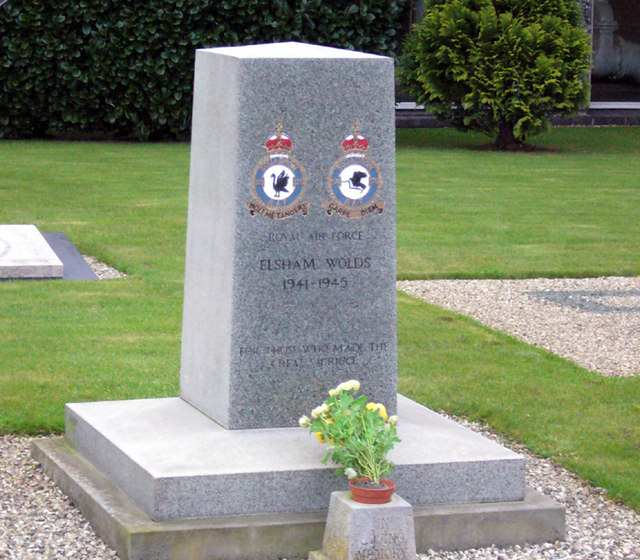
RAF Elsham Wolds
Knowledge base stats:
Talk channels stats:
Members stats:
RAF Elsham Wolds
Royal Air Force Elsham Wolds or more simply RAF Elsham Wolds is a former Royal Air Force station in England, which operated in the First World War and the Second World War. It is located just to the north east of the village of Elsham in north Lincolnshire.
An airfield was established at Elsham as early as December 1916 and used by C Flight of No. 33 Squadron of the Royal Flying Corps, initially operating F.E.2 and later Avro 504 and Bristol F.2 Fighter biplanes. From June 1918 to June 1919 it was also the squadron's headquarters, taking over from Gainsborough.
The site was the most northerly of three airfields, along with RAF Kirton in Lindsey (B Flight) and RAF Scampton (A Flight), equally spaced between the cities of Hull and Lincoln for countering Zeppelin night raids. C Flight also acted as observers for the artillery batteries located at Spurn Head and Kilnsea.
The flight stayed at Elsham until June 1918, the wooden huts and a small aircraft shed that had been erected were demolished by 1919 when the station was abandoned back to agriculture at the end of the First World War.
In the late 1930s with a new war on the horizon, extra airfields were again needed to accommodate an expansion of the RAF. Former First World War stations were surveyed for suitability, and an area just to the west of the original Elsham site was deemed to be better suited.
Work began in the winter of 1939–1940, and the station opened with the arrival in July 1941 of 103 Squadron. The station was equipped with a main runway 2,000 yards (1,829 m) long, and two subsidiaries of 1,600 yards (1,463 m) and 1,400 yards (1,280 m). Three hangars (two T-2's and one J-Type) and 27 aircraft hardstands (later increased to 36) were built. Three more T-2 hangars were built in 1944. Accommodation for around 2,500 personnel was dispersed in the nearby farmland.
No. 103 is credited with more operational sorties than any other No. 1 Group RAF squadron, and consequently suffered the group's highest losses. Of the 248 bombers lost on operations flying from Elsham Wolds, 198 were from No. 103 Squadron. By type, losses were 28 Vickers Wellingtons, 12 Halifaxes and 208 Lancasters. One Elsham Wolds Lancaster, Lancaster III ED888 M2 (Mike Squared) which served with both Nos. 103 and 576, held the Bomber Command record for operational sorties, having completed 140 between May 1943 and December 1944. A total of 974 operational hours.
Australian Don Charlwood was a navigator operating out of Elsham Wolds. In his highly regarded memoir, "No Moon Tonight", he writes movingly about his many comrades who died, those that did not (a much smaller number), and about the feelings of aircrews facing such high loss rates. Describing his arrival at Elsham Wolds with a group of 20 other young men, he wrote: ". . . of our twenty only eight were destined to depart . . . a few months later."
Hub AI
RAF Elsham Wolds AI simulator
(@RAF Elsham Wolds_simulator)
RAF Elsham Wolds
Royal Air Force Elsham Wolds or more simply RAF Elsham Wolds is a former Royal Air Force station in England, which operated in the First World War and the Second World War. It is located just to the north east of the village of Elsham in north Lincolnshire.
An airfield was established at Elsham as early as December 1916 and used by C Flight of No. 33 Squadron of the Royal Flying Corps, initially operating F.E.2 and later Avro 504 and Bristol F.2 Fighter biplanes. From June 1918 to June 1919 it was also the squadron's headquarters, taking over from Gainsborough.
The site was the most northerly of three airfields, along with RAF Kirton in Lindsey (B Flight) and RAF Scampton (A Flight), equally spaced between the cities of Hull and Lincoln for countering Zeppelin night raids. C Flight also acted as observers for the artillery batteries located at Spurn Head and Kilnsea.
The flight stayed at Elsham until June 1918, the wooden huts and a small aircraft shed that had been erected were demolished by 1919 when the station was abandoned back to agriculture at the end of the First World War.
In the late 1930s with a new war on the horizon, extra airfields were again needed to accommodate an expansion of the RAF. Former First World War stations were surveyed for suitability, and an area just to the west of the original Elsham site was deemed to be better suited.
Work began in the winter of 1939–1940, and the station opened with the arrival in July 1941 of 103 Squadron. The station was equipped with a main runway 2,000 yards (1,829 m) long, and two subsidiaries of 1,600 yards (1,463 m) and 1,400 yards (1,280 m). Three hangars (two T-2's and one J-Type) and 27 aircraft hardstands (later increased to 36) were built. Three more T-2 hangars were built in 1944. Accommodation for around 2,500 personnel was dispersed in the nearby farmland.
No. 103 is credited with more operational sorties than any other No. 1 Group RAF squadron, and consequently suffered the group's highest losses. Of the 248 bombers lost on operations flying from Elsham Wolds, 198 were from No. 103 Squadron. By type, losses were 28 Vickers Wellingtons, 12 Halifaxes and 208 Lancasters. One Elsham Wolds Lancaster, Lancaster III ED888 M2 (Mike Squared) which served with both Nos. 103 and 576, held the Bomber Command record for operational sorties, having completed 140 between May 1943 and December 1944. A total of 974 operational hours.
Australian Don Charlwood was a navigator operating out of Elsham Wolds. In his highly regarded memoir, "No Moon Tonight", he writes movingly about his many comrades who died, those that did not (a much smaller number), and about the feelings of aircrews facing such high loss rates. Describing his arrival at Elsham Wolds with a group of 20 other young men, he wrote: ". . . of our twenty only eight were destined to depart . . . a few months later."
Recent media