Recent from talks
Nothing was collected or created yet.
Vickers Wellington
View on Wikipedia
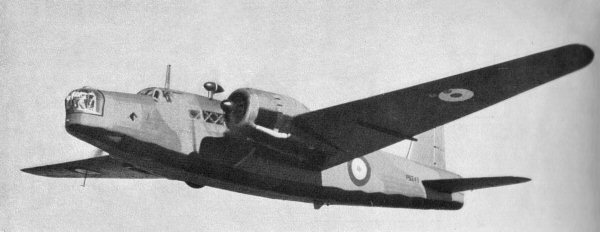
The Vickers Wellington (nicknamed the Wimpy) is a British twin-engined, long-range medium bomber. It was designed during the mid-1930s at Brooklands in Weybridge, Surrey. Led by Vickers-Armstrongs' chief designer Rex Pierson, a key feature of the aircraft is its geodetic airframe fuselage structure, which was principally designed by Barnes Wallis. Development had been started in response to Air Ministry Specification B.9/32, issued in the middle of 1932, for a bomber for the Royal Air Force.
Key Information
This specification called for a twin-engined day bomber capable of delivering higher performance than any previous design. Other aircraft developed to the same specification include the Armstrong Whitworth Whitley and the Handley Page Hampden. During the development process, performance requirements such as for the tare weight changed substantially, and the engine used was not the one originally intended.
Despite the original specification, the Wellington was used as a night bomber in the early years of the Second World War, performing as one of the principal bombers used by Bomber Command. During 1943, it started to be superseded as a bomber by the larger four-engined "heavies" such as the Avro Lancaster. The Wellington continued to serve throughout the war in other duties, particularly as an anti-submarine aircraft with RAF Coastal Command.
The Wellington was the only British bomber that was produced for the duration of the war, and was produced in a greater quantity than any other British-built bomber. The Wellington remained as first-line equipment when the war ended, although it had been increasingly relegated to secondary roles. The Wellington was one of two bombers named after Arthur Wellesley, 1st Duke of Wellington, the other being the Vickers Wellesley.
A larger heavy bomber aircraft designed to Specification B.1/35, the Vickers Warwick, was developed in parallel with the Wellington; the two aircraft shared around 85% of their structural components. Many elements of the Wellington were also re-used in a civil derivative, the Vickers VC.1 Viking.
Development
[edit]Origins
[edit]
In October 1932, the British Air Ministry invited Vickers to tender for the recently issued Specification B.9/32, which sought a twin-engine medium daylight bomber. In response, Vickers conducted a design study, led by chief designer Rex Pierson.[3] Early on, Vickers' chief structures designer Barnes Wallis proposed the use of a geodetic airframe, inspired by his previous work on airships and the single-engined Wellesley light bomber.[4] During structural testing performed at the Royal Aircraft Establishment, Farnborough, the proposed structure demonstrated not only the required strength factor of six, but reached 11 without any sign of failure, proving the geodetic airframe to possess a strength far in excess of normal levels.[4] This strength allowed for the structure design to be further developed to reduce the size of individual members and adopt simplified standard sections of lighter construction.[4]
Vickers studied and compared the performance of various air- and liquid-cooled engines to power the bomber, including the Bristol Pegasus IS2, Pegasus IIS2, and Armstrong Siddeley Tiger radials, and the Rolls-Royce Goshawk I inline.[5] The Pegasus was selected as the engine for air-cooled versions of the bomber, while the Goshawk engine was chosen for the liquid-cooled engine variant. On 28 February 1933, two versions of the aircraft, one with each of the selected powerplants, were submitted to the tender.[5] In September 1933, the Air Ministry issued a pilot contract for the Goshawk-powered version.[5] In August 1934, Vickers proposed to use either the Pegasus or the sleeve-valve nine-cylinder radial Bristol Perseus engines instead of the evaporative-cooled Goshawk, which promised improvements in speed, climb rate, ceiling, and single-engine flight capabilities without any major increase in all-up weight; the Air Ministry accepted the proposed changes.[6]
Other refinements of the design had also been implemented and approved, such as the adoption of variable-pitch propellers, and the use of Vickers-produced gun turrets in the nose and tail positions.[6] By December 1936, the specification had been revised to include front, rear, and midship wind-protected turret mountings.[5] Other specification changes included modified bomb undershields and the inclusion of spring-loaded bomb bay doors.[7] The proposal had also been developed further, a mid-wing arrangement was adopted instead of a shoulder-mounted wing for greater pilot visibility during formation flight and improved aerodynamic performance, as well as a substantially increased overall weight of the aircraft.[7] Design studies were also conducted on behalf of the Air Ministry into the adoption of the Rolls-Royce Merlin engine.[6]
In spite of a traditional preference of the establishment to strictly adhere to the restrictive tare weight for the aircraft established in the tender, both Pierson and Wallis firmly believed that their design should adopt the most powerful engine available.[4] Perhaps in response to pressure from Vickers, the Air Ministry overlooked, if not openly accepted, the removal of the tare weight restriction, as between the submission of the tender in 1933 and the flight of the first prototype in 1936, the tare weight eventually rose from 6,300 lb (2.9 t) to 11,508 lb (5.220 t).[8][a] The prescribed bomb load and range requirements were routinely revised upwards by the Air Ministry; by November 1935, figures within the ministry were interested in the possibility of operating the aircraft at an all-up weight of 30,500 lb (13.8 t), which aviation author C.F. Andrews described as "a very high figure for a medium bomber of those days".[4]
During the development phase of the aircraft, as C F Andrews puts it "the political and military climate of Europe was changing rapidly. The threats of the dictators of Germany and Italy began to exert pressure on the British government to make a reappraisal of the strength of its armed forces, especially that of the Royal Air Force".[4] By 1936, the need for a high priority to be placed on the creation of a large bomber force, which would form the spearhead of British offensive power, had been recognised; accordingly, a new command organisation within the RAF, Bomber Command, was formed that year to deliver upon this requirement.[4]
Prototype and design revision
[edit]In early 1936, an initial prototype, K4049, which was originally designated as a Type 271, was assembled. The prototype could accommodate a payload of nine 250 lb (110 kg) or 500 lb (230 kg) bombs, and both nose and tail gun positions were fitted with hand-operated turrets with a gun in each; provision for a third retractable gun in a dorsal position was made.[6] It had provision for a crew of four, along with a fifth position for special duties.[6]
On 5 June 1936, the name Crecy was chosen for the type, and it was publicly displayed as such.[10] On 15 August 1936, the aircraft was accepted for production. On 8 September 1936, the service name Wellington was adopted for the type; it fitted with Air Ministry nomenclature of naming bombers after towns and followed the Vickers Wellesley in referring to the Napoleonic War general Arthur Wellesley, the Duke of Wellington.[10] On 12 December 1936, a corresponding works order was issued for the Wellington.[5]
On 15 June 1936, K4049 conducted its maiden flight from Brooklands. Vickers chief test pilot Joseph Summers flew K4049 on its first flight, accompanied by Wallis and Trevor Westbrook.[6] The aircraft soon came to be widely regarded as being an advanced design for its era and proved to have considerable merit during its flight trials.[11] On 19 April 1937, K4049 was destroyed by an accident during a service test flight by Maurice Hare. The cause was the failure of the elevator's horn balance due to excessive slipstream exposure, leading to the aircraft inverting and rapidly descending into terrain. It was destroyed in the crash, which also resulted in the death of the navigator, Smurthwaite.[10] The horn balances were later deleted from the design and were not on production aircraft.[12]
Refinement of the Wellington's design was influenced by the issuing of Specifications B.3/34 and B.1/35, the latter of which led to a larger bomber aircraft, the Vickers Warwick[13] With detail design work on both being done at same time and both aircraft using geodetic-inspired construction there was commonality in components. The production model Wellington was a complete redesign, resulting in a lengthened nose for turret and bomb aimer's position, a reshaped elevator and deepened fuselage which accommodated a larger bombload and the increased crew from four to five members.[12] Other changes made included the adoption of a retractable tailwheel and constant-speed propellers; the Air Ministry also requested the adoption of a Nash & Thompson-design ventral turret in place of the Vickers design.[12]
On 23 December 1937, the first production Wellington Mk I, L4212, conducted its first flight, followed by an intensive flight programme.[14] Flight trials with L4212 confirmed the aerodynamic stability initially encountered by K4049, but also revealed the aircraft to be nose-heavy during dives, which was attributed to the redesigned elevator. Modifications, including the linking of the flaps and the elevator trim tabs, were tested on L4212 and resolved the problem.[15]
Production
[edit]
In August 1936, an initial order for 180 Wellington Mk I aircraft, powered by a pair of 1,050 hp (780 kW) Bristol Pegasus radial engines, was received by Vickers; it had been placed so rapidly that the order occurred prior to the first meeting intended to decide the details of the production aircraft.[16]
In October 1937, an order was placed with Gloster Aircraft Company for production of 100 Wellington Mk Is to be followed by 100 Wellington Mk II aircraft with Rolls-Royce Merlin X .[17] Another order was placed for 64 Wellingtons to be produced by Armstrong Whitworth Aircraft at Coventry. With this flurry of orders and production having been assured by the end of 1937, Vickers set about simplifying the manufacturing process of the aircraft and announced a target of building one Wellington per day.[17]

The geodetic design took longer to build than comparable aircraft using the more conventional monocoque approach, leading to some criticism of the Wellington.[17] In addition it was difficult to cut holes in the fuselage for access or equipment fixtures; to aid manufacturing, the Leigh light was deployed through the mounting for the absent FN9 ventral turret.
The Gloster and AWA contracts were transferred to shadow factories in the north-west. In the late 1930s, Vickers built Wellingtons at a rate of one per day at Weybridge and 50 a month at Broughton in North Wales.[18] Many of the employees on the production lines were only semi-skilled and new to aircraft construction.[17] Peak wartime production in 1942 saw monthly rates of 70 at Weybridge, 130 at Broughton and 102 at Blackpool. Shadow factories were set up to produce parts for the Wellington all over the British Isles.[17]
In October 1943, as a propaganda and morale-boosting exercise, workers at Broughton gave up their weekend to build Wellington number LN514 rushed by the clock. The bomber was assembled in 23 hours 50 minutes, and took off after 24 hours 48 minutes, beating the record of 48 hours set by a factory in California. Each Wellington was usually built within 60 hours. It was filmed for the Ministry of Information for a newsreel Worker's Week-End, and was broadcast in both Britain and America.[19][20] It was the first time in aviation history that an aircraft manufacturer anywhere in the world had attempted such a feat with a metal aircraft of this scale.[17]
A total of 180 Wellington Mk I aircraft were built; 150 for the RAF and 30 for the Royal New Zealand Air Force (RNZAF) (which were transferred to the RAF on the outbreak of war and used by 75 Squadron). In October 1938, the Mk I entered service with 9 Squadron. The Wellington was initially outnumbered by the Handley Page Hampden (also ordered by the Ministry to B.9/32) and the Armstrong Whitworth Whitley (to B.34/3 for a 'night' bomber) but outlasted both rival aircraft in service. The Wellington went on to be built in 16 variants and two post-war training conversions. The number of Wellingtons built totalled 11,462 of all versions, a greater quantity produced than any other British bomber.[17] On 13 October 1945, the last Wellington to be produced rolled out.
Further development
[edit]The Wellington Mk I was quickly superseded by improved variants. Improvements to the turrets and the strengthening of the undercarriage quickly resulted in the Wellington Mk IA.[15] The Mk IA was specified to be based on the Merlin X engined Wellington Mk II design and was in theory to be able to be fitted with either Merlins or Pegasus but in practice only radials were fitted. The Mark IA was stressed to the Mark II 28,000 lb (13,000 kg) and had stronger undercarriage with larger wheels and Frazer-Nash turrets.
Due to difficulties with performance of the Vickers turrets on the Mark I that left the Wellington with weaker than intended defences, production of Wellington Mk IB with Frazer Nash armament was proposed for trials but since the Frazer-Nash turrets were already being accepted for the Mark IA, the Mark IB may not have been built or if built re-designated as Mark IA.[15] Further development of various aspects of the aircraft, using knowledge learned was incorporated into the airframe at Weybridge by executive decision. Redesigned hydraulics and 24 volt electrical systems, along with a replacement of the ventral turret gun with two beam machine guns (either .303 Vickers K, or Browning), was designated Wellington Mk IC and a Type number generated after the fact.[21]
In January 1938, design work on what would become the Wellington Mk II formally commenced. The principal change on this model was the adoption of the Merlin engine in place of the Pegasus XVIII; other modifications included hydraulic and oxygen system revisions along with the installation of cabin heating and an astrodome.[22] On 3 March 1939, L4250, the prototype Mk II, performed its maiden flight; this had been delayed due to production delays of its Merlin X engines.[23] Stability and balance problems were encountered during flight tests of the prototype, resulting in further changes such as the enlargement of the tailplane. By late 1939, the Mk II was capable of delivering superior performance to the Mk IC, such as higher cruising and top speeds, increased all-up weight or alternatively greater range and a raised ceiling.[24]
Design
[edit]
The Vickers Wellington was a twin-engined long-range medium bomber, initially powered by a pair of Bristol Pegasus radial engines, which drove a pair of de Havilland two-pitch propellers. Various engines and propeller combinations were used on variants of the aircraft, which included models of the Bristol Hercules and the Rolls-Royce Merlin engines.[10] Recognisable characteristics of the Wellington include the high aspect ratio of its tapered wing, the depth of its fuselage and the use of a tall single fin on its tail unit, which reportedly aided in recognition of the type.[12]
The Wellington typically had a crew of five, the bomb-aimer being located in the aircraft's nose.[10] The Wellington could be fitted with dual flight controls, and specialised dual-control conversion sets were developed for the purpose of performing training upon the type.[10] The cockpit also contained provisions for heating and de-icing equipment, which was introduced on later models of the Wellington.[10] The Wellington Mk I had a maximum offensive bomb load of 4,500 lb (2,000 kg), more than one-fifth of the aircraft's 21,000 lb (9,500 kg) all-up weight.[10] Additional munitions and an expanded bombing capacity were changes in many of the wartime variants of the Wellington, including the carrying of larger bombs.[22]

Defensive armament comprised the forward and tail turret gun positions, along with a retractable revolving ventral turret. Due to the high cruising speeds of the Wellington, it had been realised that fully enclosed turrets, as opposed to semi-enclosed or exposed turrets, would be necessary; the turrets were also power-operated to traverse with the speed and manoeuvrability necessary to keep up with the new generations of opposing fighter aircraft.[17] The Vickers design put the gunner in a fixed seat behind the guns (a pair of .303 in (7.7 mm) Browning machine guns.[10] ) which were mounted on a pillar with a Nash & Thompson control unit, and fired through a moving slot in the framed canopy. Although roomy, there were problems with malfunctions and poor gunnery and Vickers were given a directive by the Air Staff to replace them. At the same time a development contract was placed with Nash & Thompson for a turret that could be used for both front and rear positions. The resulting FN.5 was also used on Short Stirling and Avro Manchester[25]
Due to the specialised nature of increasingly advanced turrets, these were treated as ancillary equipment, being designed and supplied independently and replacing Vickers' own turrets developed for the aircraft.[17] The Vickers-built ventral turret of the Mk I was replaced by a Nash & Thompson-built FN.25 counterpart as standard.[15] The squadrons were critical of the ventral turrets; when extended they slowed the aircraft by 10 mph, the single narrow window pane limited visibility and sometimes froze in place and had to be jettisoned. The ventral turrets were not fitted after the first batch of Wellington IA[26]

A novelty of the Wellington was its geodetic construction, devised by aircraft designer and inventor Barnes Wallis. The fuselage was built from 1,650 elements, consisting of duralumin W-beams which formed into a metal framework. Wooden battens were screwed to the beams and were covered with Irish linen; the linen, treated with layers of dope, formed the outer skin of the aircraft. The construction proved to be compatible with significant adaptations and alterations including greater all-up weight, larger bombs, tropicalisation and long-range fuel tanks.[24]
The metal lattice gave the structure considerable strength, with any stringer able to support a portion of load from the opposite side of the aircraft. Damaged or destroyed beams on one side could still leave the aircraft structure viable; as a result, Wellingtons with huge areas of framework missing were often able to return when other types would not have survived, leading to stories of the aircraft's "invulnerability".[5] The effect was enhanced by the fabric skin occasionally burning off leaving the naked frames exposed. A further advantage of the geodetic construction of the wings was its enabling of a unique method for housing the fuel, with each wing containing three fuel tanks within the unobstructed space provided between the front and rear spars outboard of the engines.[10] A disadvantage of the geodetic fuselage structure was its insufficient lengthwise stiffness: when fitted with attachment for towing cargo gliders, its structure "gave" and stretched slightly.[27]
Operational history
[edit]
On 3 September 1939, the same day the United Kingdom declared war on Germany in response to the invasion of Poland, No. 3 Group Bomber Command based in East Anglia comprised six front line squadrons (No. 9, No. 37, No. 38, No. 99, No. 115 and No. 149 Squadrons) and two reserve squadrons (No. 214 and No. 215 squadrons), all equipped with a mixture of Wellington Mk I and Mk IA aircraft.[24]
On 4 September 1939, less than 24 hours after the commencement of hostilities, a total of 14 Wellingtons of No. 9 and No. 149 Squadrons, alongside a number of Bristol Blenheim aircraft, performed the first RAF bombing raid of the war, against German shipping at Brunsbüttel.[24] The bombing of the harbour had not been permitted by Chamberlain's War Cabinet for fear of injuring civilians. The effectiveness of the raid was diminished by poor weather and high amounts of anti-aircraft fire. A pair of Wellingtons became the first aircraft to be lost on the Western Front.[24]
On 3 December 1939, 24 Wellingtons of No. 38, No. 115 and No. 147 Squadrons attacked the German fleet moored at Heligoland. The bombing commenced from high altitude and, while results of the bombing itself proved negligible, the ability of a formation of Wellingtons to penetrate strongly defended hostile airspace was validated.[24] On 14 December 1939, 12 Wellingtons of No. 99 Squadron conducted a low-level raid upon German shipping at the Schillig Roads and Wilhelmshaven. Encountering enemy fire from warships, flak, and Luftwaffe aircraft, the Wellington formation lost five aircraft, along with another that crashed near its base, while only one enemy fighter was shot down.[28]
On 18 December 1939, 24 Wellingtons of No. 9, No. 37 and No. 149 Squadrons participated in the Battle of the Heligoland Bight against the German fleet and naval bases in both the Schillig Roads and Wilhelmshaven. The Wellingtons were unable to drop their bombs as all vessels were in harbour, thus restrictions on endangering civilians prevented their engagement.[29] Having been alerted by radar, Luftwaffe fighter aircraft intercepted the incoming bombers near to Heligoland and attacked the formation for much of the way home. Twelve of the bombers were destroyed and a further three were badly damaged. The Wellingtons shot down four aircraft.[29][30]

The action at Heligoland highlighted the Wellington's vulnerability to attacking fighters, possessing neither self-sealing fuel tanks nor sufficient defensive armament. The nose and tail turrets protected against attacks from the front and rear, the Wellington had no defences against attacks from the beam and above, as it had not been believed that such attacks were possible owing to the high speed of aircraft involved and the deflection shooting required.[29][30] Unescorted day bombing was abandoned and Bomber Command decided to use the Wellington force to attack German communications and industrial targets instead.[29]

The Wellington was converted for night operations; on 25 August 1940, the type participated in the first night raid on Berlin. During the First 1,000 bomber raid, on Cologne on 30 May 1942, 599 out of 1,046 RAF aircraft dispatched were Wellingtons; of these, 101 were flown by Polish aircrew. During operations under Bomber Command, Wellingtons flew 47,409 operations, dropped 41,823 tons (37,941 tonnes) of bombs and lost 1,332 aircraft in action.
In one incident, a German Messerschmitt Bf 110 night-fighter attacked a Wellington returning from an attack on Münster, causing a fire at the rear of the starboard engine. The second pilot, Sergeant James Allen Ward (RNZAF) climbed out of the fuselage, kicked holes in the doped fabric of the wing for foot and hand holds to reach the starboard engine and smothered the burning upper wing covering. He and the aircraft returned home safely and Ward was awarded the Victoria Cross.[31] A unique feat for the type occurred on 23 December 1944 when a Me 163 Komet was shot down by rear gunner Gerry Elsyon, who was awarded the DFM.[32]

In 1942 the Wellington was adapted to conduct night anti-shipping torpedo attacks against German and Italian shipping in the Mediterranean. The torpedo-carrying Wellington was nicknamed the "Fishington", and the radar equipped Wellingtons that guided the torpedo carrying aircraft onto their target were dubbed the "Snoopington".[33] 38 Squadron, based in Shallufah, Egypt had a detachment of Wellingtons operating from RAF Luqa in Malta conducting anti-shipping operations with torpedoes during 1942.
The Wellington was also adopted by RAF Coastal Command, in which it contributed to the Battle of the Atlantic.[29] The Mark IC in Coastal had a endurance of over 10 hours at a cruising speed of 125 knots carrying 1,500 lb (680 kg) of bombs or depth charges.[34] It was used for anti-submarine operations; on 6 July 1942, a Wellington sank its first enemy vessel. In 1944, Wellingtons of Coastal Command were sent to Greece and performed various support duties during the British intervention in the Greek Civil War. A few Wellingtons were operated by the Hellenic Air Force.
While the Wellington was superseded in the European Theatre as more four engined bombers arrived in service, it remained in operational service for much of the war in the Middle East and still formed a key part of the RAF's Mediterranean forces as the allies moved into Italy, with some still serving in March 1945 carrying out bombing raids and dropping supplies to partisans across Southern Europe.[35][32]
In 1942, Wellingtons based in India became the RAF's first long-range bombers operating in the Far East with the arrival of 99 and 215 Squadrons RAF,[32] providing much needed bombing support for the next two years before being withdrawn and replaced by Liberators in the summer of 1944. Wellingtons were also used for maritime patrols over the Indian Ocean by 36, and later, 203 Squadrons RAF.[35]
The Wellington also served in anti-submarine duties off the African cost with 26 Squadron SAAF based in Takoradi, Gold Coast (now Ghana), and the Free French 344 Squadron from Dakar.[35]
Mine clearance
[edit]Specialised "Directional Wireless Installation" (DWI), a cover story for the true purpose of the hoop variants, fitted with a 48 ft (15 m) diameter metal hoop, were used for exploding German magnetic mines by generating a powerful magnetic field as it passed over them.[29] The first successful mine detonation occurred on 8 January 1940 followed by a second on 13 January. In the latter the aircraft flew below the safe 35 ft altitude and was caught in the explosive blast though remained flyable.[36] The hoop was an aluminium coil in an aerodynamic balsa case; turrets were faired over and unnecessary equipment removed to reduce weight. The first mine detonation unit No. 1 GRU at RAF Manston was joined by a second (No. 2 GRU) at RAF Bircham Newton. To protect the unarmed Wellingtons, Bristol Blenheims of No. 600 Squadron RAF flew escort during the Battle of France. One DWI was detached to the Middle East to act as the pattern for conversion of Wellingtons there. They were used for clearing the Suez Canal Zone and, later during the North Africa campaign, ports along the coast.[36]
Anti-submarine
[edit]For the development of what became the Leigh Light, Wing Commander Humphrey de Verd Leigh fitted a 24-inch search light in the 'dustbin' turret of a DWI Wellington testing it from January 1941. This prototype substituted batteries for the engine and generator setup to reduce weight and this carried forward into production Leigh Light-equipped Wellingtons.[37] Together with accurate radar altimeters, Wellingtons could fly safely down to 50 ft, illuminating the target submarine at around half a mile away just as the air-to-surface-vessel (ASV) radar lost the target among returns from the water's surface.[38]
Airborne radar
[edit]In late 1944, a radar-equipped Wellington XIV from 407 Sqn. RCAF was modified for use by the RAF's Fighter Interception Unit as what would now be described as an airborne early warning and control aircraft.[39] It operated at an altitude of 4,000 ft (1,200 m) over the North Sea to control a de Havilland Mosquito and a Bristol Beaufighter fighter intercepting Heinkel He 111 bombers flying from Dutch airbases and carrying out airborne launches of the V-1 flying bomb. The FIU operators on the Wellington would search for the He 111 aircraft climbing to launch altitude, then direct the Beaufighter to attack the bomber, while the Mosquito would attempt to intercept the V-1 if it was launched.[40][page needed][41]
Variants
[edit]Bomber variants
[edit]
- Type 271
- The first Wellington bomber prototype.
- Type 285 Wellington Mark I
- One pre-production prototype. Powered by two Bristol Pegasus X radial piston engines.
- Type 290 Wellington Mark I
- The first production version. Powered by two 1,000 hp (750 kW) Bristol Pegasus XVIII radial piston engines. Fitted with Vickers gun turrets, 183 built at Weybridge and Broughton in Flintshire.[42]
- Type 408 Wellington Mark IA
- Production version built to B Mark II specifications with provision for either Pegasus or Rolls-Royce Merlin engines, although only 1,000 hp (750 kW) Pegasus XVIII engines were used in practice.[43] Main landing gear moved forward 3 in (8 cm). Fitted with Nash & Thompson gun turrets. 187 built at Weybridge and Broughton in Flintshire.[42]
- Type 416 Wellington Mark IC
- The first main production variant was the Mark IC which added waist guns to the Mark IA. A total of 2,685 were produced. The Mark IC had a crew of six: a pilot, radio operator, navigator/bomb aimer, observer/nose gunner, tail gunner and waist gunner. A total of 2,685 were built at Weybridge, Broughton in Flintshire and Blackpool.[42]

- Type 406 Wellington Mark II
- The B Mark II was identical to the Mark IC with the exception of the powerplant; using the 1,145 hp (855 kW) Rolls-Royce Merlin X engine instead. A total of 401 were produced at Weybridge.[42]
- Type 417 Wellington B Mark III
- The next significant variant was the B Mark III which featured the 1,375 hp (1,025 kW) Bristol Hercules III or XI engine and a four-gun tail turret, instead of two-gun. A total of 1,519 Mark IIIs were built, becoming mainstays of Bomber Command from late 1941 through into 1942, with all but the two prototypes being built at Broughton in Flintshire and at Blackpool.[44][45] After trials in 1942, the Wellington III was cleared to tow Hotspur, Hadrian and Horsa gliders,[46] although this was observed to have an adverse effect on the geodetic structure.[47] The Wellington III was also seen over Salisbury Plain while towing Spitfires. This would have allowed Spitfire reinforcements for the defence of Malta to be towed from Gibraltar to within range of Malta before being released. Whether this was done is unconfirmed.[46]
- Type 424 Wellington B Mark IV
- The 220 B Mark IV Wellingtons used the 1,200 hp (900 kW) Pratt & Whitney Twin Wasp engine and were flown by two Polish and two RAAF squadrons. A total of 220 were built at Broughton in Flintshire.
- Type 442 Wellington B Mark VI
- Pressurised with a long wingspan and 1,600 hp (1,190 kW) Merlin R6SM (60-series, two-stage) engines, 63 were produced and were operated by 109 Squadron and as Gee radio navigation trainers. A total of 63 were built at Weybridge. Fitted with Sperry bombsight.[48] The B.VI's high-altitude fuselage design optimised for pressurisation had a solid, bullet-like nose with no nose turret, and a cockpit with an astrodome-like bubble canopy. The rear turret was a remotely operated FN.20 sighted from a dome in the cockpit.[b][49] This is the aircraft that spurred Rolls-Royce into developing the two-stage supercharged Merlin 60-series engine.
- Type 440 Wellington B Mark X
- The most widely produced variant of which 3,804 were built. It was similar to the Mark III except for the 1,675 hp (1,250 kW) Hercules XVIII powerplant. The Mark X was the basis for a number of Coastal Command versions. A total of 3,803 were built at Broughton in Flintshire and Blackpool.
Coastal Command variants
[edit]- Type 429 Wellington General Reconnaissance (GR) Mark VIII
- Mark IC conversion for Coastal Command service. Roles included reconnaissance, anti-submarine and anti-shipping attack. A Coastal Command Wellington was the first aircraft to be fitted with the anti-submarine Leigh light. A total of 307 were built at Weybridge, 58 fitted with the Leigh light.
- Type 458 Wellington GR Mark XI
- Maritime version of B Mark X with an ordinary nose turret and mast radar ASV Mark II radar no waist guns, 180 built at Weybridge and Blackpool.[50]
- Type 455 Wellington GR Mark XII
- Maritime version of B Mark X armed with torpedoes (two 18-inch carried under wings). Redesigned nose to accommodate centrimetric ASV Mark III radar which had a radome in the chin position rather use than external aerials. Twin flexible machine guns in a clear canopy replaced the front turret. Leigh light in bomb bay. Hercules VI or XVI engines. 58 built at Weybridge and Broughton in Flintshire.[50]
- Type 466 Wellington GR Mark XIII
- Maritime version of B Mark X with an ordinary nose turret and mast radar ASV Mark II instead of chin radome, no waist guns. Hercules XVII engines of 1,735 hp. 844 built – 2 at Weybridge and rest at Blackpool.[51]
- Type 467 Wellington GR Mark XIV
- Maritime version of B Mark X with a chin radome housing the ASV Mark III radar and RP-3 explosive rocket rails under the wings. Hercules XVII engines 841 built at Weybridge, Broughton and Blackpool.
Transport variants
[edit]- Wellington C Mark XV
- Service conversions of the Wellington Mark IA into unarmed transport aircraft; able to carry up to 18 troops.
- Wellington C Mark XVI
- Service conversions of the Wellington Mark IC into unarmed transport aircraft; able to carry up to 18 troops.
Trainer variants
[edit]- Type 487 Wellington T Mark XVII
- Service conversion of a Wellington Mk XI bomber into nightfighter training aircraft with SCR720 Air Intercept radar in a bulbous nose and rear turret removed and faired over; powered by two Bristol Hercules XVII radial piston engines.[52]
- Type 490 Wellington T Mark XVIII
- Production version. For training wireless operators and navigators Powered by two Bristol Hercules XVI radial piston engines. A total of 80 were built at Blackpool, plus some conversions.[52]
- Wellington T Mark XIX
- Service conversions of the Wellington Mark X used for bomber crew training;[52] remained in use as a trainer until 1953.
- Type 619 Wellington T Mark X
- Postwar conversions of the Wellington Bomber into training aircraft by Boulton Paul in Wolverhampton.[53] For navigation training the front turret was removed and replaced by a fairing and the interior re-equipped.[53] Some were sold to France and Greek Royal Hellenic Air Force (6) in 1946.[54]
Experimental and conversion variants
[edit]- Type 298 Wellington Mark II prototype
- one aircraft L4250; powered by two 1,145 hp (854 kW) Rolls-Royce Merlin inline piston engines.
- Type 299 Wellington Mark III prototype
- two only.
- Type 410 Wellington Mark IV prototype
- Serial R1220; powered by two Pratt & Whitney Twin Wasp radial piston engines.
- Type 416 Wellington (II)
- The original Wellington II prototype was converted with the installation of a 40 mm (1.57 in) Vickers S gun with predictor gunsight in the dorsal position. This was the planned armament to be mounted in the nose of the Vickers Type 414 twin-engined fighter for which the Air Ministry raised specification F22.39. The armament was first flown on 25 October 1940 and test fired 8 November.[55]
- Type 418 Wellington DWI (Detonation Without Impact) Mark I
- Conversion of four Wellington Mark IAs to minesweeping aircraft for exploding magnetic mines. Fitted with Ford V-8 petrol engine and Mawdsley electrical generator to induce magnetic field in a 48 ft (15 m) diameter loop mounted under fuselage. They had a solid nose with a bracket supporting the loop, which was also supported under the rear fuselage and the wings, outboard of the engines. DWI was also known as "Directional Wireless Installation" – to mislead the true purpose of the loop.
- Type 419 Wellington DWI Mark II
- DWI Mark I aircraft upgraded by installation of de Havilland Gipsy Six engine for increased generation power. 11 aircraft were converted to this standard. They were operated by No. 1 General Reconnaissance Unit, RAF, sweeping mines in the Thames Estuary for a short time until the Royal Navy had an equivalent capability to sweep magnetic mines. The unit was transferred to Egypt for use in the Suez Canal.[56]
- Type 407 and Type 421 Wellington Mark V
- Second and first prototypes respectively: three were built, designed for pressurised, high-altitude operations using turbocharged Hercules VIII engines.
- Wellington Mark VI
- One Wellington Mark V with Merlin 60-series engines, high-altitude prototype only.
- Type 449 Wellington Mark VIG
- Production version of Type 431. Two aircraft were only built.
- Wellington Mark VII
- Single aircraft, built as a testbed for the 40 mm Vickers S gun turret.
- Type 435 Wellington Mark IC
- conversion of one Wellington to test Turbinlite night interception searchlight.[54]
- Type 437 Wellington Mark IX
- one Mark IC conversion for troop transport.
- Type 439 Wellington Mark II
- one Wellington Mark II was converted with the installation of a 40 mm Vickers S gun in the nose.[54]
- Type 443 Wellington Mark V
- One Wellington used to test the Bristol Hercules VIII engine.[54]
- Type 445 Wellington (I)
- one Wellington was used to test the Whittle W2B/23 turbojet engine, the engine was fitted in the tail of the aircraft.
- Type 454 and Type 459 Wellington Mark IX
- prototypes with ASV Mark II, ASV Mark III radars, and powered by two Bristol Hercules VI and XVI radial piston engines.
- Type 470 and Type 486 Wellington
- Designations of two Wellington Mark II aircraft fitted with the Whittle W2B and W2/700 jet engines respectively.[54]
- Type 478 Wellington Mark X
- one Wellington was used to test the Bristol Hercules 100 engine.[54]
- Type 602 Wellington Mark X
- one Wellington was fitted with two Rolls-Royce Dart turboprop engines.
- Wellington Mark III
- one Wellington was used for glider tug, for glider clearance for Waco Hadrian, General Aircraft Hotspur and Airspeed Horsa gliders.
Total built
[edit]A total number of 11,461 aircraft is most often quoted.[c] There is some question over several aircraft and the total may be a few either side of this figure. In combination, the Wellingtons and 846 Warwicks represent more than 75 per cent of the total number of aircraft built by the Vickers-Armstrongs company.[58]
Operators
[edit]Aircraft on display
[edit]There are two complete surviving Vickers Wellingtons preserved in the United Kingdom.[53] Some other substantial parts also survive.[53] Wellington IA serial number N2980 is owned by Brooklands Museum at Brooklands, Surrey. Built at Brooklands and first flown in November 1939, this aircraft took part in the RAF's daylight bombing raids on Germany early in the Second World War but later lost power during a training flight on 31 December 1940 and ditched in Loch Ness. All the occupants survived except the rear gunner, who was killed when his parachute failed to open. The aircraft was recovered from the bottom of Loch Ness in September 1985 and restored in the late 1980s and 1990s. A new Wellington exhibition featuring N2980 was officially opened by Robin Holmes (who led the recovery team), Penelope Keith (as trustee of Brooklands Museum), Norman Parker (who worked for Vickers) and Ken Wallis (who flew Wellingtons operationally) on 15 June 2011, the 75th anniversary of the first flight of the type's effective prototype in 1936.

On 15 September 2016, after having its outer wings removed the day before, N2980 was towed from the Bellman hangar in which it was restored and where it had been displayed for nearly 30 years. This move was the first time that 'R' for 'Robert' had moved on its undercarriage since its last flight in 1940. The aircraft was exhibited in a temporary building while the Bellman hangar was relocated and restored until taken off display and moved back into the latter building on 25 July 2017. The aeroplane is the centre-piece of the 'Brooklands Aircraft Factory' exhibition about the aircraft industry at Brooklands, which was formally opened on 13 November 2017.[59]
Wellington T.10 serial number MF628 is held by the Royal Air Force Museum.[60] It was delivered to RAF No.18 MU (Maintenance Unit) for storage at RAF Tinwald Downs, Dumfries, as a Wellington B.X, on 11 May 1944.[53] In March 1948 the front gun turret was removed in its conversion to a T.10 for its role as a postwar aircrew trainer. This aircraft is the Wellington seen taking off in The Dam Busters and was also used for some air-to-air photography on the movie.
This aircraft made the last flight of a Wellington, from Aston Down to Wisley, in January 1955. The RAF Museum later refitted the front gun turret in keeping with its original build as a B.X (wartime mark numbers used Roman numerals, Arabic numerals were adopted postwar).[53][60] In Autumn 2010, this aircraft was taken to the RAF Museum's site at Cosford for restoration.
Specifications (Wellington Mark IC)
[edit]

Data from Vickers Aircraft since 1908,[61] The Vickers Wellington I & II[42]
General characteristics
- Crew: five or six
- Length: 64 ft 7 in (19.69 m)
- Wingspan: 86 ft 2 in (26.26 m)
- Height: 17 ft 5 in (5.31 m)
- Wing area: 840 sq ft (78 m2)
- Empty weight: 18,556 lb (8,417 kg)
- Max takeoff weight: 28,500 lb (12,927 kg)
- Powerplant: 2 × Bristol Pegasus Mark XVIII radial engines, 1,050 hp (780 kW) each
Performance
- Maximum speed: 235 mph (378 km/h, 204 kn) at 15,500 ft (4,700 m)
- Range: 2,550 mi (4,100 km, 2,220 nmi)
- Service ceiling: 18,000 ft (5,500 m)
- Rate of climb: 1,120 ft/min (5.7 m/s)
Armament
- Guns: 6–8× .303 (7.7 mm) "Browning .303 Mk II" machine guns:
- Bombs: 4,500 lb (2,000 kg) bombs
In popular culture
[edit]- The Wellington was nicknamed the Wimpy by RAF personnel, after the portly J. Wellington Wimpy character from the Popeye cartoons.[62]
- Nebeští jezdci ("Riders in the Sky") (1968), about a Czechoslovakian bomber crew in the RAF, based on the real operations of No. 311 Squadron RAF.[63]
- Pastoral, a 1944 novel by the author Nevil Shute about the crew of a Wellington
- Target for Tonight (1941), a documentary about a Wellington on a raid over Germany.
- Worker's Week-End (1943), a documentary newsreel about the construction of Vickers Wellington LN514 in record time.
- One of Our Aircraft is Missing, a 1942 British war film about the crew of a Wellington forced down in the Netherlands.
- A straight on the Silverstone Circuit is named the Wellington Straight in reference to the type being based at what was then named RAF Silverstone.[64]
- G – for Genevieve and L for Lucy, both about fictional Polish bomber crews in the RAF during World War II, by Janusz Meissner
See also
[edit]Related development
Aircraft of comparable role, configuration, and era
- Armstrong Whitworth Whitley
- Dornier Do 17
- Douglas B-18 Bolo
- Handley Page Hampden
- Heinkel He 111
- Ilyushin Il-4
- Junkers Ju 88
- North American B-25 Mitchell
Related lists
References
[edit]Notes
[edit]- ^ Tony Buttler notes that Specification B.3/34 had a higher tare weight because of the lapse of international agreement in 1934 on the weights on bombers and Vickers declined to tender to the specification because they were already scaling up the Type 271 design to where it would meet the specification[9]
- ^ The original design included a pressurised rear turret but Parnall were not able to deliver the FN.70.
- ^ According to Andrews & Morgan (1988); using their own data the total is 11,462.[57]
- ^ 4× from Mark III onwards
- ^ deleted from Mark III onwards
Citations
[edit]- ^ Andrews and Morgan 1988, p. 363.
- ^ Murray 2012, p. 154.
- ^ "Remembering Rex Pierson". Flight (and Aircraft Engineer). Vol. LXII, no. 2287. 21 November 1952. p. 651. Archived from the original on 4 March 2016. Retrieved 6 November 2015.
- ^ a b c d e f g Andrews 1967, p. 3.
- ^ a b c d e f Andrews 1967, p. 5.
- ^ a b c d e f Andrews 1967, p. 6.
- ^ a b Andrews 1967, pp. 5–6.
- ^ Andrews 1967, pp. 3, 5–6.
- ^ Buttler, 2004. p. 93
- ^ a b c d e f g h i j Andrews 1967, p. 7.
- ^ Andrews 1967, pp. 6–7.
- ^ a b c d Andrews 1967, p. 10.
- ^ Andrews 1967, pp. 7, 10.
- ^ Andrews 1967, pp. 10–11.
- ^ a b c d Andrews 1967, p. 11.
- ^ Andrews 1967, pp. 3–4.
- ^ a b c d e f g h i Andrews 1967, p. 4.
- ^ Andrews 1967, pp. 4–5.
- ^ "Building a bomber plane in just a day." BBC News Magazine, 13 September 2010.
- ^ "Workers weekend" "Workers weekend (video)"The National Archives. Retrieved: 12 February 2014.
- ^ Andrews 1967, pp. 11–12.
- ^ a b Andrews 1967, pp. 12–13.
- ^ Andrews 1967, p. 12.
- ^ a b c d e f Andrews 1967, p. 13.
- ^ Clarke, R. Wallace (1993). British Aircraft Armament. Patrick Stephens. pp. 94, 109.
- ^ Clarke 1993 pp. 126–127
- ^ "WW2 People's War – The Horsa Glider". BBC.
- ^ Andrews 1967, pp. 13, 14.
- ^ a b c d e f Andrews 1967, p. 14.
- ^ a b Richards 1953, p. 46.
- ^ Richards 1995, p. 115.
- ^ a b c Bowman, Martin (1989). Wellington The Geodetic Giant. Shrewsbury: Airlife Publishing Ltd. p. 105. ISBN 1-85310-076-5.
- ^ Conyers Nesbit, Roy (2012). "6 Fuel for the Panzerarmee". The Armed Rovers: Beauforts and Beaufighters Over the Mediterranean. Barnsley: Pen and Sword. ISBN 978-1-84884-895-5.
- ^ Richards 1953, p. 412.
- ^ a b c Bond, Steve (2014). Wimpy. London: Grub Street. ISBN 978-1-909808-14-0.
- ^ a b Mackay 1985 p. 23
- ^ Bowman 2011, pp. 54–55.
- ^ Bowman 2011, p. 55.
- ^ Jackson 2007, p. 217.
- ^ R.H. Hamilton in Perkins, L.W., ed., Flight into Yesterday – A Memory or Two from Members of the Wartime Aircrew Club of Kelowna, L.P. Laserprint, Ltd., Kelowna, B.C., 2000
- ^ 407 Squadron History 1941–1996 – a Narrative History, 407 Squadron, 1996
- ^ a b c d e Andrews 1967, p. 16.
- ^ Andrews 1970, pp. 44–56.
- ^ Andrews & Morgan 1988, pp. 334–335
- ^ Delve 1998, pp. 49–50
- ^ a b Andrews & Morgan 1988, p. 334
- ^ Bowyer 1986, p. 47
- ^ Bowman 2011, p. 123.
- ^ Clarke 1993 p. 123
- ^ a b Bowman 2011, p. 60.
- ^ Bowman 2011, p. 62.
- ^ a b c Bowman 2011, pp. 62–63.
- ^ a b c d e f Simpson, Andrew. "Vickers Wellington X MF628/9210M: Museum Accession Number 69/A/17." Royal Air Force Museum. Retrieved: 13 January 2008.
- ^ a b c d e f Bowman 2011 pp. 123–124
- ^ Buttler 2004, p. 43.
- ^ From Bouncing Bombs to Concorde – The Authorised Biography of Aviation Pioneer Sir George Edwards OM, Robert Gardner 2006, ISBN 0750943890, p. 28
- ^ Andrews & Morgan 1988, p. 363.
- ^ Murray, 2012, p. 39.
- ^ "Spectacular new Brooklands Aircraft Factory and Flight Shed opened by Prince Michael of Kent". Brooklands Museum. Retrieved 3 February 2017.
- ^ a b "Vickers Wellington X." Royal Air Force Museum. Retrieved: 13 January 2008.
- ^ Andrews and Morgan 1988, p. 340.
- ^ "Wellington Aviation Museum: The Vickers Wellington". Archived from the original on 28 July 2011. Retrieved 28 May 2018.
- ^ Kucera, Pawel. "Recreating a Wimpy". Aeroplane Monthly, September 2001. pp. 72–75.
- ^ "What's in a name? The history behind Silverstone's iconic corners". Formula One World Championship Limited. 3 July 2015. Retrieved 6 August 2022.
Bibliography
[edit]- Anon. Geodetics on the Grand Scale - A Detailed Description of the Vickers-Armstrongs Wellington I, in : 'Flight', July 6 1939.
- Andrews, C. F. (1967). The Vickers Wellington I & II (Aircraft in Profile 125). Leatherhead, Surrey: Profile Publications.
- Andrews, C. F.; Morgan, E. B. (1988) [1968]. Vickers Aircraft since 1908. London, UK: Putnam. ISBN 0-85177-815-1.
- Bond, Steve (2014). Wimpy. London, UK: Grub Street. ISBN 978-1-909808-14-0.
- Bowman, Martin (1989). Wellington, The Geodetic Giant. Shrewsbury, UK: Airlife Publishing Ltd. ISBN 1-85310-076-5.
- Bowman, Martin W (2011). The Wellington Bomber Story. Stroud: The History Press. ISBN 978-0-7524-6193-9.
- Bowyer, Chaz (1982). Wellington at War. Shepperton, Surrey: Ian Allan Ltd. ISBN 0-7110-1220-2.
- Bowyer, Chaz (1986). Wellington Bomber. London, UK: William Kimber & Co Ltd. ISBN 0-7183-0619-8.
- Buttler, Tony (2004). Fighters and Bombers 1935–1950. British Secret Projects 3. Midland Publishing.
- Cooksley, Peter G. (1987). Wellington, Mainstay of Bomber Command. Wellingborough, Northamptonshire: Patrick Stephens Ltd. ISBN 0-85059-851-6.
- Cooling, Rupert (August–November 1980). "Under Cover of Darkness... The Wellington at War". Air Enthusiast. No. 13. pp. 63–71. ISSN 0143-5450.
- Crosby, Francis (2007). The World Encyclopedia of Bombers. London, UK: Anness Publishing Ltd. ISBN 1-84477-511-9.
- Delve, Ken (1998). Vickers Armstrong Wellington. Ramsbury, Wiltshire, UK: The Crowood Press Ltd. ISBN 1-86126-109-8.
- Flintham, V. (1990). Air Wars and Aircraft: A Detailed Record of Air Combat, 1945 to the Present. New York, US: Facts on File. ISBN 0-8160-2356-5.
- Gilman, J.D.; Clive, J. (1978). KG 200. London, UK: Pan Books Ltd. ISBN 0-85177-819-4.
- Hall, Alan W. (1997). Vickers Wellington, Warpaint Series No. 10. Husborne Crawley, Berfordshire: Hall Park Books Ltd.
- Jackson, Robert (2007). Britain's Greatest Aircraft. Barnsley, UK: Pen & Sword Books Ltd. ISBN 978-1-84415-383-1.
- Jackson, Robert, ed. (2010). 101 Great Bombers. New York, US: Rosen Publishing Group. ISBN 978-1-4358-3594-8.
- Lihou, Maurice (2003). Out of the Italian Night: Wellington Bomber Operations 1944–45. Shrewsbury, UK: Airlife Publishing Ltd. ISBN 1-84037-405-5.
- Lumsden, Alec (1974). Wellington Special. Shepperton, Surrey: Ian Allan Ltd. ISBN 0-7110-0527-3.
- Mackay, Ron (1986). Wellington in Action, Aircraft Number 76. Carrollton, Texas: Squadron/Signal Publications, Inc. ISBN 0-89747-183-0.
- Murray, Iain (2009). Bouncing-Bomb Man: The Science of Sir Barnes Wallis. Haynes. ISBN 978-1-84425-588-7.
- Murray, Iain (2012). Vickers Wellington Manual. Haynes. ISBN 978-0-85733-230-1.
- Ovčáčík, Michal; Susa, Karel (2003). Vickers-Armstrongs Wellington Medium Bomber variants. Prague, Czech Republic: 4+ Publications. ISBN 80-902559-7-3.
- Richards, Denis (1995). The Hardest Victory: RAF Bomber Command in the Second World War. London, UK: Coronet Books. ISBN 0-340-61720-9.
- Richards, Denis (1953). Royal Air Force 1939–1945: Volume I The Fight at Odds. London, UK: HMSO.
- Roba, Jean-Louis & Cony, Christophe (October 2001). "Donnerkeil: 12 février 1942" [Operation Donnerkeil: 12 February 1942]. Avions: Toute l'Aéronautique et son histoire (in French). No. 103. pp. 25–32. ISSN 1243-8650.
- Spooner, Nigel (2024). A History of Aviation at Brooklands in 100 Objects. Barnsley, England: Pen & Sword Airworld. ISBN 978-1-52679-091-0.
- Tarring, Trevor; Joseland, Mark (2011). Archie Frazer-Nash .. Engineer. London, UK: The Frazer Nash Archives. ISBN 978-0-9570351-0-2.
External links
[edit]Vickers Wellington
View on GrokipediaDevelopment
Origins
In 1932, the British Air Ministry issued Specification B.9/32, seeking a twin-engined day bomber for the Royal Air Force that could achieve a top speed of 250 mph at 15,000 feet and a range of 720 miles while carrying a 1,000-pound bomb load.[4][6] This requirement marked a significant advancement over contemporary bombers, such as the biplane Handley Page Heyford with its maximum speed of 142 mph and the Fairey Hendon monoplane limited to 155 mph, aiming to equip the RAF with aircraft capable of evading fighter interception and conducting effective strategic operations.[10][11] Vickers-Armstrongs responded to the specification with its Type 271 design, led by chief designer Rex Pierson and incorporating structural innovations from engineer Barnes Wallis.[2] The key feature was Wallis's geodetic construction technique, which used a lattice of lightweight metal tubes to form a self-bracing framework, providing exceptional strength-to-weight ratio essential for meeting the demanding performance targets without excessive material use.[6] This approach, previously applied in airships and the Vickers Wellesley, allowed the airframe to distribute loads evenly, enhancing durability while keeping the structure light.[12] The initial Type 271 proposal outlined a high-wing monoplane configuration with a twin-engine setup powered by Bristol Pegasus radial engines, each rated at around 1,000 horsepower, and a fabric-covered geodetic fuselage to minimize weight and drag.[13] Compared to the slower, more vulnerable predecessors like the Heyford and Hendon, the Type 271's monoplane design and advanced structure promised superior speed, range, and payload capacity, leading to its selection by the Air Ministry in 1935 for prototype development as one of the primary responses to B.9/32.[14]Prototype and Initial Design
The first prototype of the Vickers Wellington, serial number K4049, was constructed at the Vickers-Armstrongs factory in Weybridge during 1936 as a response to [Air Ministry](/page/Air Ministry) Specification B.9/32.[2] This aircraft featured the innovative geodetic airframe structure developed by Barnes Wallis, consisting of a lattice of interlocking metal tubes for enhanced strength and lightness.[15] On 15 June 1936, K4049 conducted its maiden flight from the nearby Brooklands aerodrome, lasting approximately 40 minutes and piloted by Vickers chief test pilot Joseph "Mutt" Summers, with test observer J. D. R. Heath as crew.[15][2] Initial flight testing revealed stability and balance issues, primarily attributed to the aircraft's deep fuselage and forward weight distribution from the radial engines.[16] These problems led to prompt modifications, including the enlargement of the tailplane to improve directional control and overall handling.[16] Further adjustments were made to the undercarriage retraction mechanism to address minor deployment snags observed during early landings, enhancing ground handling and takeoff performance.[3] In response to Air Ministry feedback during the evaluation phase, several design revisions were implemented on the prototype to refine operational suitability.[2] The bomb bay was improved to allow for more flexible bomb loads, transitioning from a fixed arrangement of nine 250 lb bombs to a deeper, compartmentalized doors-off design capable of accommodating larger ordnance like 500 lb bombs without impeding flight characteristics.[15] Engine cowlings were also redesigned for better airflow management around the Bristol Pegasus X radials, reducing drag and aiding cooling efficiency during extended flights.[15] A second prototype, incorporating these refinements and initial defensive features, was built to further validate the design.[15] This aircraft featured revised turret placements, with nose and tail positions adapted for Vickers hydraulically powered twin-gun mounts instead of the hand-operated ones on K4049, improving crew protection without excessive weight penalty.[3] Performance trials of this follow-on airframe demonstrated a maximum speed of 235 mph at 15,500 ft, confirming the type's potential as a medium bomber with adequate range and payload capacity.[3]Production Phases
Production of the Vickers Wellington began with an initial order from the Air Ministry for 180 Mk I aircraft placed on 15 August 1936, following the successful first flight of the prototype earlier that year.[17] This order marked the transition from design to full-scale manufacturing at the primary Vickers-Armstrongs facility in Weybridge, Surrey, where the aircraft's geodetic airframe could leverage existing expertise in advanced construction techniques.[3] As tensions escalated toward World War II, subsequent contracts rapidly expanded output to equip RAF Bomber Command, with production scaling significantly by 1938 to meet urgent operational needs.[18] To achieve wartime scale, Vickers established additional manufacturing sites beyond Weybridge, including the Broughton factory near Chester and the Blackpool facility, which together with shadow factories handled component fabrication and final assembly.[19] These dispersed locations, part of the pre-war Shadow Scheme, aimed to protect production from Luftwaffe attacks; after the 1940-1941 Blitz damaged southern industrial areas, further dispersal of operations minimized disruptions and sustained momentum.[20] Subcontractors played a crucial role by supplying key components such as fuselages and wings, allowing main sites to focus on integration and testing.[19] Wartime production faced significant hurdles, including acute labor shortages that required recruiting and training thousands of workers—up to 6,000 at peak sites—often on extended shifts, as well as material rationing that limited access to critical resources like aluminum.[21] To counter these constraints and accelerate output, Vickers implemented wartime adaptations such as streamlined assembly processes, culminating in efficiencies like the record construction of a complete Wellington in under 24 hours at Broughton in June 1943.[21] Despite these challenges, production peaked at 302 aircraft per month in 1942 across sites, with Weybridge alone contributing 2,515 units overall.[22][3] By the war's end in 1945, a total of 11,461 Wellingtons had been built, making it the most numerous British bomber of the conflict.[2]Further Developments
As the Vickers Wellington entered widespread service, efforts focused on enhancing its performance for evolving wartime demands, particularly in high-altitude operations and maritime patrol roles. The Mark III variant, introduced in 1941, marked a significant upgrade by replacing the earlier Pegasus radial engines with Bristol Hercules III engines, each producing 1,500 horsepower, which improved high-altitude capabilities and overall climb rate while maintaining the aircraft's geodetic structure.[23] This change allowed the Wellington to operate more effectively against increasing threats from enemy fighters at altitude, with the first production examples entering RAF service in early 1941 following prototype flights in 1939.[23] To bolster its utility in anti-submarine warfare, the Wellington received key electronic enhancements in 1942, including integration of the centimetric ASV.Mk.II radar system on variants like the Mark VIII, which featured ventral "dustbin" antennas for surface vessel detection over ranges up to 20 miles.[24] Complementing this, adaptations for the Leigh Light—a 22-million-candela searchlight—were fitted to Coastal Command Wellingtons starting in April 1942, enabling night illumination of targets for accurate depth charge attacks during patrols over the Bay of Biscay.[25] These modifications, first operationalized by No. 172 Squadron, significantly increased the Wellington's effectiveness against U-boats by combining radar detection with visual targeting in low-light conditions.[25] Post-1943 production emphasized durability amid intensifying flak threats over Europe, with upgrades to the geodetic frame in later marks like the Mark X incorporating light alloy reinforcements in the nose structure to replace earlier mild steel components, enhancing resistance to shrapnel while preserving the airframe's inherent load distribution.[26] These changes, implemented from late 1943, allowed Wellingtons to sustain heavier battle damage without catastrophic failure, extending their frontline viability in both bombing and maritime roles.[26] Development of advanced high-altitude configurations culminated in the Mark VI, which featured a pressurized forward cabin and extended wingspan for operations above 30,000 feet, powered by Rolls-Royce Merlin 60-series engines, each producing 1,600 horsepower. The prototype (W5795) first flew in October 1941. A total of 63 Mk VI were produced, though most were later converted to training roles such as the T.17 and T.19 variants.[23]Design
Airframe and Structure
The Vickers Wellington's airframe was defined by its pioneering geodetic construction, developed by British engineer Barnes Wallis, which utilized a space frame of spirally interlaced load-bearing members to form a robust, lightweight structure.[12] This basket-weave lattice distributed stresses evenly across the framework, providing an exceptional strength-to-weight ratio that exceeded standard requirements; tests by the Royal Aircraft Establishment demonstrated a safety factor of 11, far surpassing the mandated factor of 6 for aircraft certification.[27] The design drew from Wallis's earlier work on airships and was first applied to production aircraft in the Wellington, enabling it to withstand significant battle damage without catastrophic failure.[28] The primary structural elements consisted of duralumin W-beams and tubes, numbering around 1,650 in the fuselage alone, interwoven to create a self-bracing skeleton that resisted torsion and bending loads effectively.[29] This metal lattice was covered by a taut, weatherproof fabric skin, typically Irish linen or cotton doped for durability, which maintained the aircraft's aerodynamic shape while minimizing weight.[29] The Wellington's overall dimensions included a wingspan of 86 ft 2 in (26.26 m), a length of 64 ft 7 in (19.68 m), and a height of 17 ft 6 in (5.33 m), with the wings featuring a high-aspect-ratio elliptical planform that enhanced lift efficiency and reduced drag during long-range operations.[26] Mid-war modifications introduced self-sealing fuel tanks to further bolster survivability against enemy fire, integrated into the wing structure without compromising the geodetic framework.[30] Compared to contemporary monocoque designs, the geodetic airframe offered superior damage tolerance, as impacts could be redistributed around affected areas via the interconnected lattice, facilitating easier field repairs through localized patching of the fabric and replacement of individual members.[28] This resilience contributed to higher crash survivability rates, with the flexible structure absorbing impact energy better than rigid metal-skinned alternatives, allowing crews to endure accidents that would destroy other bombers.[31] The design's modularity also supported rapid production adaptations, though detailed assembly techniques remained proprietary to Vickers.[12]Powerplant and Performance
The Vickers Wellington's powerplant centered on Bristol radial engines, providing reliable propulsion for its medium bomber role. The initial production Mark I featured two Bristol Pegasus XVIII nine-cylinder air-cooled radial engines, each rated at 1,050 horsepower, which were selected for their proven durability and availability during the late 1930s. These engines drove de Havilland three-blade variable-pitch metal propellers, enabling efficient power delivery across varying flight regimes and contributing to the aircraft's operational versatility in early wartime missions.[32][9] Subsequent upgrades addressed performance limitations encountered in combat, particularly against improving enemy defenses. The Mark III variant incorporated two more powerful Bristol Hercules XI fourteen-cylinder sleeve-valve radial engines, each producing 1,500 horsepower, which significantly enhanced speed and altitude capabilities while maintaining compatibility with the Wellington's geodetic airframe.[7] This transition allowed the aircraft to operate more effectively at medium altitudes, though it required adaptations to cooling and fuel delivery systems to handle the increased power output.[2][33] Performance metrics reflected these powerplant choices, with the Mark I achieving a maximum speed of 235 mph at 15,500 feet, a service ceiling of 18,000 feet, and a climb rate of 1,120 feet per minute under typical operational loads. Range extended to 1,540 miles when fitted with a 4,500-pound bomb load, supporting strategic bombing raids deep into enemy territory. The fuel system, with a total capacity of 750 imperial gallons in main tanks distributed across wing and fuselage tanks and optional auxiliary tanks adding up to 250 gallons, enabled these distances but introduced efficiency trade-offs during high-altitude operations, where reduced air density lowered engine efficiency.[3][33][26]Armament and Defensive Systems
The Vickers Wellington was equipped with a versatile internal bomb bay capable of accommodating up to 4,500 lb (2,041 kg) of ordnance, such as nine 500 lb bombs for strategic bombing missions.[8] This configuration allowed for a balanced load distribution along the fuselage, optimizing the aircraft's geodetic structure for medium-range operations.[33] For anti-shipping roles, later adaptations permitted an external load of up to 1,500 lb (680 kg), typically including torpedoes or additional bombs slung beneath the fuselage.[26] Defensive armament evolved across production marks to enhance survivability against fighter interception. The initial Mark I featured twin .303 in (7.7 mm) Browning machine guns in a nose Vickers turret, supplemented by a twin-gun Vickers turret in the tail and a retractable ventral turret, each also mounting two .303 in Brownings.[7] Upgrades in the Mark IA introduced hydraulically powered Nash & Thompson turrets in the nose and tail, each with twin .303 in guns, replacing the earlier Vickers designs for improved firing arcs and reliability.[26] The Mark IC further refined this by deleting the ventral turret and adding two beam-mounted .303 in guns for lateral defense, standardizing on six guns total.[33] Later marks, such as the III and beyond, incorporated a four-gun Nash & Thompson tail turret to counter escalating threats from night fighters.[7] In maritime configurations, the Wellington carried special loads including up to four 420 lb (190 kg) depth charges or naval mines, released through modified bay doors to support anti-submarine warfare.[26] These adaptations maintained the core defensive turret setup while prioritizing ordnance versatility for coastal command duties.[8]Crew Accommodations and Avionics
The Vickers Wellington typically accommodated a crew of five or six members, consisting of a pilot, navigator, bomb aimer, wireless operator (who often doubled as the front gunner), and rear gunner.[34] The navigator utilized an astrodome positioned above the crew compartment to facilitate celestial navigation during long-range flights.[35] The cockpit featured dual flying controls, mechanically coupled to the primary controls and mounted in front of the starboard seat for training or operational flexibility.[36] Crew members relied on electrically heated suits to combat extreme cold at operational altitudes, though these were not always available to the pilot or second-in-command.[37] Escape provisions included hatches in the nose, astrodome area, and rear fuselage, allowing crew egress in emergencies, albeit with challenges due to the aircraft's narrow internal layout.[35] Avionics in the Wellington included the standard TR.9D radio transmitter-receiver for communication and coordination with ground stations or other aircraft.[38] From early 1942, many Wellingtons were equipped with the Gee radio navigation system, which provided hyperbolic positioning for improved accuracy over long distances using ground-based transmitters.[39] Early Identification Friend or Foe (IFF) transponders, such as Mark I or II models, were fitted to distinguish Allied aircraft from enemy forces during intercepts. Standard production models lacked an autopilot, requiring manual control throughout missions.[40] Bombing operations employed the Course Setting Bomb Sight (CSBS) Mk IX, a vector-type device that accounted for wind drift and aircraft motion to enhance release precision.[41] For night missions, drift sights allowed the bomb aimer to measure crosswinds visually through a periscope-like instrument, compensating for limited visibility and supporting area bombing tactics. Crew interfaces for defensive turrets were integrated into these positions, enabling gunners to monitor and engage threats while maintaining primary duties.[42]Operational History
Early Service and Bomber Command
The Vickers Wellington entered service with the Royal Air Force's No. 99 Squadron at RAF Mildenhall in October 1938, marking the type's introduction as a frontline medium bomber within Bomber Command.[15] Initial operations commenced shortly thereafter with anti-shipping patrols over the North Sea, providing early experience in reconnaissance and maritime interdiction roles ahead of full-scale combat.[43] As the war escalated, the Wellington became central to Bomber Command's strategic night bombing campaigns from 1940 to 1941, targeting German industrial centers including the Ruhr Valley. These operations involved thousands of sorties, with Wellingtons contributing significantly to raids such as the initial assault on the region on 15 May 1940, where 99 bombers attacked targets in the industrial heartland.[44] By mid-1941, the aircraft had flown over 1,000 sorties in support of these efforts, focusing on factories, steelworks, and transportation infrastructure to disrupt Nazi war production.[45] Early in the conflict, Wellingtons suffered high attrition rates, averaging around 7% per sortie due to encounters with Luftwaffe fighters during daylight attempts and initial night operations. Notable losses included the 18 December 1939 raid on Wilhelmshaven, where 10 of 22 Wellingtons were shot down by German fighters, with 3 more crashing on return to England, highlighting the vulnerabilities of unescorted bombers.[45][46] In response, Bomber Command shifted emphasis to night flying, incorporating adaptations like improved navigation aids and camouflage to reduce visibility and fighter intercepts, which gradually lowered loss rates over time.[46] By 1941, the Wellington's reliability had enabled rapid squadron expansion, with over 30 RAF units equipped with the type across Bomber Command groups, enhancing the force's capacity for sustained offensive operations. Commonwealth contributions bolstered this growth, including the Royal Australian Air Force's No. 458 Squadron, formed in July 1941 under the Empire Air Training Scheme and operational with Wellingtons by October, conducting bombing missions from bases in Yorkshire.[47]Maritime and Anti-Submarine Operations
In 1940, the Vickers Wellington began transitioning to RAF Coastal Command roles, supplementing reconnaissance and patrol duties amid the intensifying Battle of the Atlantic.[48] Early adaptations focused on maritime reconnaissance, with squadrons like No. 172 receiving the aircraft to bolster convoy protection efforts against German surface raiders and submarines.[49] The Mark IC and Mark II variants proved particularly suitable for these tasks, being retrofitted with Air-to-Surface Vessel (ASV) Mark II radar systems to detect surface vessels during convoy patrols.[50] These modifications enabled Wellingtons to scan for threats at ranges up to approximately 20 miles for larger ships, allowing crews to vector in on potential targets while maintaining radio silence to avoid alerting enemies.[51] Operating from bases in southwest England, such as Chivenor and Predannack, these aircraft conducted routine sweeps over the Western Approaches, providing early warning to merchant convoys and coordinating with escort vessels.[52] Anti-submarine warfare became a primary focus for Coastal Command Wellingtons, employing tactics that combined radar-guided searches with the Leigh Light—a powerful searchlight for illuminating targets at night—and depth charge attacks.[49] Crews would patrol the Bay of Biscay, a key transit route for U-boats, using ASV radar to locate submerged or surfaced submarines before closing to drop patterns of depth charges aimed at hull rupture or flooding.[50] In 1943, these operations intensified, with Wellington squadrons such as No. 172 and No. 547 credited with sinking seven U-boats through such coordinated strikes, significantly contributing to the attrition of the German submarine fleet during a critical phase of the Battle of the Atlantic.[52] Wellington mine-laying missions further hampered Axis naval movements, with aircraft sowing naval mines in strategic chokepoints to deny safe passage to U-boats and surface ships.[53] Over the course of the war, Coastal Command Wellingtons flew more than 4,000 such sorties in the Bay of Biscay and English Channel, targeting approaches to German-occupied ports like Brest and Lorient to disrupt resupply and repair operations.[54] These "gardening" operations, as they were codenamed, forced U-boats into riskier surface transits and compounded the effectiveness of patrol sweeps.[55] From 1943 onward, the integration of the ASV Mark II centimetric radar enhanced Wellington effectiveness, extending reliable detection ranges to around 20 miles even in adverse weather, though detailed radar advancements are covered elsewhere.[51] This upgrade allowed for more precise targeting during night operations, reducing the time between detection and attack while minimizing exposure to flak or fighter interception.[56]Training, Transport, and Special Roles
The Vickers Wellington served extensively in RAF training roles, particularly within Operational Training Units (OTUs) where it equipped 22 bomber OTUs by late 1944 for the instruction of aircrews in medium bomber operations.[57] These units utilized the aircraft's robust geodetic airframe to simulate combat conditions, including night navigation and bombing runs, helping to prepare thousands of pilots, navigators, and gunners for frontline service. Postwar, dedicated trainer conversions further extended its utility; the Wellington T Mk 10, derived from Mk X bombers, incorporated dual controls in the cockpit for pilot instruction and had its armament minimized, with the nose turret faired over to reduce weight and drag. Boulton Paul Aircraft converted over 270 such aircraft between January 1946 and March 1952, involving complete stripping, overhaul, and re-covering of the geodetic structure to ensure airworthiness for navigation and crew training schools.[58][33] In transport capacities, the Wellington was adapted from bomber configurations to perform utility missions, including VIP flights and paratroop trials. Conversions of early marks like the Mk IA and IC enabled carriage of up to 18 troops or equivalent freight, with internal modifications to accommodate passengers or cargo in the bomb bay and fuselage. No. 512 Squadron, a Transport Command unit formed in 1943, employed Wellingtons alongside other types for airborne support tasks, such as ferrying personnel and conducting paratroop dropping trials to evaluate troop deployment tactics.[2][59] These roles highlighted the aircraft's versatility, allowing rapid reconfiguration for non-combat logistics in forward areas. The Wellington also fulfilled specialized non-combat functions, notably in airborne mine clearance and radar calibration. The Directional Wireless Installation (DWI) variant, primarily based on the Mk IC, featured a 48-foot-diameter electrified aluminum coil trailed beneath the fuselage to generate a magnetic field mimicking a ship's signature, safely detonating German magnetic influence mines in coastal waters and harbors. Approximately 14 DWIs were produced from 1940 onward, proving effective in clearing shipping lanes without risking surface vessels.[60] For radar duties, squadrons like No. 162, operating from bases in Egypt and the Middle East, used Wellington Mk VIIIs for radio calibration flights, towing targets or emitting signals to verify ground and airborne radar systems across operational theaters. Following D-Day, Wellingtons contributed to supply operations in liberated Europe, dropping essential provisions to advancing ground forces and resistance groups. Units adapted the bomber for these missions by loading the bomb bay with containers of food, ammunition, and medical supplies, supporting logistics in contested areas. Notably, during Operation Market Garden in September 1944, Wellingtons augmented resupply efforts to British airborne troops at Arnhem, delivering critical payloads despite challenging weather and flak to sustain isolated positions.[6]End of Service and Losses
The Vickers Wellington was gradually phased out of frontline service with RAF Bomber Command by late 1943, as more capable four-engine heavy bombers such as the Avro Lancaster assumed the primary strategic bombing role. The last major operational sortie by Wellington bomber squadrons occurred on the night of 8/9 October 1943, targeting Hanover, after which the type was withdrawn from main force bombing operations. Some units, including No. 300 Polish Squadron, continued limited minelaying missions with the Wellington until March 1944, but the aircraft's role in Bomber Command effectively ended as production shifted to newer types.[40][57] In other commands, the Wellington persisted longer, particularly in Coastal Command's anti-submarine and maritime reconnaissance duties, where variants equipped with Leigh Lights and ASV radar contributed to U-boat hunting until the war's close in 1945. Post-war, the aircraft transitioned to training, transport, and radar calibration roles, with the final RAF retirement occurring in March 1953. Most airframes were demobilized and scrapped during the late 1940s, though a small number were exported to allied nations, with deliveries concluding around 1948.[2][26] The Wellington's operational history was marked by heavy attrition, with 1,332 aircraft lost in action by Bomber Command alone, contributing to broader losses estimated in the thousands across all theaters and roles. These casualties resulted in thousands of aircrew fatalities, underscoring the risks of early-war night bombing. The most devastating single night for the type came during the 18 December 1939 raid on Wilhelmshaven, where 10 of 22 dispatched Wellingtons were shot down by German fighters, representing approximately 45% losses and highlighting the vulnerabilities of unescorted daylight operations.[22][46] Despite these losses, the Wellington's innovative geodetic airframe, designed by Barnes Wallis, provided exceptional resilience, enabling many heavily damaged aircraft to return to base when others would have been destroyed. This lattice-like structure distributed battle damage effectively, allowing the bomber to absorb flak and fighter hits while maintaining structural integrity on the homeward leg. Such durability was a key factor in the type's longevity and the survival of numerous crews amid intense attrition.[28]Variants
Bomber Marks
The Vickers Wellington Mark I served as the initial production bomber variant for the Royal Air Force, with 181 aircraft constructed primarily at the Vickers-Armstrong Weybridge factory between 1938 and 1939. Powered by two Bristol Pegasus XVIII radial engines each delivering 1,050 horsepower, the Mark I featured a geodetic airframe designed for medium bombing roles, carrying up to 4,500 pounds of bombs internally. It entered service with Bomber Command in late 1938, forming the backbone of early strategic operations against German targets following the outbreak of war.[7][6] Sub-variants of the Mark I included the IA, a tropicalized version adapted for desert environments with dust filters and reinforced undercarriage, seeing use in North Africa from 1940; 187 were produced. The IC, the most numerous sub-variant with 2,685 built, introduced the distinctive "beavertail" tail turret housing four .303-inch Browning machine guns, enhancing rear defense against night fighters during strategic raids over Germany in 1940-1941. These modifications addressed vulnerabilities identified in early combat, allowing the Wellington to conduct unescorted night bombing missions despite Luftwaffe opposition.[33][2] The Mark II, produced in 401 units from mid-1940, represented an interim upgrade with two Rolls-Royce Merlin X inline engines providing 1,145 horsepower each. This variant achieved a top speed of 255 miles per hour at 15,000 feet, an improvement over the Mark I, enabling more effective evasion during daylight and early night raids. Deployed by squadrons such as No. 9 and No. 149 in Bomber Command's 1941 campaigns, the Mark II participated in operations like the raid on Berlin in March 1941, carrying similar bomb loads but with refined hydraulics for better turret operation. Engine upgrades contributed to marginal performance gains without altering the core geodetic structure.[33][2][61] Over 1,500 Mark III variants were manufactured starting in early 1941, primarily at shadow factories in Cheshire and elsewhere, making it the most prolific bomber mark for RAF strategic operations through 1943. Equipped with two Bristol Hercules XI radial engines rated at 1,590 horsepower each, the Mark III offered enhanced climb rate and ceiling, reaching 22,000 feet, which proved vital for high-altitude night bombing to avoid flak. It standardized the Nash & Thompson four-gun tail turret and introduced an optional "dustbin" ventral turret for downward defense, though this was often removed to reduce drag. The Mark III dominated Bomber Command's force during major 1942-1943 offensives, including the Thousand Bomber raids, where Wellingtons comprised up to 60% of the attacking force, dropping incendiaries and high-explosive bombs on industrial targets like Essen and Hamburg.[2][6][62] The Mark IV, a further evolution for strategic bombing, was produced in 220 units starting in 1941, equipped with two Pratt & Whitney R-1830-S3C4-G Twin Wasp radial engines each rated at 1,200 horsepower. Intended to address engine supply issues, it saw limited service in bomber roles and exports, including to the Soviet Union, before being adapted for maritime duties.[4][33] The Mark V was an experimental high-altitude variant with three prototypes built in 1940-1941, featuring a pressurized forward cabin, extended wingspan, and Bristol Hercules VIII engines with turbo-superchargers, reaching up to 25,000 feet but abandoned due to technical issues. The Mark VI, produced in 63 units from 1942, used Rolls-Royce Merlin 60-series engines for improved high-altitude performance and was employed in limited numbers for specialized bombing missions. The Mark X, the final major bomber variant with 3,803 built from 1943, incorporated Bristol Hercules VI or XVI engines, enhanced defensive armament, and served as the basis for many later conversions, remaining in frontline service until 1945.[6][33]Coastal and Maritime Variants
The coastal and maritime variants of the Vickers Wellington were specifically adapted for RAF Coastal Command's roles in anti-submarine warfare, convoy protection, and general reconnaissance over the Atlantic and other seas during World War II. These modifications included enhanced radar systems, extended fuel capacity for longer patrols, specialized lighting for night operations, and weaponry tailored to surface and submerged threats, enabling the aircraft to contribute significantly to the Battle of the Atlantic. Unlike the bomber marks, these variants prioritized endurance and detection over high-altitude bombing, with production focusing on integration of naval equipment like torpedoes and rockets.[2][33] The Wellington GR Mk VIII, an early maritime adaptation of the Mk IC produced in 271 units from 1941, featured ASV Mk II radar and was primarily used as a torpedo bomber by squadrons like No. 172 for anti-shipping strikes, with some fitted for depth charges.[33][26] The Wellington GR Mk XI, introduced in 1942, served as a foundational maritime patrol aircraft based on the Mk X structure. A total of 307 were produced, featuring the ASV Mk II radar in a chin radome for detecting surface vessels and a retractable Leigh Light to illuminate U-boats at night without alerting them via radar emissions. Range was extended to approximately 1,885 miles at 180 mph, supporting extended anti-submarine searches, with some examples also fitted for depth charge deployment. These aircraft were powered by Bristol Hercules XVI engines and operated without the nose turret to accommodate the radar installation.[33][2][8] The GR Mk XII variant, produced in limited numbers with 58 aircraft built starting in late 1942, was optimized as a torpedo bomber for striking surfaced submarines and escort vessels during Atlantic convoy operations. It carried 1,000 lb Mk VIII aerial torpedoes in addition to depth charges, while retaining the Leigh Light and ASV radar from the Mk XI for targeting. Powered by Bristol Hercules XVII engines, the Mk XII emphasized low-level attacks and was used by squadrons like No. 172 for night strikes, though its production was curtailed due to the shift toward more advanced types.[33][63][2] Subsequent developments included the GR Mk XIII and Mk XIV, which were designed for high-altitude anti-submarine operations to evade enemy flak while employing standoff weapons. The Mk XIII, with 844 produced from 1943, incorporated RP-3 rocket projectiles with 25 lb or 60 lb warheads launched from higher altitudes, alongside ASV radar and increased fuel for patrols. The Mk XIV, numbering 841 built, built on this with the addition of the centimetric H2S radar for all-weather surface mapping and U-boat location, improving effectiveness in fog or darkness; both marks used Bristol Hercules XVII engines and were key in late-war convoy escorts. Approximately 1,685 aircraft across these two marks were manufactured at Weybridge, Blackpool, and Chester.[33][2][64] General Reconnaissance (GR) designations encompassed these marks and others adapted for maritime patrol, including provisions for flame-float droppers—incendiary markers dropped to illuminate sea areas during night searches for survivors or submarines. These floats burned brightly to reveal periscopes or conning towers without relying solely on searchlights, enhancing the Wellington's versatility in low-visibility conditions over open water.[33][2]Trainer and Transport Conversions
The Vickers Wellington saw extensive post-war conversions into trainer variants to support the Royal Air Force's operational training units (OTUs). The primary trainer model was the Wellington T.Mk.10, a conversion of surplus Mk.X bombers undertaken by Boulton Paul Aircraft from 1947 onward, with approximately 270 aircraft modified for navigation and crew training roles. These conversions involved the installation of dual controls, removal of all armament including the nose and tail turrets, and elimination of the bomb bay to accommodate additional training equipment, while retaining the reliable Bristol Hercules radial engines for extended service life. The T.10s were primarily employed by air navigation schools and OTUs, such as No. 6 Air Navigation School at RAF Topcliffe, performing instructional flights until their phased withdrawal around 1955, after which many were scrapped or placed in storage.[65][58][6] Transport conversions of the Wellington expanded its utility in logistical and VIP roles during and after the war, particularly with modifications to enhance cargo and passenger capacity. The Wellington Mk.X transport variant, adapted from standard bomber airframes, featured the removal of nose and tail turrets, addition of large freight doors on the fuselage sides, and reconfiguration of the interior for up to 10-12 passengers or equivalent cargo loads, making it suitable for short-range shuttle services. These aircraft served notably with No. 24 Squadron RAF at RAF Hendon from 1943 to 1944, handling VIP transport duties including the conveyance of high-ranking officials and priority freight within the UK and to continental Europe. Similar adaptations were applied to Canadian-built Wellington Mk.Xs for the Royal Canadian Air Force, designated as C.Mk.20 and C.Mk.21, which could carry approximately 1,800 lb (816 kg) of cargo or a small troop complement in their repurposed bomb bays, supporting RCAF logistics in training and ferry operations through the late 1940s.[66][6] Experimental efforts also included paratroop transport trials under the designation DZ.252, where a Wellington was fitted with static jump doors and strengthened floor sections to facilitate airborne infantry drops. Conducted in 1942-1943 as part of early British airborne force development, these tests evaluated the aircraft's suitability for low-level parachute operations but revealed limitations in speed, stability, and capacity compared to dedicated transports like the Albermarle, leading to limited adoption and no widespread production. The trials contributed to broader RAF assessments of bomber conversions for special operations but were ultimately overshadowed by more capable platforms.[67][68]Experimental and Prototype Variants
The Vickers Wellington served as a versatile testbed for several experimental modifications during and after World War II, focusing on advanced propulsion, radar systems, rescue equipment, and high-altitude capabilities. These one-off conversions and prototypes were primarily aimed at evaluating technologies for future aircraft designs, though many did not progress beyond trials due to performance limitations or shifting priorities.[6] One notable experimental effort involved adapting the Wellington as a flying testbed for early jet engines. In 1942, a Wellington was modified to carry the Whittle W.2B/23 turbojet engine mounted in the tail section, allowing in-flight testing without relying on the jet for primary propulsion. This configuration enabled the first aerial trials of a British jet engine on August 9, 1942, contributing to the development of subsequent turbojet technologies, though the aircraft itself was not intended for operational jet-powered flight.[69] For radar development, the Wellington Mk IC was used in early experiments with airborne intercept (AI) radar systems. A specific conversion, designated as the Wellington T.17, was created from a GR.XI airframe to train night-fighter crews on the American SCR-720 AI radar installed in the nose, facilitating simulated intercepts and radar operation practice. These testbeds helped refine night-fighting tactics and radar integration, though the Wellington's role was limited to evaluation rather than combat deployment in this capacity.[6] The Wellington also underwent trials for air-sea rescue equipment, with two Mk IA aircraft fitted with an experimental airborne lifeboat in the bomb bay, designed for parachute deployment to assist downed crews. These conversions, developed under Barnes Wallis's oversight at Vickers, tested the feasibility of integrating self-propelled rescue boats into bomber airframes, paving the way for similar systems on larger aircraft like the Warwick, but the concept was not adopted for widespread Wellington use due to size constraints.[15] The most ambitious prototype variant was the Wellington Mk V, an experimental high-altitude bomber designated under Vickers Types 407 and 421. Three examples were built with a pressurized forward cabin to protect the crew at altitudes above 20,000 feet, stretched wingspans for improved lift, and powered by Bristol Hercules VIII engines with turbo-superchargers. During trials, the Mk V reached approximately 25,000 feet, but issues with engine reliability, cabin pressure maintenance, and overall performance at extreme altitudes led to the program's abandonment in favor of more promising designs like the Lancaster.[70][6]Operators
Royal Air Force and Commonwealth
The Vickers Wellington served as a primary medium bomber and multi-role aircraft across various Royal Air Force (RAF) and Commonwealth units during and after the Second World War, forming the backbone of early Bomber Command operations and contributing to maritime patrols, training, and reserve duties. In RAF Bomber Command, key squadrons equipped with the Wellington included Nos. 9, 37, 101, and 149, alongside Royal Canadian Air Force (RCAF) units Nos. 419 and 428, which operated under RAF command as part of No. 6 (RCAF) Group. The Royal Australian Air Force (RAAF) also operated Wellingtons with Nos. 458 and 466 Squadrons in Bomber Command and maritime roles from 1941 onward, focusing on operations in the Middle East and Europe. The Royal New Zealand Air Force (RNZAF) utilized Wellingtons primarily in No. 75 Squadron for maritime reconnaissance and bombing from 1943, with personnel serving in RAF units in the Pacific theater. At its peak strength in early 1942, Bomber Command's medium bomber force—predominantly Wellingtons—reached 44 squadrons before reductions later that year due to re-equipment with heavier types.[71][72][73][74][75][76][77] RAF Coastal Command employed the Wellington for anti-submarine warfare and maritime reconnaissance, with notable units including No. 172 Squadron, which pioneered Leigh Light-equipped variants for night operations; No. 304 (Polish) Squadron; RCAF No. 407 Squadron; and No. 311 (Czechoslovak) Squadron.[26][78][8][79] These squadrons focused on patrols over the Atlantic and North Sea, contributing to the Battle of the Atlantic. Training roles were extensive, with Operational Training Units (OTUs) such as Nos. 11, 16, and 27 providing crew instruction on the Wellington for bomber and maritime duties.[80][81][82] Additionally, under the British Commonwealth Air Training Plan (formerly the Empire Air Training Scheme), Wellingtons were used for advanced instruction in Canada and Australia, supporting the production of aircrew for RAF and Commonwealth squadrons.[83] The South African Air Force (SAAF) operated Wellingtons during the war with No. 26 Squadron for maritime and training roles in Africa, retaining them post-war for training and transport duties until retirement in 1948.[84] Post-war, the Wellington remained in RAF service for target-towing and training until its final retirement in 1953, primarily as the T.10 conversion.[2] Throughout its career, the type suffered heavy attrition, with over 1,300 lost in Bomber Command operations alone and total RAF losses exceeding 3,000 aircraft across all roles.[22]Foreign Operators
The Polish Air Forces in exile operated Vickers Wellingtons extensively during World War II, as part of the 15 squadrons that served alongside the RAF. Bomber squadrons No. 300 "Ziemi Mazowskiej" (Land of Masovia), No. 301 "Ziemi Pomorskiej" (Land of Pomerania), No. 304, and No. 305 were equipped with the aircraft from July 1940, conducting strategic bombing missions over Germany and occupied Europe. These units, based initially at RAF Hemswell and later at other Bomber Command stations, flew Wellingtons on night raids, including operations against Berlin and industrial targets. A total of 88 aircraft were delivered to Polish squadrons, with service continuing post-war until 1947 for training and transport roles.[85][86][33]Preservation
Surviving Airframes
As of November 2025, only two complete Vickers Wellington airframes survive worldwide, both preserved in UK museums, alongside several partial wrecks and components recovered from crash sites.[3][1] These remnants highlight the aircraft's historical significance, with most examples static displays rather than airworthy restorations, though parts from multiple wrecks could potentially support future reconstruction efforts.[87] The most notable complete survivor is N2980, a Mark IA built in 1939 at Brooklands and the only known example from that factory to see active World War II service. It ditched in Loch Ness, Scotland, on December 31, 1940, during a training flight and remained submerged for 45 years until its recovery in September 1985, remarkably well-preserved due to the loch's cold, low-oxygen waters. Now restored and displayed at Brooklands Museum in Weybridge, Surrey, it features original geodetic structure and serves as a key exhibit illustrating the bomber's design innovations.[3][88] The second complete airframe, MF628, is a Mark X converted to T.10 trainer configuration in 1944 and used postwar for navigation training until 1953. Acquired by the RAF Museum in 1974, it underwent over a decade of conservation, culminating in its public unveiling in April 2023 at the RAF Museum Midlands in Cosford, Shropshire, with its fabric-covered fuselage intact—the only surviving Wellington retaining this original skin. This restoration addressed corrosion and structural issues, making it a vital representation of late-war variants.[1][89] Partial airframes include significant recoveries from crash sites. In the UK, wreckage from L7775 (Mark I), which crashed in the Scottish Cairngorms on October 24, 1940, is displayed at the Lincolnshire Aviation Heritage Centre in East Kirkby, comprising wings, fuselage sections, and engines recovered over years of expeditions.[90][91]_(16038814377).jpg) Overseas, the tail section and an engine from BK309 (Mark III), ditched in a Norwegian lake on October 24, 1942, were salvaged in 1989 and exhibited at Flyhistorisk Museum in Sola, Norway. A fuselage section from a Polish-operated Wellington is preserved at the Polish Aviation Museum in Kraków, representing foreign service examples. No airworthy Wellingtons exist as of 2025, though enthusiast projects explore using accumulated parts for potential flight restoration.[90][91]Restorations and Displays
Several notable restoration projects have preserved Vickers Wellington airframes for public display, highlighting the challenges of working with the aircraft's unique geodetic construction. At Brooklands Museum in Surrey, UK, the sole surviving Wellington originally built at the site, serial N2980 (Mk IA), was recovered from Loch Ness in 1985 after spending nearly 45 years submerged. Volunteers and experts completed a multi-decade restoration, reassembling the geodetic lattice frame and covering it with period-appropriate Irish linen doped fabric, resulting in a static display that represents early production models from 1939.[3] A major international effort culminated at the RAF Museum Midlands in Cosford, where T Mk X serial MF628—originally a bomber converted for navigation training—was fully restored over 12 years starting in 2010. Recovered elements from its post-war storage were repaired, with the geodetic frame meticulously rebuilt using original techniques to replicate wartime bomber configuration; the project addressed extensive fabric decay and metal fatigue, culminating in its public unveiling in April 2023 as the centerpiece of a Bomber Command exhibition.[1] Restoration efforts worldwide face significant hurdles due to the scarcity of original parts for the intricate geodetic airframe, often requiring custom fabrication of lattice tubing and doped coverings from wartime specifications. Sourcing authentic materials like Irish linen and brass fittings remains difficult, as does replicating the bamboo reinforcements in some components, leading to collaborations between museums and aerospace engineers to ensure structural integrity without compromising historical accuracy.[92]Specifications (Mark IC)
General Characteristics
The Vickers Wellington Mark IC was manned by a crew of six, comprising the pilot, navigator, bomb-aimer, wireless operator (often doubling as air gunner), front gunner, and rear gunner.[26] This configuration allowed for efficient operation during long-range bombing missions, with roles divided to handle navigation, communication, bombing, and defensive gunnery.[93] The aircraft employed a distinctive geodetic airframe structure, pioneered by engineer Barnes Wallis, consisting of a lattice framework of duralumin tubes forming interlocking rings and longitudinal stringers, over which fabric—typically Irish linen—was stretched and doped for tautness.[2] This innovative construction provided remarkable strength-to-weight ratio and damage tolerance, enabling the Wellington to withstand significant battle damage while maintaining structural integrity.[2] Key physical parameters for the Mark IC are summarized below:| Characteristic | Metric | Imperial |
|---|---|---|
| Length | 19.68 m | 64 ft 7 in |
| Wingspan | 26.26 m | 86 ft 2 in |
| Height | 5.31 m | 17 ft 5 in |
| Wing area | 74.1 m² | 798 sq ft |
| Empty weight | 8,417 kg | 18,556 lb |
| Max takeoff weight | 12,950 kg | 28,500 lb |
| Fuel capacity | 6,100 L | 1,343 Imp gal |
