



Community hub
Recent from talks
Knowledge base stats:
Talk channels stats:
Members stats:
RS-68
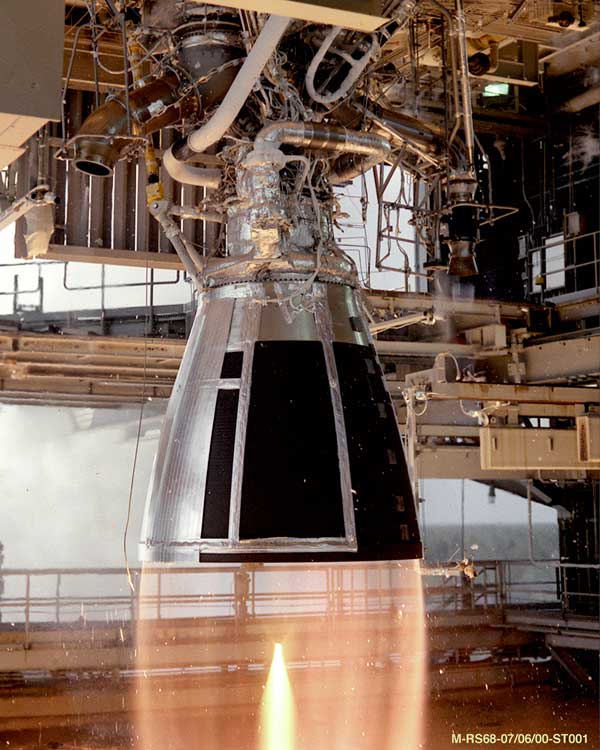
The RS-68 (Rocket System-68) was a liquid-fuel rocket engine that used liquid hydrogen (LH2) and liquid oxygen (LOX) as propellants in a gas-generator cycle. It was the largest hydrogen-fueled rocket engine ever flown.
Designed and manufactured in the United States by Rocketdyne (later Pratt & Whitney Rocketdyne and Aerojet Rocketdyne). Development started in the 1990s with the goal of producing a simpler, less costly, heavy-lift engine for the Delta IV launch system. Two versions of the engine have been produced: the original RS-68 and the improved RS-68A. A third version, the RS-68B, was planned for the National Aeronautics and Space Administration's (NASA) Ares V rocket before the cancellation of the rocket and the Constellation Program in 2010.
One of the main goals of the RS-68 program was to produce a simple engine that would be cost-effective when used for a single launch. To achieve this, the RS-68 has 80% fewer parts than the multi-launch RS-25 Space Shuttle Main Engine (SSME). The adverse consequences of this simplicity were a significantly lower thrust-to-weight ratio and a 10% lower specific impulse compared to the SSME. The benefit of this simplicity is the RS-68's reduced construction cost.
The RS-68 was developed at Rocketdyne Propulsion and Power, located in Canoga Park, Los Angeles, California, where the SSME was manufactured. It was designed to power the Delta IV Evolved Expendable Launch Vehicle (EELV). The initial development engines were assembled at the nearby Santa Susana Field Laboratory where the Saturn V's Rocketdyne F-1 engines were developed and tested for the Apollo missions to the Moon. The initial testing of the RS-68 occurred at the Air Force Research Laboratory (AFRL), Edwards Air Force Base, California, and later at NASA's Stennis Space Center. The RS-68 was certified in December 2001 for use on Delta IV rockets.
An RS-68 was part of each Delta IV Common Booster Core. The largest of the launch vehicles, the Delta IV Heavy, used three CBCs mounted together.
The engine produced 758,000 pounds-force (3,370 kN) in a vacuum and 663,000 pounds-force (2,950 kN) at sea level. The engine's mass was 14,560 pounds (6,600 kg). With this thrust, the engine had a thrust-to-weight ratio of 51.2 and a specific impulse of 410 seconds (4.0 km/s) in a vacuum and 365 seconds (3.58 km/s) at sea level. The RS-68 was gimbaled hydraulically and was capable of throttling between 58% and 102% thrust.
The RS-68A is an updated version of the RS-68, with increased specific impulse and thrust (to over 700,000 pounds-force (3,100 kN) at sea level). The first launch on 29 June 2012, from the Cape Canaveral Air Force Station used three RS-68A engines mounted in a Delta IV Heavy rocket.
The RS-68 was retired as of the last Delta IV Heavy flight in April 2024.
Hub AI
RS-68 AI simulator
(@RS-68_simulator)
RS-68
The RS-68 (Rocket System-68) was a liquid-fuel rocket engine that used liquid hydrogen (LH2) and liquid oxygen (LOX) as propellants in a gas-generator cycle. It was the largest hydrogen-fueled rocket engine ever flown.
Designed and manufactured in the United States by Rocketdyne (later Pratt & Whitney Rocketdyne and Aerojet Rocketdyne). Development started in the 1990s with the goal of producing a simpler, less costly, heavy-lift engine for the Delta IV launch system. Two versions of the engine have been produced: the original RS-68 and the improved RS-68A. A third version, the RS-68B, was planned for the National Aeronautics and Space Administration's (NASA) Ares V rocket before the cancellation of the rocket and the Constellation Program in 2010.
One of the main goals of the RS-68 program was to produce a simple engine that would be cost-effective when used for a single launch. To achieve this, the RS-68 has 80% fewer parts than the multi-launch RS-25 Space Shuttle Main Engine (SSME). The adverse consequences of this simplicity were a significantly lower thrust-to-weight ratio and a 10% lower specific impulse compared to the SSME. The benefit of this simplicity is the RS-68's reduced construction cost.
The RS-68 was developed at Rocketdyne Propulsion and Power, located in Canoga Park, Los Angeles, California, where the SSME was manufactured. It was designed to power the Delta IV Evolved Expendable Launch Vehicle (EELV). The initial development engines were assembled at the nearby Santa Susana Field Laboratory where the Saturn V's Rocketdyne F-1 engines were developed and tested for the Apollo missions to the Moon. The initial testing of the RS-68 occurred at the Air Force Research Laboratory (AFRL), Edwards Air Force Base, California, and later at NASA's Stennis Space Center. The RS-68 was certified in December 2001 for use on Delta IV rockets.
An RS-68 was part of each Delta IV Common Booster Core. The largest of the launch vehicles, the Delta IV Heavy, used three CBCs mounted together.
The engine produced 758,000 pounds-force (3,370 kN) in a vacuum and 663,000 pounds-force (2,950 kN) at sea level. The engine's mass was 14,560 pounds (6,600 kg). With this thrust, the engine had a thrust-to-weight ratio of 51.2 and a specific impulse of 410 seconds (4.0 km/s) in a vacuum and 365 seconds (3.58 km/s) at sea level. The RS-68 was gimbaled hydraulically and was capable of throttling between 58% and 102% thrust.
The RS-68A is an updated version of the RS-68, with increased specific impulse and thrust (to over 700,000 pounds-force (3,100 kN) at sea level). The first launch on 29 June 2012, from the Cape Canaveral Air Force Station used three RS-68A engines mounted in a Delta IV Heavy rocket.
The RS-68 was retired as of the last Delta IV Heavy flight in April 2024.