
Recent from talks
Rabbit-proof fence
Knowledge base stats:
Talk channels stats:
Members stats:
Rabbit-proof fence
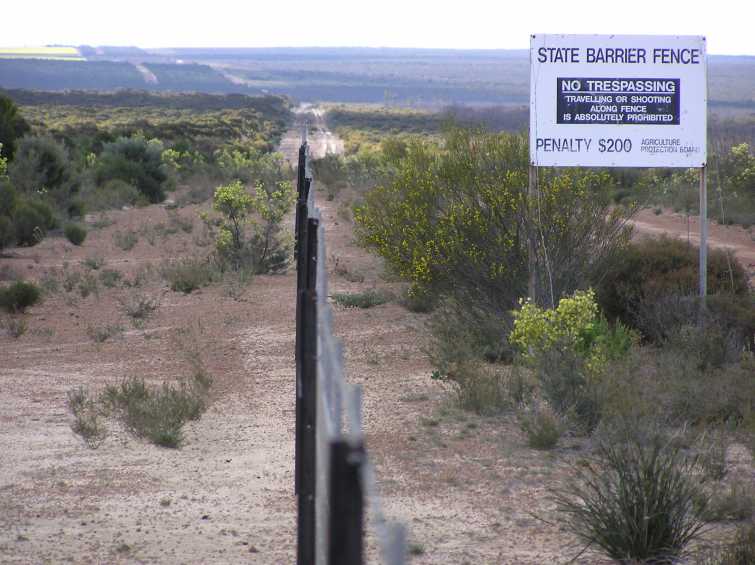
The State Barrier Fence, formerly known as the Rabbit-Proof Fence, the State Vermin Barrier Fence, and the Emu Fence, is a series of pest-exclusion fences originally constructed between 1902 and 1907 to keep rabbits and other agricultural pests from entering Western Australia from the east.
There are three fences in Western Australia: the original No. 1 Fence crosses the state from north to south, No. 2 Fence is smaller and further west, and No. 3 Fence is smaller still and runs east–west. The fences took six years to build. When completed, the rabbit-proof fence (including all three fences) stretched 3,256 kilometres (2,023 mi). The cost to build each kilometre of fence at the time was about $250 (equivalent to $42,000 in 2022).
When it was completed in 1907, the 1,833-kilometre (1,139 mi) No. 1 Fence was the longest unbroken fence in the world.
Rabbits were introduced to Australia by the First Fleet in 1788. They became a problem after October 1859, when Thomas Austin released 24 wild rabbits from England for hunting purposes, believing "The introduction of a few rabbits could do little harm and might provide a touch of home, in addition to a spot of hunting."
With virtually no local predators, the rabbits became extremely prolific and spread rapidly across the southern parts of the country. Australia had ideal conditions for an explosion in the rabbit population, which constituted an invasive species.
By 1887, agricultural losses from rabbit damage compelled the New South Wales Government to offer a £25,000 reward (equivalent to $3,900,000 in 2022) for "any method of success not previously known in the Colony for the effectual extermination of rabbits". A Royal Commission was held in 1901 to investigate the situation. It determined to build a pest-exclusion fence.
The fence posts are placed 12 ft (3.7 m) apart and have a minimum diameter of 4 in (100 mm). There were initially three wires of 12+1⁄2 gauge, strung 4 in (102 mm), 1 ft 8 in (0.5 m), and 3 ft (0.9 m) above ground, with a barbed wire added later at 3 ft 4 in (1.02 m) and a plain wire at 3 ft 7 in (1.1 m). To make the fence a barrier against dingoes and foxes as well, wire netting extending 6 in (150 mm) below ground, was attached to the wire.
The fence was constructed with a variety of materials, according to the local climate and availability of wood. At first, fence posts were made from salmon gum and gimlet, but they attracted termites (locally known as white ants) and had to be replaced. Split white gum was one of the best types of wood used in the fence. Other timbers used were mulga, wodjil, native pine, and tea-tree, depending on local availability. Iron posts were used where there was no wood. Most materials had to be hauled hundreds of kilometres from rail heads and ports by bullock, mule and camel teams.
Hub AI
Rabbit-proof fence AI simulator
(@Rabbit-proof fence_simulator)
Rabbit-proof fence
The State Barrier Fence, formerly known as the Rabbit-Proof Fence, the State Vermin Barrier Fence, and the Emu Fence, is a series of pest-exclusion fences originally constructed between 1902 and 1907 to keep rabbits and other agricultural pests from entering Western Australia from the east.
There are three fences in Western Australia: the original No. 1 Fence crosses the state from north to south, No. 2 Fence is smaller and further west, and No. 3 Fence is smaller still and runs east–west. The fences took six years to build. When completed, the rabbit-proof fence (including all three fences) stretched 3,256 kilometres (2,023 mi). The cost to build each kilometre of fence at the time was about $250 (equivalent to $42,000 in 2022).
When it was completed in 1907, the 1,833-kilometre (1,139 mi) No. 1 Fence was the longest unbroken fence in the world.
Rabbits were introduced to Australia by the First Fleet in 1788. They became a problem after October 1859, when Thomas Austin released 24 wild rabbits from England for hunting purposes, believing "The introduction of a few rabbits could do little harm and might provide a touch of home, in addition to a spot of hunting."
With virtually no local predators, the rabbits became extremely prolific and spread rapidly across the southern parts of the country. Australia had ideal conditions for an explosion in the rabbit population, which constituted an invasive species.
By 1887, agricultural losses from rabbit damage compelled the New South Wales Government to offer a £25,000 reward (equivalent to $3,900,000 in 2022) for "any method of success not previously known in the Colony for the effectual extermination of rabbits". A Royal Commission was held in 1901 to investigate the situation. It determined to build a pest-exclusion fence.
The fence posts are placed 12 ft (3.7 m) apart and have a minimum diameter of 4 in (100 mm). There were initially three wires of 12+1⁄2 gauge, strung 4 in (102 mm), 1 ft 8 in (0.5 m), and 3 ft (0.9 m) above ground, with a barbed wire added later at 3 ft 4 in (1.02 m) and a plain wire at 3 ft 7 in (1.1 m). To make the fence a barrier against dingoes and foxes as well, wire netting extending 6 in (150 mm) below ground, was attached to the wire.
The fence was constructed with a variety of materials, according to the local climate and availability of wood. At first, fence posts were made from salmon gum and gimlet, but they attracted termites (locally known as white ants) and had to be replaced. Split white gum was one of the best types of wood used in the fence. Other timbers used were mulga, wodjil, native pine, and tea-tree, depending on local availability. Iron posts were used where there was no wood. Most materials had to be hauled hundreds of kilometres from rail heads and ports by bullock, mule and camel teams.
Recent media