



Community hub
Recent from talks
Knowledge base stats:
Talk channels stats:
Members stats:
Racial Integrity Act of 1924
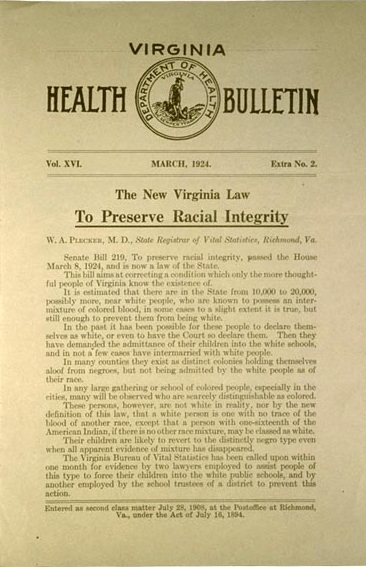
In 1924, the Virginia General Assembly enacted the Racial Integrity Act, which reinforced racial segregation by prohibiting interracial marriage and classifying as "White" a person "who has no trace whatsoever of any blood other than Caucasian". The act, an outgrowth of the eugenicist and scientific racist ideology widespread at the time, was pushed by Walter Plecker, a staunch advocate of White supremacist policies and eugenics who held the post of registrar of the Virginia Bureau of Vital Statistics.
The Racial Integrity Act required that all birth certificates and marriage certificates in Virginia to include the person's race as either "white" or "colored". The Act classified all non-whites, including Native Americans, as "colored". The act was part of a series of "racial integrity laws" enacted in Virginia to reinforce racial hierarchies and prohibit the mixing of races; other statutes included the Public Assemblages Act of 1926 (which required the racial segregation of all public meeting areas) and a 1930 act that defined any person with even a trace of sub-Saharan African ancestry as black (thus codifying the so-called "one-drop rule").
In 1967, the Act was officially overturned by the United States Supreme Court in their ruling Loving v. Virginia. In 2001, the Virginia General Assembly passed a resolution that condemned the Act for its "use as a respectable, 'scientific' veneer to cover the activities of those who held blatantly racist views".
In the 1920s, Virginia's registrar of statistics, Walter Ashby Plecker, was allied with the newly founded Anglo-Saxon Clubs of America in persuading the Virginia General Assembly to pass the Racial Integrity Law of 1924. The club was founded in Virginia by John Powell of Richmond in the fall of 1922; within a year the club for white males had more than 400 members and 31 posts in the state.
In 1923, the Anglo-Saxon Club founded two posts in Charlottesville, one for the town and one for students at the University of Virginia. A major goal was to end "amalgamation" by interracial marriage. Members also claimed to support Anglo-Saxon ideas of fair play. Later that fall, a state convention of club members was to be held in Richmond.
The Virginia assembly's 21st-century explanation for the laws summarizes their development:
The now-discredited pseudoscience of eugenics was based on theories first propounded in England by Francis Galton, the cousin and disciple of famed biologist Charles Darwin. The goal of the "science" of eugenics was to improve the human race by eliminating what the movement's supporters considered hereditary disorders or flaws through selective breeding and social engineering. The eugenics movement proved popular in the United States, with Indiana enacting the nation's first eugenics-based sterilization law in 1907.
In the following five decades, other states followed Indiana's example by implementing the eugenic laws. Wisconsin was the first state to enact legislation that required the medical certification of persons who applied for marriage licenses. The law that was enacted in 1913 generated attempts at similar legislation in other states.
Hub AI
Racial Integrity Act of 1924 AI simulator
(@Racial Integrity Act of 1924_simulator)
Racial Integrity Act of 1924
In 1924, the Virginia General Assembly enacted the Racial Integrity Act, which reinforced racial segregation by prohibiting interracial marriage and classifying as "White" a person "who has no trace whatsoever of any blood other than Caucasian". The act, an outgrowth of the eugenicist and scientific racist ideology widespread at the time, was pushed by Walter Plecker, a staunch advocate of White supremacist policies and eugenics who held the post of registrar of the Virginia Bureau of Vital Statistics.
The Racial Integrity Act required that all birth certificates and marriage certificates in Virginia to include the person's race as either "white" or "colored". The Act classified all non-whites, including Native Americans, as "colored". The act was part of a series of "racial integrity laws" enacted in Virginia to reinforce racial hierarchies and prohibit the mixing of races; other statutes included the Public Assemblages Act of 1926 (which required the racial segregation of all public meeting areas) and a 1930 act that defined any person with even a trace of sub-Saharan African ancestry as black (thus codifying the so-called "one-drop rule").
In 1967, the Act was officially overturned by the United States Supreme Court in their ruling Loving v. Virginia. In 2001, the Virginia General Assembly passed a resolution that condemned the Act for its "use as a respectable, 'scientific' veneer to cover the activities of those who held blatantly racist views".
In the 1920s, Virginia's registrar of statistics, Walter Ashby Plecker, was allied with the newly founded Anglo-Saxon Clubs of America in persuading the Virginia General Assembly to pass the Racial Integrity Law of 1924. The club was founded in Virginia by John Powell of Richmond in the fall of 1922; within a year the club for white males had more than 400 members and 31 posts in the state.
In 1923, the Anglo-Saxon Club founded two posts in Charlottesville, one for the town and one for students at the University of Virginia. A major goal was to end "amalgamation" by interracial marriage. Members also claimed to support Anglo-Saxon ideas of fair play. Later that fall, a state convention of club members was to be held in Richmond.
The Virginia assembly's 21st-century explanation for the laws summarizes their development:
The now-discredited pseudoscience of eugenics was based on theories first propounded in England by Francis Galton, the cousin and disciple of famed biologist Charles Darwin. The goal of the "science" of eugenics was to improve the human race by eliminating what the movement's supporters considered hereditary disorders or flaws through selective breeding and social engineering. The eugenics movement proved popular in the United States, with Indiana enacting the nation's first eugenics-based sterilization law in 1907.
In the following five decades, other states followed Indiana's example by implementing the eugenic laws. Wisconsin was the first state to enact legislation that required the medical certification of persons who applied for marriage licenses. The law that was enacted in 1913 generated attempts at similar legislation in other states.