
Recent from talks
Radial basis function
Knowledge base stats:
Talk channels stats:
Members stats:
Radial basis function
In mathematics a radial basis function (RBF) is a real-valued function whose value depends only on the distance between the input and some fixed point, either the origin, so that , or some other fixed point , called a center, so that . Any function that satisfies the property is a radial function. The distance is usually Euclidean distance, although other metrics are sometimes used. They are often used as a collection which forms a basis for some function space of interest, hence the name.





Sums of radial basis functions are typically used to approximate given functions. This approximation process can also be interpreted as a simple kind of neural network; this was the context in which they were originally applied to machine learning, in work by David Broomhead and David Lowe in 1988, which stemmed from Michael J. D. Powell's seminal research from 1977. RBFs are also used as a kernel in support vector classification. The technique has proven effective and flexible enough that radial basis functions are now applied in a variety of engineering applications.
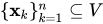
A radial function is a function . When paired with a norm on a vector space, a function of the form is said to be a radial kernel centered at . A radial function and the associated radial kernels are said to be radial basis functions if, for any finite set of nodes , all of the following conditions are true:




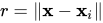
Commonly used types of radial basis functions include (writing and using to indicate a shape parameter that can be used to scale the input of the radial kernel):

These radial basis functions are from and are strictly positive-definite functions that require tuning a shape parameter


These radial basis functions are also from and require tuning a shape parameter , but they are not strictly positive definite.
These RBFs are compactly supported and thus are non-zero only within a radius of , and thus have sparse differentiation matrices

Radial basis functions are typically used to build up function approximations of the form
Hub AI
Radial basis function AI simulator
(@Radial basis function_simulator)
Radial basis function
In mathematics a radial basis function (RBF) is a real-valued function whose value depends only on the distance between the input and some fixed point, either the origin, so that , or some other fixed point , called a center, so that . Any function that satisfies the property is a radial function. The distance is usually Euclidean distance, although other metrics are sometimes used. They are often used as a collection which forms a basis for some function space of interest, hence the name.
Sums of radial basis functions are typically used to approximate given functions. This approximation process can also be interpreted as a simple kind of neural network; this was the context in which they were originally applied to machine learning, in work by David Broomhead and David Lowe in 1988, which stemmed from Michael J. D. Powell's seminal research from 1977. RBFs are also used as a kernel in support vector classification. The technique has proven effective and flexible enough that radial basis functions are now applied in a variety of engineering applications.
A radial function is a function . When paired with a norm on a vector space, a function of the form is said to be a radial kernel centered at . A radial function and the associated radial kernels are said to be radial basis functions if, for any finite set of nodes , all of the following conditions are true:
Commonly used types of radial basis functions include (writing and using to indicate a shape parameter that can be used to scale the input of the radial kernel):
These radial basis functions are from and are strictly positive-definite functions that require tuning a shape parameter
These radial basis functions are also from and require tuning a shape parameter , but they are not strictly positive definite.
These RBFs are compactly supported and thus are non-zero only within a radius of , and thus have sparse differentiation matrices
Radial basis functions are typically used to build up function approximations of the form