


Community hub
Recent from talks
Contribute something
Nothing was collected or created yet.
Metric space
View on Wikipedia


In mathematics, a metric space is a set together with a notion of distance between its elements, usually called points. The distance is measured by a function called a metric or distance function.[1] Metric spaces are a general setting for studying many of the concepts of mathematical analysis and geometry.
The most familiar example of a metric space is 3-dimensional Euclidean space with its usual notion of distance. Other well-known examples are a sphere equipped with the angular distance and the hyperbolic plane. A metric may correspond to a metaphorical, rather than physical, notion of distance: for example, the set of 100-character Unicode strings can be equipped with the Hamming distance, which measures the number of characters that need to be changed to get from one string to another.
Since they are very general, metric spaces are a tool used in many different branches of mathematics. Many types of mathematical objects have a natural notion of distance and therefore admit the structure of a metric space, including Riemannian manifolds, normed vector spaces, and graphs. In abstract algebra, the p-adic numbers arise as elements of the completion of a metric structure on the rational numbers. Metric spaces are also studied in their own right in metric geometry[2] and analysis on metric spaces.[3]
Many of the basic notions of mathematical analysis, including balls, completeness, as well as uniform, Lipschitz, and Hölder continuity, can be defined in the setting of metric spaces. Other notions, such as continuity, compactness, and open and closed sets, can be defined for metric spaces, but also in the even more general setting of topological spaces.
Definition and illustration
[edit]Motivation
[edit]
To see the utility of different notions of distance, consider the surface of the Earth as a set of points. We can measure the distance between two such points by the length of the shortest path along the surface, "as the crow flies"; this is particularly useful for shipping and aviation. We can also measure the straight-line distance between two points through the Earth's interior; this notion is, for example, natural in seismology, since it roughly corresponds to the length of time it takes for seismic waves to travel between those two points.
The notion of distance encoded by the metric space axioms has relatively few requirements. This generality gives metric spaces a lot of flexibility. At the same time, the notion is strong enough to encode many intuitive facts about what distance means. This means that general results about metric spaces can be applied in many different contexts.
Like many fundamental mathematical concepts, the metric on a metric space can be interpreted in many different ways. A particular metric may not be best thought of as measuring physical distance, but, instead, as the cost of changing from one state to another (as with Wasserstein metrics on spaces of measures) or the degree of difference between two objects (for example, the Hamming distance between two strings of characters, or the Gromov–Hausdorff distance between metric spaces themselves).
Definition
[edit]Formally, a metric space is an ordered pair (M, d) where M is a set and d is a metric on M, i.e., a functionsatisfying the following axioms for all points :[4][5]


- The distance from a point to itself is zero:
- (Positivity) The distance between two distinct points is always positive:
- (Symmetry) The distance from x to y is always the same as the distance from y to x:
- The triangle inequality holds: This is a natural property of both physical and metaphorical notions of distance: you can arrive at z from x by taking a detour through y, but this will not make your journey any shorter than the direct path.




If the metric d is unambiguous, one often refers by abuse of notation to "the metric space M".
By taking all axioms except the second, one can show that distance is always non-negative:Therefore the second axiom can be weakened to and combined with the first to make .[6]



Simple examples
[edit]The real numbers
[edit]The real numbers with the distance function given by the absolute difference form a metric space. Many properties of metric spaces and functions between them are generalizations of concepts in real analysis and coincide with those concepts when applied to the real line.

Metrics on Euclidean spaces
[edit]
The Euclidean plane can be equipped with many different metrics. The Euclidean distance familiar from school mathematics can be defined by


The taxicab or Manhattan distance is defined by and can be thought of as the distance you need to travel along horizontal and vertical lines to get from one point to the other, as illustrated at the top of the article.

The maximum, , or Chebyshev distance is defined by This distance does not have an easy explanation in terms of paths in the plane, but it still satisfies the metric space axioms. It can be thought of similarly to the number of moves a king would have to make on a chess board to travel from one point to another on the given space.


In fact, these three distances, while they have distinct properties, are similar in some ways. Informally, points that are close in one are close in the others, too. This observation can be quantified with the formula which holds for every pair of points .


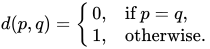
A radically different distance can be defined by setting Using Iverson brackets, In this discrete metric, all distinct points are 1 unit apart: none of them are close to each other, and none of them are very far away from each other either. Intuitively, the discrete metric no longer remembers that the set is a plane, but treats it just as an undifferentiated set of points.
![{\displaystyle d(p,q)=[p\neq q]}](https://wikimedia.org/api/rest_v1/media/math/render/svg/e025bbb02a33d44a0c2373007bd8e878240f2dc4)
All of these metrics can be easily extended to make sense on as well as .

Subspaces
[edit]Given a metric space (M, d) and a subset , we can consider A to be a metric space by measuring distances the same way we would in M. Formally, the induced metric on A is a function defined by For example, if we take the two-dimensional sphere S2 as a subset of , the Euclidean metric on induces the straight-line metric on S2 described above. Two more useful examples are the open interval (0, 1) and the closed interval [0, 1] thought of as subspaces of the real line.




History
[edit]Arthur Cayley, in his article "On Distance", extended metric concepts beyond Euclidean geometry into domains bounded by a conic in a projective space. His distance was given by logarithm of a cross ratio. Any projectivity leaving the conic stable also leaves the cross ratio constant, so isometries are implicit. This method provides models for elliptic geometry and hyperbolic geometry, and Felix Klein, in several publications, established the field of non-euclidean geometry through the use of the Cayley-Klein metric.
The idea of an abstract space with metric properties was addressed in 1906 by René Maurice Fréchet[7] and the term metric space was coined by Felix Hausdorff in 1914.[8][9][10]
Fréchet's work laid the foundation for understanding convergence, continuity, and other key concepts in non-geometric spaces. This allowed mathematicians to study functions and sequences in a broader and more flexible way. This was important for the growing field of functional analysis. Mathematicians like Hausdorff and Stefan Banach further refined and expanded the framework of metric spaces. Hausdorff introduced topological spaces as a generalization of metric spaces. Banach's work in functional analysis heavily relied on the metric structure. Over time, metric spaces became a central part of modern mathematics. They have influenced various fields including topology, geometry, and applied mathematics. Metric spaces continue to play a crucial role in the study of abstract mathematical concepts.
Basic notions
[edit]A distance function is enough to define notions of closeness and convergence that were first developed in real analysis. Properties that depend on the structure of a metric space are referred to as metric properties. Every metric space is also a topological space, and some metric properties can also be rephrased without reference to distance in the language of topology; that is, they are really topological properties.
The topology of a metric space
[edit]For any point x in a metric space M and any real number r > 0, the open ball of radius r around x is defined to be the set of points that are strictly less than distance r from x: This is a natural way to define a set of points that are relatively close to x. Therefore, a set is a neighborhood of x (informally, it contains all points "close enough" to x) if it contains an open ball of radius r around x for some r > 0.


An open set is a set which is a neighborhood of all its points. It follows that the open balls form a base for a topology on M. In other words, the open sets of M are exactly the unions of open balls. As in any topology, closed sets are the complements of open sets. Sets may be both open and closed as well as neither open nor closed.
This topology does not carry all the information about the metric space. For example, the distances d1, d2, and d∞ defined above all induce the same topology on , although they behave differently in many respects. Similarly, with the Euclidean metric and its subspace the interval (0, 1) with the induced metric are homeomorphic but have very different metric properties.

Conversely, not every topological space can be given a metric. Topological spaces which are compatible with a metric are called metrizable and are particularly well-behaved in many ways: in particular, they are paracompact[11] Hausdorff spaces (hence normal) and first-countable.[a] The Nagata–Smirnov metrization theorem gives a characterization of metrizability in terms of other topological properties, without reference to metrics.
Convergence
[edit]Convergence of sequences in Euclidean space is defined as follows:
- A sequence (xn) converges to a point x if for every ε > 0 there is an integer N such that for all n > N, d(xn, x) < ε.
Convergence of sequences in a topological space is defined as follows:
- A sequence (xn) converges to a point x if for every open set U containing x there is an integer N such that for all n > N, .

In metric spaces, both of these definitions make sense and they are equivalent. This is a general pattern for topological properties of metric spaces: while they can be defined in a purely topological way, there is often a way that uses the metric which is easier to state or more familiar from real analysis.
Completeness
[edit]Informally, a metric space is complete if it has no "missing points": every sequence that looks like it should converge to something actually converges.
To make this precise: a sequence (xn) in a metric space M is Cauchy if for every ε > 0 there is an integer N such that for all m, n > N, d(xm, xn) < ε. By the triangle inequality, any convergent sequence is Cauchy: if xm and xn are both less than ε away from the limit, then they are less than 2ε away from each other. If the converse is true—every Cauchy sequence in M converges—then M is complete.
Euclidean spaces are complete, as is with the other metrics described above. Two examples of spaces which are not complete are (0, 1) and the rationals, each with the metric induced from . One can think of (0, 1) as "missing" its endpoints 0 and 1. The rationals are missing all the irrationals, since any irrational has a sequence of rationals converging to it in (for example, its successive decimal approximations). These examples show that completeness is not a topological property, since is complete but the homeomorphic space (0, 1) is not.
This notion of "missing points" can be made precise. In fact, every metric space has a unique completion, which is a complete space that contains the given space as a dense subset. For example, [0, 1] is the completion of (0, 1), and the real numbers are the completion of the rationals.
Since complete spaces are generally easier to work with, completions are important throughout mathematics. For example, in abstract algebra, the p-adic numbers are defined as the completion of the rationals under a different metric. Completion is particularly common as a tool in functional analysis. Often one has a set of nice functions and a way of measuring distances between them. Taking the completion of this metric space gives a new set of functions which may be less nice, but nevertheless useful because they behave similarly to the original nice functions in important ways. For example, weak solutions to differential equations typically live in a completion (a Sobolev space) rather than the original space of nice functions for which the differential equation actually makes sense.
Bounded and totally bounded spaces
[edit]
A metric space M is bounded if there is an r such that no pair of points in M is more than distance r apart.[b] The least such r is called the diameter of M.
The space M is called precompact or totally bounded if for every r > 0 there is a finite cover of M by open balls of radius r. Every totally bounded space is bounded. To see this, start with a finite cover by r-balls for some arbitrary r. Since the subset of M consisting of the centers of these balls is finite, it has finite diameter, say D. By the triangle inequality, the diameter of the whole space is at most D + 2r. The converse does not hold: an example of a metric space that is bounded but not totally bounded is (or any other infinite set) with the discrete metric.
Compactness
[edit]Compactness is a topological property which generalizes the properties of a closed and bounded subset of Euclidean space. There are several equivalent definitions of compactness in metric spaces:
- A metric space M is compact if every open cover has a finite subcover (the usual topological definition).
- A metric space M is compact if every sequence has a convergent subsequence. (For general topological spaces this is called sequential compactness and is not equivalent to compactness.)
- A metric space M is compact if it is complete and totally bounded. (This definition is written in terms of metric properties and does not make sense for a general topological space, but it is nevertheless topologically invariant since it is equivalent to compactness.)
One example of a compact space is the closed interval [0, 1].
Compactness is important for similar reasons to completeness: it makes it easy to find limits. Another important tool is Lebesgue's number lemma, which shows that for any open cover of a compact space, every point is relatively deep inside one of the sets of the cover.
Functions between metric spaces
[edit]
Unlike in the case of topological spaces or algebraic structures such as groups or rings, there is no single "right" type of structure-preserving function between metric spaces. Instead, one works with different types of functions depending on one's goals. Throughout this section, suppose that and are two metric spaces. The words "function" and "map" are used interchangeably.


Isometries
[edit]One interpretation of a "structure-preserving" map is one that fully preserves the distance function:
- A function is distance-preserving[12] if for every pair of points x and y in M1,


It follows from the metric space axioms that a distance-preserving function is injective. A bijective distance-preserving function is called an isometry.[13] One perhaps non-obvious example of an isometry between spaces described in this article is the map defined by


If there is an isometry between the spaces M1 and M2, they are said to be isometric. Metric spaces that are isometric are essentially identical.
Continuous maps
[edit]On the other end of the spectrum, one can forget entirely about the metric structure and study continuous maps, which only preserve topological structure. There are several equivalent definitions of continuity for metric spaces. The most important are:
- Topological definition. A function is continuous if for every open set U in M2, the preimage is open.
- Sequential continuity. A function is continuous if whenever a sequence (xn) converges to a point x in M1, the sequence converges to the point f(x) in M2.



- (These first two definitions are not equivalent for all topological spaces.)
- ε–δ definition. A function is continuous if for every point x in M1 and every ε > 0 there exists δ > 0 such that for all y in M1 we have

A homeomorphism is a continuous bijection whose inverse is also continuous; if there is a homeomorphism between M1 and M2, they are said to be homeomorphic. Homeomorphic spaces are the same from the point of view of topology, but may have very different metric properties. For example, is unbounded and complete, while (0, 1) is bounded but not complete.
Uniformly continuous maps
[edit]A function is uniformly continuous if for every real number ε > 0 there exists δ > 0 such that for all points x and y in M1 such that , we have


The only difference between this definition and the ε–δ definition of continuity is the order of quantifiers: the choice of δ must depend only on ε and not on the point x. However, this subtle change makes a big difference. For example, uniformly continuous maps take Cauchy sequences in M1 to Cauchy sequences in M2. In other words, uniform continuity preserves some metric properties which are not purely topological.
On the other hand, the Heine–Cantor theorem states that if M1 is compact, then every continuous map is uniformly continuous. In other words, uniform continuity cannot distinguish any non-topological features of compact metric spaces.
Lipschitz maps and contractions
[edit]A Lipschitz map is one that stretches distances by at most a bounded factor. Formally, given a real number K > 0, the map is K-Lipschitz if Lipschitz maps are particularly important in metric geometry, since they provide more flexibility than distance-preserving maps, but still make essential use of the metric.[14] For example, a curve in a metric space is rectifiable (has finite length) if and only if it has a Lipschitz reparametrization.

A 1-Lipschitz map is sometimes called a nonexpanding or metric map. Metric maps are commonly taken to be the morphisms of the category of metric spaces.
A K-Lipschitz map for K < 1 is called a contraction. The Banach fixed-point theorem states that if M is a complete metric space, then every contraction admits a unique fixed point. If the metric space M is compact, the result holds for a slightly weaker condition on f: a map admits a unique fixed point if


Quasi-isometries
[edit]A quasi-isometry is a map that preserves the "large-scale structure" of a metric space. Quasi-isometries need not be continuous. For example, and its subspace are quasi-isometric, even though one is connected and the other is discrete. The equivalence relation of quasi-isometry is important in geometric group theory: the Švarc–Milnor lemma states that all spaces on which a group acts geometrically are quasi-isometric.[15]

Formally, the map is a quasi-isometric embedding if there exist constants A ≥ 1 and B ≥ 0 such that It is a quasi-isometry if in addition it is quasi-surjective, i.e. there is a constant C ≥ 0 such that every point in is at distance at most C from some point in the image .



Notions of metric space equivalence
[edit]Given two metric spaces and :
- They are called homeomorphic (topologically isomorphic) if there is a homeomorphism between them (i.e., a continuous bijection with a continuous inverse). If and the identity map is a homeomorphism, then and are said to be topologically equivalent.
- They are called uniformic (uniformly isomorphic) if there is a uniform isomorphism between them (i.e., a uniformly continuous bijection with a uniformly continuous inverse).
- They are called bilipschitz homeomorphic if there is a bilipschitz bijection between them (i.e., a Lipschitz bijection with a Lipschitz inverse).
- They are called isometric if there is a (bijective) isometry between them. In this case, the two metric spaces are essentially identical.
- They are called quasi-isometric if there is a quasi-isometry between them.


Metric spaces with additional structure
[edit]Normed vector spaces
[edit]
A normed vector space is a vector space equipped with a norm, which is a function that measures the length of vectors. The norm of a vector v is typically denoted by . Any normed vector space can be equipped with a metric in which the distance between two vectors x and y is given by The metric d is said to be induced by the norm .


Conversely,[16] if a metric d on a vector space X is
- translation invariant: for every x, y, and a in X; and
- absolutely homogeneous: for every x and y in X and real number α;


then is a norm induced by the metric. A similar relationship holds between seminorms and pseudometrics.

Among examples of metrics induced by a norm are the metrics d1, d2, and d∞ on , which are induced by the Manhattan norm, the Euclidean norm, and the maximum norm, respectively. More generally, the Kuratowski embedding allows one to see any metric space as a subspace of a normed vector space.
Infinite-dimensional normed vector spaces, particularly spaces of functions, are studied in functional analysis. Completeness is particularly important in this context: a complete normed vector space is known as a Banach space. An unusual property of normed vector spaces is that linear transformations between them are continuous if and only if they are Lipschitz. Such transformations are known as bounded operators.
Length spaces
[edit]
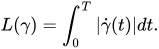
A curve in a metric space (M, d) is a continuous function . The length of γ is measured by In general, this supremum may be infinite; a curve of finite length is called rectifiable.[17] Suppose that the length of the curve γ is equal to the distance between its endpoints—that is, it is the shortest possible path between its endpoints. After reparametrization by arc length, γ becomes a geodesic: a curve which is a distance-preserving function.[15] A geodesic is a shortest possible path between any two of its points.[c]
![{\displaystyle \gamma :[0,T]\to M}](https://wikimedia.org/api/rest_v1/media/math/render/svg/f51598fa2d3e48c963d4e56c0af969afaa51f549)

A geodesic metric space is a metric space which admits a geodesic between any two of its points. The spaces and are both geodesic metric spaces. In , geodesics are unique, but in , there are often infinitely many geodesics between two points, as shown in the figure at the top of the article.


The space M is a length space (or the metric d is intrinsic) if the distance between any two points x and y is the infimum of lengths of paths between them. Unlike in a geodesic metric space, the infimum does not have to be attained. An example of a length space which is not geodesic is the Euclidean plane minus the origin: the points (1, 0) and (-1, 0) can be joined by paths of length arbitrarily close to 2, but not by a path of length 2. An example of a metric space which is not a length space is given by the straight-line metric on the sphere: the straight line between two points through the center of the Earth is shorter than any path along the surface.
Given any metric space (M, d), one can define a new, intrinsic distance function dintrinsic on M by setting the distance between points x and y to be the infimum of the d-lengths of paths between them. For instance, if d is the straight-line distance on the sphere, then dintrinsic is the great-circle distance. However, in some cases dintrinsic may have infinite values. For example, if M is the Koch snowflake with the subspace metric d induced from , then the resulting intrinsic distance is infinite for any pair of distinct points.
Riemannian manifolds
[edit]A Riemannian manifold is a space equipped with a Riemannian metric tensor, which determines lengths of tangent vectors at every point. This can be thought of defining a notion of distance infinitesimally. In particular, a differentiable path in a Riemannian manifold M has length defined as the integral of the length of the tangent vector to the path: On a connected Riemannian manifold, one then defines the distance between two points as the infimum of lengths of smooth paths between them. This construction generalizes to other kinds of infinitesimal metrics on manifolds, such as sub-Riemannian and Finsler metrics.
The Riemannian metric is uniquely determined by the distance function; this means that in principle, all information about a Riemannian manifold can be recovered from its distance function. One direction in metric geometry is finding purely metric ("synthetic") formulations of properties of Riemannian manifolds. For example, a Riemannian manifold is a CAT(k) space (a synthetic condition which depends purely on the metric) if and only if its sectional curvature is bounded above by k.[20] Thus CAT(k) spaces generalize upper curvature bounds to general metric spaces.
Metric measure spaces
[edit]Real analysis makes use of both the metric on and the Lebesgue measure. Therefore, generalizations of many ideas from analysis naturally reside in metric measure spaces: spaces that have both a measure and a metric which are compatible with each other. Formally, a metric measure space is a metric space equipped with a Borel regular measure such that every ball has positive measure.[21] For example Euclidean spaces of dimension n, and more generally n-dimensional Riemannian manifolds, naturally have the structure of a metric measure space, equipped with the Lebesgue measure. Certain fractal metric spaces such as the Sierpiński gasket can be equipped with the α-dimensional Hausdorff measure where α is the Hausdorff dimension. In general, however, a metric space may not have an "obvious" choice of measure.
One application of metric measure spaces is generalizing the notion of Ricci curvature beyond Riemannian manifolds. Just as CAT(k) and Alexandrov spaces generalize sectional curvature bounds, RCD spaces are a class of metric measure spaces which generalize lower bounds on Ricci curvature.[22]
Further examples and applications
[edit]Graphs and finite metric spaces
[edit]A metric space is discrete if its induced topology is the discrete topology. Although many concepts, such as completeness and compactness, are not interesting for such spaces, they are nevertheless an object of study in several branches of mathematics. In particular, finite metric spaces (those having a finite number of points) are studied in combinatorics and theoretical computer science.[23] Embeddings in other metric spaces are particularly well-studied. For example, not every finite metric space can be isometrically embedded in a Euclidean space or in Hilbert space. On the other hand, in the worst case the required distortion (bilipschitz constant) is only logarithmic in the number of points.[24][25]
For any undirected connected graph G, the set V of vertices of G can be turned into a metric space by defining the distance between vertices x and y to be the length of the shortest edge path connecting them. In graph theory, this is also called the shortest-path distance or geodesic distance. In geometric group theory this construction is applied to the Cayley graph of a (typically infinite) finitely-generated group, yielding the word metric. Up to a bilipschitz homeomorphism, the word metric depends only on the group and not on the chosen finite generating set.[15]
Metric embeddings and approximations
[edit]An important area of study in finite metric spaces is the embedding of complex metric spaces into simpler ones while controlling the distortion of distances. This is particularly useful in computer science and discrete mathematics, where algorithms often perform more efficiently on simpler structures like tree metrics.
A significant result in this area is that any finite metric space can be probabilistically embedded into a tree metric with an expected distortion of , where is the number of points in the metric space.[26]


This embedding is notable because it achieves the best possible asymptotic bound on distortion, matching the lower bound of . The tree metrics produced in this embedding dominate the original metrics, meaning that distances in the tree are greater than or equal to those in the original space. This property is particularly useful for designing approximation algorithms, as it allows for the preservation of distance-related properties while simplifying the underlying structure.

The result has significant implications for various computational problems:
- Network design: Improves approximation algorithms for problems like the Group Steiner tree problem (a generalization of the Steiner tree problem) and Buy-at-bulk network design (a problem in Network planning and design) by simplifying the metric space to a tree metric.
- Clustering: Enhances algorithms for clustering problems where hierarchical clustering can be performed more efficiently on tree metrics.
- Online algorithms: Benefits problems like the k-server problem and metrical task system by providing better competitive ratios through simplified metrics.
The technique involves constructing a hierarchical decomposition of the original metric space and converting it into a tree metric via a randomized algorithm. The distortion bound has led to improved approximation ratios in several algorithmic problems, demonstrating the practical significance of this theoretical result.
Distances between mathematical objects
[edit]In modern mathematics, one often studies spaces whose points are themselves mathematical objects. A distance function on such a space generally aims to measure the dissimilarity between two objects. Here are some examples:
- Functions to a metric space. If X is any set and M is a metric space, then the set of all bounded functions (i.e. those functions whose image is a bounded subset of ) can be turned into a metric space by defining the distance between two bounded functions f and g to be This metric is called the uniform metric or supremum metric.[27] If M is complete, then this function space is complete as well; moreover, if X is also a topological space, then the subspace consisting of all bounded continuous functions from X to M is also complete. When X is a subspace of , this function space is known as a classical Wiener space.
- String metrics and edit distances. There are many ways of measuring distances between strings of characters, which may represent sentences in computational linguistics or code words in coding theory. Edit distances attempt to measure the number of changes necessary to get from one string to another. For example, the Hamming distance measures the minimal number of substitutions needed, while the Levenshtein distance measures the minimal number of deletions, insertions, and substitutions; both of these can be thought of as distances in an appropriate graph.
- Graph edit distance is a measure of dissimilarity between two graphs, defined as the minimal number of graph edit operations required to transform one graph into another.
- Wasserstein metrics measure the distance between two measures on the same metric space. The Wasserstein distance between two measures is, roughly speaking, the cost of transporting one to the other.
- The set of all m by n matrices over some field is a metric space with respect to the rank distance .
- The Helly metric in game theory measures the difference between strategies in a game.




Hausdorff and Gromov–Hausdorff distance
[edit]The idea of spaces of mathematical objects can also be applied to subsets of a metric space, as well as metric spaces themselves. Hausdorff and Gromov–Hausdorff distance define metrics on the set of compact subsets of a metric space and the set of compact metric spaces, respectively.
Suppose (M, d) is a metric space, and let S be a subset of M. The distance from S to a point x of M is, informally, the distance from x to the closest point of S. However, since there may not be a single closest point, it is defined via an infimum: In particular, if and only if x belongs to the closure of S. Furthermore, distances between points and sets satisfy a version of the triangle inequality: and therefore the map defined by is continuous. Incidentally, this shows that metric spaces are completely regular.





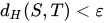
Given two subsets S and T of M, their Hausdorff distance is Informally, two sets S and T are close to each other in the Hausdorff distance if no element of S is too far from T and vice versa. For example, if S is an open set in Euclidean space T is an ε-net inside S, then . In general, the Hausdorff distance can be infinite or zero. However, the Hausdorff distance between two distinct compact sets is always positive and finite. Thus the Hausdorff distance defines a metric on the set of compact subsets of M.


The Gromov–Hausdorff metric defines a distance between (isometry classes of) compact metric spaces. The Gromov–Hausdorff distance between compact spaces X and Y is the infimum of the Hausdorff distance over all metric spaces Z that contain X and Y as subspaces. While the exact value of the Gromov–Hausdorff distance is rarely useful to know, the resulting topology has found many applications.
Miscellaneous examples
[edit]- Given a metric space (X, d) and an increasing concave function such that f(t) = 0 if and only if t = 0, then is also a metric on X. If f(t) = tα for some real number α < 1, such a metric is known as a snowflake of d.[28]
- The tight span of a metric space is another metric space which can be thought of as an abstract version of the convex hull.
- The knight's move metric, the minimal number of knight's moves to reach one point in from another, is a metric on .
- The British Rail metric (also called the "post office metric" or the "French railway metric") on a normed vector space is given by for distinct points and , and . More generally can be replaced with a function taking an arbitrary set to non-negative reals and taking the value at most once: then the metric is defined on by for distinct points and , and . The name alludes to the tendency of railway journeys to proceed via London (or Paris) irrespective of their final destination.
- The Robinson–Foulds metric used for calculating the distances between Phylogenetic trees in Phylogenetics[29]





Constructions
[edit]Product metric spaces
[edit]If are metric spaces, and N is the Euclidean norm on , then is a metric space, where the product metric is defined by and the induced topology agrees with the product topology. By the equivalence of norms in finite dimensions, a topologically equivalent metric is obtained if N is the taxicab norm, a p-norm, the maximum norm, or any other norm which is non-decreasing as the coordinates of a positive n-tuple increase (yielding the triangle inequality).



Similarly, a metric on the topological product of countably many metric spaces can be obtained using the metric
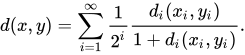
The topological product of uncountably many metric spaces need not be metrizable. For example, an uncountable product of copies of is not first-countable and thus is not metrizable.
Quotient metric spaces
[edit]If M is a metric space with metric d, and is an equivalence relation on M, then we can endow the quotient set with a pseudometric. The distance between two equivalence classes and is defined as where the infimum is taken over all finite sequences and with , , .[30] In general this will only define a pseudometric, i.e. does not necessarily imply that . However, for some equivalence relations (e.g., those given by gluing together polyhedra along faces), is a metric.


![{\displaystyle [x]}](https://wikimedia.org/api/rest_v1/media/math/render/svg/07548563c21e128890501e14eb7c80ee2d6fda4d)
![{\displaystyle [y]}](https://wikimedia.org/api/rest_v1/media/math/render/svg/f637a17dac262ee0fc8d58e31d08ca3ebe5a0fed)
![{\displaystyle d'([x],[y])=\inf\{d(p_{1},q_{1})+d(p_{2},q_{2})+\dotsb +d(p_{n},q_{n})\},}](https://wikimedia.org/api/rest_v1/media/math/render/svg/c12948e3aa74a8510139fedcafd35cc2844a73d4)





![{\displaystyle d'([x],[y])=0}](https://wikimedia.org/api/rest_v1/media/math/render/svg/4f0686af91a21fdf1ed41059fa39ffbbe883bd4f)
![{\displaystyle [x]=[y]}](https://wikimedia.org/api/rest_v1/media/math/render/svg/9c34866e2a1216182b168dc1e272b0b02f1aab3a)

The quotient metric is characterized by the following universal property. If is a metric (i.e. 1-Lipschitz) map between metric spaces satisfying f(x) = f(y) whenever , then the induced function , given by , is a metric map


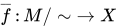
![{\displaystyle {\overline {f}}([x])=f(x)}](https://wikimedia.org/api/rest_v1/media/math/render/svg/aa40e344823d6033e5b82eaf6f31f3a562c6c9c6)

The quotient metric does not always induce the quotient topology. For example, the topological quotient of the metric space identifying all points of the form is not metrizable since it is not first-countable, but the quotient metric is a well-defined metric on the same set which induces a coarser topology. Moreover, different metrics on the original topological space (a disjoint union of countably many intervals) lead to different topologies on the quotient.[31]
![{\displaystyle \mathbb {N} \times [0,1]}](https://wikimedia.org/api/rest_v1/media/math/render/svg/0c5ec3356c30166cf0b83c98cb406ee5517cb93c)

A topological space is sequential if and only if it is a (topological) quotient of a metric space.[32]
Generalizations of metric spaces
[edit]There are several notions of spaces which have less structure than a metric space, but more than a topological space.
- Uniform spaces are spaces in which distances are not defined, but uniform continuity is.
- Approach spaces are spaces in which point-to-set distances are defined, instead of point-to-point distances. They have particularly good properties from the point of view of category theory.
- Continuity spaces are a generalization of metric spaces and posets that can be used to unify the notions of metric spaces and domains.
There are also numerous ways of relaxing the axioms for a metric, giving rise to various notions of generalized metric spaces. These generalizations can also be combined. The terminology used to describe them is not completely standardized. Most notably, in functional analysis pseudometrics often come from seminorms on vector spaces, and so it is natural to call them "semimetrics". This conflicts with the use of the term in topology.
Extended metrics
[edit]Some authors define metrics so as to allow the distance function d to attain the value ∞, i.e. distances are non-negative numbers on the extended real number line.[4] Such a function is also called an extended metric or "∞-metric". Every extended metric can be replaced by a real-valued metric that is topologically equivalent. This can be done using a subadditive monotonically increasing bounded function which is zero at zero, e.g. or .


Metrics valued in structures other than the real numbers
[edit]The requirement that the metric take values in can be relaxed to consider metrics with values in other structures, including:

- Ordered fields, yielding the notion of a generalised metric.
- More general directed sets. In the absence of an addition operation, the triangle inequality does not make sense and is replaced with an ultrametric inequality. This leads to the notion of a generalized ultrametric.[33]
These generalizations still induce a uniform structure on the space.
Pseudometrics
[edit]A pseudometric on is a function which satisfies the axioms for a metric, except that instead of the second (identity of indiscernibles) only for all is required.[34] In other words, the axioms for a pseudometric are:


- .

In some contexts, pseudometrics are referred to as semimetrics[35] because of their relation to seminorms.
Quasimetrics
[edit]Occasionally, a quasimetric is defined as a function that satisfies all axioms for a metric with the possible exception of symmetry.[36] The name of this generalisation is not entirely standardized.[37]

Quasimetrics are common in real life. For example, given a set X of mountain villages, the typical walking times between elements of X form a quasimetric because travel uphill takes longer than travel downhill. Another example is the length of car rides in a city with one-way streets: here, a shortest path from point A to point B goes along a different set of streets than a shortest path from B to A and may have a different length.
A quasimetric on the reals can be defined by setting The 1 may be replaced, for example, by infinity or by or any other subadditive function of y-x. This quasimetric describes the cost of modifying a metal stick: it is easy to reduce its size by filing it down, but it is difficult or impossible to grow it.
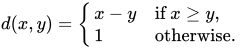

Given a quasimetric on X, one can define an R-ball around x to be the set . As in the case of a metric, such balls form a basis for a topology on X, but this topology need not be metrizable. For example, the topology induced by the quasimetric on the reals described above is the (reversed) Sorgenfrey line.

Metametrics or partial metrics
[edit]In a metametric, all the axioms of a metric are satisfied except that the distance between identical points is not necessarily zero. In other words, the axioms for a metametric are:


Metametrics appear in the study of Gromov hyperbolic metric spaces and their boundaries. The visual metametric on such a space satisfies for points on the boundary, but otherwise is approximately the distance from to the boundary. Metametrics were first defined by Jussi Väisälä.[38] In other work, a function satisfying these axioms is called a partial metric[39][40] or a dislocated metric.[34]

Semimetrics
[edit]A semimetric on is a function that satisfies the first three axioms, but not necessarily the triangle inequality:
Some authors work with a weaker form of the triangle inequality, such as:
ρ-relaxed triangle inequality ρ-inframetric inequality


The ρ-inframetric inequality implies the ρ-relaxed triangle inequality (assuming the first axiom), and the ρ-relaxed triangle inequality implies the 2ρ-inframetric inequality. Semimetrics satisfying these equivalent conditions have sometimes been referred to as quasimetrics,[41] nearmetrics[42] or inframetrics.[43]
The ρ-inframetric inequalities were introduced to model round-trip delay times in the internet.[43] The triangle inequality implies the 2-inframetric inequality, and the ultrametric inequality is exactly the 1-inframetric inequality.
Premetrics
[edit]Relaxing the last three axioms leads to the notion of a premetric, i.e. a function satisfying the following conditions:
This is not a standard term. Sometimes it is used to refer to other generalizations of metrics such as pseudosemimetrics[44] or pseudometrics;[45] in translations of Russian books it sometimes appears as "prametric".[46] A premetric that satisfies symmetry, i.e. a pseudosemimetric, is also called a distance.[47]
Any premetric gives rise to a topology as follows. For a positive real , the -ball centered at a point is defined as



A set is called open if for any point in the set there is an -ball centered at which is contained in the set. Every premetric space is a topological space, and in fact a sequential space. In general, the -balls themselves need not be open sets with respect to this topology. As for metrics, the distance between two sets and , is defined as



This defines a premetric on the power set of a premetric space. If we start with a (pseudosemi-)metric space, we get a pseudosemimetric, i.e. a symmetric premetric. Any premetric gives rise to a preclosure operator as follows:


Pseudoquasimetrics
[edit]The prefixes pseudo-, quasi- and semi- can also be combined, e.g., a pseudoquasimetric (sometimes called hemimetric) relaxes both the indiscernibility axiom and the symmetry axiom and is simply a premetric satisfying the triangle inequality. For pseudoquasimetric spaces the open -balls form a basis of open sets. A very basic example of a pseudoquasimetric space is the set with the premetric given by and The associated topological space is the Sierpiński space.


Sets equipped with an extended pseudoquasimetric were studied by William Lawvere as "generalized metric spaces".[48] From a categorical point of view, the extended pseudometric spaces and the extended pseudoquasimetric spaces, along with their corresponding nonexpansive maps, are the best behaved of the metric space categories. One can take arbitrary products and coproducts and form quotient objects within the given category. If one drops "extended", one can only take finite products and coproducts. If one drops "pseudo", one cannot take quotients.
Lawvere also gave an alternate definition of such spaces as enriched categories. The ordered set can be seen as a category with one morphism if and none otherwise. Using + as the tensor product and 0 as the identity makes this category into a monoidal category . Every (extended pseudoquasi-)metric space can now be viewed as a category enriched over :


- The objects of the category are the points of M.
- For every pair of points x and y such that , there is a single morphism which is assigned the object of .
- The triangle inequality and the fact that for all points x derive from the properties of composition and identity in an enriched category.
- Since is a poset, all diagrams that are required for an enriched category commute automatically.


Metrics on multisets
[edit]The notion of a metric can be generalized from a distance between two elements to a number assigned to a multiset of elements. A multiset is a generalization of the notion of a set in which an element can occur more than once. Define the multiset union as follows: if an element x occurs m times in X and n times in Y then it occurs m + n times in U. A function d on the set of nonempty finite multisets of elements of a set M is a metric[49] if

- if all elements of X are equal and otherwise (positive definiteness)
- depends only on the (unordered) multiset X (symmetry)
- (triangle inequality)



By considering the cases of axioms 1 and 2 in which the multiset X has two elements and the case of axiom 3 in which the multisets X, Y, and Z have one element each, one recovers the usual axioms for a metric. That is, every multiset metric yields an ordinary metric when restricted to sets of two elements.
A simple example is the set of all nonempty finite multisets of integers with . More complex examples are information distance in multisets;[49] and normalized compression distance (NCD) in multisets.[50]

See also
[edit]- Acoustic metric – Tensor characterizing signal-carrying properties in a medium
- Complete metric space – Metric geometry
- Diversity (mathematics) – Generalization of metric spaces
- Generalized metric space
- Hilbert's fourth problem – Construct all metric spaces where lines resemble those on a sphere
- Metric tree – Tree data structure
- Minkowski distance – Vector distance using pth powers
- Signed distance function – Distance from a point to the boundary of a set
- Similarity measure – Real-valued function that quantifies similarity between two objects
- Space (mathematics) – Mathematical set with some added structure
- Ultrametric space – Type of metric space
Notes
[edit]- ^ Balls with rational radius around a point x form a neighborhood basis for that point.
- ^ In the context of intervals in the real line, or more generally regions in Euclidean space, bounded sets are sometimes referred to as "finite intervals" or "finite regions". However, they do not typically have a finite number of elements, and while they all have finite volume, so do many unbounded sets. Therefore this terminology is imprecise.
- ^ This differs from usage in Riemannian geometry, where geodesics are only locally shortest paths. Some authors define geodesics in metric spaces in the same way.[18][19]
Citations
[edit]- ^ Čech 1969, p. 42.
- ^ Burago, Burago & Ivanov 2001.
- ^ Heinonen 2001.
- ^ a b Burago, Burago & Ivanov 2001, p. 1.
- ^ Gromov 2007, p. xv.
- ^ Gleason, Andrew (1991). Fundamentals of Abstract Analysis (1st ed.). Taylor & Francis. p. 223. doi:10.1201/9781315275444. ISBN 9781315275444. S2CID 62222843.
- ^ Fréchet, M. (December 1906). "Sur quelques points du calcul fonctionnel". Rendiconti del Circolo Matematico di Palermo. 22 (1): 1–72. doi:10.1007/BF03018603. S2CID 123251660.
- ^ F. Hausdorff (1914) Grundzuge der Mengenlehre
- ^ Blumberg, Henry (1927). "Hausdorff's Grundzüge der Mengenlehre". Bulletin of the American Mathematical Society. 6: 778–781. doi:10.1090/S0002-9904-1920-03378-1.
- ^ Mohamed A. Khamsi & William A. Kirk (2001) Introduction to Metric Spaces and Fixed Point Theory, page 14, John Wiley & Sons
- ^ Rudin, Mary Ellen. A new proof that metric spaces are paracompact Archived 2016-04-12 at the Wayback Machine. Proceedings of the American Mathematical Society, Vol. 20, No. 2. (Feb., 1969), p. 603.
- ^ Burago, Burago & Ivanov 2001, p. 2.
- ^ Burago, Burago & Ivanov 2001, p. 2.
Some authors refer to any distance-preserving function as an isometry, e.g. Munkres 2000, p. 181. - ^ Gromov 2007, p. xvii.
- ^ a b c Margalit & Thomas 2017.
- ^ Narici & Beckenstein 2011, pp. 47–66.
- ^ Burago, Burago & Ivanov 2001, Definition 2.3.1.
- ^ Burago, Burago & Ivanov 2001, Definition 2.5.27.
- ^ Gromov 2007, Definition 1.9.
- ^ Burago, Burago & Ivanov 2001, p. 127.
- ^ Heinonen 2007, p. 191.
- ^ Gigli, Nicola (2018-10-18). "Lecture notes on differential calculus on RCD spaces". Publications of the Research Institute for Mathematical Sciences. 54 (4): 855–918. arXiv:1703.06829. doi:10.4171/PRIMS/54-4-4. S2CID 119129867.
- ^ Linial, Nathan (2003). "Finite metric-spaces—combinatorics, geometry and algorithms". Proceedings of the ICM, Beijing 2002. Vol. 3. pp. 573–586. arXiv:math/0304466.
- ^ Bourgain, J. (1985). "On lipschitz embedding of finite metric spaces in Hilbert space". Israel Journal of Mathematics. 52 (1–2): 46–52. doi:10.1007/BF02776078. S2CID 121649019.
- ^ Jiří Matoušek and Assaf Naor, ed. "Open problems on embeddings of finite metric spaces". Archived 2010-12-26 at the Wayback Machine.
- ^ Fakcharoenphol, J.; Rao, S.; Talwar, K. (2004). "A tight bound on approximating arbitrary metrics by tree metrics". Journal of Computer and System Sciences. 69 (3): 485–497. doi:10.1016/j.jcss.2004.04.011.
- ^ Ó Searcóid 2006, p. 107.
- ^ Gottlieb, Lee-Ad; Solomon, Shay (2014-06-08). Light spanners for snowflake metrics. SOCG '14: Proceedings of the thirtieth annual symposium on Computational geometry. pp. 387–395. arXiv:1401.5014. doi:10.1145/2582112.2582140.
- ^ Robinson, D.F.; Foulds, L.R. (February 1981). "Comparison of phylogenetic trees". Mathematical Biosciences. 53 (1–2): 131–147. doi:10.1016/0025-5564(81)90043-2. S2CID 121156920.
- ^ Burago, Burago & Ivanov 2001, Definition 3.1.12.
- ^ See Burago, Burago & Ivanov 2001, Example 3.1.17, although in this book the quotient is incorrectly claimed to be homeomorphic to the topological quotient.
- ^ Goreham, Anthony. Sequential convergence in Topological Spaces Archived 2011-06-04 at the Wayback Machine. Honours' Dissertation, Queen's College, Oxford (April, 2001), p. 14
- ^ Hitzler & Seda 2016, Definition 4.3.1.
- ^ a b Hitzler & Seda 2016, Definition 4.2.1.
- ^ Burago, Burago & Ivanov 2001, Definition 1.1.4.
- ^ Steen & Seebach (1995); Smyth (1988)
- ^ Rolewicz (1987) calls them "semimetrics". That same term is also frequently used for two other generalizations of metrics.
- ^ Väisälä 2005.
- ^ "Partial metrics: welcome". www.dcs.warwick.ac.uk. Archived from the original on 2017-07-27. Retrieved 2018-05-02.
- ^ Bukatin, Michael; Kopperman, Ralph; Matthews, Steve; Pajoohesh, Homeira (2009-10-01). "Partial Metric Spaces" (PDF). American Mathematical Monthly. 116 (8): 708–718. doi:10.4169/193009709X460831. S2CID 13969183.
- ^ Xia 2009.
- ^ Xia 2008.
- ^ a b Fraigniaud, Lebhar & Viennot 2008.
- ^ Buldygin & Kozachenko 2000.
- ^ Helemskii 2006.
- ^ Arkhangel'skii & Pontryagin (1990); Aldrovandi & Pereira (2017)
- ^ Deza & Laurent 1997.
- ^ Lawvere (1973); Vickers (2005)
- ^ a b Vitányi 2011.
- ^ Cohen & Vitányi 2012.
![{\displaystyle \mathbb {N} \times [0,1]/\mathbb {N} \times \{0\}}](https://wikimedia.org/api/rest_v1/media/math/render/svg/164e745a9cdb6d724c627cfb69a25fc21f4c7902)
References
[edit]- Aldrovandi, Ruben; Pereira, José Geraldo (2017), An Introduction to Geometrical Physics (2nd ed.), Hackensack, New Jersey: World Scientific, p. 20, ISBN 978-981-3146-81-5, MR 3561561
- Arkhangel'skii, A. V.; Pontryagin, L. S. (1990), General Topology I: Basic Concepts and Constructions Dimension Theory, Encyclopaedia of Mathematical Sciences, Springer, ISBN 3-540-18178-4
- Bryant, Victor (1985). Metric spaces: Iteration and application. Cambridge University Press. ISBN 0-521-31897-1.
- Buldygin, V. V.; Kozachenko, Yu. V. (2000), Metric Characterization of Random Variables and Random Processes, Translations of Mathematical Monographs, vol. 188, Providence, Rhode Island: American Mathematical Society, p. 129, doi:10.1090/mmono/188, ISBN 0-8218-0533-9, MR 1743716
- Burago, Dmitri; Burago, Yuri; Ivanov, Sergei (2001). A course in metric geometry. Providence, RI: American Mathematical Society. ISBN 0-8218-2129-6.
- Čech, Eduard (1969). Point Sets. Academic Press. ISBN 0121648508.
- Cohen, Andrew R.; Vitányi, Paul M. B. (2012), "Normalized compression distance of multisets with applications", IEEE Transactions on Pattern Analysis and Machine Intelligence, 37 (8): 1602–1614, arXiv:1212.5711, doi:10.1109/TPAMI.2014.2375175, PMC 4566858, PMID 26352998
- Deza, Michel Marie; Laurent, Monique (1997), Geometry of Cuts and Metrics, Algorithms and Combinatorics, vol. 15, Springer-Verlag, Berlin, p. 27, doi:10.1007/978-3-642-04295-9, ISBN 3-540-61611-X, MR 1460488
- Fraigniaud, P.; Lebhar, E.; Viennot, L. (2008), "The inframetric model for the internet", 2008 IEEE INFOCOM - The 27th Conference on Computer Communications, pp. 1085–1093, CiteSeerX 10.1.1.113.6748, doi:10.1109/INFOCOM.2008.163, ISBN 978-1-4244-2026-1, S2CID 5733968
- Gromov, Mikhael (2007). Metric structures for Riemannian and non-Riemannian spaces. Boston: Birkhäuser. ISBN 978-0-8176-4582-3.
- Heinonen, Juha (2001). Lectures on analysis on metric spaces. New York: Springer. ISBN 0-387-95104-0.
- Heinonen, Juha (2007-01-24). "Nonsmooth calculus". Bulletin of the American Mathematical Society. 44 (2): 163–232. doi:10.1090/S0273-0979-07-01140-8.
- Helemskii, A. Ya. (2006), Lectures and Exercises on Functional Analysis, Translations of Mathematical Monographs, vol. 233, Providence, Rhode Island: American Mathematical Society, p. 14, doi:10.1090/mmono/233, ISBN 978-0-8218-4098-6, MR 2248303
- Hitzler, Pascal; Seda, Anthony (2016-04-19). Mathematical Aspects of Logic Programming Semantics. CRC Press. ISBN 978-1-4398-2962-2.
- Lawvere, F. William (December 1973). "Metric spaces, generalized logic, and closed categories". Rendiconti del Seminario Matematico e Fisico di Milano. 43 (1): 135–166. doi:10.1007/BF02924844. S2CID 1845177.
- Margalit, Dan; Thomas, Anne (2017). "Office Hour 7. Quasi-isometries". Office hours with a geometric group theorist. Princeton University Press. pp. 125–145. ISBN 978-1-4008-8539-8. JSTOR j.ctt1vwmg8g.11.
- Munkres, James R. (2000). Topology (2nd ed.). Upper Saddle River, NJ: Prentice Hall, Inc. ISBN 978-0-13-181629-9. OCLC 42683260. (accessible to patrons with print disabilities)
- Narici, Lawrence; Beckenstein, Edward (2011), Topological Vector Spaces, Pure and applied mathematics (Second ed.), Boca Raton, FL: CRC Press, ISBN 978-1584888666, OCLC 144216834
- Ó Searcóid, Mícheál (2006). Metric spaces. London: Springer. ISBN 1-84628-369-8.
- Papadopoulos, Athanase (2014). Metric spaces, convexity, and non-positive curvature (Second ed.). Zürich, Switzerland: European Mathematical Society. ISBN 978-3-03719-132-3.
- Rolewicz, Stefan (1987). Functional Analysis and Control Theory: Linear Systems. Springer. ISBN 90-277-2186-6.
- Rudin, Walter (1976). Principles of Mathematical Analysis (Third ed.). New York: McGraw-Hill. ISBN 0-07-054235-X. OCLC 1502474.
- Smyth, M. (1988), "Quasi uniformities: reconciling domains with metric spaces", in Main, M.; Melton, A.; Mislove, M.; Schmidt, D. (eds.), Mathematical Foundations of Programming Language Semantics, Lecture Notes in Computer Science, vol. 298, Springer-Verlag, pp. 236–253, doi:10.1007/3-540-19020-1_12, ISBN 978-3-540-19020-2
- Steen, Lynn Arthur; Seebach, J. Arthur Jr. (1995) [1978]. Counterexamples in Topology. Dover. ISBN 978-0-486-68735-3. MR 0507446.
- Vitányi, Paul M. B. (2011). "Information distance in multiples". IEEE Transactions on Information Theory. 57 (4): 2451–2456. arXiv:0905.3347. doi:10.1109/TIT.2011.2110130. S2CID 6302496.
- Väisälä, Jussi (2005). "Gromov hyperbolic spaces" (PDF). Expositiones Mathematicae. 23 (3): 187–231. doi:10.1016/j.exmath.2005.01.010. MR 2164775.
- Vickers, Steven (2005). "Localic completion of generalized metric spaces, I". Theory and Applications of Categories. 14 (15): 328–356. MR 2182680.
- Weisstein, Eric W. "Product Metric". MathWorld.
- Xia, Qinglan (2008). "The geodesic problem in nearmetric spaces". Journal of Geometric Analysis. 19 (2): 452–479. arXiv:0807.3377. doi:10.1007/s12220-008-9065-4. S2CID 17475581.
- Xia, Q. (2009). "The geodesic problem in quasimetric spaces". Journal of Geometric Analysis. 19 (2): 452–479. arXiv:0807.3377. doi:10.1007/s12220-008-9065-4. S2CID 17475581.
External links
[edit]- "Metric space", Encyclopedia of Mathematics, EMS Press, 2001 [1994]
- Far and near—several examples of distance functions at cut-the-knot.
| Fields |  | |
|---|---|---|
| Key concepts | ||
| Metrics and properties | ||
| Key results | ||


Metric space
View on GrokipediaDefinition and Basic Examples
Motivation and Intuition
Metric spaces arise as a natural generalization of the familiar notion of distance, providing a versatile framework to quantify "separation" between elements in arbitrary sets and thereby extend geometric and analytic techniques to non-Euclidean structures like spaces of functions or networks represented as graphs. This abstraction enables mathematicians to apply concepts such as nearness and separation uniformly across diverse domains, fostering deeper insights into the behavior of complex objects that defy visualization in traditional coordinate systems.[3][4] The intuition behind metric spaces stems from the limitations of Euclidean distance in capturing relationships in abstract settings, motivating a shift toward generalized distance measures that support the study of convergence—where sequences approach limits—and continuity, where small changes yield small effects, as well as approximation techniques essential for solving equations or optimizing functions in infinite-dimensional contexts. By abstracting distance, these spaces bridge classical geometry with modern analysis, allowing tools developed for points in plane to inform problems involving entire curves or data configurations.[5][3] Intuitively, consider the everyday use of distances on a road map to plan efficient paths between locations; similarly, an abstract metric equips data points in clustering algorithms with a measure of similarity, grouping related items based on their "closeness," or guides optimization routines by defining how far a current solution lies from an ideal one, iteratively refining approximations through distance minimization. This analogy underscores how metrics transform vague notions of proximity into precise, computable relations, unlocking analytical power in fields from machine learning to theoretical physics.[4][5]Formal Definition
A metric space is a pair , where is a nonempty set and is a function, called the metric or distance function, satisfying the following axioms for all :- (non-negativity),
- if and only if (identity of indiscernibles),
- (symmetry),
- (triangle inequality).[6]
Euclidean Spaces and Subspaces
The Euclidean space , consisting of ordered -tuples of real numbers, forms a fundamental example of a metric space when equipped with the Euclidean metric. This metric is defined as for and in . It corresponds to the -norm (or 2-norm) on vectors, , where denotes the standard dot product, providing a natural measure of straight-line distance in -dimensional space.[9][10] This structure generalizes to infinite dimensions through Hilbert spaces, which are complete vector spaces over or equipped with an inner product that induces a norm and the associated metric . Hilbert spaces serve as infinite-dimensional analogs of Euclidean spaces, enabling the study of function spaces like with the metric derived from integration against the inner product.[11][12] Given a metric space , any subset inherits a metric by restricting to , yielding the induced metric space where for . This induced metric is extrinsic, as it relies directly on distances measured in the ambient space , potentially allowing "shortcuts" through points outside . In contrast, an intrinsic metric on is defined as the infimum of the lengths of all paths within connecting two points, which accounts only for paths staying inside and often yields larger distances; for length spaces, the intrinsic metric coincides with the original if is geodesically convex.[10][13][14][15] A concrete example is the closed unit ball as a subspace of . The induced metric measures Euclidean distances between points in , such as , preserving straight-line paths within the disk; since is convex, the induced and intrinsic metrics agree for all pairs of points.[10][16]Discrete and Trivial Metrics
The discrete metric provides a simple way to equip any nonempty set with a metric structure that emphasizes individuality of points without regard to any underlying geometry. Defined as if and if , this metric satisfies the standard axioms: non-negativity, identity of indiscernibles, symmetry, and the triangle inequality (since distances are at most 1, and ).[17][18] In this metric, the open ball of radius around any point is the singleton , making every singleton open and thus every subset of open in the induced topology.[19] This structure implies that the discrete metric space has no non-trivial convergent sequences: a sequence converges to a limit only if it is eventually constant, equal to , because for any , the condition forces for all sufficiently large .[4] Consequently, the space lacks continuous paths or limits beyond constant sequences, highlighting its "jumpy" nature as a boundary case in metric theory. For example, on any finite set such as , the discrete metric treats all distinct elements as equidistant, which arises in combinatorics for modeling uniform distances in permutation or sorting problems.[20] In contrast, the trivial pseudometric, often called the indiscrete or zero metric, is defined by for all . While it satisfies non-negativity, symmetry, and the triangle inequality, it violates the identity of indiscernibles axiom (requiring for ) unless , making it a pseudometric rather than a true metric on sets with more than one point.[21] Formally applicable to any set, this construction collapses all points to a single effective location, rendering the induced topology indiscrete: only the empty set and itself are open. It serves as an extreme degenerate case, useful for illustrating minimal structures in generalized distance theories, though not a proper metric space for .[22]Historical Context
Early Developments
The foundations of metric spaces trace back to 19th-century developments in real analysis, where mathematicians sought rigorous criteria for convergence and continuity independent of specific geometric intuitions. In 1821, Augustin-Louis Cauchy introduced the Cauchy criterion for sequence convergence in his textbook Cours d'analyse de l'École Royale Polytechnique, defining a sequence as convergent if its terms become arbitrarily close to one another, without presupposing the existence of a limit value within the real numbers.[23] This approach emphasized intrinsic properties of sequences, laying groundwork for abstract notions of distance and nearness in later spaces. Building on Cauchy's ideas, Karl Weierstrass and Bernhard Riemann advanced concepts of uniform continuity and convergence during the mid-19th century, crucial for analyzing functions on intervals and series expansions. Weierstrass, in his Berlin lectures from the 1860s, stressed uniform convergence to ensure the limits of continuous functions remained continuous, providing tools to handle infinite processes rigorously in real analysis.[24] Similarly, Riemann employed uniform limits in his 1854 habilitation thesis on trigonometric series and complex functions, using them to establish integrability and analytic continuation properties that required consistent behavior across domains.[25] These uniform notions highlighted the need for global control over distances between points, influencing the abstraction of analytical tools beyond the real line. The transition to fully abstract metric spaces occurred in the early 20th century, driven by efforts to generalize Euclidean geometry to arbitrary sets equipped with distance functions. In 1906, Maurice Fréchet introduced the formal concept of metric spaces in his doctoral thesis Sur quelques points du calcul fonctionnel, defining a metric as a distance function satisfying positivity, symmetry, and the triangle inequality, thereby enabling the study of convergence, continuity, and compactness in non-Euclidean settings like function spaces. Preceding full metric integration, Felix Hausdorff developed axiomatic topology in his 1914 monograph Grundzüge der Mengenlehre, axiomatizing topological spaces through neighborhood filters without inherent distance, which provided a structural foundation later enriched by metrics to quantify separations and limits.[26] Hausdorff's framework distinguished topological invariance from metric-specific properties, setting the stage for metric spaces as a concrete realization of topological ideas with added measurability of distances.Key Mathematicians and Milestones
The foundational work on metric spaces is attributed to Maurice Fréchet, who explicitly defined the concept in his 1906 doctoral dissertation Sur quelques points du calcul fonctionnel.[27] In this thesis, Fréchet introduced the abstract notion of a distance function satisfying the axioms of non-negativity, symmetry, and the triangle inequality, allowing for the generalization of convergence and continuity beyond Euclidean spaces.[27] This innovation laid the groundwork for modern topology by providing a framework to study spaces of functions and infinite-dimensional settings.[27] Building on Fréchet's ideas, Felix Hausdorff further developed and integrated metric spaces into broader topological theory in his 1914 book Grundzüge der Mengenlehre.[28] Hausdorff coined the term "metrischer Raum" (metric space) and explored how metrics induce topologies, including separation axioms and compactness properties, thereby establishing metric spaces as a cornerstone of general topology.[28] His work emphasized the interplay between metric structures and set-theoretic foundations, influencing subsequent axiomatic approaches.[26] In the 1920s, Stefan Banach extended metric space concepts to normed linear spaces in his 1922 dissertation Sur les opérations linéaires dans les espaces de dimensions infinies.[29] Banach focused on complete normed vector spaces—now known as Banach spaces—where the metric arises from a norm, enabling the rigorous treatment of linear operators and fixed-point theorems essential for functional analysis.[29] This milestone bridged metric theory with linear algebra, facilitating applications in infinite-dimensional problems.[29] By the late 1930s, generalizations beyond metrics emerged, notably with André Weil's introduction of uniform spaces in 1937 as a structure capturing uniform continuity without requiring a full metric. Uniform spaces, detailed in Weil's Sur les espaces à structure uniforme, encompass metric spaces while allowing for non-metrizable examples, such as topological groups, and proved vital for extending notions like completeness and Cauchy sequences. Following World War II, metric space theory profoundly influenced functional analysis, particularly in solving partial differential equations (PDEs) through Sobolev spaces and weak solutions, as well as in probability theory via metrics on spaces of measures for convergence of distributions. These developments, accelerated by postwar mathematical schools in the United States and Europe, underscored metric spaces' role in unifying analysis across infinite dimensions.Core Properties and Topology
Induced Topology
A metric on a set induces a topology on , known as the metric topology, where the open sets are arbitrary unions of open balls defined by for and . The collection of all such open balls forms a basis for , meaning every open set in can be expressed as a union of basis elements, and for any open set containing a point , there exists an open ball for some . This basis property ensures that the metric topology is well-defined and compatible with the standard axioms of topology.[30] A topological space is metrizable if there exists a metric on such that . Not all topological spaces are metrizable, as some lack the structural properties required to admit a compatible metric. However, every metric topology is Hausdorff, since for distinct points , there exist disjoint open balls and separating them whenever . Additionally, metric topologies are first-countable: at each point , the countable collection forms a local basis, or equivalently, balls with rational radii provide a countable local basis.[30][31][30] Two metrics and on the same set induce the same topology if and only if, for every and , there exists such that and vice versa; this ensures the open balls of one metric generate the same open sets as the other. For example, the bounded metric induces the same topology as the original metric . As a concrete illustration, the discrete metric if and if induces the discrete topology on , where every subset of is open, since every singleton is the open ball .[30][30][30]Convergence of Sequences
In a metric space , a sequence in is said to converge to a point if for every , there exists a positive integer such that for all .[32] This condition is equivalently expressed as .[32] Convergence in this sense captures the intuitive notion that the terms of the sequence get arbitrarily close to the limit point as increases, measured by the metric distance. A sequence in a metric space is called a Cauchy sequence if for every , there exists a positive integer such that for all .[32] Every convergent sequence is Cauchy, since if , then the distances between terms must shrink as both indices grow large.[32] A metric space is complete if every Cauchy sequence in it converges to some point in the space.[32] The notion of sequence convergence defined via the metric is equivalent to convergence in the topology induced on by , where the latter uses open neighborhoods (such as open balls) to characterize limits.[33] In particular, in metric spaces, sequential convergence suffices to describe the induced topology, unlike in more general topological spaces where nets may be necessary.[33] A standard example occurs in the real numbers equipped with the absolute value metric , where convergence of sequences aligns with the familiar limit concept from calculus; for instance, the sequence converges to since .[32] In contrast, consider the rational numbers with the same metric restricted from . The sequence of rational approximations to , such as , , , and so on (defined recursively to satisfy ), forms a Cauchy sequence in because the terms get arbitrarily close to each other.[34] However, it does not converge to any point in , as is irrational.[34]Completeness
A metric space is said to be complete if every Cauchy sequence in converges to a point in .[35] This property ensures that the space has no "holes," meaning sequences that get arbitrarily close to each other ultimately settle at a limit within the space itself.[36] Classic examples illustrate this distinction. The Euclidean space equipped with the standard metric is complete, as Cauchy sequences in converge due to the completeness of and componentwise limits.[37] In contrast, the rational numbers with the usual metric inherited from form an incomplete metric space; for instance, a sequence of rationals converging to in is Cauchy in but does not converge to any rational number.[38] Every metric space admits a completion: a complete metric space containing as a dense subspace, with the embedding being an isometry.[39] This completion is unique up to isometry, meaning any two completions are isometric over .[40] A prominent example is the real line , which serves as the completion of , where is dense in and the metric extends naturally.[41] Complete metric spaces exhibit significant topological properties, notably through the Baire category theorem, which states that a complete metric space cannot be expressed as a countable union of nowhere dense sets—or equivalently, the intersection of countably many dense open sets is dense.[42] This theorem underscores the "large" nature of complete spaces in the category sense, distinguishing them from meager sets.[43] The completeness property plays a crucial role in analysis, particularly for extending functions. Specifically, if is a complete metric space and is uniformly continuous on a dense subset , where is complete, then extends uniquely to a uniformly continuous function on all of .[40] This extension theorem facilitates constructions in functional analysis and beyond.Bounded and Totally Bounded Sets
In a metric space , a subset is bounded if the distances between its points are uniformly controlled, specifically if there exists a real number such that for all .[44] This is equivalent to being contained in some open ball of finite radius centered at a point in .[44] The diameter of , denoted , provides a precise measure of this boundedness and is defined as Thus, is bounded if and only if .[44] A stronger notion is that of total boundedness, which captures the idea of being approximable by finite sets at any scale. A subset is totally bounded if, for every , there exists a finite set of points such that is covered by the union of open balls for .[45] This finite set is called a finite -net for , emphasizing that every point in can be approximated within distance by one of these finitely many points. Total boundedness implies the existence of such finite covers at arbitrarily small scales, linking it to concepts of finite approximation. Total boundedness is strictly stronger than mere boundedness in general metric spaces, though every totally bounded set is bounded. To see this, consider : the corresponding finite 1-net has finite pairwise distances, say bounded by some ; then for any , with and , it follows that , so .[45] In complete metric spaces, total boundedness is equivalent to precompactness, meaning that the closure is compact.[46] Representative examples illustrate these concepts in familiar settings. The closed interval in the metric space is totally bounded, as for any , it can be covered by finitely many (at most ) open balls of radius centered at the points where , and if .[45] In contrast, the entire real line with the standard metric is unbounded, since . An example of a bounded but not totally bounded set is an infinite discrete space, such as the natural numbers equipped with the discrete metric if and otherwise; here , but for , any cover by balls of radius requires infinitely many, one per point.[45]Compactness and Related Notions
Compact Metric Spaces
In metric spaces, compactness is defined topologically as the property that every open cover of the space admits a finite subcover.[47] This ensures that the space is "finite in a covering sense," preventing it from being too spread out or infinite in a way that requires infinitely many open sets to cover.[48] A subset of a metric space is compact if it inherits this property in the subspace metric.[49] In metric spaces, compactness is equivalent to sequential compactness, where every sequence in the space has a subsequence that converges to a point within the space.[47] This equivalence holds specifically because metric spaces are first-countable, allowing sequences to capture the topological structure effectively.[48] Furthermore, a metric space is compact if and only if it is complete and totally bounded, meaning it can be covered by finitely many balls of any given radius ε > 0 for every ε > 0, combined with every Cauchy sequence converging.[49] Compact metric spaces exhibit several key properties that underscore their "well-behaved" nature. Every compact subset is closed and bounded, ensuring no "holes" or unbounded extensions.[47] Additionally, the continuous image of a compact metric space under a continuous mapping is itself compact, preserving the compactness under topological transformations.[48] A representative example of compact metric spaces occurs in Euclidean space: any closed and bounded subset of , such as the closed unit ball , is compact.[49] This illustrates how compactness combines boundedness with closure to yield finite covering properties in familiar settings.[47]Sequential Compactness
In metric spaces, sequential compactness is defined as the property that every sequence in the space has a convergent subsequence whose limit lies within the space.[50] This notion provides a sequence-based characterization of compactness, particularly useful in spaces where sequences capture topological behavior effectively.[51] A key result in metric space theory is that sequential compactness is equivalent to compactness for subsets of metric spaces. This equivalence holds because compactness implies total boundedness, meaning that for any , the space can be covered by a finite -net (a finite set of balls of radius that cover the space). In a totally bounded space, any sequence must have infinitely many terms within one of these finite balls, allowing the extraction of a Cauchy subsequence that converges due to completeness, which is also implied by compactness.[50][51] Thus, in metric spaces, the sequence-based and open cover-based definitions of compactness coincide.[52] A prominent application of sequential compactness appears in the Bolzano-Weierstrass theorem for Euclidean spaces: every bounded sequence in has a convergent subsequence. This follows from the fact that bounded sets in are totally bounded and the space is complete, ensuring the existence of such a subsequence within the closure of the set.[51] Unlike in general topological spaces, where sequential compactness and compactness may differ (for example, compactness does not always imply sequential compactness without additional structure like first countability), metric spaces ensure these properties are identical due to their metrizable nature and the sequential nature of their topology.[52]Heine-Borel Theorem in Metric Spaces
The Heine-Borel theorem characterizes compactness in Euclidean spaces via closure and boundedness. Specifically, in equipped with the Euclidean metric , a subset is compact if and only if it is closed and bounded.[53][54] To outline the proof, first note that compactness implies both closure and boundedness, as established by standard covering arguments: if is not closed, an open cover exploiting limit points yields a contradiction, and if unbounded, balls of increasing radius require infinitely many covers.[53] For the converse, boundedness in implies total boundedness, meaning can be covered by finitely many balls of any fixed radius , via induction on dimension and finite covers of intervals.[54][55] Closure ensures completeness, as closed subsets of the complete space are complete. In metric spaces, a set is compact if it is complete and totally bounded, so closed and bounded subsets of are compact.[53][55] This result generalizes beyond the Euclidean metric: in any finite-dimensional normed vector space, all norms are equivalent, inducing the same topology as the Euclidean one, so closed and bounded sets remain compact.[56][55] Thus, the Heine-Borel property holds for complete metric spaces where boundedness implies total boundedness, such as finite-dimensional normed spaces.[57] However, the property fails in infinite-dimensional settings. For instance, in the Hilbert space of square-summable sequences with the metric , the closed unit ball is closed and bounded but not compact, as the orthonormal basis sequence has no convergent subsequence.[57] No infinite-dimensional Banach space satisfies the Heine-Borel property.[53][57]Mappings and Continuity
Continuous Functions
In metric spaces, continuity of a function is defined using the distances provided by the metrics. Consider metric spaces and , and a function . The function is continuous at a point if for every , there exists a such that for all , implies .[58] The function is continuous on if it is continuous at every point in . This - definition captures the intuitive notion that points close to in are mapped to points close to in . Equivalent characterizations of continuity arise from the topological structure induced by the metric. Specifically, is continuous if and only if it preserves limits of convergent sequences: whenever a sequence in converges to , the sequence in converges to .[59] Another equivalence is that the inverse image is open in for every open set in , which aligns with the open sets generated by the metric on and the induced topology on .[60] A stronger form of continuity is uniform continuity, where the choice of depends only on and not on the specific point : for every , there exists a such that for all , implies .[61] Every uniformly continuous function is continuous, but the converse does not hold in general; however, if is a compact metric space and is continuous, then is uniformly continuous.[60]Uniform Continuity
In metric spaces, uniform continuity strengthens the notion of continuity by requiring a uniform control over the function's behavior across the entire domain. Specifically, let and be metric spaces, and let be a function. Then is uniformly continuous if for every , there exists a such that for all , implies .[61] This contrasts with ordinary continuity, where the may depend on the point , allowing it to vary locally; uniform continuity demands a single that works globally for the whole space.[62] A key result linking uniform continuity to the structure of the domain is the Heine-Cantor theorem, which states that if is a compact metric space and is continuous, then is uniformly continuous.[63] The proof relies on the total boundedness of compact sets: cover with finitely many balls of radius where is chosen from the continuity at each center, ensuring the uniform applies everywhere.[64] This theorem highlights how compactness enforces uniformity, as the finite cover prevents the from shrinking indefinitely across an unbounded or non-compact domain. Uniform continuity also interacts crucially with Cauchy sequences. If is uniformly continuous and is a Cauchy sequence in , then is a Cauchy sequence in .[5] To see this, for any , choose from the definition of uniform continuity; since is Cauchy, there exists such that for , so for .[65] This preservation property is vital for extending functions to completions of metric spaces, as continuous maps alone may not maintain Cauchyness. A classic example illustrating the distinction is the function from (with the standard metric) to . This function is continuous everywhere, as the - definition holds pointwise with .[66] However, it is not uniformly continuous on : for , suppose some works; choose and for large integer , then but , contradicting uniformity.[67] In contrast, restricting to the compact interval , becomes uniformly continuous by the Heine-Cantor theorem, as , so suffices globally.[68]Lipschitz Maps and Contractions
A Lipschitz map between metric spaces provides a quantitative bound on how much distances are distorted under the mapping. Consider metric spaces and . A function is Lipschitz continuous if there exists a nonnegative constant , called the Lipschitz constant, such that for all . The infimum of all such is the best Lipschitz constant, which measures the minimal distortion induced by . This condition ensures that does not expand distances by more than a fixed multiple, making it a stronger form of continuity than mere uniform continuity.[69][70] Lipschitz maps inherit key properties from their bounded distortion. In particular, every Lipschitz map is uniformly continuous: given , choose , then if , it follows that . This implication holds because the linear bound on distance ratios allows a uniform choice of independent of location in . A generalization of Lipschitz continuity is Hölder continuity with exponent , where there exists such that for all ; here, Lipschitz corresponds to the case , but for , the mapping allows sublinear growth in distortion, weakening the bound while still ensuring uniform continuity.[70][71] When the Lipschitz constant satisfies , the map is called a contraction (or strict contraction). In this case, the Banach fixed-point theorem guarantees powerful existence and convergence results. Specifically, if is a complete metric space, then has a unique fixed point such that , and for any initial , the sequence defined by converges to in the metric . The rate of convergence is geometric, with , enabling efficient iterative approximation in applications like solving equations. This theorem, originally proved in the context of abstract sets and integral equations, underpins many numerical methods in analysis. An illustrative example of a Lipschitz map with constant (non-expansive) is the orthogonal projection onto a closed convex subset in Euclidean space equipped with the standard metric. For any closed and convex, the projection defined by satisfies for all , and the constant 1 is sharp, as equality holds for points in affine subspaces. This property extends to Hilbert spaces more generally.[72]Isometries and Equivalences
Isometries
In metric spaces, an isometry is defined as a bijective mapping between two metric spaces such that for all . This condition ensures that preserves all pairwise distances exactly, thereby maintaining the intrinsic geometric structure of the space.[17] Isometries possess several key properties that highlight their rigidity. They are injective, as distinct points must map to distinct points to preserve positive distances. Moreover, every isometry is continuous with respect to the topologies induced by the metrics, since for any , setting ensures that if , then . The inverse of an isometry is also an isometry, implying that isometries are open mappings and thus homeomorphisms between the underlying topological spaces.[73][74][75] The collection of all isometries from a metric space to itself forms a group under function composition, known as the isometry group . This group acts on by evaluating the isometries at points, capturing the symmetries of the space. The identity map is the neutral element, and the group operation is associative due to the associativity of composition.[76][75] An important generalization is the isometric embedding, which is an injective mapping satisfying for all , but without requiring surjectivity. Such embeddings allow a metric space to be realized as a subset of a larger space while preserving distances, facilitating constructions like completions.[77][78] Representative examples illustrate these concepts. In the Euclidean space equipped with the standard metric , the isometries include all rotations (orthogonal transformations with determinant 1), translations for , and their compositions with reflections, generating the full Euclidean group . These preserve distances rigidly, reflecting the symmetries of flat space.[77]Quasi-Isometries
Quasi-isometries provide a notion of equivalence between metric spaces that captures their coarse or large-scale geometry, ignoring bounded distortions and focusing on asymptotic behavior. This concept is fundamental in coarse geometry and geometric group theory, where exact distances are less relevant than how spaces "look" at infinity. Introduced by Gromov in the study of hyperbolic groups, quasi-isometries allow for the classification of spaces up to bounded perturbations, making them invariant under changes in finite-scale details.[79] Formally, let and be metric spaces. A map is a -quasi-isometry, where and , if it satisfies the inequality for all , and is quasi-surjective: there exists such that every satisfies . Equivalently, there exists a quasi-inverse such that both and for all and . Being quasi-isometric is an equivalence relation on the class of metric spaces, as the composition of two quasi-isometries is again a quasi-isometry with adjusted constants.[80] Quasi-isometries preserve essential large-scale geometric features, such as asymptotic dimension, growth rates, and the presence of quasi-geodesics. For instance, a subset is -quasi-convex if every geodesic segment joining points in lies within distance of ; quasi-isometries map quasi-convex sets to quasi-convex sets with controlled . This preservation ensures that properties like relative hyperbolicity or the existence of boundaries are invariant under quasi-isometry.[80] In applications to group theory, quasi-isometries classify the coarse geometry of finitely generated groups via their Cayley graphs: for a group with finite generating set , the word metric on satisfies that and are quasi-isometric for any other finite generating set , allowing intrinsic notions of geometry independent of presentation. This is particularly powerful in Gromov hyperbolic spaces, where a space is -hyperbolic if geodesic triangles are -thin; hyperbolicity is a quasi-isometry invariant, enabling the study of group actions on such spaces and their boundaries. For example, the integer lattice with the -metric (sum of absolute differences) is quasi-isometric to with the -metric (Euclidean distance), as the norms are equivalent up to multiplicative constants and additive , reflecting that both capture the same large-scale Euclidean structure.[79][80]Metric Space Equivalences
Two metrics and on the same set are topologically equivalent if they induce the same topology on , meaning that the open sets generated by the two metrics coincide.[81] This equivalence holds if and only if the identity map between the metric spaces and is a homeomorphism, preserving convergence of sequences and continuity of functions but not necessarily distances or uniform properties.[82] Unlike stricter notions, topological equivalence does not require control over the distortion of distances, allowing metrics that generate identical topological structures while differing significantly in their geometric interpretations.[83] Uniform equivalence strengthens topological equivalence by requiring that the two metrics induce the same uniform structure on , which is equivalent to them having the same Cauchy sequences.[84] In this case, the identity map is uniformly continuous and has a uniformly continuous inverse, preserving notions like uniform continuity and completeness across the metrics.[85] Uniformly equivalent metrics thus capture finer properties than topologically equivalent ones, such as the behavior of Cauchy filters, but still allow for bounded distortion in distances without exact preservation.[84] Bi-Lipschitz equivalence provides an even stronger relation, where there exists a constant such that for all .[86] This implies both topological and uniform equivalence, as the identity map is bi-Lipschitz, bounding the distortion of distances multiplicatively and preserving Lipschitz properties of functions between the spaces.[87] Bi-Lipschitz equivalent metrics maintain the same large-scale geometry up to scaling, making them useful for comparing spaces where quantitative distance control is needed.[86] A key example of metrics that are topologically equivalent but not uniformly equivalent arises from snowflaked transformations: for a metric on and , the snowflaked metric induces the same topology as , since the identity map is a homeomorphism, but alters the uniform structure by changing the Cauchy sequences.[88] This transformation "flattens" the space, increasing distances at small scales while compressing large ones, which preserves openness and convergence but destroys uniform continuity in one direction.[89] Snowflaked metrics illustrate how topological equivalence can decouple from metric geometry, often appearing in fractal analysis where embedding properties are studied.[88] All norms on the finite-dimensional Euclidean space are bi-Lipschitz equivalent, meaning that for any two norms and , there exists (depending on ) such that for all .[90] This equivalence follows from the compactness of the unit sphere in one norm, ensuring bounded distortion across the space, and implies that all such norm-induced metrics generate the same topology and uniform structure on .[91] Consequently, properties like completeness and separability are uniform across choices of norm, facilitating analysis in vector spaces without dependence on the specific norm selected.[90]Structured Metric Spaces
Normed Vector Spaces
A normed vector space is a pair , where is a vector space over the real or complex numbers and is a norm satisfying: (i) if and only if , (ii) for all scalars and vectors , and (iii) for all .[92] The norm induces a metric on defined by for all .[92] This satisfies the metric axioms: non-negativity and iff follow from the norm's positivity; symmetry holds since ; and the triangle inequality derives directly from the norm's subadditivity.[92] The induced metric exhibits properties tied to the vector space structure. It is translation-invariant, meaning for all , reflecting the norm's compatibility with addition.[93] Additionally, it is homogeneous: for all scalars and , stemming from the norm's scalar multiplication property.[94] A Banach space is a normed vector space that is complete with respect to the induced metric, ensuring every Cauchy sequence converges to an element in the space.[95] Prominent examples include the spaces for , consisting of sequences with (or the sup norm for ), which form complete normed spaces under componentwise operations.[96] In finite-dimensional vector spaces, all norms are equivalent, meaning for any two norms and , there exist constants such that for all in the space; this implies the induced metrics generate the same topology.[97]Length and Geodesic Spaces
In metric geometry, a length space is a metric space in which the distance between any two points equals the infimum of the lengths of all paths connecting them. The length of a continuous path is defined as the supremum of the sums taken over all finite partitions of the interval : This length is independent of the parametrization of and satisfies by the triangle inequality. The space is then a length space if for all .[98] A geodesic in a length space is a path that achieves the infimum, meaning ; such paths are also called shortest paths or minimizing geodesics. A length space is geodesic if a geodesic exists between every pair of points, and it is locally geodesic if, for every point and sufficiently small , any two points within distance of are connected by a geodesic segment contained in the ball of radius around . These concepts generalize the notion of curves in more structured spaces, allowing the metric to be realized as path lengths without assuming differentiability.[98] Key properties of length spaces include their intrinsic nature, where distances reflect path optimizations. In particular, the Hopf–Rinow theorem states that for a locally compact length space, the following are equivalent: the space is complete as a metric space, every closed and bounded subset is compact (i.e., the space is proper), and the space is geodesically complete (meaning Cauchy sequences of geodesics converge appropriately, and minimizing geodesics exist between any two points). This theorem bridges metric completeness with the existence of global geodesics, analogous to its role in Riemannian geometry but applicable in the purely metric setting. Length spaces that are complete are thus geodesic under local compactness, ensuring robust path structures.[98] Representative examples illustrate these ideas. The Euclidean space equipped with the standard metric is a length space, where the length of a path coincides with the integral of its speed for differentiable curves, and geodesics are straight-line segments realizing the Euclidean distance. Similarly, metric trees—real trees or graphs with edges metrized as intervals—are geodesic length spaces, featuring unique geodesics between any two points along the tree branches, with no cycles to allow alternative paths. These examples highlight how length spaces capture hierarchical or flat geometries without additional vectorial structure.[98]Riemannian Manifolds
A Riemannian manifold is a smooth manifold equipped with a Riemannian metric, which is a smooth assignment of an inner product to each tangent space at every point, varying smoothly across the manifold.[99] This inner product, denoted at a point , is positive definite and allows the measurement of lengths and angles locally, mimicking the Euclidean structure on each tangent space.[99] The metric induces a local distance function near each point via the exponential map, which sends a tangent vector to the endpoint of the unique geodesic starting at with initial velocity , providing a diffeomorphism from a neighborhood of the zero vector in to a neighborhood of in .[100] The global distance on a Riemannian manifold is defined as the geodesic distance , where the length of a curve is .[100] Geodesics, the curves minimizing this length, are determined by the Levi-Civita connection, the unique torsion-free connection compatible with the metric that parallel transports tangent vectors along curves while preserving the inner product.[101] This distance satisfies the axioms of a metric space, turning the manifold into a length space where the infimum is achieved by minimizing geodesics between points.[100] A Riemannian manifold is complete if every geodesic can be extended to all real time parameters, equivalently, if the metric space is complete under the geodesic distance.[102] For simply connected complete Riemannian manifolds with non-positive sectional curvature, the Cartan-Hadamard theorem asserts that the exponential map at any point is a diffeomorphism onto the entire manifold, implying the space is diffeomorphic to Euclidean space and contractible.[103] A classic example is the 2-sphere with the round metric induced from , where the Riemannian metric is in spherical coordinates, and the geodesic distance is the great-circle distance for points on the unit sphere.[100] Another is the hyperbolic plane , realized as the upper half-plane with metric , which has constant sectional curvature and geodesic distance given by for , illustrating a simply connected space of non-positive curvature.[104]Applications and Advanced Examples
Graph and Network Metrics
In graph theory, the vertices of a connected graph form a metric space under the shortest path metric, where the distance between distinct vertices is the length of a shortest path from to . In unweighted graphs, this is the minimum number of edges in any such path; in weighted graphs with positive edge weights , it is the minimum sum of weights along any path.[105][77] This distance satisfies the metric axioms: , for , symmetry , and the triangle inequality .[106] The shortest path metric on graphs exhibits discrete properties, with distances taking values in non-negative integers for unweighted cases or in the additive semigroup generated by edge weights otherwise. It induces a geodesic structure when edges are viewed as straight-line segments of lengths equal to their weights, allowing paths to approximate geodesics in the metric space. The diameter of this metric space coincides with the graph diameter, defined as the supremum of distances over all vertex pairs, which measures the graph's overall spread.[107][108][106] Representative examples illustrate these properties. In the cycle graph with vertices, the distance is the minimum arc length along the cycle, yielding a diameter of . Infinite trees, such as the infinite regular tree, admit a shortest path metric where unique paths ensure well-defined finite distances within connected components, though the space may have infinite diameter. In electrical networks modeled as undirected graphs with unit edge resistances, the resistance metric is the effective resistance between and —computed as the voltage drop under unit current injection—which also forms a metric and captures connectivity beyond simple paths.[106][109][110] These metrics find applications in combinatorial and network analysis. In social networks, shortest path distances quantify "degrees of separation," enabling centrality measures like betweenness to identify influential nodes. Routing in communication networks relies on shortest path computations to minimize latency or cost, as in protocols using Dijkstra's algorithm. Graph hyperbolicity, where the shortest path metric satisfies Gromov's -hyperbolicity condition (approximating tree-like behavior via thin triangles), aids in modeling hierarchical or scale-free structures, such as biological or web networks.[111][112][113]Embeddings into Metric Spaces
In metric space theory, an embedding of a metric space into another is an injective function that preserves distances up to a multiplicative factor known as the distortion , satisfying for all .[114] Such embeddings allow complex metrics to be approximated in simpler target spaces, facilitating analysis and computation, though they differ from isometries, which require .[77] A foundational result is Bourgain's theorem, which guarantees that any finite metric space with points can be embedded into a Hilbert space (equivalently, ) with distortion .[115] This bound is tight in the worst case, as there exist metric spaces requiring distortion for such embeddings, and it applies to arbitrary finite metrics without additional structure.[116] The theorem, proved constructively via random partitions, has enabled numerous approximation algorithms by reducing general metrics to Euclidean geometry.[117] The Johnson-Lindenstrauss lemma complements this by focusing on dimensionality reduction within Euclidean spaces: any set of points in high-dimensional can be embedded into with dimensions and distortion , for any .[118] This probabilistic result, originally established using random projections, preserves pairwise distances approximately and extends to general metrics via prior embeddings like Bourgain's, allowing efficient low-dimensional representations.[119] A notable example of low-distortion embeddings is the isometric embedding of tree metrics into : the shortest-path metric on any finite weighted tree with vertices admits an isometric embedding into with , achieved by assigning coordinates based on distances along separating paths or cuts.[120] This preserves all distances exactly () and highlights how hierarchical structures like trees fit naturally into sup-norm spaces without approximation loss.[121] Embeddings into metric spaces find key applications in machine learning, particularly through metric multidimensional scaling (MDS), which embeds a dissimilarity matrix (approximating a metric) into low-dimensional Euclidean space by minimizing the stress function that measures distance discrepancies.[122] In metric MDS, the goal is to find points such that the Euclidean distances closely match the input dissimilarities, often using classical MDS via eigendecomposition of the Gram matrix for exact low-rank approximations when possible.[123] This technique enables visualization and clustering of high-dimensional data while preserving metric structure, with origins in psychometrics but widespread use in data analysis. Another application arises in metric Ramsey theory, which studies guaranteed large subsets of arbitrary metric spaces that embed with low distortion into structured targets like ultrametrics or Hilbert spaces.[124] For instance, every -point metric space contains a subset of size that embeds into an ultrametric with distortion , providing Ramsey-type guarantees for approximation in hierarchical or Euclidean settings.[125] These results underpin online algorithms and combinatorial optimization by ensuring "well-behaved" substructures exist in complex metrics.[124]Distances Between Sets and Objects
In metric spaces, distances between sets provide a way to quantify the similarity or deviation between subsets, extending the notion of pointwise distances to collections of points. The Hausdorff distance is a fundamental such metric, originally introduced by Felix Hausdorff in 1914. For nonempty subsets and of a metric space , the directed Hausdorff distance from to is defined as and the (symmetric) Hausdorff distance is where denotes the open -neighborhood of .[126][127] This formulation captures the smallest such that each set is contained in the -expansion of the other. The Hausdorff distance satisfies the axioms of a metric on the collection of all nonempty closed and bounded subsets of a complete metric space, provided the subsets are equipped with the subspace metric.[127] In such spaces, this hyperspace is complete: Cauchy sequences of closed bounded sets converge to another closed bounded set in the Hausdorff metric. However, extending the Hausdorff distance to all closed subsets (not necessarily bounded) fails to yield a true metric, as the distance may be infinite between unbounded sets, and the space is generally not complete.[127] A concrete example illustrates the Hausdorff distance: consider the closed intervals and in with the standard metric, where . Here, since , but because the point is at distance from the nearest point in . Thus, .[128] The Gromov-Hausdorff distance extends the Hausdorff distance to compare metric spaces up to isometry, measuring how closely two spaces and can be embedded into a common metric space. Formally, it is defined via isometric embeddings and into some metric space , as where the infimum is over all such , or equivalently via the infimum over all surjective isometries and correspondences (relations satisfying certain diameter conditions) of half the distortion of .[129] This distance metrizes convergence of metric spaces and is central to geometric group theory and analysis on metric spaces. Hausdorff and Gromov-Hausdorff distances find applications in image analysis, where the Hausdorff distance measures shape similarity by comparing boundaries or point clouds, enabling tasks like object recognition and template matching even under partial occlusions.[130] In fractal geometry, the Hausdorff metric establishes convergence of iterated function systems to their attractors, quantifying how sequences of sets approximate self-similar fractals.[131] Additionally, distances on probability measures, such as the Wasserstein metrics, adapt these ideas to collections of "objects" represented by distributions: for probability measures on a metric space, the -Wasserstein distance is where are couplings of and ; this originates from Kantorovich's work on optimal transport and metrizes weak convergence plus moment conditions.[132]Constructions of New Metric Spaces
Product Metric Spaces
In the Cartesian product of metric spaces for , a product metric combines the individual distances to define a metric on the product space . Common constructions include the maximum metric , the sum metric , and the Euclidean metric .[10] These metrics satisfy the metric axioms, with the triangle inequality following from the corresponding inequalities in each factor space, often via Minkowski's inequality for the case.[10] Another general form, suitable for unbounded metrics, is , which bounds each term and ensures the sum converges.[133] The product metric induces the product topology on , where basic open sets are finite intersections of preimages under projections of open sets in . Specifically, for with the standard metrics, both the maximum metric and the Euclidean metric generate the same topology as the product of the standard topologies on each .[30] Regarding completeness, the product space is complete if and only if each factor is complete, as Cauchy sequences in the product are Cauchy in each coordinate under these metrics, and convergence occurs componentwise.[10] For infinite products with countable, a metric inducing the product topology can be defined using a weighted sum, such as when the are bounded (e.g., by rescaling to [0,1]-valued metrics). This ensures convergence of the series and metrizability of the product topology.[134] The supremum metric is suitable when all , as in the uniform metric on , but it induces a finer uniform topology rather than the product topology unless modified.[135] A classic example is the Cantor space , the countable product of discrete two-point spaces with the discrete metric , equipped with the metric (or 0 if ); this is an ultrametric inducing the product topology and yielding a complete, compact space. As an illustrative example, consider as the product of two copies of with the standard metric . The maximum metric is , while the Euclidean metric is . These metrics are equivalent, meaning they generate the same open sets and bounded sets, though balls differ in shape: -balls are squares aligned with axes, and -balls are disks.[10] Both ensure is complete, reflecting the completeness of each .[10]Quotient Metric Spaces
In a metric space , an equivalence relation on partitions into equivalence classes . The quotient set is equipped with the quotient metric defined by This construction yields a pseudometric on , as satisfies non-negativity, symmetry, and the triangle inequality: for distinct classes , since for any , there exist , , such that and , and by the triangle inequality in , . However, may degenerate, meaning for some , violating the separation axiom of a metric. The space is a genuine metric space if and only if whenever ; this holds when the equivalence classes are sufficiently separated in , such as when they are closed and pairwise at positive distance, or when the equivalence relation is closed in , ensuring the quotient topology is Hausdorff.[136][137] The quotient construction handles identifications that collapse parts of the space, but it can lead to topological challenges. If the equivalence relation is not closed—meaning the saturation of a closed set in is not closed—the induced topology on from may fail to be Hausdorff, as distinct points could have arbitrarily close representatives without coinciding. In such cases, the quotient map , , is continuous but not necessarily open or closed, complicating embeddings or further constructions. To ensure Hausdorffness, the relation must often be chosen so that equivalence classes are closed subsets of . A classic example is the circle , obtained as the quotient , where if . The quotient metric is which equals the shortest arc length on the unit circle (angular distance up to ) and forms a genuine metric, as implies . This metric induces the standard topology on , compatible with its embedding in . Another example is real projective space , the quotient of the unit sphere by the antipodal relation . The quotient metric is where is the geodesic distance on (great-circle distance, ). Since , we have , and it is zero only if , yielding a metric space whose geometry reflects distances between lines through the origin in . These examples illustrate how quotient metrics preserve essential distance information while collapsing symmetries.[14][138]Submetric Spaces
A submetric space arises from a subset of a metric space by equipping with the restricted metric for all . This restriction preserves the metric axioms—non-negativity, symmetry, the triangle inequality, and the identity of indiscernibles—provided is non-empty, thereby making a metric space in its own right.[139] The induced topology on is the subspace topology from , ensuring that open sets in are intersections of open sets in with . This construction is fundamental for studying properties of subsets within larger spaces, such as boundedness or compactness, which transfer appropriately under the induced metric.[85] In contrast, the intrinsic metric on a subset accounts for paths confined to . Specifically, if is a length space, the intrinsic metric is defined as the infimum of the lengths of all paths with and , where the length over partitions . This satisfies , with equality holding if contains nearly optimal paths approximating the direct distance in . However, may exceed in subsets lacking short connecting paths within , potentially altering connectivity or completeness properties.[139][140] A classic example is the rational numbers as a subset of the real line with the standard Euclidean metric . The induced metric on coincides exactly with the restriction of the Euclidean metric, preserving distances between rationals as in . Since is dense in , and is complete, the completion of is isometric to , embedding as a dense subspace.[141] Another illustration occurs in Riemannian manifolds, where a geodesic submanifold—such as a great circle in a sphere—inherits an induced metric that is itself geodesic, meaning the intrinsic metric on the submanifold matches the restricted Riemannian distance, facilitating the study of local geometry within the ambient manifold.[139] Key properties of submetric spaces include preservation of isometries: if is dense in a complete metric space , then with its induced metric is isometric to a dense subset of , and the completion of is isometric to . This ensures that dense submetrics capture the essential structure of complete spaces, aiding in approximations and embeddings. Closed submetrics, being complete if is, retain compactness or separability traits from . These features underscore the role of submetrics in extending analytical tools from ambient spaces to subsets.[141][140]Generalizations Beyond Standard Metrics
Pseudometrics and Semimetrics
A pseudometric on a set is a function that satisfies non-negativity ( for all ), reflexivity ( for all ), symmetry ( for all ), and the triangle inequality ( for all ). Unlike a metric, a pseudometric allows for distinct points , so it does not necessarily separate points. A pseudometric space is the pair equipped with such a function. The induced topology on is generated by the open balls for and , which forms a uniform space but may identify distinct points as topologically indistinguishable if .[74] To obtain a metric space from a pseudometric space, one can form the quotient space where if and only if ; the function (where $$ denotes the equivalence class) then defines a metric on the quotient. This construction preserves the topology, as the quotient map is continuous and open. Pseudometrics arise naturally in functional analysis, such as the seminorm-induced distance on a vector space, where is a seminorm (satisfying not implying ); the resulting space is pseudometric unless the seminorm is a norm. A simple example is the pseudometric on given by , which ignores the -coordinate and equates points with the same -value.[74][142] The term semimetric is used variably in the literature, sometimes as a synonym for pseudometric. In other contexts, particularly in studies of near-metrics and geodesic problems, a semimetric relaxes the symmetry axiom while retaining non-negativity, reflexivity, and the triangle inequality, allowing in general. Thus, a semimetric space may model directed distances, such as in oriented graphs where measures the shortest path from to but not vice versa. For instance, on the set of vertices of a directed graph, define as the length of the shortest directed path from to (or if none exists, though often restricted to finite cases); this satisfies the semimetric axioms but lacks symmetry unless the graph is undirected. The topology induced by a semimetric is more subtle, as open balls may not be symmetric, leading to non-Hausdorff spaces in general. Semimetrics appear in optimization and transport theory, where asymmetry captures directional costs.[142][143] In some distance encyclopedias, semimetrics are defined with the full metric axioms except possibly lacking strict separation (aligning with pseudometrics), while pseudometrics emphasize the topological relaxation. Regardless of terminology, both structures generalize metrics by weakening axioms to accommodate applications where perfect separation or symmetry is unnecessary, such as in quotient constructions or asymmetric phenomena. Completions and uniformities extend similarly to pseudometric and semimetric spaces, mirroring metric theory but accounting for non-separation or directionality.[137][74][143]Quasimetrics and Partial Metrics
A quasimetric on a set is a function satisfying if and only if , and the triangle inequality for all , but without requiring symmetry . This generalization allows for asymmetric distances, useful in contexts where directionality matters, such as one-way processes.[144] This is defined as metric space ( X , d ) but without the symmetry requirement for d. Quasi-metric spaces have numerous recent applications both.[145] A representative example of a quasimetric arises in directed graphs, where the distance is the length of the shortest directed path from to , which may differ from due to the graph's orientation. Another example appears in probabilistic settings, such as the directed total variation distance between probability measures, where asymmetry reflects differing directional divergences.[146][147] Partial metrics extend metrics further by relaxing the condition that self-distance is zero. Specifically, a partial metric on is a function such that for all :- (symmetry),
- (non-negativity and reflexivity),
- if then (separation),
- (triangle inequality).