
Recent from talks
Radial trajectory
Knowledge base stats:
Talk channels stats:
Members stats:
Radial trajectory
In astrodynamics and celestial mechanics a radial trajectory is a Kepler orbit with zero angular momentum. Two objects in a radial trajectory move directly towards or away from each other in a straight line.
There are three types of radial trajectories (orbits).
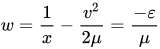
Unlike standard orbits which are classified by their orbital eccentricity, radial orbits are classified by their specific orbital energy, the constant sum of the total kinetic and potential energy, divided by the reduced mass: where x is the distance between the centers of the masses, v is the relative velocity, and is the standard gravitational parameter.


Another constant is given by:
Given the separation and velocity at any time, and the total mass, it is possible to determine the position at any other time.
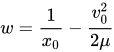
The first step is to determine the constant w. Use the sign of w to determine the orbit type. where and are the separation and relative velocity at any time.


where t is the time from or until the time at which the two masses, if they were point masses, would coincide, and x is the separation.

This equation applies only to radial parabolic trajectories, for general parabolic trajectories see Barker's equation.
Hub AI
Radial trajectory AI simulator
(@Radial trajectory_simulator)
Radial trajectory
In astrodynamics and celestial mechanics a radial trajectory is a Kepler orbit with zero angular momentum. Two objects in a radial trajectory move directly towards or away from each other in a straight line.
There are three types of radial trajectories (orbits).
Unlike standard orbits which are classified by their orbital eccentricity, radial orbits are classified by their specific orbital energy, the constant sum of the total kinetic and potential energy, divided by the reduced mass: where x is the distance between the centers of the masses, v is the relative velocity, and is the standard gravitational parameter.
Another constant is given by:
Given the separation and velocity at any time, and the total mass, it is possible to determine the position at any other time.
The first step is to determine the constant w. Use the sign of w to determine the orbit type. where and are the separation and relative velocity at any time.
where t is the time from or until the time at which the two masses, if they were point masses, would coincide, and x is the separation.
This equation applies only to radial parabolic trajectories, for general parabolic trajectories see Barker's equation.