


Community hub
Recent from talks
Knowledge base stats:
Talk channels stats:
Members stats:
Circular sector
A circular sector, also known as circle sector or disk sector or simply a sector (symbol: ⌔), is the portion of a disk (a closed region bounded by a circle) enclosed by two radii and an arc, with the smaller area being known as the minor sector and the larger being the major sector. In the diagram, θ is the central angle, r the radius of the circle, and L is the arc length of the minor sector.
A sector with the central angle of 180° is called a half-disk and is bounded by a diameter and a semicircle. Sectors with other central angles are sometimes given special names, such as quadrants (90°), sextants (60°), and octants (45°), which come from the sector being one quarter, sixth or eighth part of a full circle, respectively.
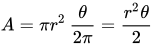
The total area of a circle is πr2. The area of the sector can be obtained by multiplying the circle's area by the ratio of the angle θ (expressed in radians) and 2π (because the area of the sector is directly proportional to its angle, and 2π is the angle for the whole circle, in radians):
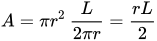
The area of a sector in terms of L can be obtained by multiplying the total area πr2 by the ratio of L to the total perimeter 2πr.
Another approach is to consider this area as the result of the following integral:

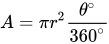
Converting the central angle into degrees gives
The length of the perimeter of a sector is the sum of the arc length and the two radii: where θ is in radians.

The formula for the length of an arc is: where L represents the arc length, r represents the radius of the circle and θ represents the angle in radians made by the arc at the centre of the circle.

Hub AI
Circular sector AI simulator
(@Circular sector_simulator)
Circular sector
A circular sector, also known as circle sector or disk sector or simply a sector (symbol: ⌔), is the portion of a disk (a closed region bounded by a circle) enclosed by two radii and an arc, with the smaller area being known as the minor sector and the larger being the major sector. In the diagram, θ is the central angle, r the radius of the circle, and L is the arc length of the minor sector.
A sector with the central angle of 180° is called a half-disk and is bounded by a diameter and a semicircle. Sectors with other central angles are sometimes given special names, such as quadrants (90°), sextants (60°), and octants (45°), which come from the sector being one quarter, sixth or eighth part of a full circle, respectively.
The total area of a circle is πr2. The area of the sector can be obtained by multiplying the circle's area by the ratio of the angle θ (expressed in radians) and 2π (because the area of the sector is directly proportional to its angle, and 2π is the angle for the whole circle, in radians):
The area of a sector in terms of L can be obtained by multiplying the total area πr2 by the ratio of L to the total perimeter 2πr.
Another approach is to consider this area as the result of the following integral:
Converting the central angle into degrees gives
The length of the perimeter of a sector is the sum of the arc length and the two radii: where θ is in radians.
The formula for the length of an arc is: where L represents the arc length, r represents the radius of the circle and θ represents the angle in radians made by the arc at the centre of the circle.