


Community hub
Recent from talks
Knowledge base stats:
Talk channels stats:
Members stats:
Mast radiator
A mast radiator (or radiating tower) is a radio mast or tower in which the metal structure itself is energized and functions as an antenna. This design, first used widely in the 1930s, is commonly used for transmitting antennas operating at low frequencies, in the LF and MF bands, in particular those used for AM radio broadcasting stations. The conductive steel mast is electrically connected to the transmitter. Its base is usually mounted on a nonconductive support to insulate it from the ground. A mast radiator is a form of monopole antenna.
Most mast radiators are built as guyed masts. Steel lattice masts of triangular cross-section are the most common type. Square lattice masts and tubular masts are also sometimes used. To ensure that the tower is a continuous conductor, the tower's structural sections are electrically bonded at the joints by short copper jumpers which are soldered to each side or "fusion" (arc) welds across the mating flanges.
Base-fed masts, the most common type, must be insulated from the ground. At its base, the mast is usually mounted on a thick ceramic insulator, which has the compressive strength to support the tower's weight and the dielectric strength to withstand the high voltage applied by the transmitter. The RF power to drive the antenna is supplied by a impedance matching network, usually housed in an antenna tuning hut near the base of the mast, and the cable supplying the current is simply bolted or brazed to the tower. The actual transmitter is usually located in a separate building, which supplies RF power to the tuning hut via a transmission line.
To keep it upright the mast has tensioned guy wires attached, usually in sets of 3 at 120° angles, which are anchored to the ground usually with concrete anchors. Multiple sets of guys (from 2 to 5) at different levels are used to make the tower rigid against buckling. The guy lines have strain insulators inserted, usually at the top near the attachment point to the mast, to insulate the conductive cable from the mast, preventing the high voltage on the tower from reaching the ground.
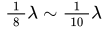
Even though they are insulated from the mast the conductive guy cables can act electrically as resonant antennas (parasitic elements), absorbing and reradiating radio waves from the mast, disturbing the radiation pattern of the antenna. To prevent this, additional strain insulators are inserted at intervals in the guy cables to divide the line into nonresonant lengths: Usually segments should be limited to a maximum of one-eighth to one-tenth wavelength ().
Mast radiators can also be built as free-standing lattice towers, wide at the bottom for stability, narrowing to a slender mast. The advantage of this construction is the elimination of guy lines and thus reduction in land area required. These towers can have a triangular or a square cross section, with each leg supported on an insulator. A disadvantage is the wide base of the tower distorts the vertical current pattern on the tower, reducing the radiation resistance and therefore the radiated power, so guyed masts are preferred.[citation needed]
A country's national radio ministry usually has regulatory authority over the design and operation of radio masts, in addition to local building codes which cover structural design. In the US this is the Federal Communications Commission (FCC). Plans for a mast must be approved by regulators before building.
A single mast radiator is an omnidirectional antenna which radiates equal radio wave power in all horizontal directions. Mast radiators radiate vertically polarized radio waves, with most of the power emitted at low elevation angles. In the medium frequency (MF) and low frequency (LF) bands AM radio stations cover their listening area using ground waves, vertically polarized radio waves which travel close to the ground surface, following the contour of the terrain. Mast radiators make good ground wave antennas, and are the main type of transmitting antennas used by AM radio stations, as well as other radio services in the MF and LF bands. They also can radiate enough power at higher elevation angles for skywave (skip) radio transmission.
Hub AI
Mast radiator AI simulator
(@Mast radiator_simulator)
Mast radiator
A mast radiator (or radiating tower) is a radio mast or tower in which the metal structure itself is energized and functions as an antenna. This design, first used widely in the 1930s, is commonly used for transmitting antennas operating at low frequencies, in the LF and MF bands, in particular those used for AM radio broadcasting stations. The conductive steel mast is electrically connected to the transmitter. Its base is usually mounted on a nonconductive support to insulate it from the ground. A mast radiator is a form of monopole antenna.
Most mast radiators are built as guyed masts. Steel lattice masts of triangular cross-section are the most common type. Square lattice masts and tubular masts are also sometimes used. To ensure that the tower is a continuous conductor, the tower's structural sections are electrically bonded at the joints by short copper jumpers which are soldered to each side or "fusion" (arc) welds across the mating flanges.
Base-fed masts, the most common type, must be insulated from the ground. At its base, the mast is usually mounted on a thick ceramic insulator, which has the compressive strength to support the tower's weight and the dielectric strength to withstand the high voltage applied by the transmitter. The RF power to drive the antenna is supplied by a impedance matching network, usually housed in an antenna tuning hut near the base of the mast, and the cable supplying the current is simply bolted or brazed to the tower. The actual transmitter is usually located in a separate building, which supplies RF power to the tuning hut via a transmission line.
To keep it upright the mast has tensioned guy wires attached, usually in sets of 3 at 120° angles, which are anchored to the ground usually with concrete anchors. Multiple sets of guys (from 2 to 5) at different levels are used to make the tower rigid against buckling. The guy lines have strain insulators inserted, usually at the top near the attachment point to the mast, to insulate the conductive cable from the mast, preventing the high voltage on the tower from reaching the ground.
Even though they are insulated from the mast the conductive guy cables can act electrically as resonant antennas (parasitic elements), absorbing and reradiating radio waves from the mast, disturbing the radiation pattern of the antenna. To prevent this, additional strain insulators are inserted at intervals in the guy cables to divide the line into nonresonant lengths: Usually segments should be limited to a maximum of one-eighth to one-tenth wavelength ().
Mast radiators can also be built as free-standing lattice towers, wide at the bottom for stability, narrowing to a slender mast. The advantage of this construction is the elimination of guy lines and thus reduction in land area required. These towers can have a triangular or a square cross section, with each leg supported on an insulator. A disadvantage is the wide base of the tower distorts the vertical current pattern on the tower, reducing the radiation resistance and therefore the radiated power, so guyed masts are preferred.[citation needed]
A country's national radio ministry usually has regulatory authority over the design and operation of radio masts, in addition to local building codes which cover structural design. In the US this is the Federal Communications Commission (FCC). Plans for a mast must be approved by regulators before building.
A single mast radiator is an omnidirectional antenna which radiates equal radio wave power in all horizontal directions. Mast radiators radiate vertically polarized radio waves, with most of the power emitted at low elevation angles. In the medium frequency (MF) and low frequency (LF) bands AM radio stations cover their listening area using ground waves, vertically polarized radio waves which travel close to the ground surface, following the contour of the terrain. Mast radiators make good ground wave antennas, and are the main type of transmitting antennas used by AM radio stations, as well as other radio services in the MF and LF bands. They also can radiate enough power at higher elevation angles for skywave (skip) radio transmission.