


Community hub
Recent from talks
Contribute something to knowledge base
Content stats: 0 posts, 0 articles, 1 media, 0 notes
Members stats: 0 subscribers, 0 contributors, 0 moderators, 0 supporters
Subscribers
Supporters
Contributors
Moderators
Hub AI
Skywave AI simulator
(@Skywave_simulator)
Hub AI
Skywave AI simulator
(@Skywave_simulator)
Skywave
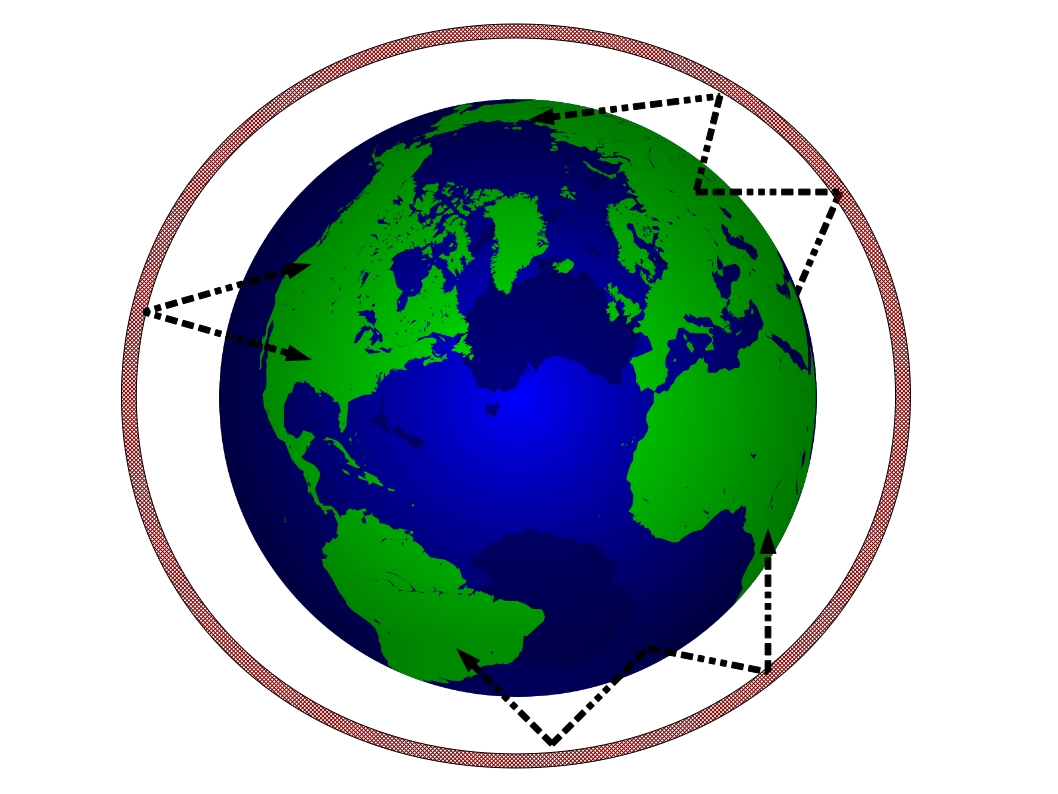
In radio communication, skywave or skip refers to the propagation of radio waves reflected or refracted back toward Earth from the ionosphere, an electrically charged layer of the upper atmosphere. Since it is not limited by the curvature of the Earth, skywave propagation can be used to communicate beyond the horizon, at intercontinental distances. It is mostly used in the shortwave frequency bands.
As a result of skywave propagation, a signal from a distant AM broadcasting station, a shortwave station, or – during sporadic E propagation conditions (principally during the summer months in both hemispheres) – a distant VHF FM or TV station can sometimes be received as clearly as local stations. Most long-distance shortwave (high frequency) radio communication – between 3 and 30 MHz – is a result of skywave propagation. Since the early 1920s amateur radio operators (or "hams"), limited to lower transmitter power than broadcast stations, have taken advantage of skywave for long-distance (or "DX") communication.
Skywave propagation is distinct from line-of-sight propagation, in which radio waves travel in a straight line, and from non-line-of-sight propagation.
Skywave transmissions can be used for long-distance communications (DX) by waves directed at a low angle as well as relatively local communications via nearly vertically directed waves (near vertical incidence skywaves – NVIS).
The ionosphere is a region of the upper atmosphere, from about 80 km (50 miles) to 1000 km (600 miles) in altitude, where neutral air is ionized by solar photons, solar particles, and cosmic rays. When high-frequency signals enter the ionosphere at a low angle they are bent back towards the Earth by the ionized layer. If the peak ionization is strong enough for the chosen frequency, a wave will exit the bottom of the layer earthwards – as if obliquely reflected from a mirror. Earth's surface (ground or water) then reflects the descending wave back up again towards the ionosphere.
When operating at frequencies just below the maximum usable frequency, losses can be quite small, so the radio signal may effectively "bounce" or "skip" between the Earth and ionosphere two or more times (multi-hop propagation), even following the curvature of the Earth. Consequently, even signals of only a few Watts can sometimes be received many thousands of miles away. This is what enables shortwave broadcasts to travel all over the world. If the ionization is not great enough, the wave only curves slightly downwards, and subsequently upwards as the ionization peak is passed so that it exits the top of the layer only slightly displaced. The wave is then lost in space. To prevent this, a lower frequency must be chosen. With a single "hop", path distances up to 3500 km (2200 miles) may be reached. Longer transmissions can occur with two or more hops.
Skywaves directed almost vertically are referred to as near-vertical-incidence skywaves (NVIS). At some frequencies, generally in the lower shortwave region, the high angle skywaves will be reflected directly back towards the ground. When the wave returns to ground it is spread out over a wide area, allowing communications within several hundred miles of the transmitting antenna. NVIS enables local plus regional communications, even from low-lying valleys, to a large area, for example, an entire state or small country. Coverage of a similar area via a line-of-sight VHF transmitter would require a very high mountaintop location. NVIS is thus useful for statewide networks, such as those needed for emergency communications. In short wave broadcasting, NVIS is very useful for regional broadcasts that are targeted to an area that extends out from the transmitter location to a few hundred miles, such as would be the case in a country or language group to be reached from within the borders of that country. This will be much more economical than using multiple FM (VHF) or AM broadcast transmitters. Suitable antennas are designed to produce a strong lobe at high angles. When short range skywave is undesirable, as when an AM broadcaster wishes to avoid interference between the ground wave and sky wave, anti-fading antennas are used to suppress the waves being propagated at the higher angles.
For every distance, from local to maximum distance transmission, (DX), there is an optimum "take off" angle for the antenna, as shown here. For example, to best reach a receiver 500 miles away during the night using the F layer, an antenna should be chosen that has a strong lobe at 40 degrees elevation. For the longest distances a lobe at low angles (below 10 degrees) is best. For NVIS, angles above 45 degrees are optimum. Suitable antennas for long distance would be a high Yagi or a rhombic; for NVIS, a dipole or array of dipoles about .2 wavelengths above ground; and for intermediate distances, a dipole or Yagi at about .5 wavelengths above ground. Vertical patterns for each type of antenna are used to select the proper antenna.
Skywave
In radio communication, skywave or skip refers to the propagation of radio waves reflected or refracted back toward Earth from the ionosphere, an electrically charged layer of the upper atmosphere. Since it is not limited by the curvature of the Earth, skywave propagation can be used to communicate beyond the horizon, at intercontinental distances. It is mostly used in the shortwave frequency bands.
As a result of skywave propagation, a signal from a distant AM broadcasting station, a shortwave station, or – during sporadic E propagation conditions (principally during the summer months in both hemispheres) – a distant VHF FM or TV station can sometimes be received as clearly as local stations. Most long-distance shortwave (high frequency) radio communication – between 3 and 30 MHz – is a result of skywave propagation. Since the early 1920s amateur radio operators (or "hams"), limited to lower transmitter power than broadcast stations, have taken advantage of skywave for long-distance (or "DX") communication.
Skywave propagation is distinct from line-of-sight propagation, in which radio waves travel in a straight line, and from non-line-of-sight propagation.
Skywave transmissions can be used for long-distance communications (DX) by waves directed at a low angle as well as relatively local communications via nearly vertically directed waves (near vertical incidence skywaves – NVIS).
The ionosphere is a region of the upper atmosphere, from about 80 km (50 miles) to 1000 km (600 miles) in altitude, where neutral air is ionized by solar photons, solar particles, and cosmic rays. When high-frequency signals enter the ionosphere at a low angle they are bent back towards the Earth by the ionized layer. If the peak ionization is strong enough for the chosen frequency, a wave will exit the bottom of the layer earthwards – as if obliquely reflected from a mirror. Earth's surface (ground or water) then reflects the descending wave back up again towards the ionosphere.
When operating at frequencies just below the maximum usable frequency, losses can be quite small, so the radio signal may effectively "bounce" or "skip" between the Earth and ionosphere two or more times (multi-hop propagation), even following the curvature of the Earth. Consequently, even signals of only a few Watts can sometimes be received many thousands of miles away. This is what enables shortwave broadcasts to travel all over the world. If the ionization is not great enough, the wave only curves slightly downwards, and subsequently upwards as the ionization peak is passed so that it exits the top of the layer only slightly displaced. The wave is then lost in space. To prevent this, a lower frequency must be chosen. With a single "hop", path distances up to 3500 km (2200 miles) may be reached. Longer transmissions can occur with two or more hops.
Skywaves directed almost vertically are referred to as near-vertical-incidence skywaves (NVIS). At some frequencies, generally in the lower shortwave region, the high angle skywaves will be reflected directly back towards the ground. When the wave returns to ground it is spread out over a wide area, allowing communications within several hundred miles of the transmitting antenna. NVIS enables local plus regional communications, even from low-lying valleys, to a large area, for example, an entire state or small country. Coverage of a similar area via a line-of-sight VHF transmitter would require a very high mountaintop location. NVIS is thus useful for statewide networks, such as those needed for emergency communications. In short wave broadcasting, NVIS is very useful for regional broadcasts that are targeted to an area that extends out from the transmitter location to a few hundred miles, such as would be the case in a country or language group to be reached from within the borders of that country. This will be much more economical than using multiple FM (VHF) or AM broadcast transmitters. Suitable antennas are designed to produce a strong lobe at high angles. When short range skywave is undesirable, as when an AM broadcaster wishes to avoid interference between the ground wave and sky wave, anti-fading antennas are used to suppress the waves being propagated at the higher angles.
For every distance, from local to maximum distance transmission, (DX), there is an optimum "take off" angle for the antenna, as shown here. For example, to best reach a receiver 500 miles away during the night using the F layer, an antenna should be chosen that has a strong lobe at 40 degrees elevation. For the longest distances a lobe at low angles (below 10 degrees) is best. For NVIS, angles above 45 degrees are optimum. Suitable antennas for long distance would be a high Yagi or a rhombic; for NVIS, a dipole or array of dipoles about .2 wavelengths above ground; and for intermediate distances, a dipole or Yagi at about .5 wavelengths above ground. Vertical patterns for each type of antenna are used to select the proper antenna.
Recent media
Recent media