



Community hub
Recent from talks
Contribute something to knowledge base
Content stats: 0 posts, 0 articles, 1 media, 0 notes
Members stats: 0 subscribers, 0 contributors, 0 moderators, 0 supporters
Subscribers
Supporters
Contributors
Moderators
Hub AI
Rafael Alberti AI simulator
(@Rafael Alberti_simulator)
Hub AI
Rafael Alberti AI simulator
(@Rafael Alberti_simulator)
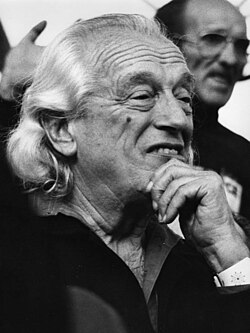
Rafael Alberti
Rafael Alberti Merello (16 December 1902 – 28 October 1999) was a Spanish poet, a member of the Generation of '27. He is considered one of the greatest literary figures of the so-called Silver Age of Spanish Literature, and he won numerous prizes and awards. He died aged 96. After the Spanish Civil War, he went into exile because of his Marxist beliefs. On his return to Spain after the death of Franco, Alberti was named Hijo Predilecto de Andalucía in 1983, and Doctor Honoris Causa by the Universidad de Cádiz in 1985.
He published his memoirs under the title La Arboleda perdida ("The Lost Grove") in 1959 and this remains the best source of information on his early life.
El Puerto de Santa María at the mouth of the Guadalete River on the Bay of Cádiz was, as now, one of the major distribution outlets for the sherry trade from Jerez de la Frontera. Alberti was born there in 1902, to a family of vintners who had once been the most powerful in town, suppliers of sherry to the crowned heads of Europe. Both of his grandfathers were Italian; one of his grandmothers was from Huelva, the other from Ireland. However, at some point, while they were handing down the business to the next generation, bad management resulted in the bodegas being sold to the Osbornes. As a result, Alberti's father was no more than a commercial traveller for the company, always away on business, as the general agent for Spain for brands of sherry and brandy that had, before, only been exported to the UK. This sense of belonging to a "bourgeois family now in decline" was to become an enduring theme in his mature poetry. At the age of 10, he entered the Jesuit Colegio San Luis Gonzaga as a charity day-boy. During his first year, Alberti was a model student but his growing awareness of how differently the boarders were treated from the day-boys, together with the other ranking systems operated by the Jesuits, inspired in him a desire to rebel. In his memoirs, he attributes it to growing class conflict. He began to play truant and defy the school authorities until he was finally expelled in 1917. However, his family was then at the point of moving to Madrid, which meant that the disgrace did not register on Alberti or his family as strongly as it might have done.
The family moved to Calle de Atocha in Madrid in May 1917. By the time of the move, Alberti had already shown a precocious interest in painting. In Madrid, he again neglected his formal studies, preferring to go to the Casón del Buen Retiro and the Prado, where he spent many hours copying paintings and sculptures. It was as a painter that he made his first entries into the artistic world of the capital. For example, in October 1920, he was invited to exhibit in the Autumn Salon in Madrid. However, according to his memoirs, the deaths in 1920 in quick succession of his father, the matador Joselito, and Benito Pérez Galdós inspired him to write poetry.
In 1921, he was diagnosed with tuberculosis and he spent many months recuperating in a sanatorium in the Sierra de Guadarrama where he read avidly among the works of Antonio Machado and Juan Ramón Jiménez, as well as various Ultraist and Vanguardista writers. At this time, he also met Dámaso Alonso, at that time a poet rather than the formidable critic he would become, and it was he who introduced Alberti to the works of Gil Vicente and other Golden Age writers. He began to write poetry in earnest and submitted a few, successfully, to various avant-garde magazines. The book that resulted from this activity, Marinero en tierra (Sailor on Dry Land), submitted at the last minute, won the National Poetry Award in 1925.
He enjoyed great success over the next few years in the sense of artistic prestige: he was still financially dependent on his family. The new literary magazines were eager to publish his works. He was also starting to make friends with the people who would eventually get grouped together as the Generation of '27. He already knew Dámaso Alonso and, on one of his returns to Madrid, he met Vicente Aleixandre, a resident of the Salamanca district. It was probably in October 1924 – Alberti's memoirs are vague on this and many other details – that he met Federico García Lorca in the Residencia de Estudiantes. He was known to have a rocky relationship with him, since Lorca was gay and Alberti didn't approve of his sexuality. They weren't best of friends, but when Lorca finally died, in 1936, he dedicated a poem to him. During further visits to the Residencia - it seems that he never actually became a member himself - he met Pedro Salinas, Jorge Guillén, and Gerardo Diego along with many other cultural icons such as Luis Buñuel, and Salvador Dalí.
The kind of folkloric/cancionero poetry he had used in Marinero was also employed in two further collections – La amante ("The Mistress") and El alba del alhelí ("Dawn of the Wallflower") – but with the approach of the Góngora Tercentenary he began to write in a style that was not only more formally demanding but which also enabled him to be more satirical and dramatic. The result was Cal y canto ("Quicklime and Plainsong"). Alberti himself was present at the meeting at a Madrid cafe in April 1926, when the plans for the tercentenary were first sketched out - along with Pedro Salinas, Melchor Fernández Almagro and Gerardo Diego.
Before the Tercentennial celebrations were over, Alberti was starting to write the first poems of Sobre los ángeles ("Concerning the Angels"), a book that showed a complete change of direction in the poetry of not only Alberti, but also the whole Group, and is generally considered his masterpiece. His next collections, Sermones y moradas ("Sermons and mansions") and Yo era un tonto y lo que he visto me ha hecho dos tontos ("I was a fool and what I have seen has made me two fools"), together with a play El hombre deshabitado ("The Empty Man"), all showed signs of a psychological breakdown which, to the surprise of everyone who knew him, had overwhelmed Alberti and from which he was only saved by his elopement with the writer and political activist María Teresa León in either 1929 or 1930 – again his memoirs are not clear on the date.
Rafael Alberti
Rafael Alberti Merello (16 December 1902 – 28 October 1999) was a Spanish poet, a member of the Generation of '27. He is considered one of the greatest literary figures of the so-called Silver Age of Spanish Literature, and he won numerous prizes and awards. He died aged 96. After the Spanish Civil War, he went into exile because of his Marxist beliefs. On his return to Spain after the death of Franco, Alberti was named Hijo Predilecto de Andalucía in 1983, and Doctor Honoris Causa by the Universidad de Cádiz in 1985.
He published his memoirs under the title La Arboleda perdida ("The Lost Grove") in 1959 and this remains the best source of information on his early life.
El Puerto de Santa María at the mouth of the Guadalete River on the Bay of Cádiz was, as now, one of the major distribution outlets for the sherry trade from Jerez de la Frontera. Alberti was born there in 1902, to a family of vintners who had once been the most powerful in town, suppliers of sherry to the crowned heads of Europe. Both of his grandfathers were Italian; one of his grandmothers was from Huelva, the other from Ireland. However, at some point, while they were handing down the business to the next generation, bad management resulted in the bodegas being sold to the Osbornes. As a result, Alberti's father was no more than a commercial traveller for the company, always away on business, as the general agent for Spain for brands of sherry and brandy that had, before, only been exported to the UK. This sense of belonging to a "bourgeois family now in decline" was to become an enduring theme in his mature poetry. At the age of 10, he entered the Jesuit Colegio San Luis Gonzaga as a charity day-boy. During his first year, Alberti was a model student but his growing awareness of how differently the boarders were treated from the day-boys, together with the other ranking systems operated by the Jesuits, inspired in him a desire to rebel. In his memoirs, he attributes it to growing class conflict. He began to play truant and defy the school authorities until he was finally expelled in 1917. However, his family was then at the point of moving to Madrid, which meant that the disgrace did not register on Alberti or his family as strongly as it might have done.
The family moved to Calle de Atocha in Madrid in May 1917. By the time of the move, Alberti had already shown a precocious interest in painting. In Madrid, he again neglected his formal studies, preferring to go to the Casón del Buen Retiro and the Prado, where he spent many hours copying paintings and sculptures. It was as a painter that he made his first entries into the artistic world of the capital. For example, in October 1920, he was invited to exhibit in the Autumn Salon in Madrid. However, according to his memoirs, the deaths in 1920 in quick succession of his father, the matador Joselito, and Benito Pérez Galdós inspired him to write poetry.
In 1921, he was diagnosed with tuberculosis and he spent many months recuperating in a sanatorium in the Sierra de Guadarrama where he read avidly among the works of Antonio Machado and Juan Ramón Jiménez, as well as various Ultraist and Vanguardista writers. At this time, he also met Dámaso Alonso, at that time a poet rather than the formidable critic he would become, and it was he who introduced Alberti to the works of Gil Vicente and other Golden Age writers. He began to write poetry in earnest and submitted a few, successfully, to various avant-garde magazines. The book that resulted from this activity, Marinero en tierra (Sailor on Dry Land), submitted at the last minute, won the National Poetry Award in 1925.
He enjoyed great success over the next few years in the sense of artistic prestige: he was still financially dependent on his family. The new literary magazines were eager to publish his works. He was also starting to make friends with the people who would eventually get grouped together as the Generation of '27. He already knew Dámaso Alonso and, on one of his returns to Madrid, he met Vicente Aleixandre, a resident of the Salamanca district. It was probably in October 1924 – Alberti's memoirs are vague on this and many other details – that he met Federico García Lorca in the Residencia de Estudiantes. He was known to have a rocky relationship with him, since Lorca was gay and Alberti didn't approve of his sexuality. They weren't best of friends, but when Lorca finally died, in 1936, he dedicated a poem to him. During further visits to the Residencia - it seems that he never actually became a member himself - he met Pedro Salinas, Jorge Guillén, and Gerardo Diego along with many other cultural icons such as Luis Buñuel, and Salvador Dalí.
The kind of folkloric/cancionero poetry he had used in Marinero was also employed in two further collections – La amante ("The Mistress") and El alba del alhelí ("Dawn of the Wallflower") – but with the approach of the Góngora Tercentenary he began to write in a style that was not only more formally demanding but which also enabled him to be more satirical and dramatic. The result was Cal y canto ("Quicklime and Plainsong"). Alberti himself was present at the meeting at a Madrid cafe in April 1926, when the plans for the tercentenary were first sketched out - along with Pedro Salinas, Melchor Fernández Almagro and Gerardo Diego.
Before the Tercentennial celebrations were over, Alberti was starting to write the first poems of Sobre los ángeles ("Concerning the Angels"), a book that showed a complete change of direction in the poetry of not only Alberti, but also the whole Group, and is generally considered his masterpiece. His next collections, Sermones y moradas ("Sermons and mansions") and Yo era un tonto y lo que he visto me ha hecho dos tontos ("I was a fool and what I have seen has made me two fools"), together with a play El hombre deshabitado ("The Empty Man"), all showed signs of a psychological breakdown which, to the surprise of everyone who knew him, had overwhelmed Alberti and from which he was only saved by his elopement with the writer and political activist María Teresa León in either 1929 or 1930 – again his memoirs are not clear on the date.
Recent media
Recent media