



Community hub
Recent from talks
Knowledge base stats:
Talk channels stats:
Members stats:
Ragamuffin War
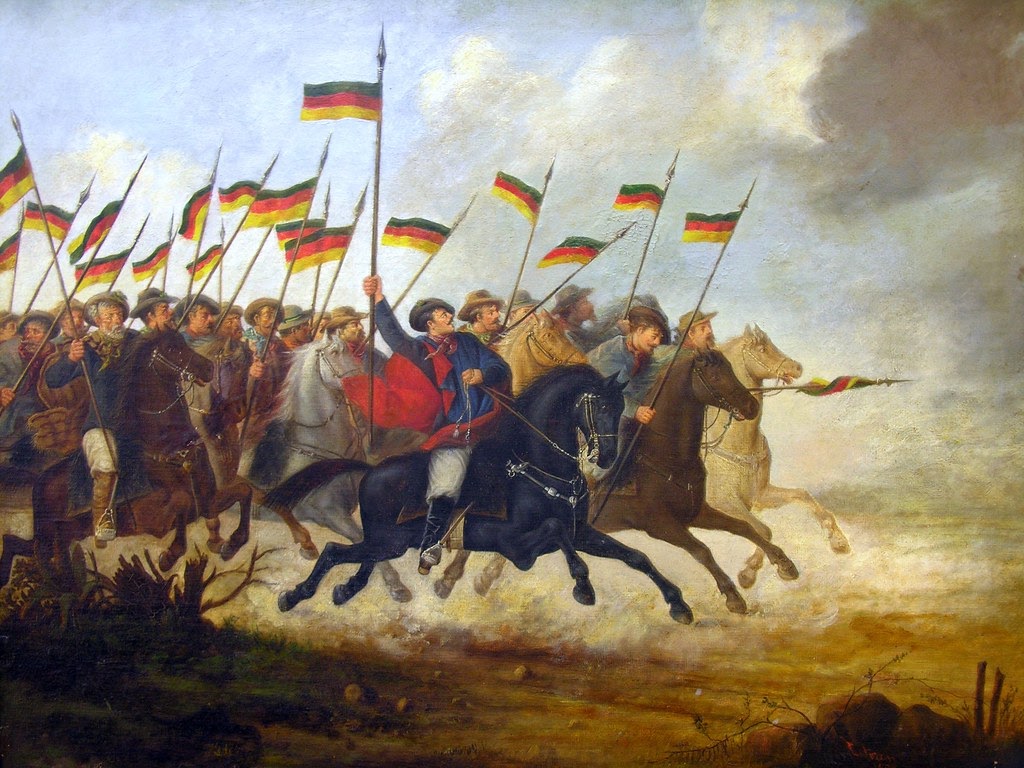
The Ragamuffin War (Portuguese: Guerra dos Farrapos), also known as the Ragamuffin Revolution or Heroic Decade, was a republican uprising that began in southern Brazil during the regency period, centered in the province of Rio Grande do Sul and, for a time, extending into neighboring Santa Catarina. It began on 20 September 1835, when rebel forces seized Porto Alegre, and soon turned into a wider confrontation between Brazil's imperial government and an opposition coalition led by influential regional leaders, such as Bento Gonçalves and Antônio de Sousa Neto, who proclaimed the secession of the province and the creation of the Riograndense Republic following the rebel victory at the battle of Seival in 1836.
The war is often situated within the broader political and institutional instability of Brazil's regency era, when numerous armed conflicts exposed the fragility of imperial authority and intensified disputes over the degree of autonomy between the Court and Brazil's provinces. In Rio Grande do Sul, the tensions unfolded over the region's economy, reliant on livestock and the production of jerked beef. Producers in Rio Grande do Sul complained that local jerked beef was burdened by high export and customs taxation and by import duties on salt, while Uruguay and Argentina benefited from more favorable tax treatment in Brazilian markets, making the local product less competitive within the country, which led to economic grievances with the Imperial government, but also due to a broader desire for greater autonomy and opposition to centralized control over the province. The revolution also influenced other rebel movements throughout the country, such as the Sabinada, in Bahia, in 1837, and the Liberal Rebellions in Minas Gerais and São Paulo, in 1842.
The new republic operated from shifting inland capitals such as Piratini and later other towns. From the late 1830s, the war also became entangled with the politics of the wider Río de la Plata region, as the rebel republic pursued agreements and alliances with neighboring Uruguayan and Argentine caudillos. In 1839, with the participation of the Italian revolutionary Giuseppe Garibaldi, the rebels carried the war to the Brazilian coast and proclaimed the short-lived Juliana Republic in Santa Catarina. The conflict ended on 1 March 1845 with the Treaty of Ponche Verde, which granted amnesty and reintegration terms for the rebel leaders and included economic concessions such as a tariff on imported jerked beef.
Some rebel leaders promised freedom to those enslaved men who enlisted into the Republican army and as a result many slaves organized troops during the conflict, including the Black Lancers, who were annihilated in a surprise attack in 1844 known as the Porongos Massacre. Due to this fact, the historian Clóvis Moura interpreted the Ragamuffin movement as abolitionist, but other historians argue he was mistaken. The rebels as a whole never demanded the general abolition of slavery, and the 1843 republican constitution preserved slavery; while most rebel commanders, including Bento Gonçalves, were themselves slaveholders.
In Portuguese, the term farrapo literally denotes a rag or torn piece of cloth, and by extension can refer to someone shabbily dressed (a "ragamuffin"). In turn, the derivation farroupilha, a derogatory label used to refer to the rebels, circulated earlier in the political vocabulary during Brazil's regency period, especially in the Court (Rio de Janeiro), where it was used as a nickname for the political faction associated with the radical wing of liberalism (the "exalted liberals", also called jurujubas). This milieu produced and consumed a dense newspaper and pamphlet press in which factional labels were deployed as weapons and badges of identity. In that context, farroupilha operated as a marker of those who defended strong provincial autonomy, federalism, and were hostile to centralizing projects. While farroupilha is well-attested as a regency-era factional nickname in the Court, contemporaneous narratives about Rio Grande do Sul's provincial politics describe farrapos and farroupilhas as paired epithets in local partisan conflict. Lindolfo Collor stated that "legalists" (reactionaries) called the province's liberals farrapos or farroupilhas to imply they had "no representation in society", adding that the liberals, rather than taking offense, came to embrace the label with pride.
The uprising is believed to have begun over the difference between the economy of Rio Grande do Sul and that of the rest of the country. Unlike the other provinces, the economy of Rio Grande do Sul focused on the internal market rather than exporting commodities. The province's main product, charque (dried and salted beef), suffered badly from competition from charque imported from Uruguay and Argentina. The people that benefited from these markets were called Gaúchos: nomadic cowhands and farmers who lived in Rio Grande do Sul. The Gaúchos also lived in Argentina and Uruguay.
In 1835, Antônio Rodrigues Fernandes Braga was nominated president of Rio Grande do Sul. At first, his appointment pleased the liberal farmers, but that soon changed. On his first day in the office, he accused many farmers of being separatists.
On 20 September 1835, General Bento Gonçalves captured the capital, Porto Alegre, beginning an uprising against the perceived unfair trade reinforced by the provincial government. The provincial president fled to the city of Rio Grande, 334 km (208 mi) to the south. In Porto Alegre, the rebels, also known as "ragamuffins" (Portuguese: farrapos) after the fringed leather worn by the gaúchos, elected Marciano José Pereira Ribeiro their new president. Responding to the situation and further upsetting the rebels, the Brazilian regent, Diogo Antônio Feijó, appointed a new provincial president, who was forced to take office in exile in Rio Grande.
Hub AI
Ragamuffin War AI simulator
(@Ragamuffin War_simulator)
Ragamuffin War
The Ragamuffin War (Portuguese: Guerra dos Farrapos), also known as the Ragamuffin Revolution or Heroic Decade, was a republican uprising that began in southern Brazil during the regency period, centered in the province of Rio Grande do Sul and, for a time, extending into neighboring Santa Catarina. It began on 20 September 1835, when rebel forces seized Porto Alegre, and soon turned into a wider confrontation between Brazil's imperial government and an opposition coalition led by influential regional leaders, such as Bento Gonçalves and Antônio de Sousa Neto, who proclaimed the secession of the province and the creation of the Riograndense Republic following the rebel victory at the battle of Seival in 1836.
The war is often situated within the broader political and institutional instability of Brazil's regency era, when numerous armed conflicts exposed the fragility of imperial authority and intensified disputes over the degree of autonomy between the Court and Brazil's provinces. In Rio Grande do Sul, the tensions unfolded over the region's economy, reliant on livestock and the production of jerked beef. Producers in Rio Grande do Sul complained that local jerked beef was burdened by high export and customs taxation and by import duties on salt, while Uruguay and Argentina benefited from more favorable tax treatment in Brazilian markets, making the local product less competitive within the country, which led to economic grievances with the Imperial government, but also due to a broader desire for greater autonomy and opposition to centralized control over the province. The revolution also influenced other rebel movements throughout the country, such as the Sabinada, in Bahia, in 1837, and the Liberal Rebellions in Minas Gerais and São Paulo, in 1842.
The new republic operated from shifting inland capitals such as Piratini and later other towns. From the late 1830s, the war also became entangled with the politics of the wider Río de la Plata region, as the rebel republic pursued agreements and alliances with neighboring Uruguayan and Argentine caudillos. In 1839, with the participation of the Italian revolutionary Giuseppe Garibaldi, the rebels carried the war to the Brazilian coast and proclaimed the short-lived Juliana Republic in Santa Catarina. The conflict ended on 1 March 1845 with the Treaty of Ponche Verde, which granted amnesty and reintegration terms for the rebel leaders and included economic concessions such as a tariff on imported jerked beef.
Some rebel leaders promised freedom to those enslaved men who enlisted into the Republican army and as a result many slaves organized troops during the conflict, including the Black Lancers, who were annihilated in a surprise attack in 1844 known as the Porongos Massacre. Due to this fact, the historian Clóvis Moura interpreted the Ragamuffin movement as abolitionist, but other historians argue he was mistaken. The rebels as a whole never demanded the general abolition of slavery, and the 1843 republican constitution preserved slavery; while most rebel commanders, including Bento Gonçalves, were themselves slaveholders.
In Portuguese, the term farrapo literally denotes a rag or torn piece of cloth, and by extension can refer to someone shabbily dressed (a "ragamuffin"). In turn, the derivation farroupilha, a derogatory label used to refer to the rebels, circulated earlier in the political vocabulary during Brazil's regency period, especially in the Court (Rio de Janeiro), where it was used as a nickname for the political faction associated with the radical wing of liberalism (the "exalted liberals", also called jurujubas). This milieu produced and consumed a dense newspaper and pamphlet press in which factional labels were deployed as weapons and badges of identity. In that context, farroupilha operated as a marker of those who defended strong provincial autonomy, federalism, and were hostile to centralizing projects. While farroupilha is well-attested as a regency-era factional nickname in the Court, contemporaneous narratives about Rio Grande do Sul's provincial politics describe farrapos and farroupilhas as paired epithets in local partisan conflict. Lindolfo Collor stated that "legalists" (reactionaries) called the province's liberals farrapos or farroupilhas to imply they had "no representation in society", adding that the liberals, rather than taking offense, came to embrace the label with pride.
The uprising is believed to have begun over the difference between the economy of Rio Grande do Sul and that of the rest of the country. Unlike the other provinces, the economy of Rio Grande do Sul focused on the internal market rather than exporting commodities. The province's main product, charque (dried and salted beef), suffered badly from competition from charque imported from Uruguay and Argentina. The people that benefited from these markets were called Gaúchos: nomadic cowhands and farmers who lived in Rio Grande do Sul. The Gaúchos also lived in Argentina and Uruguay.
In 1835, Antônio Rodrigues Fernandes Braga was nominated president of Rio Grande do Sul. At first, his appointment pleased the liberal farmers, but that soon changed. On his first day in the office, he accused many farmers of being separatists.
On 20 September 1835, General Bento Gonçalves captured the capital, Porto Alegre, beginning an uprising against the perceived unfair trade reinforced by the provincial government. The provincial president fled to the city of Rio Grande, 334 km (208 mi) to the south. In Porto Alegre, the rebels, also known as "ragamuffins" (Portuguese: farrapos) after the fringed leather worn by the gaúchos, elected Marciano José Pereira Ribeiro their new president. Responding to the situation and further upsetting the rebels, the Brazilian regent, Diogo Antônio Feijó, appointed a new provincial president, who was forced to take office in exile in Rio Grande.