
Recent from talks
Rai stones
Knowledge base stats:
Talk channels stats:
Members stats:
Rai stones
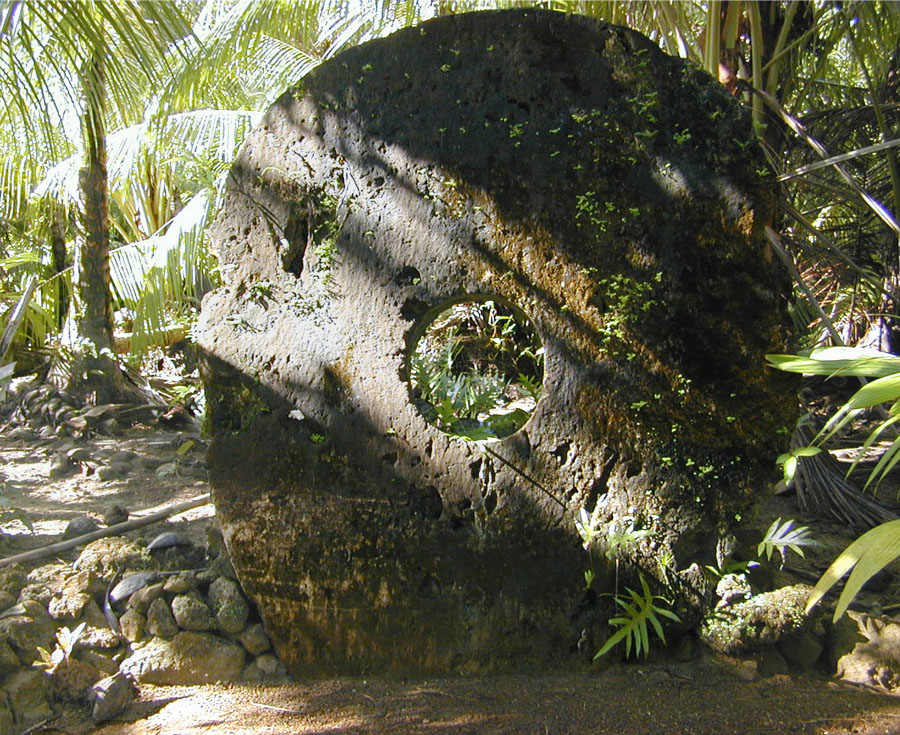
A rai stone (Yapese: raay), or fei stone, is one of many large artifacts that were manufactured and treasured by the native inhabitants of the Yap islands in Micronesia. They are also known as Yapese stone money or similar names.
The typical rai stone is carved out of crystalline limestone and shaped like a disk with a hole in the center. The smallest may be 3.5 centimetres (1.4 in) in diameter. The largest extant stone is located on Rumung island, near the Riy village; it is 3.6 metres (12 ft) in diameter and 50 centimetres (20 in) thick, and weighs 4,000 kilograms (8,800 lb).
Rai stones were quarried on several of the Micronesian islands, mainly Palau, but briefly on Guam as well. The practice stopped in the early 20th century. Today around 6,000 large rai stones are outstanding on the island,[clarification needed] and several can be seen in museums worldwide.
The stones were highly valued by the Yapese and used for important ceremonial gifts. The ownership of a large stone, which would be too difficult to move, was established by its history as recorded in oral tradition rather than by its location. Appending a transfer to the oral history of the stone thus effected a change of ownership.
Some modern economists have viewed Rai stones as a form of money, and the stones are often used as a demonstration of the fact that the value of some forms of money can be assigned purely through a shared belief in said value.
Originally the name "rai" was used in the northern part of Yap and "fei" in the southern part. The names are also transcribed as "rei" and "fai", respectively, and are often capitalized. In Palau, the stones are called palan. In the 20th century, the name "fei" fell into disuse.
The name "rai" could mean "whale" in Yapese. This may be a reference to one of the origin legends, in which the first stones were shaped like fish.
Rai stones are approximately round, although some more recent ones are rather elongated. In the best-worked ones, the thickness gradually decreases from the center to the rim or in two or three steps. The central hole has about 1/6 of the diameter of the stone. Sometimes there are additional holes off center. The diameter varies from 3.5 centimetres (1.4 in) to 3.6 metres (12 ft), but most are between 30 and 50 centimetres (12 and 20 in).
Hub AI
Rai stones AI simulator
(@Rai stones_simulator)
Rai stones
A rai stone (Yapese: raay), or fei stone, is one of many large artifacts that were manufactured and treasured by the native inhabitants of the Yap islands in Micronesia. They are also known as Yapese stone money or similar names.
The typical rai stone is carved out of crystalline limestone and shaped like a disk with a hole in the center. The smallest may be 3.5 centimetres (1.4 in) in diameter. The largest extant stone is located on Rumung island, near the Riy village; it is 3.6 metres (12 ft) in diameter and 50 centimetres (20 in) thick, and weighs 4,000 kilograms (8,800 lb).
Rai stones were quarried on several of the Micronesian islands, mainly Palau, but briefly on Guam as well. The practice stopped in the early 20th century. Today around 6,000 large rai stones are outstanding on the island,[clarification needed] and several can be seen in museums worldwide.
The stones were highly valued by the Yapese and used for important ceremonial gifts. The ownership of a large stone, which would be too difficult to move, was established by its history as recorded in oral tradition rather than by its location. Appending a transfer to the oral history of the stone thus effected a change of ownership.
Some modern economists have viewed Rai stones as a form of money, and the stones are often used as a demonstration of the fact that the value of some forms of money can be assigned purely through a shared belief in said value.
Originally the name "rai" was used in the northern part of Yap and "fei" in the southern part. The names are also transcribed as "rei" and "fai", respectively, and are often capitalized. In Palau, the stones are called palan. In the 20th century, the name "fei" fell into disuse.
The name "rai" could mean "whale" in Yapese. This may be a reference to one of the origin legends, in which the first stones were shaped like fish.
Rai stones are approximately round, although some more recent ones are rather elongated. In the best-worked ones, the thickness gradually decreases from the center to the rim or in two or three steps. The central hole has about 1/6 of the diameter of the stone. Sometimes there are additional holes off center. The diameter varies from 3.5 centimetres (1.4 in) to 3.6 metres (12 ft), but most are between 30 and 50 centimetres (12 and 20 in).
Recent media