
Recent from talks
Rainbow boa
Knowledge base stats:
Talk channels stats:
Members stats:
Rainbow boa
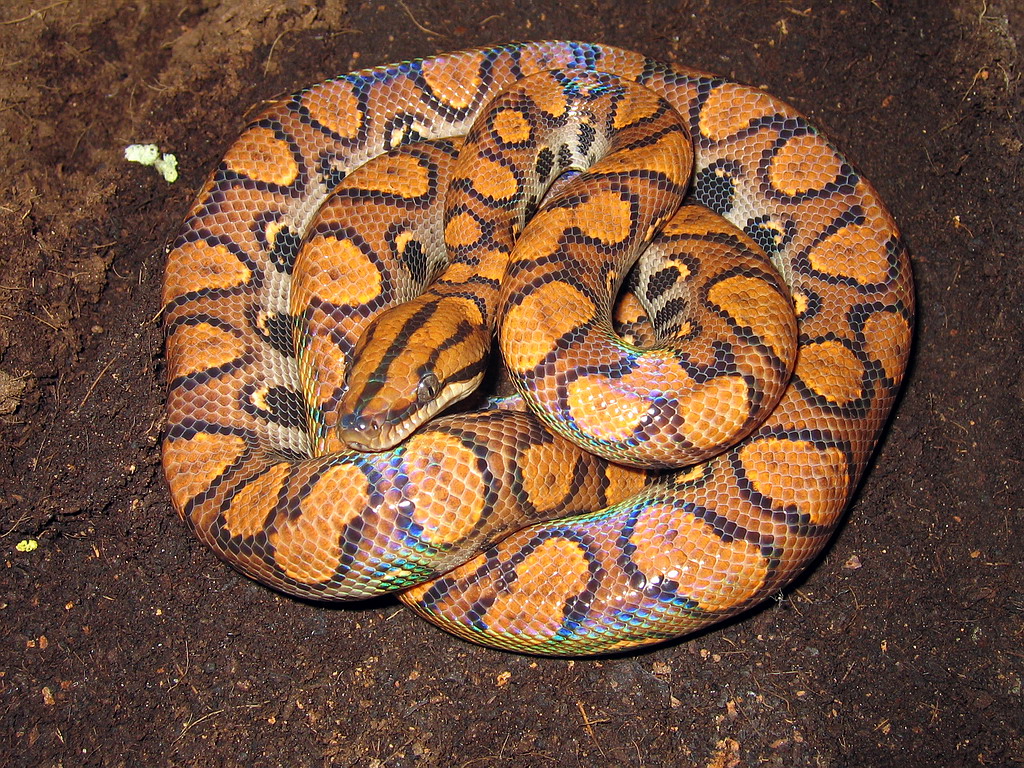
The rainbow boa (Epicrates cenchria) is a boa species endemic to South America. A semi-arboreal species (not only do they climb in the wild but also proven in captivity), it is known for its attractive iridescent/holographic sheen caused by structural coloration. Five subspecies are currently recognized, including the nominate subspecies described here.
The rainbow boa is found in South America. It occurs east of the Andes, roughly reaching northern Argentina (in the provinces Chaco, Córdoba, Corrientes, Formosa, Salta, Santiago del Estero and Tucumán).
The rainbow boa's habitat generally consists of humid woodlands and rainforests, but it can also be found in open savannas.
The rainbow boa is typically orange, brown, or reddish brown, with a paler belly and black markings: three parallel stripes on the head, rings down the back, and lateral blotches with a crescent over them, although there is a great deal of natural variation that may be heightened by artificial breeding. It is 4 to 6 feet in length and sexually dimorphic, as females are slightly longer and have wider abdomens. Males are stronger when compared with females of the same length and more resistant to handling.
The rainbow boa is nocturnal and most active in the middle of the night.
This species is semi-arboreal, spending time both on the ground and in trees. It is also known to spend time in bodies of water, and is considered a capable swimmer.
The rainbow boa reaches sexual maturity at 1.2 meters for males and 1.4 meters for females, or when they're approximately 2.5 to 4 years old. Females need to be the correct size otherwise they could have complications during and after birth. Males can mate with multiple females which can be beneficial for reptile breeding.
Males generally go without feeding during the mating season and females tend to eat smaller portions during the breeding season. In order to decrease the probability of birthing issues, females should be fed smaller rats/mice in order to save space for proper ova development.
Hub AI
Rainbow boa AI simulator
(@Rainbow boa_simulator)
Rainbow boa
The rainbow boa (Epicrates cenchria) is a boa species endemic to South America. A semi-arboreal species (not only do they climb in the wild but also proven in captivity), it is known for its attractive iridescent/holographic sheen caused by structural coloration. Five subspecies are currently recognized, including the nominate subspecies described here.
The rainbow boa is found in South America. It occurs east of the Andes, roughly reaching northern Argentina (in the provinces Chaco, Córdoba, Corrientes, Formosa, Salta, Santiago del Estero and Tucumán).
The rainbow boa's habitat generally consists of humid woodlands and rainforests, but it can also be found in open savannas.
The rainbow boa is typically orange, brown, or reddish brown, with a paler belly and black markings: three parallel stripes on the head, rings down the back, and lateral blotches with a crescent over them, although there is a great deal of natural variation that may be heightened by artificial breeding. It is 4 to 6 feet in length and sexually dimorphic, as females are slightly longer and have wider abdomens. Males are stronger when compared with females of the same length and more resistant to handling.
The rainbow boa is nocturnal and most active in the middle of the night.
This species is semi-arboreal, spending time both on the ground and in trees. It is also known to spend time in bodies of water, and is considered a capable swimmer.
The rainbow boa reaches sexual maturity at 1.2 meters for males and 1.4 meters for females, or when they're approximately 2.5 to 4 years old. Females need to be the correct size otherwise they could have complications during and after birth. Males can mate with multiple females which can be beneficial for reptile breeding.
Males generally go without feeding during the mating season and females tend to eat smaller portions during the breeding season. In order to decrease the probability of birthing issues, females should be fed smaller rats/mice in order to save space for proper ova development.
Recent media