
Recent from talks
Rainscreen
Knowledge base stats:
Talk channels stats:
Members stats:
Rainscreen
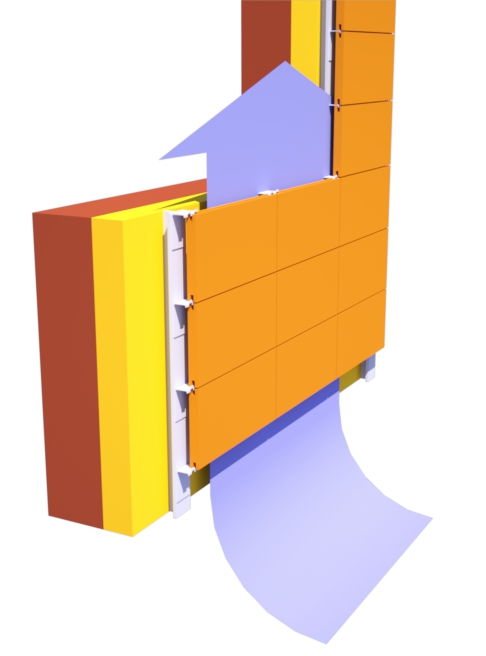
A rainscreen is an exterior wall detail where the siding (wall cladding) stands off from the moisture-resistant surface of an air/water barrier applied to the sheathing to create a capillary break and to allow drainage and evaporation. The rainscreen is the cladding or siding itself but the term rainscreen implies a system of building. Ideally the rainscreen prevents the wall air/water barrier from getting wet but because of cladding attachments and penetrations (such as windows and doors) water is likely to reach this point, and hence materials are selected to be moisture tolerant and integrated with flashing. In some cases a rainscreen wall is called a pressure-equalized rainscreen wall where the ventilation openings are large enough for the air pressure to nearly equalize on both sides of the rain screen, but this name has been criticized as being redundant and is only useful to scientists and engineers.
A screen in general terms is a barrier. The rainscreen in a wall is sometimes defined as the first layer of material on the wall, the siding itself. Also, rainscreen is defined as the entire system of the siding, drainage plane and a moisture/air barrier. A veneer that does not stand off from the wall sheathing to create a cavity is not a rainscreen. However, a masonry veneer can be a rainscreen wall if it is ventilated.
Many terms have been applied to rain screen walls including basic, open, conventional, pressure-equalized, pressure-moderated rainscreen systems or assemblies. These terms have caused confusion as to what a rain screen is but all reflect the rainscreen principle of a primary and secondary line of defense. One technical difference is between a plane (a gap of 3⁄8 inch (9.5 mm) or less) and a channel (a gap of more than 3⁄8 inch (9.5 mm)).[citation needed]
In general terms a rainscreen wall may be called a cavity or drained wall. The two other basic types of exterior walls in terms of water resistance are barrier walls which rely on the one exterior surface to prevent ingress and mass walls which allow but absorb some leakage.
In the early 1960s research was conducted in Norway on rain penetration of windows and walls, and Øivind Birkeland published a treatise referring to a "rain barrier". In 1963 the Canadian National Research Council published a pamphlet titled "Rain Penetration and its Control" using the term "open rain screen".
Rainscreen cladding is a kind of double-wall construction that utilizes a surface to help keep the rain out, as well as an inner layer to offer thermal insulation, prevent excessive air leakage and carry wind loading. The surface breathes just like a skin as the inner layer reduces energy losses.
For water to enter a wall first the water must get onto the wall and the wall must have openings. Water can then enter the wall by capillary action, gravity, momentum, and air pressure (wind). The rainscreen system provides for two lines of defense against the water intrusion into the walls: The rainscreen and a means to dissipate leakage often referred to as a channel. In a rainscreen the air gap allows the circulation of air on the moisture barrier. (These may or may not serve as a vapour barrier, which can be installed on the interior or exterior side of the insulation depending on the climate). This helps direct water away from the main exterior wall which in many climates is insulated. Keeping the insulation dry helps prevent problems such as mold formation and water leakage. The vapour-permeable air/weather barrier prevents water molecules from entering the insulated cavity but allows the passage of vapour, thus reducing the trapping of moisture within the main wall assembly.
The air gap (or cavity) can be created in several ways. One method is to use furring (battens, strapping) fastened vertically to the wall. Ventilation openings are made at the bottom and top of the wall so air can naturally rise through the cavity. Wall penetrations including windows and doors require special care to maintain the ventilation. In the pressure-equalized system the ventilation openings must be large enough to allow air-flow to equalize the pressure on both sides of the cladding. A ratio of 10:1 cladding leakage area to ventilation area has been suggested.
Hub AI
Rainscreen AI simulator
(@Rainscreen_simulator)
Rainscreen
A rainscreen is an exterior wall detail where the siding (wall cladding) stands off from the moisture-resistant surface of an air/water barrier applied to the sheathing to create a capillary break and to allow drainage and evaporation. The rainscreen is the cladding or siding itself but the term rainscreen implies a system of building. Ideally the rainscreen prevents the wall air/water barrier from getting wet but because of cladding attachments and penetrations (such as windows and doors) water is likely to reach this point, and hence materials are selected to be moisture tolerant and integrated with flashing. In some cases a rainscreen wall is called a pressure-equalized rainscreen wall where the ventilation openings are large enough for the air pressure to nearly equalize on both sides of the rain screen, but this name has been criticized as being redundant and is only useful to scientists and engineers.
A screen in general terms is a barrier. The rainscreen in a wall is sometimes defined as the first layer of material on the wall, the siding itself. Also, rainscreen is defined as the entire system of the siding, drainage plane and a moisture/air barrier. A veneer that does not stand off from the wall sheathing to create a cavity is not a rainscreen. However, a masonry veneer can be a rainscreen wall if it is ventilated.
Many terms have been applied to rain screen walls including basic, open, conventional, pressure-equalized, pressure-moderated rainscreen systems or assemblies. These terms have caused confusion as to what a rain screen is but all reflect the rainscreen principle of a primary and secondary line of defense. One technical difference is between a plane (a gap of 3⁄8 inch (9.5 mm) or less) and a channel (a gap of more than 3⁄8 inch (9.5 mm)).[citation needed]
In general terms a rainscreen wall may be called a cavity or drained wall. The two other basic types of exterior walls in terms of water resistance are barrier walls which rely on the one exterior surface to prevent ingress and mass walls which allow but absorb some leakage.
In the early 1960s research was conducted in Norway on rain penetration of windows and walls, and Øivind Birkeland published a treatise referring to a "rain barrier". In 1963 the Canadian National Research Council published a pamphlet titled "Rain Penetration and its Control" using the term "open rain screen".
Rainscreen cladding is a kind of double-wall construction that utilizes a surface to help keep the rain out, as well as an inner layer to offer thermal insulation, prevent excessive air leakage and carry wind loading. The surface breathes just like a skin as the inner layer reduces energy losses.
For water to enter a wall first the water must get onto the wall and the wall must have openings. Water can then enter the wall by capillary action, gravity, momentum, and air pressure (wind). The rainscreen system provides for two lines of defense against the water intrusion into the walls: The rainscreen and a means to dissipate leakage often referred to as a channel. In a rainscreen the air gap allows the circulation of air on the moisture barrier. (These may or may not serve as a vapour barrier, which can be installed on the interior or exterior side of the insulation depending on the climate). This helps direct water away from the main exterior wall which in many climates is insulated. Keeping the insulation dry helps prevent problems such as mold formation and water leakage. The vapour-permeable air/weather barrier prevents water molecules from entering the insulated cavity but allows the passage of vapour, thus reducing the trapping of moisture within the main wall assembly.
The air gap (or cavity) can be created in several ways. One method is to use furring (battens, strapping) fastened vertically to the wall. Ventilation openings are made at the bottom and top of the wall so air can naturally rise through the cavity. Wall penetrations including windows and doors require special care to maintain the ventilation. In the pressure-equalized system the ventilation openings must be large enough to allow air-flow to equalize the pressure on both sides of the cladding. A ratio of 10:1 cladding leakage area to ventilation area has been suggested.
Recent media