Hubbry Logo
HousewrapHousewrapMain
Open search
Housewrap
Community hub
Housewrap
logo
8 pages, 0 posts
0 subscribers
Be the first to start a discussion here.
Housewrap
Housewrap
from Wikipedia
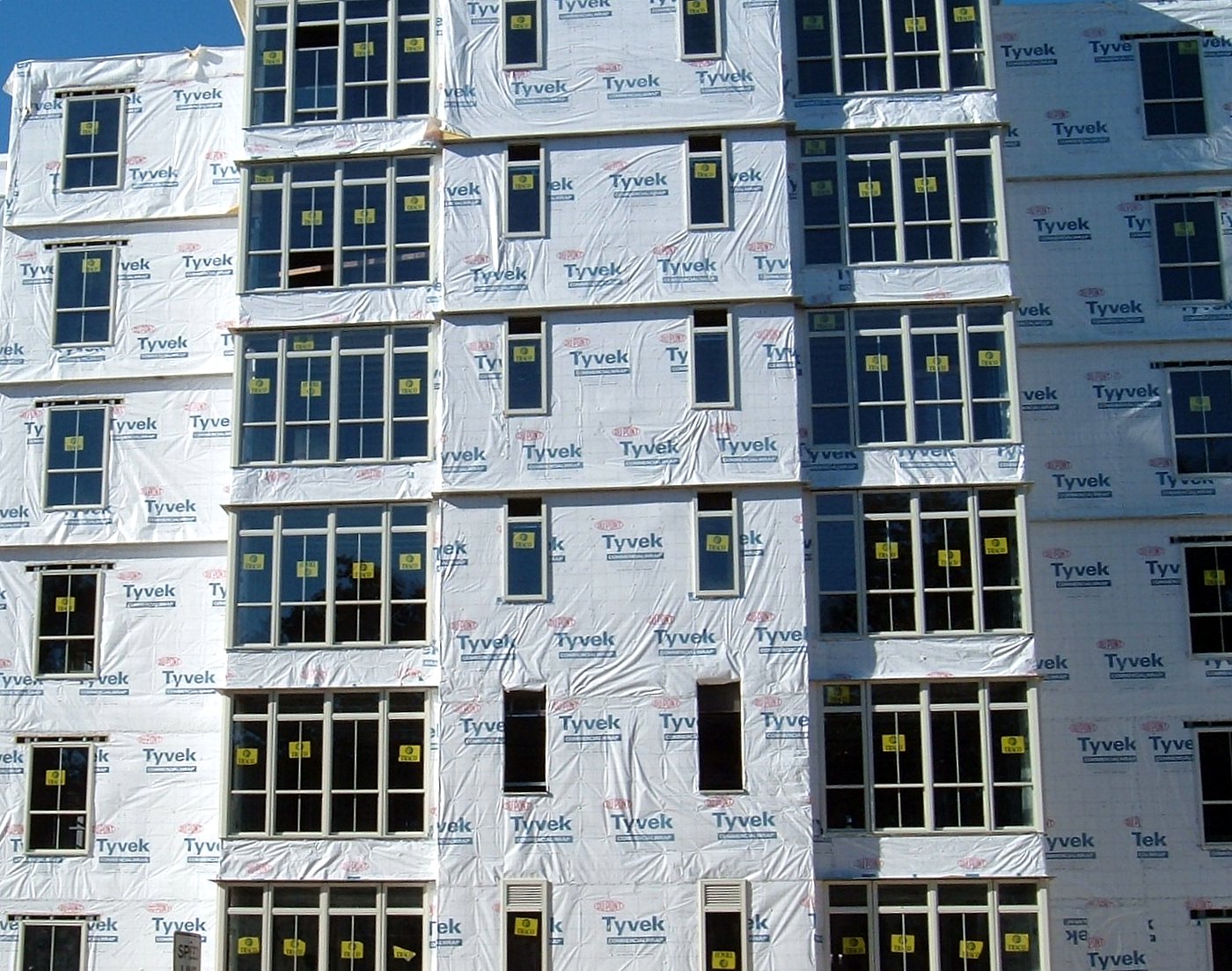
A building wrapped with Tyvek-brand housewrap during construction

Housewrap (or house wrap), also known by the genericized trademark homewrap (or home wrap), generally denotes a modern synthetic material used to protect buildings. Housewrap functions as a water-resistant layer, preventing rain or snow from getting into the wall assembly while allowing water vapor to pass to the exterior. Housewraps can only be exposed for a few months, as it is NOT a weather resistant layer, and weather elements including sunlight and temperature, can damage it. Furthermore housewraps are not a form of insulation. If moisture from either direction is allowed to build up within stud or cavity walls, mold and rot can set in and fiberglass or cellulose insulation will lose its R-value because of the heat-conducting moisture. House wrap may also serve as an air barrier if it is sealed carefully at seams and supported to resist wind loads.[1]

Housewrap is a replacement for the older tar paper or asphalt saturated felt on walls. It is lighter in weight, available in much wider rolls, stronger, and both faster and easier to apply.

Major types

[edit]

Installation

[edit]

Housewrap is installed between the sheathing and the exterior siding, and is used behind vinyl, wood clapboards, shingles or shakes, brick, and other building materials. In all cases, the housewrap helps prevent water intrusion when liquid water gets past the siding and its trim and caulking.

As such, housewrap must be both water shedding and have a high moisture vapor transmission rate (MVTR) to be effective.[2] It must also withstand abuse during installation, and because housewrap is often left exposed for some time before being cladded-over, it must hold up to wind and resist UV for 30 to 90 days. Some new designs must be installed carefully or they will slightly rip or tear during installation, possibly allowing for water infiltration at the damaged areas. Being both thin and inelastic, most newer designs do not "self-seal" well against nails or staples like asphalt products.

Properties

[edit]
  • Typical MVTR ~200 grams/100 square-inches/24hours (or greater, i.e., Tyvek is ~400)
  • Typical 2 ounces/square-yard (varies greatly with manufacturer)
  • Typical width 9' (108)" on a 3" core

References

[edit]
Revisions and contributorsEdit on WikipediaRead on Wikipedia
from Grokipedia
Housewrap is a synthetic sheet used as a weather-resistive barrier (WRB) in residential and commercial , installed over wall sheathing and beneath exterior siding to protect building structures from air infiltration and water penetration while permitting internal moisture vapor to escape. This breathable function helps prevent moisture accumulation, mold growth, and structural damage within wall assemblies. Developed as a lightweight, durable alternative to traditional asphalt-saturated felt or , housewrap emerged in the late , with pioneering products like DuPont's HomeWrap introduced in the early 1980s for enhanced performance in modern building envelopes. Commonly manufactured from materials such as spunbonded (HDPE) fibers or woven , housewrap features micro-perforations or inherent pore structures that balance water resistance with vapor permeability. Notable brands include Tyvek HomeWrap by , which uses fused HDPE fibers with a basis weight of 1.8 oz/yd² and water resistance up to 250 cm, and TYPAR BuildingWrap, a -based product offering five times the tear strength of standard wraps. These materials are typically supplied in wide rolls—often 9 feet by 100–150 feet—for efficient coverage during installation. Housewrap contributes to energy efficiency by minimizing air leakage, which can reduce heating and cooling costs by up to 20% in some applications, and it supports compliance with building codes such as the International Residential Code (IRC) Section R703.2, which mandates at least one layer of WRB over exterior wall sheathing. By providing these protective qualities, housewrap extends the lifespan of building components and enhances overall occupant comfort in diverse climates.

Introduction

Definition

Housewrap is a synthetic, flexible sheet material employed as a weather-resistive barrier (WRB) in building envelopes, positioned behind exterior cladding to protect structural components from water intrusion while permitting the passage of water vapor. Typically composed of high-density polyethylene (HDPE) or polypropylene fibers that are spunbonded or woven into a nonwoven fabric, it forms a durable yet permeable layer essential for moisture management in residential and light commercial construction. Key characteristics of housewrap include its lightweight construction, generally around 2 ounces per , which facilitates handling and installation compared to older materials like . It is commonly supplied in wide rolls measuring 9 to 10 feet in width and 100 to 150 feet in length, allowing for efficient coverage of surfaces during framing. These attributes make it stronger and more user-friendly than traditional barriers, serving as a modern replacement for in many applications. Unlike insulation materials, provides no thermal resistance and is designed solely for weather protection. It is not a full , as its permeability allows drying to the exterior, and it is unsuitable for prolonged exposure to ultraviolet light or elements without protective cladding, typically requiring coverage within 90 to 180 days of installation. The term "housewrap" derives from its role in enveloping or "wrapping" the exterior sheathing of a , akin to for .

Purpose in Construction

Housewrap serves as a secondary barrier in building envelopes, primarily designed to shed bulk , such as or , that penetrates the exterior cladding, thereby protecting the underlying structural sheathing from damage. This function is critical for preventing accumulation that could lead to rot, mold growth, or structural degradation in wall assemblies. Additionally, housewrap is engineered to be vapor permeable, allowing inward-driven vapor from the interior or within the wall to escape outward, which helps maintain the integrity of wood-based sheathing materials like or (OSB). In typical wall assemblies, housewrap is installed directly over the structural sheathing—such as or OSB—and beneath the exterior cladding, including materials like or brick veneer, forming a continuous drainage plane that directs incidental away from vulnerable components. This positioning ensures that the housewrap acts as a backup to the cladding, which serves as the first line of defense against exposure, while facilitating the overall management strategy of the . When seams, edges, and penetrations are properly sealed, housewrap can also function as an air barrier, minimizing uncontrolled air leakage through the wall assembly and contributing to improved energy efficiency by reducing heat loss or gain. However, housewrap is not intended as the primary water barrier, as it relies on the cladding to deflect the majority of , and its effectiveness diminishes without meticulous sealing to maintain continuity.

History

Early Barriers

The origins of modern housewrap can be traced to 19th-century building papers, particularly asphalt-saturated felt known as , which emerged around the mid-1800s as a basic form of moisture protection in construction. This material was typically produced by impregnating kraft or rag paper with or asphalt derived from , creating a semi-waterproof barrier intended to shield wooden sheathing from rain and wind-driven moisture. Early adoption occurred during the era, where it was used not only for roofing but also as an underlayment for wall sidings in hastily built structures. By the early , tar paper had become a standard underlayment beneath exterior siding in residential and commercial buildings, primarily to facilitate water shedding and provide a secondary defense against weather infiltration. However, its practical limitations were significant: rolls weighed 30 to 60 pounds each, making them cumbersome to transport and unroll, while their narrow 36-inch width necessitated extensive overlapping and multiple courses during installation, increasing labor demands. The material was also prone to tearing during handling or exposure to wind, and its low vapor permeability—often around 5 perms when dry—tended to trap interior moisture within wall assemblies, promoting and potential rot in sheathing. Additional era-specific drawbacks included fire hazards from the flammable asphalt content, which could ignite during installation or if exposed, and gradual degradation over time due to exposure and mechanical wear, leading to brittleness and reduced efficacy within a few years. A pivotal event underscoring these vulnerabilities occurred in , when widespread reports of peeling and blistering exterior on newly insulated homes revealed critical flaws in traditional building papers. The addition of interior insulation in colder climates drove moist indoor air toward the exterior, where the impermeable nature of prevented drying, causing moisture accumulation behind siding and in coatings. This issue prompted U.S. Forest Products Laboratory studies on wall moisture dynamics, highlighting the need for more breathable materials and influencing a gradual shift toward synthetic alternatives by the mid-20th century.

Development of Modern Housewrap

The development of modern housewrap began in the mid-20th century with a significant breakthrough in synthetic materials. In 1955, researcher Jim White discovered a process for creating flash-spun fibers, leading to the invention of , a nonwoven sheet material known for its durability, water resistance, and breathability. Initially commercialized in 1967 for applications such as and protective envelopes, was adapted for use as housewrap in the early 1990s, marking the transition from traditional barriers like asphalt-saturated felt to synthetic alternatives that offered superior performance in moisture management. This innovation was propelled by broader influential factors, particularly the energy crises of the 1970s, including the 1973–1974 Arab Oil Embargo, which heightened awareness of building energy efficiency and the need for effective air barriers to reduce infiltration and heat loss. Research by building scientist Joe Lstiburek emphasized the importance of vapor permeability in these materials, advocating for assemblies with at least 5 perms to allow drying and prevent moisture accumulation, thereby avoiding historical failures from impermeable barriers that trapped vapor in walls. By the , housewrap saw rapid adoption in residential due to its dual resistance to liquid water and air leakage, combined with practical advantages like wider roll widths (9 feet) and lighter weight compared to earlier felts, which facilitated easier installation over sheathing. Organizations such as the Building Science Corporation, led by Lstiburek, played a key role in promoting permeable water-resistive barriers (WRBs) like , highlighting their ability to serve as both rainwater screens and air control layers while permitting vapor diffusion to maintain wall assemblies' long-term integrity. Key milestones in the 1990s and 2000s further solidified housewrap's role in standard practice. The introduction of the International Residential Code (IRC) in 2000 integrated requirements for weather-resistive barriers behind exterior claddings, effectively mandating housewrap or equivalent permeable sheets for most wood-framed walls to ensure protection against bulk water penetration. In the 2000s, drainable variants emerged to enhance water management, with products like HydroGap introduced in 2012 featuring integrated drainage grooves or spacers that created a gap for rapid bulk water shedding, up to 100 times faster than standard housewrap, reducing risks of rot and mold in wall cavities. Post-2010, the focus shifted toward eco-friendly and recyclable options, driven by demands in building practices. Materials like , composed of , gained recognition for their recyclability—capable of being processed into new products without quality loss—and low environmental impact during production, with manufacturers emphasizing reduced waste and inert landfilling properties. In the , further innovations include self-adhering membranes and enhanced drainage features for improved performance and . This evolution reflected a broader industry trend toward high-performance WRBs that balanced moisture control with , aligning with energy codes and standards.

Types

Traditional Synthetic Wraps

Traditional synthetic wraps are primarily composed of spunbonded or cross-laminated polyethylene, such as fibers that are spun and fused into a uniform non-woven sheet. These materials evolved from synthetic innovations in the , providing a durable alternative to older barriers. Major examples include Tyvek HomeWrap, a non-perforated spunbonded sheet designed for high while blocking liquid water. Barricade Building Wrap, made from non-woven , offers robust air and water resistance in standard form. TYPAR HouseWrap, composed of non-perforated spunbonded , offers high vapor permeability through its material structure while providing water resistance. These wraps typically come in rolls measuring 9 to 10 feet in width and 100 to 200 feet in length, with basis weights ranging from 1.5 to 3 ounces per , enabling efficient broad coverage and basic water shedding over large wall surfaces. Compared to traditional asphalt-saturated felt, synthetic wraps provide 5 to 10 times greater tensile and tear strength, making them far more resistant to ripping during handling and exposure. They are also easier to cut and tear by hand for installers due to their flexibility and uniformity, and they deliver consistent performance across diverse climates without degrading from moisture saturation.

Specialized Variants

Drainable housewraps incorporate design features such as vertical grooves or spacers to facilitate enhanced drainage behind exterior cladding, reducing the risk of accumulation in wall assemblies. For instance, Benjamin Obdyke's HydroGap features compression-resistant 1 mm spacers that create a continuous drainage gap, enabling over 100 times more water removal compared to standard housewraps while maintaining a vapor permeability rating of 16 perms. This tri-laminate material provides superior strength and water holdout without requiring seam tape, making it suitable for applications with composite or fiber cement siding. Self-adhered membranes offer peel-and-stick installation for superior airtightness, particularly in high-risk areas like and rough openings where traditional wraps might require additional taping. Henry Blueskin VP100, a premium vapor-permeable option, forms a fully adhered, monolithic barrier that self-seals around fasteners, achieving over 95% drainage efficiency and eliminating uncontrolled air leakage in wood-framed . Similarly, Blueskin SA provides an impermeable alternative using SBS-modified asphalt laminated to , ideal for creating watertight seals without mechanical fasteners. Recent self-adhered options, like Grip-Rite ProWrap-SA introduced around 2024, provide 60+ perms vapor permeability, over 90% drainage efficiency, and simplified installation via peel-and-stick method. Beyond sheet-based systems, fluid-applied liquid water-resistive barriers (WRBs) consist of spray-on or roll-on polymer coatings that form seamless, monolithic membranes directly on sheathing, bridging gaps and penetrations more effectively than discrete sheets. Tyvek Fluid Applied WB+ is engineered for commercial projects, delivering air and water protection while allowing vapor transmission in heavy-duty applications. PROSOCO Spray Wrap MVP similarly provides a durable, fluid-applied barrier for cavity walls and veneer, preventing air and water infiltration with high flexibility. Integrated foam boards combine rigid insulation with an embedded WRB layer for simplified installation and enhanced . Huber Engineered Woods' ZIP System R-Sheathing features a structural OSB panel overlaid with insulation and an integrated weather-resistive barrier, offering built-in air, , and protection in a single product. Perforated wraps promote increased and vapor transmission, particularly beneficial in humid climates to facilitate drying and prevent interstitial . These materials include micro-perforations that allow vapor escape while maintaining water resistance, as seen in products like SmartFOIL, which uses tiny perforations to balance air barrier function with permeability in -prone environments. Asphalt felt serves as a low-cost niche option in certain building codes, functioning as an approved WRB with a minimum of 5 perms when dry. No. 15 asphalt-saturated felt, often specified in residential applications, provides basic water resistance at roughly half the cost of synthetic alternatives, though its performance drops in wet conditions.

Properties

Water and Vapor Transmission

Housewrap materials are engineered to resist liquid water penetration while permitting the diffusion of , a dual functionality essential for effective moisture management in building envelopes. The water resistance of housewrap primarily stems from its hydrophobic surface, which repels bulk liquid , preventing infiltration during rain events or wind-driven moisture exposure. This property is rigorously evaluated using the hydrostatic head test per AATCC 127, as referenced in the ASTM E2556 standard for vapor-permeable flexible sheet water-resistive barriers. For instance, ® HomeWrap® demonstrates no passage under hydrostatic pressures exceeding 98 inches (approximately 249 cm), far surpassing typical exposure conditions in residential construction. Vapor permeability, quantified by the (MVTR), enables housewrap to allow interior moisture to escape as vapor, reducing the risk of accumulation and within assemblies. MVTR values for common housewraps typically range from 50 to 500 g/m²/day, measured per ASTM E96 procedures, with higher values indicating greater . A representative example is ® HomeWrap®, which achieves an MVTR of approximately 400 g/m²/day (equivalent to 56 perms under ASTM E96 Method A), facilitating outward drying while maintaining structural integrity. This permeability is achieved through the material's microporous structure, such as non-woven fibers, which permit molecular vapor without allowing liquid passage. Air permeability in housewrap is minimized to serve as an effective air barrier when properly sealed, limiting unintended airflow that could transport moisture into assemblies. Sealed non-perforated housewraps exhibit very low air permeance, typically ≤0.004 cfm/ft² at a 0.3-inch gauge pressure differential, as required for air barrier classification under standards like ASTM E2178. In contrast, perforated variants, which include mechanical micro-holes to enhance vapor transmission, display higher air permeability, potentially up to several times that of non-perforated types, though they still outperform traditional building papers in controlled installations. The core principle governing housewrap performance is the balance between drainability—its capacity to shed and channel bulk liquid water away from the wall—and permeability, which ensures vapor escape to avert and mold growth. This equilibrium is critical in moisture management, as excessive impermeability could trap vapor, while inadequate water resistance might allow leakage; research emphasizes that optimal housewraps integrate both to support durable, energy-efficient envelopes in varied climates.

Mechanical and Durability

Housewrap materials exhibit robust mechanical properties that enable them to withstand physical stresses during installation and service life, including tensile strengths typically ranging from 30 to 100 lbs/inch (ASTM D5035 or D882) and tear strengths from 5 to 50 lbs (ASTM D1117 or D5034), which help resist loads and on-site handling abuse. For instance, certain synthetic housewraps achieve tensile strengths up to 85 lbs/inch in the machine direction, ensuring durability against tearing from construction activities or environmental forces. UV resistance is a critical mechanical attribute, with most housewraps limited to 3-6 months of direct exposure before degradation such as chalking or brittleness occurs, as evaluated under standards like ASTM D1929 for material stability. This timeframe accommodates typical construction delays while preventing significant loss of structural integrity from solar radiation. Housewraps demonstrate broad tolerance, maintaining integrity from -40°F to 180°F without compromising , alongside a low flame spread index classified as Class A per ASTM E84, which limits fire propagation in building assemblies. These properties support reliable operation across diverse climates and enhance overall . Additional durability factors include strong resistance to fungal growth, passing ASTM D3273 tests to inhibit mold and propagation in humid conditions. Housewraps also exhibit against alkalis found in , resisting degradation from contact with cementitious materials during construction. Polyethylene-based variants further contribute to through recyclability, as (HDPE) components can be processed into new products without loss of material value.

Installation

Preparation

Prior to installing housewrap, a thorough site assessment is essential to ensure optimal performance of the weather-resistive barrier. The exterior sheathing must be clean, dry, flat, and free of debris, frost, moisture, dirt, grease, or any contaminants that could compromise or drainage. Additionally, the framing and sheathing should be inspected for structural integrity in accordance with local building codes to confirm the wall assembly can withstand environmental loads. The tools required for preparation include a for cutting, a and measuring tape for layout accuracy, and plastic-capped staples or long enough to penetrate into the framing studs to secure the without tearing. Seam tape, typically acrylic- or butyl-based and 2 to 4 inches wide, should also be on hand to seal overlaps during layout planning. Material handling begins with unrolling the housewrap and allowing it to acclimate to the site conditions to prevent handling issues. Layout should be planned to minimize seams, such as by using full-height drops from the with 6- to 12-inch vertical overlaps, ensuring efficient coverage and shingling direction. Safety measures include wearing gloves and to guard against cuts or irritation from sharp edges and adhesives. Flammable housewrap variants, which may melt above 250°F (121°C), require avoiding ignition sources like open flames or sparks during handling.

Procedures and Best Practices

The installation of housewrap begins at the bottom of the wall, working upward to ensure proper shingling that directs downward and outward. The material is unrolled horizontally or vertically, with the first course positioned to extend at least 1 inch (preferably 2 inches) below the or onto the foundation for integration with drainage features. Subsequent courses are applied in a shingle-like fashion, with the upper layer overlapping the lower by a minimum of 6 inches to facilitate drainage. Vertical overlaps between adjacent rolls should measure 6 to 12 inches, with the upper piece lapped over the lower to maintain the drainage plane. At external corners and around window and door openings, a double layer of housewrap is recommended, extending at least 12 inches onto adjacent surfaces to enhance protection against water intrusion. This shingled layering prevents reverse laps, which can trap moisture and compromise the barrier's effectiveness. Fastening involves securing the housewrap to studs or sheathing using capped staples or plastic cap nails spaced 6 to 18 inches apart along vertical stud lines, with closer spacing at edges and seams for stability. Fasteners should be long enough to penetrate the sheathing and into the framing studs, but over-tightening must be avoided to prevent puckering that could impede the drainage plane. In high-wind areas, additional fasteners may be used at 12-inch intervals horizontally between studs. Sealing is critical for maintaining continuity, with all horizontal and vertical seams taped using manufacturer-approved acrylic or butyl tape to create an effective air and water barrier. Around penetrations, windows, and doors, the housewrap is cut using an "I-cut" or inverted Y-method, with 45-degree slits extending 8 inches from corners to allow folding into the rough opening for secure integration. Sill pans or self-adhered flashing are installed beneath windows to divert water, ensuring all edges are taped or adhered in a shingled sequence. Best practices emphasize meticulous technique to maximize performance, including immediate inspection for tears or defects after installation and repair with tape or patches as needed. If cladding installation is delayed, the housewrap should be covered with temporary UV-protective sheeting, as prolonged exposure beyond 3 to 4 months can degrade the material. Tools from preparation, such as utility knives and tape measures, aid in precise cutting and alignment during these steps.

Standards and Applications

Building Code Requirements

The International Residential Code (IRC) Section R703.2 mandates that not fewer than one layer of an approved water-resistive barrier be applied over studs or sheathing of all exterior walls, with flashing as described in Section R703.4, to prevent water accumulation within the wall assembly. This barrier, such as housewrap, must comply with performance criteria including compliance with standards such as ICC-ES AC38 for water-resistive barriers, which may include testing per ASTM E331 for water penetration resistance under specified pressure differentials. For most wall assemblies, this ensures protection behind exterior cladding like vinyl or wood siding. Relevant ASTM standards establish minimum performance thresholds for housewrap materials. ASTM E1677 specifies requirements for air barrier materials or systems in low-rise framed walls, including air permeance not exceeding 0.004 cfm/ft² (0.02 L/s·m²) at a 75 Pa (0.3-inch ) pressure difference, allowing housewrap to serve as a Type I air barrier when properly installed. ASTM D226 defines Type I or II asphalt-saturated felt as a traditional water-resistive option, with synthetic housewraps approved as alternatives if they meet equivalent holdout and vapor permeability. Additionally, ASTM E2556 outlines criteria for vapor-permeable flexible sheet water-resistive barriers, including a hydrostatic pressure resistance test (per AATCC 127), with products like demonstrating resistance equivalent to a 250 cm head without penetration. Regional building codes incorporate variations based on and hazard risks. The International Energy Conservation Code (IECC) integrates air barrier requirements into energy efficiency provisions, such as Section C402.5.1, which demands a continuous air barrier across the building to limit air leakage to 0.40 cfm/ft² at 75 Pa for commercial , with housewrap contributing when sealed per manufacturer instructions. In high-wind or seismic zones, enhanced mandates apply; for instance, ASCE 7 wind load provisions require wall assemblies to resist design pressures up to 45 psf in hurricane-prone areas (Risk Category II at 115 mph basic ), often necessitating housewrap with proven infiltration resistance exceeding 15 psf per ASTM E331 to maintain integrity. Product certification ensures compliance, with housewrap required to hold ICC Evaluation Service (ICC-ES) listings verifying adherence to acceptance criteria like AC38 for water-resistive barriers. These listings, such as ESR-2375 for products, confirm performance in various assemblies but prohibit standard housewrap use in configurations like gaps without specific approval, as it may not provide adequate drainage or attachment under code scrutiny.

Considerations for Use

When selecting housewrap for a building project, plays a critical role in preventing -related issues such as and structural damage. In cold or humid , housewraps with high vapor transmission rates (MVTR), typically above 50 perms, are essential to allow interior vapor to escape and dry the wall assembly, thereby reducing the risk of buildup behind impermeable barriers. In wet or rainy , drainable housewrap variants that incorporate textured surfaces or integrated drainage channels outperform standard flat membranes by facilitating faster water shedding and minimizing bulk water accumulation. Compatibility with exterior claddings is another key factor to ensure long-term performance and avoid or drainage failures. For applications, standard synthetic housewraps can bond directly to the stucco rendering, potentially trapping moisture; thus, a dedicated drainage plane—such as a textured housewrap or additional layer—is required to create separation and promote drying. With veneer, housewrap must be installed with an air space of at least 1 inch to allow ventilation and prevent wicking of moisture into the wall assembly. Housewrap should never be used in direct contact with , as it lacks the durability to resist degradation from ground moisture and pests. From an environmental perspective, most synthetic housewraps are non-biodegradable but offer recyclability options to mitigate waste; for instance, DuPont's recycling program processes used material into pellets for reuse in new products. These materials generally emit low volatile organic compounds (VOCs), with certifications like GreenGuard Gold confirming minimal off-gassing during installation and use, though their production involves energy-intensive . Cost-benefit analysis favors housewrap installation due to its role in air sealing, with material costs ranging from $0.10 to $0.30 per , often yielding a through 10-20% reductions in heating and cooling energy use over the building's lifespan. However, improper overlaps or sealing during installation can compromise effectiveness, leading to water intrusion and higher long-term repair costs, underscoring the need for meticulous application.

References

Add your contribution
Related Hubs
User Avatar
No comments yet.