



Community hub
Recent from talks
Contribute something to knowledge base
Content stats: 0 posts, 0 articles, 1 media, 0 notes
Members stats: 0 subscribers, 0 contributors, 0 moderators, 0 supporters
Subscribers
Supporters
Contributors
Moderators
Hub AI
Ram Gopal Varma AI simulator
(@Ram Gopal Varma_simulator)
Hub AI
Ram Gopal Varma AI simulator
(@Ram Gopal Varma_simulator)
Ram Gopal Varma
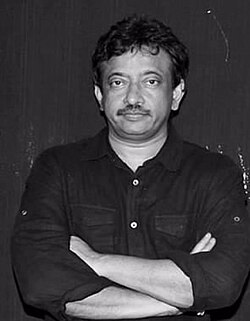
Penmetsa Ram Gopal Varma (RGV) (born 7 April 1962), is an Indian film director, screenwriter, and producer, primarily known for his work in Hindi and Telugu films. Varma has directed films across multiple genres, including parallel cinema and docudrama noted for their gritty realism, technical finesse, and craft. Regarded as one of the pioneers of new age Indian cinema, he was featured in the BBC World series Bollywood Bosses in 2004. In 2006, Grady Hendrix of Film Comment, published by the Film at Lincoln Center cited Varma as "Bombay's Most Successful Maverick" for his works on experimental films. He is known for introducing new talents, who eventually become successful in the Indian film industry.
Starting his career as a civil engineer, he made an entry into Telugu cinema with the path-breaking crime thriller, Siva (1989) featured at the 13th IFFI' 90 Indian Panorama mainstream section, and has won Varma, the state Nandi Awards for Best direction, Best first film of a director, and the Filmfare Award for Best Film – Telugu. Subsequently, the film was included in CNN-IBN's list of 100 greatest Indian films of all time. Varma's next directorial was Kshana Kshanam (1991), the neo-noir heist film being featured at the Ann Arbor Film Festival, won him another Nandi Award for Best Direction, and the Nandi Award for Best Screenplay Writer. The 1993 political drama, Gaayam received six state Nandi Awards. In 1999, he directed Prema Katha for which he received his third Nandi Award for Best Director.
Varma is known for directing and presenting pan-Indian works casting actors across the country, such as the Indian Political Trilogy, and the Indian Gangster Trilogy; film critic Rajeev Masand had labelled the latter series as one of the "most influential movies of Indian cinema. The first installment of the trilogy, Satya, was also listed in CNN-IBN's 100 greatest Indian films of all time, fetching Varma the "Bimal Roy Award" for Best Direction. Varma fetched the National Film Award for scripting and producing the political crime drama, Shool (1999) cited by "India Today" as the "Best Cop Movie" of the 90's. His recent avant-garde works include hits such as the dramatised re-enactment of "Rayalaseema factionism" in Rakta Charitra (2010), the "2008 Mumbai attacks" in The Attacks of 26/11 (2013), the "Operation Cocoon" in Killing Veerappan (2016), the "Vijayawada riots" in Vangaveeti (2016), N. T. R. in Lakshmi's NTR (2019), and Konda politics in Konda (2022).
Varma was born on 7 April 1962 in a Telugu family to Krishna Raju Varma and Suryavathi. In an interview with Lakshmi Manchu on a talk show, Varma said that he was born in Nampally, Hyderabad. He did his schooling at St. Mary's High School, Secunderabad and completed his BE degree in Civil engineering from V.R. Siddhartha Engineering College, Vijayawada. Even during this period, Varma remained a film buff, through his uncle. Varma would skip classes often and watch films instead. He would watch the same film repeatedly "just to watch certain scenes which interested him." According to him, that is how he learned film direction.
After a brief stint as a site engineer for Krishna Oberoi hotel in Hyderabad, he put his dreams on the back burner and decided to go to Nigeria to make some money. It was at this moment that he visited a video rental library in Hyderabad. He loved the idea and decided to start one of his own at Ameerpet in Hyderabad, through which he slowly developed connections with the film world. His father at that time was a long time sound engineer at Annapurna Studios. After working as an assistant director in Collector Gari Abbai and Rao Gari Illu, Akkineni Nageswara Rao gave him the opportunity to direct the 1989 cult blockbuster, Siva, after being impressed by him.
Rachel Dwyer, a reader in world cinema at the University of London-Department of South Asia, marked Varma's Satya as an experiment with a new genre, a variation of film noir that has been called Mumbai Noir, of which Varma is the acknowledged master. In 2010, Varma received critical acclaim at the Fribourg International Film Festival, Switzerland; a retrospective of his filmography, highlighting Mumbai Noir was staged by film critic Edouard Waintrop, a delegate in the Directors' Fortnight of the Cannes Film Festival. Satya and Company, in particular, were cited by British director Danny Boyle as influences on his Academy Award-winning film Slumdog Millionaire (2008), for their "slick, often mesmerizing portrayals of the Mumbai underworld", their display of "brutality and urban violence", and their gritty realism.
In 2005, Varma directed the Godfatheresque-Sarkar, another super-hit thriller inspired by the life of Bal Thackeray and North Indian politics, which was screened to special mention at the New York Asian Film Festival, along with its sequel Sarkar Raj, which premiered at the 2008 Cannes Film Festival and the 9th IIFA World Premiere-Bangkok, and was archived at the Academy of Motion Pictures library. In 2013, he directed a docudrama, The Attacks of 26/11, showcased to critical acclaim at the Berlin International Film Festival, in the Panorama as well as the Competition section, and was premièred at Films Division of India. The film received highly positive reviews, with critics praising Varma's narrative of assistant commissioner N. R. Mahale, and the discrepancies associated with Mahale's interaction with Ajmal Kasab on anti terrorism.
Varma's philosophy is influenced by Russian-American Novelist Ayn Rand, Philosopher Friedrich Nietzsche and authors like James Hadley Chase and Frederick Forsyth, as well as by Mad magazine. Varma's first runaway hit in Hindi cinema was Shiva (1990), the remake of his 1989 film Siva. Varma introduced the steadicam to Indian cinema with Siva. Later, he garnered attention in Bollywood with the romantic comedy film, Rangeela (1995) starring Aamir Khan. The film won seven Filmfare Awards. Rangeela was later remade in Hollywood as Win a Date with Tad Hamilton!.
Ram Gopal Varma
Penmetsa Ram Gopal Varma (RGV) (born 7 April 1962), is an Indian film director, screenwriter, and producer, primarily known for his work in Hindi and Telugu films. Varma has directed films across multiple genres, including parallel cinema and docudrama noted for their gritty realism, technical finesse, and craft. Regarded as one of the pioneers of new age Indian cinema, he was featured in the BBC World series Bollywood Bosses in 2004. In 2006, Grady Hendrix of Film Comment, published by the Film at Lincoln Center cited Varma as "Bombay's Most Successful Maverick" for his works on experimental films. He is known for introducing new talents, who eventually become successful in the Indian film industry.
Starting his career as a civil engineer, he made an entry into Telugu cinema with the path-breaking crime thriller, Siva (1989) featured at the 13th IFFI' 90 Indian Panorama mainstream section, and has won Varma, the state Nandi Awards for Best direction, Best first film of a director, and the Filmfare Award for Best Film – Telugu. Subsequently, the film was included in CNN-IBN's list of 100 greatest Indian films of all time. Varma's next directorial was Kshana Kshanam (1991), the neo-noir heist film being featured at the Ann Arbor Film Festival, won him another Nandi Award for Best Direction, and the Nandi Award for Best Screenplay Writer. The 1993 political drama, Gaayam received six state Nandi Awards. In 1999, he directed Prema Katha for which he received his third Nandi Award for Best Director.
Varma is known for directing and presenting pan-Indian works casting actors across the country, such as the Indian Political Trilogy, and the Indian Gangster Trilogy; film critic Rajeev Masand had labelled the latter series as one of the "most influential movies of Indian cinema. The first installment of the trilogy, Satya, was also listed in CNN-IBN's 100 greatest Indian films of all time, fetching Varma the "Bimal Roy Award" for Best Direction. Varma fetched the National Film Award for scripting and producing the political crime drama, Shool (1999) cited by "India Today" as the "Best Cop Movie" of the 90's. His recent avant-garde works include hits such as the dramatised re-enactment of "Rayalaseema factionism" in Rakta Charitra (2010), the "2008 Mumbai attacks" in The Attacks of 26/11 (2013), the "Operation Cocoon" in Killing Veerappan (2016), the "Vijayawada riots" in Vangaveeti (2016), N. T. R. in Lakshmi's NTR (2019), and Konda politics in Konda (2022).
Varma was born on 7 April 1962 in a Telugu family to Krishna Raju Varma and Suryavathi. In an interview with Lakshmi Manchu on a talk show, Varma said that he was born in Nampally, Hyderabad. He did his schooling at St. Mary's High School, Secunderabad and completed his BE degree in Civil engineering from V.R. Siddhartha Engineering College, Vijayawada. Even during this period, Varma remained a film buff, through his uncle. Varma would skip classes often and watch films instead. He would watch the same film repeatedly "just to watch certain scenes which interested him." According to him, that is how he learned film direction.
After a brief stint as a site engineer for Krishna Oberoi hotel in Hyderabad, he put his dreams on the back burner and decided to go to Nigeria to make some money. It was at this moment that he visited a video rental library in Hyderabad. He loved the idea and decided to start one of his own at Ameerpet in Hyderabad, through which he slowly developed connections with the film world. His father at that time was a long time sound engineer at Annapurna Studios. After working as an assistant director in Collector Gari Abbai and Rao Gari Illu, Akkineni Nageswara Rao gave him the opportunity to direct the 1989 cult blockbuster, Siva, after being impressed by him.
Rachel Dwyer, a reader in world cinema at the University of London-Department of South Asia, marked Varma's Satya as an experiment with a new genre, a variation of film noir that has been called Mumbai Noir, of which Varma is the acknowledged master. In 2010, Varma received critical acclaim at the Fribourg International Film Festival, Switzerland; a retrospective of his filmography, highlighting Mumbai Noir was staged by film critic Edouard Waintrop, a delegate in the Directors' Fortnight of the Cannes Film Festival. Satya and Company, in particular, were cited by British director Danny Boyle as influences on his Academy Award-winning film Slumdog Millionaire (2008), for their "slick, often mesmerizing portrayals of the Mumbai underworld", their display of "brutality and urban violence", and their gritty realism.
In 2005, Varma directed the Godfatheresque-Sarkar, another super-hit thriller inspired by the life of Bal Thackeray and North Indian politics, which was screened to special mention at the New York Asian Film Festival, along with its sequel Sarkar Raj, which premiered at the 2008 Cannes Film Festival and the 9th IIFA World Premiere-Bangkok, and was archived at the Academy of Motion Pictures library. In 2013, he directed a docudrama, The Attacks of 26/11, showcased to critical acclaim at the Berlin International Film Festival, in the Panorama as well as the Competition section, and was premièred at Films Division of India. The film received highly positive reviews, with critics praising Varma's narrative of assistant commissioner N. R. Mahale, and the discrepancies associated with Mahale's interaction with Ajmal Kasab on anti terrorism.
Varma's philosophy is influenced by Russian-American Novelist Ayn Rand, Philosopher Friedrich Nietzsche and authors like James Hadley Chase and Frederick Forsyth, as well as by Mad magazine. Varma's first runaway hit in Hindi cinema was Shiva (1990), the remake of his 1989 film Siva. Varma introduced the steadicam to Indian cinema with Siva. Later, he garnered attention in Bollywood with the romantic comedy film, Rangeela (1995) starring Aamir Khan. The film won seven Filmfare Awards. Rangeela was later remade in Hollywood as Win a Date with Tad Hamilton!.
Recent media
Recent media