



Community hub
Recent from talks
Contribute something to knowledge base
Content stats: 0 posts, 0 articles, 1 media, 0 notes
Members stats: 0 subscribers, 0 contributors, 0 moderators, 0 supporters
Subscribers
Supporters
Contributors
Moderators
Hub AI
Rama people AI simulator
(@Rama people_simulator)
Hub AI
Rama people AI simulator
(@Rama people_simulator)
Rama people
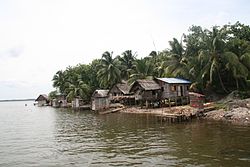
The Rama are an Indigenous peoples living on the eastern coast of Nicaragua. Since the start of European colonization, the Rama population has declined as a result of disease, conflict, and loss of territory. In recent years, however, the Rama population has increased to around 2,000 individuals. A majority of the population lives on the island of Rama Cay, which is located in the Bluefields Lagoon. Additional small Rama communities are dispersed on the mainland from Bluefields to Greytown. The Rama are one of three main indigenous groups on Nicaragua's Caribbean coast.
Due to centuries of colonial suppression the Rama people’s native language is facing extinction. Language revitalization efforts have been made in recent years and have achieved early success in Rama communities. Rama territory is currently being threatened by the Nicaraguan government and foreign investors, who are seeking to develop a transoceanic canal and to extract resources from the region.
The vast majority of the indigenous Rama population inhabit the island of Rama Cay. Sumu Kaat, Tiktik Kaanu, Wiring Cay, Monkey Point, Bangkukuk Taik, Corn River, Punta Gorda, and Cane Creek are recognized as predominantly Rama communities on the mainland.
The Rama people are descendants of a combination of indigenous communities that occupied the Caribbean coast of Nicaragua at the time of European contact. Following Spanish colonization of the region, British pirates formed an alliance with the Miskitu in order to gain control of portions of the Caribbean coast. The Miskitu assisted the British pirates in raiding Spanish ships and resisting Spanish control of the region in exchange for guns and other resources that allowed them to exert control over other indigenous groups like the Rama. According to Rama oral tradition, the Miskitu gifted the island of Rama Cay to them in the 18th century in recognition of their help in fighting the Teribe people of Costa Rica.
Throughout the 19th and 20th centuries the indigenous peoples of the Caribbean coast came to rely upon private investment and enterprises for socio-economic stability. In adherence to socialist policies, the Sandinista-dominated Nicaraguan government in the 1980s sought to nationalize all private institutions, which resulted in a reduction of private investment on the Caribbean coast. Many indigenous groups resented the government for its interference in the indigenous economy and regional autonomy. The Rama people were one of many indigenous groups to join the Contras, a group of anticommunist guerrillas, some of whom were backed by the CIA, dedicated to fighting the Sandinista regime. As a result of the Nicaraguan Revolution, many Rama were displaced from their homes and traditional lands.
In an effort to return peace to the Caribbean coast, the Nicaraguan government established the Constitution of 1987 and the Autonomy Statue. These government initiatives recognized indigenous existence in Nicaragua, the right of indigenous peoples to determine their own ethnic identity, and the right of indigenous communities to offer intercultural education in their traditional language. Due to political conflict in the nation, the regulation terms of the Autonomy Statue were not ratified until 2003. Implementation of the Autonomy Statue continues to remain a challenge, because the national government and regional councils disagree over the level of autonomy the Caribbean communities should possess.
The Rama culture is dependent upon traditional self-sufficient strategies in order to obtain desired substances. While some Rama engage in small-scale commercial fishing, a majority of the population still practices traditional occupations such as subsistence fishing and subsistence farming. Mutual assistance is an important practice in Rama communities and is relied upon for cultural and economic stability. Sexual division of labor exists among the Rama, with males responsible for hunting, fishing, and planting, while the females partake in gathering and domestic duties. Prior to the arrival of missionaries, the Rama population on Rama Cay reportedly lived in homes lacking exterior and interior walls.
Poor soil conditions in the rainforest do not allow for extensive agriculture, so like other indigenous populations in the region the Rama cultivate small fields along river banks. Crops harvested by the Rama include bananas, plantains, corn, rice, beans, coconuts, pineapple, breadfruit, and pejibaye. Fishing contributes significantly to the Rama diet, which consists of oysters, cockles, freshwater shrimp, coppermouth, and snook. Hunting is practiced primarily on the mainland where important game animals such as white-lipped peccary, tapir, and deer can be found. The Rama people are commonly known for their skill in crafting dories and for their reputation of being the best navigators on the coast.
Rama people
The Rama are an Indigenous peoples living on the eastern coast of Nicaragua. Since the start of European colonization, the Rama population has declined as a result of disease, conflict, and loss of territory. In recent years, however, the Rama population has increased to around 2,000 individuals. A majority of the population lives on the island of Rama Cay, which is located in the Bluefields Lagoon. Additional small Rama communities are dispersed on the mainland from Bluefields to Greytown. The Rama are one of three main indigenous groups on Nicaragua's Caribbean coast.
Due to centuries of colonial suppression the Rama people’s native language is facing extinction. Language revitalization efforts have been made in recent years and have achieved early success in Rama communities. Rama territory is currently being threatened by the Nicaraguan government and foreign investors, who are seeking to develop a transoceanic canal and to extract resources from the region.
The vast majority of the indigenous Rama population inhabit the island of Rama Cay. Sumu Kaat, Tiktik Kaanu, Wiring Cay, Monkey Point, Bangkukuk Taik, Corn River, Punta Gorda, and Cane Creek are recognized as predominantly Rama communities on the mainland.
The Rama people are descendants of a combination of indigenous communities that occupied the Caribbean coast of Nicaragua at the time of European contact. Following Spanish colonization of the region, British pirates formed an alliance with the Miskitu in order to gain control of portions of the Caribbean coast. The Miskitu assisted the British pirates in raiding Spanish ships and resisting Spanish control of the region in exchange for guns and other resources that allowed them to exert control over other indigenous groups like the Rama. According to Rama oral tradition, the Miskitu gifted the island of Rama Cay to them in the 18th century in recognition of their help in fighting the Teribe people of Costa Rica.
Throughout the 19th and 20th centuries the indigenous peoples of the Caribbean coast came to rely upon private investment and enterprises for socio-economic stability. In adherence to socialist policies, the Sandinista-dominated Nicaraguan government in the 1980s sought to nationalize all private institutions, which resulted in a reduction of private investment on the Caribbean coast. Many indigenous groups resented the government for its interference in the indigenous economy and regional autonomy. The Rama people were one of many indigenous groups to join the Contras, a group of anticommunist guerrillas, some of whom were backed by the CIA, dedicated to fighting the Sandinista regime. As a result of the Nicaraguan Revolution, many Rama were displaced from their homes and traditional lands.
In an effort to return peace to the Caribbean coast, the Nicaraguan government established the Constitution of 1987 and the Autonomy Statue. These government initiatives recognized indigenous existence in Nicaragua, the right of indigenous peoples to determine their own ethnic identity, and the right of indigenous communities to offer intercultural education in their traditional language. Due to political conflict in the nation, the regulation terms of the Autonomy Statue were not ratified until 2003. Implementation of the Autonomy Statue continues to remain a challenge, because the national government and regional councils disagree over the level of autonomy the Caribbean communities should possess.
The Rama culture is dependent upon traditional self-sufficient strategies in order to obtain desired substances. While some Rama engage in small-scale commercial fishing, a majority of the population still practices traditional occupations such as subsistence fishing and subsistence farming. Mutual assistance is an important practice in Rama communities and is relied upon for cultural and economic stability. Sexual division of labor exists among the Rama, with males responsible for hunting, fishing, and planting, while the females partake in gathering and domestic duties. Prior to the arrival of missionaries, the Rama population on Rama Cay reportedly lived in homes lacking exterior and interior walls.
Poor soil conditions in the rainforest do not allow for extensive agriculture, so like other indigenous populations in the region the Rama cultivate small fields along river banks. Crops harvested by the Rama include bananas, plantains, corn, rice, beans, coconuts, pineapple, breadfruit, and pejibaye. Fishing contributes significantly to the Rama diet, which consists of oysters, cockles, freshwater shrimp, coppermouth, and snook. Hunting is practiced primarily on the mainland where important game animals such as white-lipped peccary, tapir, and deer can be found. The Rama people are commonly known for their skill in crafting dories and for their reputation of being the best navigators on the coast.
Recent media
Recent media