Hubbry Logo
TapirTapirMain
Open search
Tapir
Community hub
Tapir
logo
8 pages, 0 posts
0 subscribers
Be the first to start a discussion here.
Tapir
Tapir
from Wikipedia

Tapir
Temporal range: 33.9–0 Ma Early Oligocene[1] – Recent
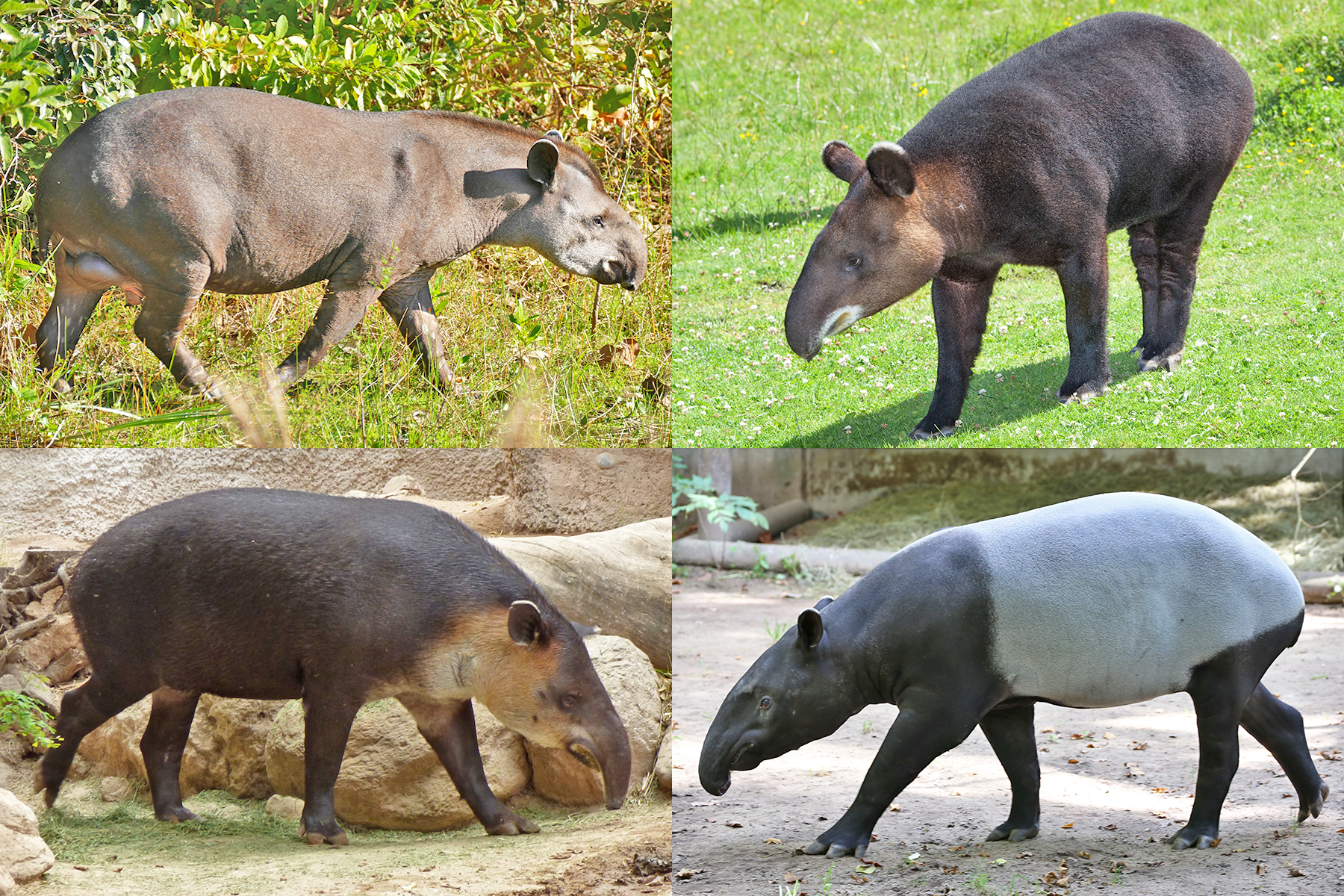
Tapir species, from top left clockwise: South American tapir (Tapirus terrestris), mountain tapir (Tapirus pinchaque), Malayan tapir (Tapirus indicus) and Baird's tapir (Tapirus bairdii)
Scientific classification Edit this classification
Kingdom: Animalia
Phylum: Chordata
Class: Mammalia
Order: Perissodactyla
Clade: Tapiromorpha
Suborder: Ceratomorpha
Superfamily: Tapiroidea
Family: Tapiridae
Gray, 1821[2][3]
Type genus
Tapirus
Brisson, 1762
Genera[7]
About 15
  Distribution of extant species
Synonyms[3]
  • Elasmognathinae Gray, 1867

Tapirs (/ˈtpər/ TAY-pər)[8][9] are large, herbivorous mammals belonging to the family Tapiridae.[3] They are similar in shape to a pig, with a short, prehensile nose trunk (proboscis). Tapirs inhabit jungle and forest regions of South and Central America and Southeast Asia. They are one of three extant branches of Perissodactyla (odd-toed ungulates), alongside equines and rhinoceroses. Only a single genus, Tapirus, is currently extant. Tapirs migrated into South America during the Pleistocene epoch from North America after the formation of the Isthmus of Panama as part of the Great American Interchange.[10] Tapirs were present across North America, but became extinct in the region at the end of the Late Pleistocene, around 12,000 years ago.

Name

[edit]

The term tapir comes from the Portuguese-language words tapir, tapira, which themselves trace their origins back to Old Tupi, specifically the term tapi'ira.[11] This word, according to Eduardo de Almeida Navarro, referred in a more precise manner to the species Tapirus terrestris.[12]

Species

[edit]

There are four widely recognized extant species of tapir, all in the genus Tapirus of the family Tapiridae. They are the South American tapir, the Malayan tapir, Baird's tapir, and the mountain tapir. In 2013, a group of researchers said they had identified a fifth species of tapir, the kabomani tapir. However, the existence of the kabomani tapir as a distinct species has been widely disputed, and recent genetic evidence further suggests that it actually is part of the species South American tapir.[13][14]

Extant species

[edit]
Photo Common name Scientific name Distribution
Baird's tapir (also called the Central American tapir) Tapirus bairdii (Gill, 1865) Mexico, Central America and northwestern South America
South American tapir (also called the Brazilian tapir or lowland tapir) Tapirus terrestris (Linnaeus, 1758) Venezuela, Colombia, and the Guianas in the north to Brazil, Argentina, and Paraguay in the south, to Bolivia, Peru, and Ecuador in the West.
Mountain tapir (also called the woolly tapir) Tapirus pinchaque (Roulin, 1829) Eastern and Central Cordilleras mountains in Colombia, Ecuador, and the far north of Peru.
Malayan tapir (also called the Asian tapir, Oriental tapir or Indian tapir) Tapirus indicus (Desmarest, 1819) Indonesia, Malaysia, Myanmar, and Thailand

The four species are all classified on the IUCN Red List as either Endangered or Vulnerable. The tapirs have a number of extinct relatives in the superfamily Tapiroidea. The closest extant relatives of the tapirs are the other odd-toed ungulates, which include horses, wild asses, zebras and rhinoceroses.

Extinct species

[edit]

During the Late Pleistocene, several other species inhabited North America, including Tapirus veroensis, native to the southern and eastern United States (with its northernmost records being New York State), and Tapirus merriami and Tapirus californicus, native to Western North America. These became extinct during the Quaternary extinction event around 12,000 years ago, along with most of the other large mammals of the Americas, co-inciding with the first arrival of humans to the continent.[15] Tapirus augustus (formerly placed in Megatapirus), native to Southeast and East Asia, substantially larger than the Malayan tapir, also became extinct at some point during the Late Pleistocene.[16] Many primitive tapirs were originally classified under Palaeotapirus including members of Paratapirus and Plesiotapirus,[17] but the original diagnostic material of the genus was too poor to characterize, leading to included species being moved to new genera.[18]

Image Species

M. harrisonensis

N. robustus

P. intermedius

P. yagii

P. simplex

  • Protapirus
    • P. aginensis
    • P. bavaricus
    • P. cetinensis
    • P. douvillei
    • P. gromovae
    • P. obliquidens
    • P. priscus
    • P. simplex

Giant tapir (T. augustus)

Cope's tapir (T. haysii)

T. veroensis

General appearance

[edit]
(video) A tapir at Ueno Zoo

Size varies between types, but most tapirs are about 2 m (6+12 ft) long, stand about 1 m (3+14 ft) high at the shoulder, and weigh between 150 and 300 kg (330 and 660 lb). Their coats are short and range in colour from reddish brown, to grey, to nearly black, with the notable exceptions of the Malayan tapir, which has a white, saddle-shaped marking on its back, and the mountain tapir, which has longer, woolly fur. All tapirs have oval, white-tipped ears, rounded, protruding rumps with stubby tails, and splayed, hooved toes, with four toes on the front feet and three on the hind feet, which help them to walk on muddy and soft ground. Baby tapirs of all types have striped-and-spotted coats for camouflage.[citation needed]

Females have a single pair of mammary glands,[19] and males have long penises relative to their body size.[20][21][22][23][24]

Physical characteristics

[edit]
Tapir showing the flehmen response

The proboscis of the tapir is a highly flexible organ, able to move in all directions, allowing the animals to grab foliage that would otherwise be out of reach. Tapirs often exhibit the flehmen response, a posture in which they raise their snouts and show their teeth to detect scents. This response is frequently exhibited by bulls sniffing for signs of other males or females in oestrus in the area. The length of the proboscis varies among species; Malayan tapirs have the longest snouts and Brazilian tapirs have the shortest.[25] The evolution of tapir probosces, made up almost entirely of soft tissues rather than bony internal structures, gives the Tapiridae skull a unique form in comparison to other perissodactyls, with a larger sagittal crest, orbits positioned more rostrally, a posteriorly telescoped cranium, and a more elongated and retracted nasoincisive incisure.[25][26]

Tapirs have brachyodont, or low-crowned teeth, that lack cementum. Their dental formula is:

Dentition
3.1.4.3
3.1.3–4.3

Totaling 42 to 44 teeth, this dentition is closer to that of equids, which may differ by one less canine, than their other perissodactyl relatives, rhinoceroses.[27][28] Their incisors are chisel-shaped, with the third large, conical upper incisor separated by a short gap from the considerably smaller canine. A much longer gap is found between the canines and premolars, the first of which may be absent.[29] Tapirs are lophodonts, and their cheek teeth have distinct lophs (ridges) between protocones, paracones, metacones and hypocones.[30][31]

Tapirs have brown eyes, often with a bluish cast to them, which has been identified as corneal cloudiness, a condition most commonly found in Malayan tapirs. The exact etiology is unknown, but the cloudiness may be caused by excessive exposure to light or by trauma.[32][33] However, the tapir's sensitive ears and strong sense of smell help to compensate for deficiencies in vision.

Tapirs have simple stomachs and are hindgut fermenters that ferment digested food in a large cecum.[34]

Life cycle

[edit]

Young tapirs reach sexual maturity between three and five years of age, with females maturing earlier than males.[35] Under good conditions, a healthy female tapir can reproduce every two years; a single young, called a calf, is born after a gestation of about 13 months.[36] The natural lifespan of a tapir is about 25 to 30 years, both in the wild and in zoos.[37] Apart from mothers and their young offspring, tapirs lead almost exclusively solitary lives.

Behaviour

[edit]

Although they frequently live in dryland forests, tapirs with access to rivers spend a good deal of time in and under water, feeding on soft vegetation, taking refuge from predators, and cooling off during hot periods. Tapirs near a water source will swim, sink to the bottom, and walk along the riverbed to feed, and have been known to submerge themselves to allow small fish to pick parasites off their bulky bodies.[37] Along with freshwater lounging, tapirs often wallow in mud pits, which helps to keep them cool and free of insects.

In the wild, the tapir's diet consists of fruit, berries, and leaves, particularly young, tender vegetation. Tapirs will spend many of their waking hours foraging along well-worn trails, snouts to the ground in search of food. Baird's tapirs have been observed to eat around 40 kg (85 lb) of vegetation in one day.[38]

Tapirs are largely nocturnal and crepuscular, although the smaller mountain tapir of the Andes is generally more active during the day than its congeners. They have monocular vision.

Copulation may occur in or out of water. In captivity, mating pairs will often copulate several times during oestrus.[19][39] Intromission lasts between 10 and 20 minutes.[40]

Habitat, predation, and vulnerability

[edit]

Adult tapirs are large enough to have few natural predators, and the thick skin on the backs of their necks helps to protect them from threats such as jaguars, crocodiles, anacondas, and tigers. The creatures are also able to run fairly quickly, considering their size and cumbersome appearance, finding shelter in the thick undergrowth of the forest or in water. Hunting for meat and hides has substantially reduced their numbers and, more recently, habitat loss has resulted in the conservation watch-listing of all four species; the Brazilian tapir is classified as vulnerable, and Baird's tapir, the mountain tapir, and the Malayan tapir are endangered. According to 2022 study published in the Neotropical Biology and Conservation, the lowland tapir in the Atlantic Forest is at risk of complete extinction as a result of anthropogenic pressures, in particular hunting, deforestation and population isolation.[41][42][43]

Evolution and natural history

[edit]
Tapirus augustus skull compared to a Protapirus simplex skull

Tapirs originated from the "tapiroids", a group of primitive perissodactyls that inhabited North America and Asia during the Eocene epoch, with tapirs probably originating from the family Helaletidae.[44][45] The oldest known members of the family Tapiridae such as Protapirus are known from the Early Oligocene of Europe.[45] The oldest representatives of the modern genus Tapirus appeared in Europe during the Mid-Miocene, with Tapirus dispersing into Asia and North America by the late Miocene.[10][46] The last species of tapir native to Europe, Tapirus arvernensis, became extinct around the end of the Pliocene, approximately 2.6 million years ago.[46][47] Tapirs dispersed into South America during Pleistocene as part of the Great American Biotic Interchange with their oldest records on the continent dating to around 2.6-1 million years ago.[10]

Approximate divergence times based on a 2013 analysis of mtDNA sequences are 0.5 Ma for T. kabomani and the T. terrestrisT. pinchaque clade, 5 Ma for T. bairdii and the three South American tapirs, and 9 Ma for the branching of T. indicus.[48] T. pinchaque arises from within a paraphyletic complex of T. terrestris populations.[48]

Tapirus

T. indicus (Malayan tapir)

T. terrestris (South American tapir, Ecuador cluster)

T. pinchaque (mountain tapir)

T. terrestris (South American tapir, other clusters)

T. bairdii (Baird's tapir)

Genetics

[edit]
Baird's tapir
A mountain tapir, the woolliest and most threatened species of tapir

The species of tapir have the following chromosomal numbers:

Malayan tapir, T. indicus 2n = 52
Mountain tapir, T. pinchaque 2n = 76
Baird's tapir, T. bairdii 2n = 80
South American tapir, T. terrestris 2n = 80

The Malayan tapir, the species most isolated geographically and genetically, has a significantly smaller number of chromosomes and has been found to share fewer homologies with the three types of American tapirs. A number of conserved autosomes (13 between karyotypes of Baird's tapir and the South American tapir, and 15 between Baird's and the mountain tapir) have also been found in the American species that are not found in the Asian animal. However, geographic proximity is not an absolute predictor of genetic similarity; for instance, G-banded preparations have revealed Malayan, Baird's and South American tapirs have identical X chromosomes, while mountain tapirs are separated by a heterochromatic addition/deletion.[49]

Lack of genetic diversity in tapir populations has become a major source of concern for conservationists. Habitat loss has isolated already small populations of wild tapirs, putting each group in greater danger of dying out completely. Even in zoos, genetic diversity is limited; all captive mountain tapirs, for example, are descended from only two founder individuals.[50]

Hybrids of Baird's and the South American tapirs were bred at the San Francisco Zoo around 1969 and later produced a backcross second generation.[51]

Conservation

[edit]

A number of conservation projects have been started around the world. The Tapir Specialist Group, a unit of the IUCN Species Survival Commission, strives to conserve biological diversity by stimulating, developing, and conducting practical programs to study, save, restore, and manage the four species of tapir and their remaining habitats in Central and South America and Southeast Asia.[52]

The Baird's Tapir Project of Costa Rica, begun in 1994, is the longest ongoing tapir project in the world. It involves placing radio collars on tapirs in Costa Rica's Corcovado National Park to study their social systems and habitat preferences.[53]

The Lowland Lowland Tapir Conservation Initiative is a conservation and research organization founded by Patrícia Medici, focused on tapir conservation in Brazil.

Attacks on humans

[edit]

Tapirs are generally shy, but when scared they can defend themselves with their very powerful jaws. In 1998, a zookeeper in Oklahoma City was mauled and had an arm severed after opening the door to a female tapir's enclosure to push food inside (the tapir's two-month-old baby also occupied the cage at the time).[54] In 2006, Carlos Manuel Rodriguez Echandi (who was then the Costa Rican Environmental Minister) became lost in the Corcovado National Park and was found by a search party with a "nasty bite" from a wild tapir.[55] In 2013, a two-year-old girl suffered stomach and arm injuries after being mauled by a South American tapir in Dublin Zoo during a supervised experience in the tapir enclosure. Dublin Zoo pleaded guilty to breaching health and safety regulations and was ordered to pay €5,000 to charity.[56] However, such examples are rare; for the most part, tapirs are likely to avoid confrontation in favour of running from predators, hiding, or, if possible, submerging themselves in nearby water until a threat is gone.[57]

Frank Buck wrote about an attack by a tapir in 1926, which he described in his book, Bring 'Em Back Alive.[58]

Folklore

[edit]

Tapirs feature in the folklore of several cultures around the world. In Japan, tapirs are associated with the mythological Baku, believed to ward off nightmares. In South America, tapirs are associated with the creation of the earth.[59]

References

[edit]
[edit]
Revisions and contributorsEdit on WikipediaRead on Wikipedia
from Grokipedia
Tapirs are large, herbivorous mammals in the family Tapiridae, the only living family in the superfamily Tapiroidea within the order (odd-toed ungulates), which also includes and rhinoceroses. They are often described as "living fossils" due to their minimal morphological changes over millions of years, with fossils dating back to the Eocene epoch. The family comprises four extant species: the lowland tapir (Tapirus terrestris), Baird's tapir ( bairdii), the mountain tapir ( pinchaque), and the Malayan tapir ( indicus). A potential fifth species, the kabomani tapir ( kabomani), has been proposed based on genetic and morphological evidence from the western Amazon but remains controversial and unconfirmed by major authorities. Physically, tapirs feature a distinctive prehensile proboscis formed by the elongation and fusion of the nose and upper lip, which aids in grasping vegetation and detecting scents, compensating for their poor eyesight. Adults typically measure 1.8–2.5 m in length, stand 0.7–1.2 m at the shoulder, and weigh 150–400 kg, with a streamlined, barrel-shaped body covered in coarse, bristly hair that varies in color among species—ranging from black-and-white stripes in the Malayan tapir to solid brown or gray in others. They have four toes on their front feet and three on their hind feet, adapted for traversing soft, muddy terrain, and their tough, leathery skin provides protection against insects and thorns. Tapirs are primarily browsers, consuming leaves, fruits, twigs, and aquatic plants, and they play a vital ecological role as seed dispersers, promoting forest regeneration by passing intact seeds through their digestive system. These animals inhabit a variety of and forested environments across the Neotropics and , including rainforests, swamps, montane cloud forests, and riverine grasslands, always in close proximity to water sources for and escape from predators. The lowland tapir ranges widely across from to , favoring lowland tropical forests and floodplains. is found in from southern to northern , preferring undisturbed humid forests and s. The mountain tapir occupies high-altitude Andean forests in , , and at elevations up to 4,300 m. The is restricted to the and , inhabiting lowland and hill rainforests up to 1,400 m. Behaviorally, tapirs are mostly solitary and crepuscular or nocturnal, using well-established trails and in mud or water to cool off; lasts 13 months, producing a single calf that remains with the mother for up to 18 months. All tapir species face severe threats from due to , , and development, as well as direct persecution through hunting for meat and hides. According to the , the lowland tapir is classified as Vulnerable, while , the mountain tapir, and the are all Endangered, with global populations estimated at fewer than 5,000 mature individuals for the most threatened species. Conservation efforts, coordinated by the IUCN SSC Tapir Specialist Group, emphasize protected areas, habitat corridors, and anti-poaching measures, recognizing tapirs as "" whose preservation benefits broader .

Taxonomy

Etymology

The word "tapir" derives from the Tupi-Guarani languages spoken by of , specifically from terms such as tapi'ira or tapira, which were adopted into and then spread to other European languages. This borrowing reflects early European encounters with the animal in , with the term first appearing in French as tapir in the and entering English usage by 1774. In indigenous and colonial languages of the , tapirs have been known by various names highlighting their distinctive features or behaviors. For instance, in Spanish-speaking regions, particularly , the animal is called anteburro, a compound term evoking a donkey-like creature, possibly alluding to its sturdy build and , as noted in early explorer accounts. Other local designations include danta in parts of , derived from indigenous roots but adapted through Spanish influence. The scientific nomenclature of tapirs evolved amid initial taxonomic uncertainties in the 18th century. , in his (1758), classified the as Hippopotamus terrestris, grouping it with due to superficial similarities in size and habitat. This was revised by in 1762, who established the genus to better reflect its unique traits, a designation that has endured in modern .

Classification

Tapirs belong to the order , which encompasses the odd-toed ungulates, characterized by their mesaxonic foot structure where the axis of symmetry passes through the third toe, distinguishing them from the paraxonic even-toed ungulates (Artiodactyla). Within , tapirs are placed in the suborder Ceratomorpha, a that also includes equids () and rhinocerotids (rhinoceroses), reflecting their closer phylogenetic relationship to rhinos than to based on shared cranial and dental features such as low-crowned molars with transverse crests. As non-ruminant herbivores, tapirs digest material through , a trait consistent with their perissodactyl affinities. The Tapiridae represents the sole surviving of tapirs, encompassing all extant species and serving as a lineage from a once-diverse group of ceratomorphs. Historically, Tapiridae was classified more broadly in the to include subfamilies such as Tapirinae (true tapirs) and Rhinocerotinae (early rhinoceros-like forms), alongside others like Lophiodontinae, but modern separates rhinoceroses into their own family, Rhinocerotidae, consolidating Tapiridae to focus on the tapir lineage with Tapirinae as the primary extant subfamily. This revision aligns with phylogenetic analyses emphasizing distinct evolutionary trajectories within Ceratomorpha. All living tapirs are classified under the single extant genus Tapirus, comprising four recognized species unified by morphological traits like their prehensile and semi-aquatic adaptations. Fossil genera such as Lophiodon, once considered potential ancestors, are now excluded from direct tapir ancestry and placed in separate families like Lophiodontidae, representing parallel branches within early Tapiroidea rather than linear precursors to modern Tapiridae. Key diagnostic features reinforcing this classification include the mesaxonic limb structure—four toes on the forefeet and three on the hindfeet, all bearing hooves—and a dental adapted for , with 42–44 teeth featuring brachydont molars suited to their herbivorous diet.

Extant Species

There are four extant species of tapir, all belonging to the genus Tapirus and classified as either Vulnerable or Endangered on the IUCN Red List due to threats from habitat loss and hunting. The South American tapir (Tapirus terrestris), also known as the lowland or Brazilian tapir, is the largest of the extant species, characterized by a blackish-brown coat and a robust build adapted to lowland forests. It has a streamlined body with a prehensile proboscis formed by an elongated nose and upper lip, and short, strong legs ending in four toes on the front feet and three on the hind feet. This species inhabits a wide range across tropical South America, from northern Colombia and Venezuela south to northern Argentina, including the Amazon Basin, the Guianas, Brazil, Ecuador, Peru, Bolivia, Paraguay, and parts of Panama and southern Mexico. The global population size is unknown, though it is decreasing (as of 2019 IUCN assessment). Baird's tapir ( bairdii), the largest native land mammal in , features a lighter reddish-brown to grayish coat with distinctive white markings on the throat, cheeks, and sometimes the belly, aiding in within dense undergrowth. Like other tapirs, it possesses a flexible for foraging and grasping vegetation. Its range spans from southeastern through to northwestern and northwestern , primarily in humid lowland and montane forests up to 3,800 meters elevation. The global is estimated at about 4,500 mature individuals and is decreasing (as of IUCN assessment). It is classified as Endangered. The mountain tapir (Tapirus pinchaque), the smallest extant species, is notable for its dense, woolly coat that is black with white or yellowish markings on the face, chest, and hindquarters, providing insulation in cooler highland environments. This woolly texture and compact form distinguish it from its smoother-coated relatives. It is restricted to the Andean highlands of and , at elevations between 2,000 and 4,300 meters in cloud forests and grasslands. The comprises fewer than 2,500 mature individuals and is declining rapidly. It holds Endangered status. The (Tapirus indicus), the only Asian species, stands out with its striking black-and-white coloration: a black body, shoulders, forelegs, and hindquarters contrasting with a white saddle-like marking across the back and sides, which serves as disruptive in shaded forests. Its range covers , including southern , southern , , and in . The global population size is unknown, though it is decreasing (as of 2016 IUCN assessment). It is listed as Endangered. A potential fifth species, the kabomani tapir (Tapirus kabomani), proposed in 2013 based on specimens from the western Amazon, remains controversial. Recent genetic studies (as of 2024) question its status as a full species distinct from T. terrestris, though new records suggest range expansion in (2025). It is not recognized by IUCN. Among the species, size varies significantly, with the reaching up to 3 meters in length and 300 kilograms or more, while the mountain tapir is smaller at about 1.8 meters long and up to 225 kilograms; Baird's and Malayan tapirs fall in between, typically 2–2.5 meters long and 250–400 kilograms. These differences reflect adaptations to their respective habitats, from lowland to montane and Asian rainforests.

Extinct Species

Several extinct genera of tapirs highlight the family's diverse evolutionary history across various epochs and regions. Protapirus, an early tapir genus, is known from the Oligocene of North America and Eurasia, with species such as Protapirus validus exhibiting primitive dental and cranial features transitional to later forms. Miotapirus, spanning the Oligocene to Miocene, occurred primarily in North America, as evidenced by specimens like Miotapirus harrisonensis from early Miocene deposits, characterized by robust limb bones adapted for forested environments. Teleoceras, a Miocene genus often described as tapir-like due to its short legs and semi-aquatic habits, included horned species such as Teleoceras fossiger from North American deposits, though it belongs to the rhinoceros family Rhinocerotidae rather than true tapirs. Notable extinct species within the genus Tapirus include Tapirus augustus, a giant form from the Pleistocene of East and , estimated to weigh up to 500 kg and representing the largest known tapir, with fossils indicating a browser diet in subtropical forests. In , Tapirus merriami inhabited the Pleistocene (late Blancan to Rancholabrean stages) across the , larger than modern species with a body mass exceeding 350 kg and cranial features suggesting adaptation to open woodlands. Many Pleistocene tapir species in the Americas became extinct around 11,000–12,000 years ago, coinciding with broader megafauna die-offs attributed to rapid climate shifts at the end of the last Ice Age and the arrival of humans, though South American lineages persisted. Over 15 extinct species have been described in the genus Tapirus alone, with fossil remains documented from every continent except Australia and Antarctica, reflecting a once-global distribution that contracted dramatically in the late Cenozoic. These extinct taxa form basal branches in the phylogeny of modern tapirs, sharing key anatomical traits like the proboscis and hypsodont dentition.

Evolution

Origins and Phylogeny

Tapirs originated in the early Eocene epoch, approximately 55–56 million years ago, evolving from primitive perissodactyls in the Laurasian supercontinent, with the earliest known fossils, such as those of the isectolophid Homogalax, discovered in . These basal forms represent the initial diversification of odd-toed ungulates following the Paleocene-Eocene Thermal Maximum, marking the emergence of the Tapiroidea superfamily from small, forest-dwelling ancestors adapted to browsing lifestyles. Within perissodactyl phylogeny, tapirs form the to (Rhinocerotidae) in the monophyletic Ceratomorpha, which diverged from the horse lineage () around 50–56 million years ago. This branching event, supported by both evidence and analyses estimating the split at 54–47 million years ago, highlights the early radiation of perissodactyl suborders during the Eocene. Key evolutionary adaptations in the tapir lineage include the gradual development of a flexible from Eocene ancestors, evidenced by retracted in early tapiroids, which facilitated enhanced in dense —contrasting with the horn development seen in some early relatives. The modern phylogeny of tapirs reveals a monophyletic comprising all four extant , with the ( indicus) as the basal sister taxon to the three (T. bairdii, T. pinchaque, and T. terrestris). Molecular estimates place the divergence between the Asian and Neotropical lineages at approximately 15–20 million years ago during the , reflecting ancient migrations across followed by isolation in the . This relatively recent underscores the tapirs' conserved morphology as "living fossils" amid broader perissodactyl extinctions.

Fossil Record

The fossil record of tapirs extends back to the early Eocene epoch, approximately 55 million years ago, when primitive members of the Tapiroidea superfamily first appeared in . Deposits in the Green River Formation of , , have yielded fossils of early tapiromorphs such as Heptodon, which represent some of the earliest known forms. These primitive perissodactyls possessed a full of 44 teeth adapted for on soft and retained four functional toes on their front feet, contrasting with the more specialized three-toed condition of later species. In , the middle Eocene Messel Pit in has preserved a rare and significant tapir specimen, dating to about 47 million years ago, highlighting the early dispersal of these mammals across . This well-preserved fossil, which was acquired from a private collection by the Messel Pit Fossil Site in 2001, underscores the diversity of Eocene mammalian faunas in subtropical forest environments. Tapir diversity peaked during the epoch (23–5.3 million years ago), with abundant remains indicating widespread distribution in the forested ecosystems of , spanning , , and . Fossils from sites in , , and the reveal a radiation of genera, including early Tapirus species, adapted to humid habitats. This diversification coincided with climatic cooling, which later restricted their range. Around 3 million years ago, during the , tapirs migrated southward from to across the newly formed Panamanian isthmus as part of the Great American Biotic Interchange, introducing the family to neotropical ecosystems. The Pleistocene epoch (2.6 million–11,700 years ago) records larger-bodied tapir species as components of North American megafaunal assemblages, with fossils demonstrating their role in grassland-forest mosaics. The Rancho La Brea tar pits in , , have yielded numerous specimens of Tapirus spp., including the extinct Tapirus californicus, which was larger than modern tapirs and preserved in asphalt deposits spanning 50,000 to 10,000 years ago. These sites illustrate the vulnerability of Pleistocene tapirs to entrapment and environmental changes leading to regional extinctions.

Physical Characteristics

General Appearance

Tapirs possess a distinctive characterized by a massive, barrel-shaped that is rounded at the back and tapers toward the front, supported by short, robust legs measuring 70-110 cm at the height. Their most prominent external feature is an elongated, flexible formed by the fusion of the and upper , creating a short that aids in grasping vegetation. This structure, combined with a short of 5-10 cm and small, rounded ears and eyes positioned low on the head, gives tapirs a streamlined appearance adapted for navigating dense undergrowth. In terms of size, tapirs are moderately large mammals, typically ranging from 1.8 to 2.5 m in body length and weighing 150–400 kg, comparable to a small or . is minimal across species, with females generally slightly larger than males, though this difference is subtle and does not extend to pronounced morphological distinctions. Some species, such as the mountain tapir, exhibit a slightly woollier , while others feature a short, bristly mane or crest of coarse along the and back. Coloration in tapirs is predominantly dark brown to , providing effective in forested environments, with thick, leathery skin that is sparsely haired except on the underside. Juveniles of most species display white or yellowish stripes and spots on the legs and shoulders, which fade within 6-8 months as the coat darkens. The stands out with its unique bicolored pattern, featuring a black body contrasted by a white saddle-like marking across the shoulders and hindquarters.

Anatomy and Physiology

Tapirs are hindgut fermenters, featuring a simple followed by an enlarged caecum and colon where symbiotic microbes break down fibrous material through . This adaptation enables efficient extraction of nutrients from low-quality , similar to that in equids, with the comprising a voluminous that constitutes over half the total length. Their includes 42 to 44 teeth, with a formula of I 3/3, C 1/1, P 4/3, M 3/3 (with minor variations), featuring low-crowned (brachyodont) molars suited for grinding tough vegetation, though lacking extensive coverage. As odd-toed ungulates (Perissodactyla), tapirs exhibit specialized locomotion adaptations, with four splayed toes on each front foot and three on each hind foot, terminating in small, hoof-like structures that provide padded, flexible support for navigating muddy or soft forest floors. These feet facilitate agile movement through dense undergrowth, while their robust build supports bursts of speed up to 48 km/h over short distances. Tapirs are proficient swimmers, often traversing rivers and using their flexible, proboscis-like snout—briefly referenced here for its role in sensory integration—as a snorkel to breathe while submerged; their nostrils possess valvular mechanisms that seal during dives, allowing submersion for several minutes. Sensory physiology in tapirs emphasizes olfaction and audition over vision, compensating for their relatively poor eyesight in dim, forested environments. The , a well-developed accessory olfactory structure within the , enhances detection of pheromones and volatile compounds, enabling precise environmental navigation and social signaling. Auditory adaptations include sensitivity to low-frequency sounds (below 1 kHz), which aligns with their vocalizations and aids in long-distance communication through vegetation, as typical of ungulates. Tapirs maintain a core body temperature around 38°C via behavioral , primarily through in mud or water, which promotes evaporative cooling and protects their sparse-haired from parasites and UV exposure. During , which lasts approximately 13 months, physiological support for fetal development relies on a diffuse epitheliochorial confined to one uterine horn, facilitating non-invasive nutrient and across multiple chorionic layers while minimizing immunological rejection.

Life Cycle and Behavior

Reproduction and Development

Tapirs exhibit a , with genetic evidence indicating that both males and females may mate with multiple partners, though is common as males compete aggressively for access to females through vocalizations, chases, and physical confrontations. Males mark territories using spraying, a observed in both wild and captive individuals to signal dominance and attract mates, though strict territorial exclusivity is not always maintained. In tropical habitats, breeding occurs year-round due to the lack of pronounced seasons, but peaks during the have been noted in some populations, aligning with increased resource availability post-rainy periods. Gestation lasts 390 to 410 days, approximately 13 months, after which females typically give birth to a single calf, with twins being extremely rare at less than 1% of births. Newborns weigh 7 to 10 kilograms and are precocial, born with eyes open and able to stand and follow their mother within hours, though they remain dependent on her for protection and . Calves are born with a camouflaged pattern of white stripes and spots on a dark , which helps them blend into forest understory and evade predators. Development proceeds rapidly, with weaning occurring between 6 and 8 months when calves are nearly full-sized and begin independently, though they may stay close to the mother for up to 18 months. is reached at 2 to 4 years, with females maturing slightly earlier around 2.8 to 3 years and males often later; in the wild, tapirs have a lifespan of 25 to 30 years, while captives can live up to 35 to 40 years under optimal conditions. Parental care is provided solely by the female, who rears the calf in isolation from other adults, it for 6 to 10 months and defending it vigorously against threats; males play no role after and do not form pair bonds. The juvenile pattern fades by 6 to 8 months, coinciding with increased independence and dispersal from the . This solitary rearing strategy aligns with the overall asocial lifestyle of tapirs, minimizing risks in predator-rich environments.

Social and Daily Behavior

Tapirs exhibit predominantly solitary social structures, with adults typically living alone except for mothers accompanied by their dependent calves, which remain with them for 12 to 18 months. In areas with abundant resources, such as mineral licks, individuals may form loose, temporary aggregations, but no stable herds or long-term social groups have been observed across species. This solitary lifestyle minimizes competition and predation risk in dense habitats. Tapirs display crepuscular to nocturnal activity patterns, with the majority of movement occurring between and dawn to avoid heat and activity. For instance, lowland tapirs show over 80% of detections from 1900 to 0500 hours, peaking at twilight periods. They spend 12 to 18 hours resting in dense cover during the day, emerging primarily at night for and other routines. Daily movements average 1 to 5 km, varying by and , with straight-line displacements often around 2 km for Malayan tapirs. Communication among tapirs relies on vocalizations, olfactory cues, and limited visual signals to convey , identity, and status. Key vocalizations include high-pitched whistles for contact, often eliciting responses from nearby individuals, and cough-like snorts or air blows as signals during perceived threats. Scent marking occurs via spraying and dung deposition, with anal region secretions contributing to olfactory messages that signal presence and reproductive state to conspecifics. These cues are particularly important in low-visibility environments where auditory and chemical signals travel farther than sight. Territoriality in tapirs is expressed through maintenance of overlapping home ranges rather than strict exclusivity, with adults defending areas of 2 to 10 km² depending on quality and . Individuals establish and patrol consistent paths through the , marking boundaries with , dung piles, and tree rubbings to advertise occupancy. is rare, typically limited to displacement displays such as ear-forward posturing, teeth-baring, or brief chases when ranges overlap, escalating to biting only if one party does not yield.

Diet and Foraging

Tapirs are herbivorous mammals with a diet dominated by browse, consisting primarily of leaves, twigs, and stems, which make up the majority of their intake. Fruits and form a significant supplementary portion, while aquatic plants contribute a smaller amount, particularly for species inhabiting areas. For instance, in (Tapirus bairdii), leaves account for about 67% of the diet, fruits 19%, stems 12%, and bark 2%, reflecting a selective strategy that favors tender . Adult tapirs consume 15-40 kg of fresh forage daily, depending on body size and availability, often nocturnally to meet these needs. Foraging involves the use of their prehensile , a flexible extension of the upper lip and , to grasp, uproot, and selectively pluck vegetation from low shrubs, vines, and understory . This tool-like appendage allows precise selection of nutritious parts, even thorny or insect-infested growth, enabling tapirs to act as selective feeders rather than indiscriminate grazers. As frugivores, they ingest fruits whole, facilitating through endozoochory, where seeds pass intact through the gut in 48-96 hours before being deposited in nutrient-rich away from parent . Dietary habits vary seasonally, with greater reliance on during wet seasons when they are abundant, and a shift toward stems, bark, and tougher browse in dry periods to compensate for reduced fruit availability. The (Tapirus indicus) deviates somewhat by incorporating more monocots, such as grasses and sedges, into its diet compared to Neotropical species. Through their feeding and dispersal behaviors, tapirs serve as key ecosystem engineers, known as "gardeners of the forest" for promoting plant diversity by scattering seeds of large-fruited species over wide areas, aiding forest regeneration and structure.

Ecology

Habitat and Distribution

Tapirs primarily inhabit tropical rainforests, swamps, and floodplains, where dense vegetation provides cover and ample foraging opportunities. These environments are characterized by high humidity and year-round rainfall, supporting the species' need for moist conditions. The mountain tapir (Tapirus pinchaque) is uniquely adapted to montane cloud forests in the Andes, occurring at elevations from 1,400 to 4,000 meters, where cooler temperatures and frequent mist prevail. The three Neotropical tapir species exhibit distributions across Central and , with the lowland tapir (Tapirus terrestris) ranging widely from and through the to northern and eastern . (Tapirus bairdii) occupies humid forests from southern to northwestern , while the mountain tapir is restricted to the Andean cordilleras of , , and northern . These ranges have become highly fragmented due to extensive , reducing connectivity between populations. In contrast, the (Tapirus indicus) is found in the Indo-Malayan realm, spanning southern , , , and , primarily in lowland and hill forests up to 1,400 meters. Within their habitats, tapirs exhibit strong microhabitat preferences for areas near permanent water bodies, such as rivers, ponds, and swamps, which facilitate through to dissipate heat and escape . They also select dense layers in forested areas for concealment and movement, avoiding open grasslands or heavily disturbed sites. These preferences underscore their reliance on structurally complex, undisturbed . Tapirs play a crucial role in their ecosystems as seed dispersers and ecosystem engineers, consuming fruits and dispersing viable seeds through their dung, which promotes forest regeneration and . Historically, the Neotropical tapirs occupied vast contiguous ranges, with the lowland tapir alone covering approximately 13.1 million km² across prior to widespread human impacts. Current distributions represent a fraction of this extent, with suitable now fragmented into isolated patches comprising less than 10% of intact forest in many regions due to and , severely limiting and population viability. The Malayan tapir's historical range similarly spanned larger forested tracts in , but today it is confined to shrinking remnants amid rapid conversion.

Predators and Defense

Tapirs face predation primarily from large felids, with jaguars (Panthera onca) and pumas (Puma concolor) targeting adults in the Americas, while tigers (Panthera tigris) occasionally prey on the Malayan tapir (Tapirus indicus) in . Calves are more vulnerable to crocodilians such as American crocodiles (Crocodylus acutus), which ambush them near water bodies. To defend against threats, tapirs rely on evasion rather than confrontation, often fleeing to nearby water sources where they are proficient swimmers and can submerge for up to several minutes, using their elongated snout as a snorkel to breathe while remaining hidden. If cornered on land, they may charge using their substantial bulk—adults weigh 250–400 kg—to deter attackers, though such aggression is rare. Additionally, tapirs produce loud vocalizations, such as whistles and snorts, to alert others or startle predators during encounters. Predation impacts tapir populations unevenly by age class; calves experience high mortality from predators, with survival to adulthood estimated below 50% in many habitats due to their smaller size and inexperience. Adults, however, are infrequently taken owing to their size and defenses, with attacks on healthy individuals being rare. aids tapir evasion, particularly for juveniles, whose coats feature mottled, striped, and spotted patterns that blend with dappled light and undergrowth. Adults enhance concealment through in , which coats their hides to mask scent and visual profile, reducing detection by predators in dense vegetation.

Vulnerability to Threats

Tapirs exhibit physiological vulnerabilities that hinder their ability to recover from declines. Their reproductive rates are notably low, with females typically producing a single offspring after a period of approximately 13 months, as observed in species like the (Tapirus bairdii). This slow fecundity, combined with reaching at around 2-3 years, limits rapid in response to disturbances. Additionally, tapirs require large home ranges, often spanning 8-14 km² depending on the species and habitat, which makes them particularly sensitive to landscape fragmentation. For instance, the (Tapirus indicus) maintains home ranges averaging 12.7 km² in Thai forests, amplifying the impacts of isolated patches that disrupt movement and resource access. Tapirs are also susceptible to various diseases, particularly in environments altered by activity. They are prone to parasitic infections, including trypanosomes such as terrestris, a identified in lowland tapirs (Tapirus terrestris) from Atlantic regions. These parasites can compromise , especially when tapirs encounter domestic in encroached habitats, increasing cross-infection risks. Furthermore, stress-related illnesses arise in fragmented landscapes, where environmental changes and proximity to developments elevate levels and weaken immune responses, as evidenced by differing profiles between protected and altered tapir populations. Their dependence on stable tropical moisture renders tapirs vulnerable to variability. As herbivores reliant on lush , they face heightened risks during droughts, which reduce availability and water sources in their habitats. projections indicate more frequent severe dry periods, potentially disrupting dynamics critical for tapir survival across their range. Isolated populations exacerbate genetic vulnerabilities through limited connectivity. Without natural or restored corridors, fragmented groups experience reduced , leading to that lowers fitness and increases extinction risk. For example, subpopulations in show signs of genetic bottlenecks due to isolation, underscoring the need for linkages to maintain diversity. This issue is compounded in small, disconnected patches, where can further impair resilience to other pressures.

Genetics

Karyotype and Chromosomes

Tapirs exhibit variation in their diploid chromosome numbers (2n) among the four extant species, reflecting differences in chromosomal fission and fusion events. The Malayan tapir (Tapirus indicus) has 2n=52, the mountain tapir (Tapirus pinchaque) has 2n=76, and both (Tapirus bairdii) and the lowland tapir (Tapirus terrestris) have 2n=80. Across species, the karyotypes consist predominantly of acrocentric autosomes, with the number of autosomal arms ranging from 80 to 94. G-banding analyses reveal highly conserved patterns among tapir species, suggesting minimal chromosomal rearrangements since their divergence, with at least 13 to 15 homologous autosomes identifiable between South American species. Heterochromatic additions or deletions account for some differences, such as in chromosomes 2 and 3 of T. bairdii and T. pinchaque, respectively. The is a large submetacentric (bi-armed) element, identical in T. bairdii, T. terrestris, and T. indicus but differing in T. pinchaque due to an additional block; the is a small acrocentric in all species. Tapirs employ the standard mammalian , with no reported chromosomal polymorphisms affecting this mechanism. In comparison to other perissodactyls, tapir karyotypes feature higher diploid numbers and more acrocentric elements than equids (typically 2n=64 with some bi-armed chromosomes) but align more closely with the inferred ancestral perissodactyl condition of numerous acrocentrics, differing from rhinoceroses which exhibit greater variation (2n=36–84) and more bi-armed chromosomes due to fusions.

Genetic Studies

Genetic studies on tapirs have revealed relatively low levels of across , often attributed to historical bottlenecks and . For instance, in the lowland tapir (Tapirus terrestris), microsatellite analyses of captive populations showed a mean expected heterozygosity of 0.67 across 10 loci, indicating moderate variation but vulnerability to . (mtDNA) surveys, particularly of the cytochrome b gene, further suggest that Pleistocene refugia in regions like western Amazonia played a central role in diversification, with distributions pointing to post-glacial expansions and subsequent bottlenecks reducing overall heterozygosity. Hybridization among tapir species is rare in nature; however, documented cases remain limited due to the species' elusive behavior and fragmented habitats. Molecular phylogenetics has clarified tapir evolutionary relationships, with analyses of the cytochrome b gene supporting a divergence between Asian and Neotropical lineages approximately 20–30 million years ago, consistent with fossil-calibrated timelines for perissodactyl diversification. Recent whole-genome assemblies, including chromosome-level references for the Malayan tapir (Tapirus indicus) and Baird's tapir, provide foundational data for exploring adaptive evolution, though detailed functional annotations remain ongoing. Genetic studies have proposed a potential fifth species, the kabomani tapir (Tapirus kabomani), based on mitochondrial DNA sequences (cytochrome b, COI, and COII genes) from specimens in the western Brazilian Amazon, showing divergence from the lowland tapir estimated at around 0.3 million years ago. However, this classification remains controversial, with critics arguing that the genetic distinctiveness is insufficient for species status due to limited sampling and lack of supporting nuclear DNA evidence, and it is not recognized by major authorities as of 2025. In conservation genetics, loci have been instrumental in assessing population viability, demonstrating that significantly reduces among tapir subpopulations. For example, studies on Malayan tapirs using nuclear markers revealed structured populations with limited dispersal, emphasizing the need for connectivity corridors to mitigate and enhance long-term persistence. Similar patterns in Neotropical species underscore how anthropogenic barriers exacerbate genetic isolation, informing targeted management strategies.

Conservation

Status

All four extant tapir species are classified on the of Threatened Species as either Vulnerable or Endangered, reflecting significant risks from habitat degradation and other pressures. The lowland tapir (Tapirus terrestris), also known as the , is assessed as Vulnerable, with its population considered stable overall but highly fragmented across its range in ; estimates suggest several thousand to tens of thousands of mature individuals, primarily concentrated in the where numbers appear stable, though populations elsewhere face heightened threats from and hunting. In contrast, the mountain tapir (Tapirus pinchaque), (Tapirus bairdii), and (Tapirus indicus) are all assessed as Endangered, with observed declines exceeding 20% over the past three generations due to ongoing habitat loss and fragmentation. The Endangered species have lower numbers: is estimated at around 4,500 individuals, the at fewer than 2,500, and the at approximately 2,500 mature individuals, all showing continued declines. Population trends differ regionally, with the Asian () and Central American () species experiencing ongoing declines in unprotected areas due to rapid habitat conversion, while the 's small, isolated populations are declining amid Andean deforestation. The lowland tapir's trend is more stable in core Amazonian habitats but threatened by fragmentation in peripheral ranges like the Atlantic Forest. These assessments primarily meet IUCN criterion A2c, indicating substantial reductions inferred from levels of exploitation, , and declines in quality; additionally, the qualifies under A4ce owing to its restricted range and projected future declines.

Threats

Tapirs face significant anthropogenic threats that have contributed to s across all . The primary danger is and fragmentation, driven by for , ranching, , and development. For instance, in , approximately 29.44% of the potential distribution area for the lowland tapir (Tapirus terrestris) has been converted to anthropogenic uses, with the and biomes accounting for nearly half of this loss, including over 80% in the . In , the (Tapirus indicus) has experienced a exceeding 50% since the 1980s, largely due to conversion of rainforests to plantations and other agricultural lands, particularly in where over half of remaining forests are inaccessible to the . These activities not only reduce available but also isolate subpopulations, increasing vulnerability to . Hunting and poaching exacerbate these pressures, with tapirs targeted for meat, hides, and occasionally as trophies, though often as incidental bycatch in traps set for other species. In regions like the Amazon and , opportunistic has intensified as tapir populations become more accessible due to road networks and trails. Roadkill from expanding highways further fragments ranges and causes direct mortality; for example, in , road accidents have become a leading cause of death for Malayan tapirs, correlating with development and increased vehicle traffic. In the wetlands of , collisions with vehicles contribute significantly to lowland tapir mortality alongside . Emerging environmental threats include , which alters rainfall patterns and vegetation, potentially leading to further degradation. For the mountain tapir (Tapirus pinchaque) in the , models predict high extinction risk due to synergistic effects of warming and habitat loss, with projected shifts in suitable areas exacerbating fragmentation. spillover from poses an additional risk, as tapirs share ranges with and domestic animals, facilitating pathogen transmission such as bacteria in tropical ecosystems. Indirectly, competition with like feral pigs in altered landscapes, such as the Brazilian , intensifies resource pressure on tapirs by altering availability and increasing transmission opportunities.

Conservation Measures

Conservation efforts for tapirs involve a combination of protected areas, coordinated initiatives, captive breeding programs, and community-based strategies aimed at preserving populations and habitats across their ranges in Central and South America and Southeast Asia. Key protected areas include Corcovado National Park in Costa Rica, which safeguards Baird's tapir (Tapirus bairdii) within its diverse lowland rainforest ecosystems, and Kerinci Seblat National Park in Indonesia, the largest protected area for the Malayan tapir (Tapirus indicus), spanning over 13,000 square kilometers of Sumatran habitat. These sites, along with others like El Rey National Park in Argentina for the South American tapir (Tapirus terrestris) and Cayambe-Coca National Park in Ecuador for the mountain tapir (Tapirus pinchaque), contribute to habitat protection, with protected areas covering varying portions of tapir ranges—such as approximately 27% of suitable habitat for Baird's tapir and 22% for mountain tapirs in Colombia. The IUCN Species Survival Commission (SSC) Tapir Specialist Group (TSG), founded in 1980, plays a central role in coordinating global conservation actions, including reintroduction programs to restore tapir populations in former habitats. For instance, in Brazil's , the Refauna project has reintroduced over 20 South American tapirs since 2017, with ongoing releases, monitoring, and documented births—including the eighth calf in 2025—establishing self-sustaining groups. The TSG supports such efforts through research grants, action planning, and international symposia, fostering collaboration among over 140 members worldwide to enhance tapir survival. Captive breeding programs are essential for genetic management and potential supplementation of wild populations, with regional studbooks maintained by organizations like the Association of Zoos and Aquariums (AZA) and the European Association of Zoos and Aquaria (EAZA) tracking several hundred tapirs across species in zoos globally. These programs emphasize reproductive health and simulation to improve breeding success; for the mountain tapir, which has fewer than 10 individuals in captivity, efforts have led to increased births in recent years through targeted pairings and veterinary support. Community-based initiatives further bolster tapir conservation by integrating local involvement in monitoring and sustainable practices, such as patrols in indigenous territories and programs that generate income while reducing habitat encroachment. In , efforts by the include planning habitat corridors to connect fragmented forests, enabling tapir movement and across protected areas in countries like and . These strategies empower indigenous communities to participate in camera trapping and restoration, promoting long-term of tapir habitats.

Human Interactions

Attacks on Humans

Attacks on humans by tapirs are extremely rare, with authenticated reports of fatalities being particularly uncommon in the scientific literature. Tapirs are generally shy and non-aggressive animals that prefer to flee from human encounters rather than engage in conflict. Documented incidents typically occur in defensive situations, such as when the animal is cornered, surprised, or protecting its young, and no cases of predatory attacks on humans have been recorded. One notable case involved a lowland tapir (Tapirus terrestris) in southeastern , where a 55-year-old surprised in his corn plantation and stabbed it, prompting a retaliatory attack. The man sustained deep bites to his thighs, neck, and cervical region, leading to severe hemorrhage and death; this marked the first reported fatal tapir attack in the literature. In another incident at in Ireland in August 2013, a Brazilian tapir mauled a two-year-old and injured her during a supervised visit inside the , causing lacerations to the child's arm and abdomen; both survived after hospital treatment, and the event was attributed to the animal being startled. A reintroduced Andean tapir (Tapirus pinchaque) in Ecuador's Antisana Ecological Reserve also charged and threatened a local resident in 2015, demonstrating defensive aggression in a post-release scenario, though no injuries occurred. More recently, in 2024, a lowland tapir attacked a 66-year-old woman in Vilhena, , , causing lacerations to her hands after she encountered the animal near her home; the injuries were non-fatal and treated medically. In conflicts, tapirs may charge headfirst or use their powerful jaws to bite, inflicting deep lacerations with their incisors that can cause significant tissue damage and hemorrhage. However, flight remains their primary response, and attacks are almost always provoked rather than unprovoked. Human-tapir encounters, and thus potential conflicts, are more frequent in areas of overlap, such as near agricultural fields where tapirs raid crops or along roads fragmented by development, increasing the risk of surprise meetings. Despite this, tapirs' inherent avoidance of humans minimizes overall danger.

Folklore and Cultural Significance

In indigenous Amazonian cultures, such as the community of , the lowland tapir (Tapirus terrestris) holds sacred status, with strict taboos prohibiting its hunting to preserve its spiritual role in maintaining ecological and cultural balance. Among the Tupi-Guarani peoples of , folklore features the tapir in narratives like the Tapirê-iauara, a mythical or derived from Tupi words for "tapir lady," symbolizing a protective yet elusive forest entity. In Mesoamerican traditions, particularly , the tapir appears in creation stories where its blood, mixed with corn dough and serpent blood, is used by the gods to form the first humans, underscoring its symbolic connection to life's origins and the natural world. Central American indigenous groups, like the Bribri of , further revere the tapir as a sacred animal tied to earth's formation in their legends, emphasizing its role as a guardian of the forest and a for resilience. In Southeast Asian folklore, the ( indicus) inspires the Japanese , a creature resembling a chimeric tapir that devours nightmares to bring peaceful sleep, originating from Chinese mo legends and evolving into a benevolent protector in Japanese tales. This association highlights the tapir's symbolic strength and otherworldly qualities, though Sumatran legends more broadly link it to protective spirits without direct underworld ties. In modern contexts, tapirs serve as emblems of tropical and conservation efforts across Central and , representing the urgent need to protect ancient ecosystems where they thrive. Artistically, tapir motifs appear in ancient ceramics, such as Nicaraguan polychrome pottery from pre-Columbian periods, where upturned-snout figures symbolize cosmic and earthly forces, though depictions remain rare compared to other fauna. Indigenous practices often involve tapirs in rituals, where they are hunted selectively for ceremonial feasts in some Amazonian tribes like the , but protected through taboos in others—such as avoiding consumption by pregnant women to prevent misfortune—reflecting a balanced reverence without overarching religious akin to that of other .

References

Add your contribution
Related Hubs
User Avatar
No comments yet.