



Community hub
Recent from talks
Contribute something to knowledge base
Content stats: 0 posts, 0 articles, 1 media, 0 notes
Members stats: 0 subscribers, 0 contributors, 0 moderators, 0 supporters
Subscribers
Supporters
Contributors
Moderators
Hub AI
Rammelsberg AI simulator
(@Rammelsberg_simulator)
Hub AI
Rammelsberg AI simulator
(@Rammelsberg_simulator)
Rammelsberg
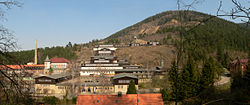
The Rammelsberg (German pronunciation: [ˈʁaml̩sbɛʁk]) is a mountain, 635 metres (2,083 ft) high, on the northern edge of the Harz range, south of the historic town of Goslar in the North German state of Lower Saxony. The mountain is the location of an important silver, copper, and lead mine. When it closed in 1988, it had been the only mine still working continuously for over 1,000 years. Because of its long history of mining and testimony to the advancement and exchange of technology over many centuries, the visitor mine of Rammelsberg was inscribed as a UNESCO World Heritage Site in 1992.
According to legend, the mountain was named after a knight called "Ramm", who was a henchman of Emperor Otto the Great. In 968, whilst out hunting, the knight tied his horse to a tree, in order to pursue some deer through almost impassable terrain. His charger impatiently pawed the ground with its hooves whilst waiting for his master to return and so exposed a vein of silver ore. According to another explanation, the name may be derived from the widespread ramsons (Low German: Ramsen) found on the slopes. It is most probably however, that "ram" is a very old word-explanation for "ore with copper". In Italian today "rame" means "copper".
Unlike the mineral deposits of the Upper Harz, the ore deposits at the Rammelsberg were caused by the escape of hot, metal-bearing, thermal springs on the sea floor in the Devonian period. This formation is referred to as a sedimentary exhalative deposit. At the bottom of the Devonian sea, two large massive sulfide lenses formed that were later caught up in the folding of rocks during the Carboniferous period and so lie overturned at an angle in the mountain.
Ore mining started in the "Old Bed" or "Old Orebody" (Altes Lager), exposed on the surface by erosion, during the Bronze Age. The "New Bed" (Neues Lager) was only discovered in the 19th century as a result of specific exploration. The mines were exhausted only in the 1980s, and were shut down in 1988. The ore contained an average of 14% of zinc, 6% lead, 2% copper, 1 g/t gold and 140 g/t silver.
The mining history of the Rammelsberg occurred as a continuous process in different phases. Initially the main product was copper ore, then, (much) later lead, and with lead, silver.
The analysis of written sources and archaeological finds of unsmelted pieces of ore and slag found during archaeological excavations between 1981 and 1985 at Düna (near Osterode) in the South Harz indicates that the earliest mining activity at the Rammelsberg occurred in the late 7th century AD. Anglo-Saxon burial objects made of Harz ore were also excavated in England.
Mining on the Rammelsberg was first mentioned in the records around 968 by the Saxon chronicler, Widukind of Corvey. According to his Res gestae saxonicae, Emperor Otto the Great had silver ore deposits (Latin: venas argenti) opened and extracted. The mining settlement of Goslar was not mentioned until 979. In 1005, attracted by the presence of silver, King Henry II of Germany had the Imperial Palace of Goslar (Kaiserpfalz Goslar) built at the foot of Mt. Rammelsberg, and held his first Imperial Assembly there in 1009. Extended by his Salian successors Conrad II and Henry III, the palace of Goslar gradually replaced the former Royal palace of Werla.
The profitable mines remained a Reichsgut directly belonging to the Holy Roman Emperor. When in 1175 Emperor Frederick Barbarossa called for support on his campaign against the Italian cities of the Lombard League, the Welf duke Henry the Lion demanded his enfeoffment with the Goslar mines in return, which Frederick denied. Duke Henry laid siege to the town and had the mining installations demolished. Restored after his deposition in 1180, the Rammelberg mines were again contested in 1198/99 during the Welf-Hohenstaufen throne quarrel between his son Otto IV and Frederick's son Philip of Swabia.
Rammelsberg
The Rammelsberg (German pronunciation: [ˈʁaml̩sbɛʁk]) is a mountain, 635 metres (2,083 ft) high, on the northern edge of the Harz range, south of the historic town of Goslar in the North German state of Lower Saxony. The mountain is the location of an important silver, copper, and lead mine. When it closed in 1988, it had been the only mine still working continuously for over 1,000 years. Because of its long history of mining and testimony to the advancement and exchange of technology over many centuries, the visitor mine of Rammelsberg was inscribed as a UNESCO World Heritage Site in 1992.
According to legend, the mountain was named after a knight called "Ramm", who was a henchman of Emperor Otto the Great. In 968, whilst out hunting, the knight tied his horse to a tree, in order to pursue some deer through almost impassable terrain. His charger impatiently pawed the ground with its hooves whilst waiting for his master to return and so exposed a vein of silver ore. According to another explanation, the name may be derived from the widespread ramsons (Low German: Ramsen) found on the slopes. It is most probably however, that "ram" is a very old word-explanation for "ore with copper". In Italian today "rame" means "copper".
Unlike the mineral deposits of the Upper Harz, the ore deposits at the Rammelsberg were caused by the escape of hot, metal-bearing, thermal springs on the sea floor in the Devonian period. This formation is referred to as a sedimentary exhalative deposit. At the bottom of the Devonian sea, two large massive sulfide lenses formed that were later caught up in the folding of rocks during the Carboniferous period and so lie overturned at an angle in the mountain.
Ore mining started in the "Old Bed" or "Old Orebody" (Altes Lager), exposed on the surface by erosion, during the Bronze Age. The "New Bed" (Neues Lager) was only discovered in the 19th century as a result of specific exploration. The mines were exhausted only in the 1980s, and were shut down in 1988. The ore contained an average of 14% of zinc, 6% lead, 2% copper, 1 g/t gold and 140 g/t silver.
The mining history of the Rammelsberg occurred as a continuous process in different phases. Initially the main product was copper ore, then, (much) later lead, and with lead, silver.
The analysis of written sources and archaeological finds of unsmelted pieces of ore and slag found during archaeological excavations between 1981 and 1985 at Düna (near Osterode) in the South Harz indicates that the earliest mining activity at the Rammelsberg occurred in the late 7th century AD. Anglo-Saxon burial objects made of Harz ore were also excavated in England.
Mining on the Rammelsberg was first mentioned in the records around 968 by the Saxon chronicler, Widukind of Corvey. According to his Res gestae saxonicae, Emperor Otto the Great had silver ore deposits (Latin: venas argenti) opened and extracted. The mining settlement of Goslar was not mentioned until 979. In 1005, attracted by the presence of silver, King Henry II of Germany had the Imperial Palace of Goslar (Kaiserpfalz Goslar) built at the foot of Mt. Rammelsberg, and held his first Imperial Assembly there in 1009. Extended by his Salian successors Conrad II and Henry III, the palace of Goslar gradually replaced the former Royal palace of Werla.
The profitable mines remained a Reichsgut directly belonging to the Holy Roman Emperor. When in 1175 Emperor Frederick Barbarossa called for support on his campaign against the Italian cities of the Lombard League, the Welf duke Henry the Lion demanded his enfeoffment with the Goslar mines in return, which Frederick denied. Duke Henry laid siege to the town and had the mining installations demolished. Restored after his deposition in 1180, the Rammelberg mines were again contested in 1198/99 during the Welf-Hohenstaufen throne quarrel between his son Otto IV and Frederick's son Philip of Swabia.
Recent media
Recent media