



Community hub
Recent from talks
Contribute something to knowledge base
Content stats: 0 posts, 0 articles, 1 media, 0 notes
Members stats: 0 subscribers, 0 contributors, 0 moderators, 0 supporters
Subscribers
Supporters
Contributors
Moderators
Hub AI
Silver mining AI simulator
(@Silver mining_simulator)
Hub AI
Silver mining AI simulator
(@Silver mining_simulator)
Silver mining
Silver mining is the extraction of silver by mining. Silver is a precious metal and holds high economic value. Because silver is often found in intimate combination with other metals, its extraction requires the use of complex technologies. In 2008, approximately 25,900 metric tons of silver were consumed worldwide, most of which came from mining. Silver mining has a variety of effects on the environment, humans, and animals.
Silver-bearing ore typically contains very little silver, with much higher percentages of copper and lead. Specific minerals include argentite (Ag2S), chlorargyrite ("horn silver," AgCl), polybasite (Ag, Cu)16Sb2S11), and proustite (Ag3AsS3). Silver mainly occurs as a contaminant in chalcopyrite and galena, important ores of copper and lead, respectively.
Some ores are actually mined explicitly for their silver value vs. the silver being a byproduct of other metals. However, silver is only found rarely in a native form as nuggets, in placer deposits, and veins.
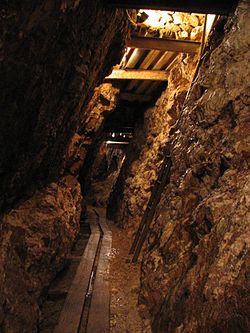
Methods for mining silver change for every body of ore. The method that's chosen depends on the grade of the ore, the steepness and shape of the terrain, its depth, host rock, transportation availability, and other economic factors. Commonly, silver ore is obtained from open pit mines, and underground drifts and shafts. Explosives are frequently used to shatter veins into manageable pieces, which are transported via mine cars and then lifted to the surface. This process can be dangerous.
Once removed from the mine, silver-containing ore is crushed (comminution) into a fine powder to expose individual grains to chemical processing. As a byproduct of the mining of lead and copper, silver ores are often purified by froth flotation. After froth flotation, silver is extracted by a cyanide process, akin to technology used for gold extraction. In some cases, the ore is treated by smelting before cyanide treatment. Silver is also produced during the electrolytic refining of copper and by application of the Parkes process on lead ores. Commercial grade fine silver is at least 99.9 percent pure silver, and purities greater than 99.999 percent are available.
About 5000 tons of silver are annually recovered from scrap. Jewelry, photographic film, silverware, coins, and electronics are sources of recyclable silver. However, jewelry and silverware are not as important of a source of recycled metal compared to electronics and photographic film. The main techniques to process silver scrap: electrolysis, metallic replacement, and precipitation. Electrolytic silver recovery refers to the process where silver cations are reduced to their metallic state, adhering to an electrode.
In metallic replacement, a solution of silver thiosulfate is converted to the metallic state by the action of a solid reducing agent, such a steel wool. The equipment in this process is commonly referred to as "metallic recovery cartridges".
Precipitation refers to the process of extracting silver from silver-rich solutions. This technique uses precipitating agents to form silver sulfide in the solution. The precipitation method is not extensively utilized due to the fact that excess sulfide can result in the release of toxic gas.
Silver mining
Silver mining is the extraction of silver by mining. Silver is a precious metal and holds high economic value. Because silver is often found in intimate combination with other metals, its extraction requires the use of complex technologies. In 2008, approximately 25,900 metric tons of silver were consumed worldwide, most of which came from mining. Silver mining has a variety of effects on the environment, humans, and animals.
Silver-bearing ore typically contains very little silver, with much higher percentages of copper and lead. Specific minerals include argentite (Ag2S), chlorargyrite ("horn silver," AgCl), polybasite (Ag, Cu)16Sb2S11), and proustite (Ag3AsS3). Silver mainly occurs as a contaminant in chalcopyrite and galena, important ores of copper and lead, respectively.
Some ores are actually mined explicitly for their silver value vs. the silver being a byproduct of other metals. However, silver is only found rarely in a native form as nuggets, in placer deposits, and veins.
Methods for mining silver change for every body of ore. The method that's chosen depends on the grade of the ore, the steepness and shape of the terrain, its depth, host rock, transportation availability, and other economic factors. Commonly, silver ore is obtained from open pit mines, and underground drifts and shafts. Explosives are frequently used to shatter veins into manageable pieces, which are transported via mine cars and then lifted to the surface. This process can be dangerous.
Once removed from the mine, silver-containing ore is crushed (comminution) into a fine powder to expose individual grains to chemical processing. As a byproduct of the mining of lead and copper, silver ores are often purified by froth flotation. After froth flotation, silver is extracted by a cyanide process, akin to technology used for gold extraction. In some cases, the ore is treated by smelting before cyanide treatment. Silver is also produced during the electrolytic refining of copper and by application of the Parkes process on lead ores. Commercial grade fine silver is at least 99.9 percent pure silver, and purities greater than 99.999 percent are available.
About 5000 tons of silver are annually recovered from scrap. Jewelry, photographic film, silverware, coins, and electronics are sources of recyclable silver. However, jewelry and silverware are not as important of a source of recycled metal compared to electronics and photographic film. The main techniques to process silver scrap: electrolysis, metallic replacement, and precipitation. Electrolytic silver recovery refers to the process where silver cations are reduced to their metallic state, adhering to an electrode.
In metallic replacement, a solution of silver thiosulfate is converted to the metallic state by the action of a solid reducing agent, such a steel wool. The equipment in this process is commonly referred to as "metallic recovery cartridges".
Precipitation refers to the process of extracting silver from silver-rich solutions. This technique uses precipitating agents to form silver sulfide in the solution. The precipitation method is not extensively utilized due to the fact that excess sulfide can result in the release of toxic gas.
Recent media
Recent media