



Community hub
Recent from talks
Contribute something to knowledge base
Content stats: 0 posts, 0 articles, 1 media, 0 notes
Members stats: 0 subscribers, 0 contributors, 0 moderators, 0 supporters
Subscribers
Supporters
Contributors
Moderators
Hub AI
Randolph Air Force Base AI simulator
(@Randolph Air Force Base_simulator)
Hub AI
Randolph Air Force Base AI simulator
(@Randolph Air Force Base_simulator)
Randolph Air Force Base
Randolph Air Force Base (IATA: RND, ICAO: KRND, FAA LID: RND) is a United States Air Force base located in Bexar County, Texas, (14.8 miles (23.8 km) east-northeast of Downtown San Antonio).
Opened in 1931, Randolph has been a flying training facility for the United States Army Air Corps, the United States Army Air Forces, and the Air Force during its entire existence.
On 1 October 2010, Randolph AFB merged with Lackland Air Force Base and the US Army's Fort Sam Houston to form Joint Base San Antonio.
Randolph AFB was named after Captain William Millican Randolph, a native of Austin, who was on the base naming committee at the time of his death in a crash.
The base served as headquarters of the Air Education and Training Command (AETC) as well as the Air Force Personnel Center (AFPC) and was known as "the Showplace of the Air Force" because of the Spanish Colonial Revival Style architecture in which all structures, including hangars were constructed. The symbol of the base was a large water tower atop Building 100, housing the headquarters for Randolph's major flying unit, the 12th Flying Training Wing (12 FTW). With its distinctive architecture, the wing's headquarters became known throughout the Air Force as "the Taj Mahal", or simply "The Taj".
The idea for Randolph began soon after passage in the United States Congress of the Air Corps Act of 1926, which changed the name of the Army Air Service to the Army Air Corps, created two new brigadier general positions and provided a five-year expansion program for the under-strength Air Corps. One of the new general officer positions was given to Frank P. Lahm, who was placed in charge of all flying training.
General Lahm established the Air Corps Training Center in August 1926 and set up its headquarters at Duncan Field, next to Kelly Field, Texas. He soon learned that the facilities at Kelly and Brooks Fields were not sufficient for proper training. The buildings, erected during World War I with a life expectancy of five years, had no suitable areas for ground training, and the living quarters were inadequate. San Antonio's rapid growth was also beginning to interfere with flying training operations. Maj. Gen. Mason Patrick, Chief of the Air Corps, visited San Antonio in December and recommended that an additional training field be built, and in April 1927 a board of officers appointed by Gen. Lahm approved an unusual circular layout.
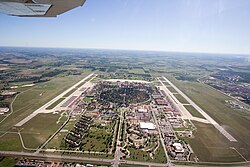
In 1927, newly assigned to Kelly Field as a dispatch officer in the motor pool, First Lieutenant Harold Clark designed a model four-quadrant airfield having a circular layout of facilities between parallel runways, after learning a new field was to be constructed. Having trained as an architect prior to entering the military during World War I, Clark sketched ideas for a perfect "Air City" on the back of old dispatch sheets, aligning the runways with prevailing winds and placing facilities by function between the runways to keep planes from having to make landing approaches over hangars, as they were forced to do at Kelly. Clark took his drawings to Lahm's executive officer, who immediately brought him before the planning board. On 1 November 1927, Clark submitted a finished plan to Lahm, and impressed with Clark's designs, Lahm detailed him to ACTC Headquarters on 8 December, to revise and develop the plans.
Randolph Air Force Base
Randolph Air Force Base (IATA: RND, ICAO: KRND, FAA LID: RND) is a United States Air Force base located in Bexar County, Texas, (14.8 miles (23.8 km) east-northeast of Downtown San Antonio).
Opened in 1931, Randolph has been a flying training facility for the United States Army Air Corps, the United States Army Air Forces, and the Air Force during its entire existence.
On 1 October 2010, Randolph AFB merged with Lackland Air Force Base and the US Army's Fort Sam Houston to form Joint Base San Antonio.
Randolph AFB was named after Captain William Millican Randolph, a native of Austin, who was on the base naming committee at the time of his death in a crash.
The base served as headquarters of the Air Education and Training Command (AETC) as well as the Air Force Personnel Center (AFPC) and was known as "the Showplace of the Air Force" because of the Spanish Colonial Revival Style architecture in which all structures, including hangars were constructed. The symbol of the base was a large water tower atop Building 100, housing the headquarters for Randolph's major flying unit, the 12th Flying Training Wing (12 FTW). With its distinctive architecture, the wing's headquarters became known throughout the Air Force as "the Taj Mahal", or simply "The Taj".
The idea for Randolph began soon after passage in the United States Congress of the Air Corps Act of 1926, which changed the name of the Army Air Service to the Army Air Corps, created two new brigadier general positions and provided a five-year expansion program for the under-strength Air Corps. One of the new general officer positions was given to Frank P. Lahm, who was placed in charge of all flying training.
General Lahm established the Air Corps Training Center in August 1926 and set up its headquarters at Duncan Field, next to Kelly Field, Texas. He soon learned that the facilities at Kelly and Brooks Fields were not sufficient for proper training. The buildings, erected during World War I with a life expectancy of five years, had no suitable areas for ground training, and the living quarters were inadequate. San Antonio's rapid growth was also beginning to interfere with flying training operations. Maj. Gen. Mason Patrick, Chief of the Air Corps, visited San Antonio in December and recommended that an additional training field be built, and in April 1927 a board of officers appointed by Gen. Lahm approved an unusual circular layout.
In 1927, newly assigned to Kelly Field as a dispatch officer in the motor pool, First Lieutenant Harold Clark designed a model four-quadrant airfield having a circular layout of facilities between parallel runways, after learning a new field was to be constructed. Having trained as an architect prior to entering the military during World War I, Clark sketched ideas for a perfect "Air City" on the back of old dispatch sheets, aligning the runways with prevailing winds and placing facilities by function between the runways to keep planes from having to make landing approaches over hangars, as they were forced to do at Kelly. Clark took his drawings to Lahm's executive officer, who immediately brought him before the planning board. On 1 November 1927, Clark submitted a finished plan to Lahm, and impressed with Clark's designs, Lahm detailed him to ACTC Headquarters on 8 December, to revise and develop the plans.
Recent media
Recent media