



Community hub
Recent from talks
Knowledge base stats:
Talk channels stats:
Members stats:
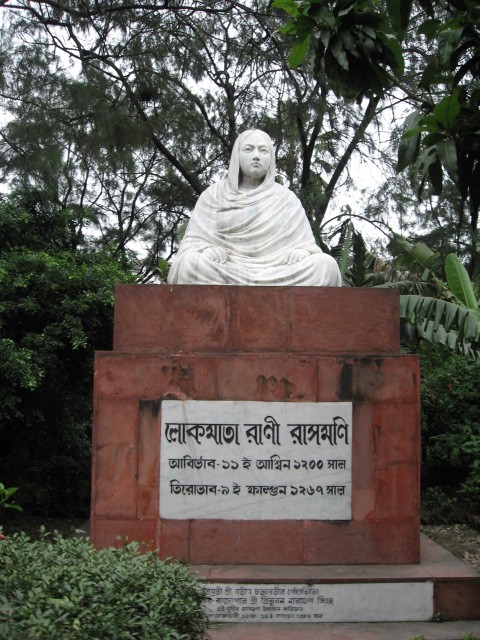
Rani Rashmoni
Rashmoni Das, popularly known as Lokamata Rani Rashmoni, also spelled as Rani Rasmani, (28 September 1793 – 19 February 1861), was an Indian businesswoman, entrepreneur, Zamindar, philanthropist and the founder of the Dakshineswar Kali Temple in Kolkata. She remained closely associated with Sri Ramakrishna Paramhansa after she appointed him as the priest of the Dakshineswar temple. She was also one of the earliest social reformers in early nineteenth-century Bengal and was one of the forerunners of the Bengal Renaissance. Besides, she also led many of the resistances against the encroaching British administration and their presence in all walks of colonial society in the Bengal province. Her other construction works include the construction of a road from Subarnarekha River to Puri for the pilgrims, Babughat (also known as Babu Rajchandra Das Ghat), Ahiritola Ghat and Nimtala ghat for the everyday bathers at the Ganges. She also offered considerable charity to the Imperial Library (now the National Library of India), and the Hindu College (now Presidency University).
Presently, the Lokmata Rani Rashmoni Mission is situated at Nimpith, South 24 Parganas, West Bengal, 743338, India.
Rashmoni was born on 28 September 1793 at 'Kona' village, Kumarhatta-Kanchanpalli (present-day Nadia-North 24 Parganas border) in a Mahishya peasant family of Harekrishna Das. Her father had learned as much as he could in his youth, so by his old days he could read the Krittivasi Ramayan and the Kashidasi Mahabharata, and even knew a little about market calculations. Again, Hare Krishna knew the work of house construction very well. Because of this, Rashmoni's father was well known in Halisahar and nearby villages. When he got some free time, he used to read Ramayana or Mahabharata. Everyone adored Rashmoni's father as he could recite the Ramayana beautifully. Her mother Rampriya Debi died when she was just seven years old. She was married to Babu Rajchandra Das (Marh) of Janbazar, Kolkata, a member of a wealthy Mahishya zamindar family, when she was eleven years old. They had four daughters.
After her husband's death in 1836, Rashmoni assumed responsibility of the zamindari and finances.
After inheriting property from her husband, she managed to endear herself to the people through her management skills of the estate and her many charitable works in the city. She was well loved and revered by the people and proved herself to be worthy of the title, "Rani".
The Rani had clashes with the British in India. By blocking the shipping trade on a part of the Ganges she compelled the British to abolish the tax imposed on fishing in the river, which threatened the livelihood of fishermen. When Puja processions were stopped by the British on the charge that they disturbed the peace, she defied the orders. The British withdrew the penalty imposed on her.
She tacitly supported social activist/scholar Ishwar Chandra Vidyasagar's campaign for widow remarriage. She even submitted a draft bill against polygamy to the East India Company, who handled the administration during those days.
The Eden Gardens (then Marh Bagan) was also a part of their Zamindari area, which they later gifted to the Eden sisters of Lord Auckland, the then Governor-General of India, as they helped him in saving life of Babu's 3rd daughter from a fatal disease.
Hub AI
Rani Rashmoni AI simulator
(@Rani Rashmoni_simulator)
Rani Rashmoni
Rashmoni Das, popularly known as Lokamata Rani Rashmoni, also spelled as Rani Rasmani, (28 September 1793 – 19 February 1861), was an Indian businesswoman, entrepreneur, Zamindar, philanthropist and the founder of the Dakshineswar Kali Temple in Kolkata. She remained closely associated with Sri Ramakrishna Paramhansa after she appointed him as the priest of the Dakshineswar temple. She was also one of the earliest social reformers in early nineteenth-century Bengal and was one of the forerunners of the Bengal Renaissance. Besides, she also led many of the resistances against the encroaching British administration and their presence in all walks of colonial society in the Bengal province. Her other construction works include the construction of a road from Subarnarekha River to Puri for the pilgrims, Babughat (also known as Babu Rajchandra Das Ghat), Ahiritola Ghat and Nimtala ghat for the everyday bathers at the Ganges. She also offered considerable charity to the Imperial Library (now the National Library of India), and the Hindu College (now Presidency University).
Presently, the Lokmata Rani Rashmoni Mission is situated at Nimpith, South 24 Parganas, West Bengal, 743338, India.
Rashmoni was born on 28 September 1793 at 'Kona' village, Kumarhatta-Kanchanpalli (present-day Nadia-North 24 Parganas border) in a Mahishya peasant family of Harekrishna Das. Her father had learned as much as he could in his youth, so by his old days he could read the Krittivasi Ramayan and the Kashidasi Mahabharata, and even knew a little about market calculations. Again, Hare Krishna knew the work of house construction very well. Because of this, Rashmoni's father was well known in Halisahar and nearby villages. When he got some free time, he used to read Ramayana or Mahabharata. Everyone adored Rashmoni's father as he could recite the Ramayana beautifully. Her mother Rampriya Debi died when she was just seven years old. She was married to Babu Rajchandra Das (Marh) of Janbazar, Kolkata, a member of a wealthy Mahishya zamindar family, when she was eleven years old. They had four daughters.
After her husband's death in 1836, Rashmoni assumed responsibility of the zamindari and finances.
After inheriting property from her husband, she managed to endear herself to the people through her management skills of the estate and her many charitable works in the city. She was well loved and revered by the people and proved herself to be worthy of the title, "Rani".
The Rani had clashes with the British in India. By blocking the shipping trade on a part of the Ganges she compelled the British to abolish the tax imposed on fishing in the river, which threatened the livelihood of fishermen. When Puja processions were stopped by the British on the charge that they disturbed the peace, she defied the orders. The British withdrew the penalty imposed on her.
She tacitly supported social activist/scholar Ishwar Chandra Vidyasagar's campaign for widow remarriage. She even submitted a draft bill against polygamy to the East India Company, who handled the administration during those days.
The Eden Gardens (then Marh Bagan) was also a part of their Zamindari area, which they later gifted to the Eden sisters of Lord Auckland, the then Governor-General of India, as they helped him in saving life of Babu's 3rd daughter from a fatal disease.