Hubbry Logo
Rapiscan SystemsRapiscan SystemsMain
Open search
Rapiscan Systems
Community hub
Rapiscan Systems
logo
8 pages, 0 posts
0 subscribers
Be the first to start a discussion here.
Rapiscan Systems
Rapiscan Systems
from Wikipedia
Rapiscan X-ray backscatter scanner
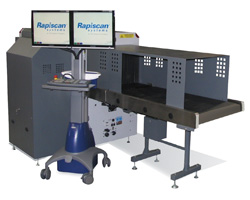
Advanced Technology (AT) X-ray systems for baggage scanning

Rapiscan Systems is an American privately held company that specialises in walk-through metal detectors and X-ray machines for screening airport luggage and cargo. The company is owned by OSI Systems.[1]

The company headquarters, in Torrance, California, USA, is the primary location for research and development, engineering, manufacturing, sales and marketing, and customer service support. Their European headquarters, and home to Rapiscan Systems Limited, is in Salfords in Surrey, England, near Gatwick Airport. The primary centre for development and distribution of X-ray systems for hold-baggage screening is also at Salfords. In Espoo, Finland, Rapiscan Systems designed and manufactured its Metor Metal Detectors, used in people-screening applications.

Rapiscan also has significant research and development, distribution, support, and manufacturing facilities in Melbourne, Australia; Singapore; Sunnyvale, California in the USA; Johor Bahru in Malaysia; Ocean Springs, Mississippi in the USA; and Hyderabad in India.[2]

The company is certified to the ISO 9001:2008 Quality Standard.[3]

History

[edit]

Rapiscan was formed in the United Kingdom in 1972 as the Security Products Division of International Aeradio Limited (IAL).[4] This company then acquired metal detector manufacturer Adams Electronics in 1984. Two years later Rapiscan's X-Ray Division and Adams Electronics were combined as IAL Security Products, located in Crawley, West Sussex. In 1993 Opto Sensors, Inc. in the United States formed Rapiscan Security Products, Inc., which then acquired Rapiscan in the UK. Opto Sensors, Inc. became OSI Systems.

Rapiscan Metor walk-through metal detectors stem originally from Outokumpu, which was one of the first companies to develop walk-through metal detectors for security screening. The systems were originally adapted from metal detectors used in the mining industry to locate parts of broken drill bits in minerals on a conveyor belt.[5] The Metor company was spun off from Outokumpu and later acquired by Rapiscan.

As of 2008, the company had installed more than 50,000 security and inspection systems globally, and in April 2008, Rapiscan Systems UK won the Queen's Award for International Trade in recognition of its growth over the previous three years, tripling its revenue during 2005–⁠2007.[6]

Rapiscan manufactures a controversial backscatter X-ray system for screening airport passengers, the Rapiscan Secure 1000.[7][8] On 23 September 1998 the device's inventor, Steven Smith, assuaged the concerns of radiation security experts about the possible risk posed to people by the device, saying "The places I think you are not going to see these in the next five years is lower-security facilities, particularly power plants, embassies, courthouses, airports, and governments...I would be extremely surprised in the next five to 10 years if the Secure 1000 is sold to any of these."[9]

The company has developed a fast 3D X-ray CT scanner for hold-luggage, the RTT80. They announced in 2008 that this scanner would undergo tests in Manchester Airport[10][11] and that it would shortly undergo testing by the TSA. The system was originally developed by CXR Ltd in Surrey, and the Engineering and Physical Sciences Research Council (EPSRC) funded a grant for the School of Mathematics, University of Manchester to work on the reconstruction problem for Rapiscan.[12] The RTT80 has an 80 cm diameter opening, and the RTT110, a 1.02m aperture.[11]

Teaming with the University of Manchester and Manchester Airport, they started a research project, EMBody, to develop the "next generation walk-by metal detector".[13] Rapiscan, the University of Manchester, and the Mines Advisory Group have a project initiated by Sir Bobby Charlton on civilian land mine clearance.[14]

See also

[edit]

References

[edit]
[edit]
Revisions and contributorsEdit on WikipediaRead on Wikipedia
from Grokipedia
Rapiscan Systems is an American security technology company founded in 1993 and headquartered in Torrance, California, specializing in the design, manufacture, and service of X-ray imaging, trace detection, and metal detection systems for threat screening in aviation, cargo, border, and checkpoint applications.

As a wholly owned subsidiary of OSI Systems, Inc. (NASDAQ: OSIS), Rapiscan has established itself as a global leader in security inspection solutions, serving high-profile clients such as the U.S. Department of Homeland Security, NATO, and major international airports like Hong Kong International, with a network of manufacturing, sales, and service operations worldwide. The company's products include baggage and parcel scanners, vehicle inspection systems, people screening portals, and radiation detection devices, emphasizing compliance with rigorous standards for detecting explosives, narcotics, and weapons.
Rapiscan's growth accelerated after the , 2001, attacks, which heightened demand for advanced screening technologies, leading to installations of tens of thousands of systems globally by the late . However, its early Secure 1000 body scanners, deployed by the U.S. , drew substantial criticism for generating images resembling passenger nudes, prompting advocacy concerns and debates over low-dose , despite company assurances of . These devices were phased out in favor of less intrusive millimeter-wave alternatives by 2013, amid additional scrutiny over potential irregularities and vulnerabilities to simple evasion methods like plastic coverings. Despite these setbacks, Rapiscan continues to innovate in non-intrusive technologies, securing multimillion-dollar contracts for and communication systems as recently as 2025.

Company Overview

Founding and Corporate Structure

Rapiscan Systems traces its origins to 1993, when Opto Sensors, Inc.—later renamed , Inc.—acquired Rapiscan Security Products Limited, a United Kingdom-based entity focused on screening technologies. This acquisition marked OSI's entry into the inspection market, integrating Rapiscan's early expertise in high-energy systems for threat detection. Initially operating as Rapiscan Security Products, the entity expanded through joint ventures, such as the 1995 formation of ECIL-Rapiscan Security Products Limited in with , to support manufacturing and assembly of systems. In March 2005, OSI Systems consolidated its disparate divisions—including Rapiscan, Metorex, Ancore, and ARACOR—under the unified Rapiscan Systems brand to streamline operations and enhance its position as a global supplier of solutions. This restructuring centralized product development, sales, and service for , gamma-ray, and related technologies, while retaining focus on , , and perimeter applications. Rapiscan Systems operates as a wholly owned of , Inc. (NASDAQ: ), a Hawthorne, California-based multinational founded in 1987. Headquartered in , Rapiscan functions as OSI's primary security and inspection division, with OSI providing overarching governance through its executive leadership, including Chairman, President, and CEO . The structure emphasizes , with Rapiscan leveraging OSI's and healthcare segments for technological synergies, though it maintains independent branding and customer-facing operations worldwide.

Global Operations and Market Position

Rapiscan Systems, a of , Inc., is headquartered in , and coordinates a unified global network for sales, service, manufacturing, and logistics to facilitate rapid deployment of security screening solutions. The company maintains forward-stocking warehouses and service centers across multiple regions, enabling efficient support for international operations, including expeditious shipping and maintenance. Key facilities include sites in Salfords, , , and Pines Industrial, , alongside subsidiaries such as Rapiscan UK Ltd., Rapiscan Mexico Holdings LLC, and Rapiscan Services . Its install base spans government and private sector clients worldwide, including , the , Manchester Airport Group, Customs, , the U.S. Department of (TSA and CBP), and the U.S. Department of Defense. Rapiscan serves diverse markets such as , ports, borders, , and event security, with deployments supporting threat detection in high-volume environments like international airports and cargo facilities. The company's global reach is evidenced by contracts for major events, including the and , often in partnership with sister entity S2 Global. Within OSI Systems' Security division—which encompasses Rapiscan, American Science and Engineering (AS&E), and S2 Global—Rapiscan bolsters a fiscal 2025 revenue of $1.196 billion for the segment, a 14.7% increase year-over-year, comprising roughly 70% of the parent's total $1.713 billion in annual revenue. This division's order backlog surpassed $1.8 billion as of mid-2025, reflecting sustained demand for its X-ray, CT, and millimeter-wave technologies in transportation and border security. While Rapiscan positions itself as a leading provider in the global security screening market—valued at approximately $9.3 billion in 2025 and projected to grow at a 6.8% CAGR through 2030—its competitive edge stems from an extensive product portfolio and integration of AI-enhanced detection, though exact market share figures remain proprietary. Independent analyses highlight Rapiscan's strong foothold in X-ray screening subsystems, particularly for aviation and cargo inspection.

Products and Technologies

Core Security Screening Systems

Rapiscan Systems' core security screening systems primarily consist of -based imaging for baggage and parcels, non-intrusive body scanners for individuals, and trace detection devices for chemical residues, all deployed at checkpoints, borders, and sites. These systems leverage multi-energy , computed tomography (CT), and (IMS) technologies to identify threats such as explosives, weapons, and narcotics while aiming to minimize false alarms and operational downtime. In baggage and parcel inspection, Rapiscan provides conventional scanners and advanced CT systems compliant with standards like those from the (TSA). The RTT®110, for instance, is a CT scanner for hold baggage screening that generates three-dimensional images to automate , processing up to 1,000 bags per hour with reduced manual intervention. Dual-view models, such as those in the 600 series, offer top and side perspectives for carry-on items, enabling operators to detect dense materials and organic threats through material discrimination based on . sizes typically range from 500 mm x 300 mm for compact checkpoints to larger configurations for parcel handling, with features like automated threat recognition software to enhance throughput in high-volume environments. People screening solutions include millimeter-wave and scanners designed for walk-through detection of concealed metallic and non-metallic items without physical contact. Models like the ProVision series use active millimeter-wave technology to produce detailed body images, identifying anomalies under clothing while adhering to radiation safety limits set by agencies such as the International Commission on Protection. Complementary walk-through metal detectors, such as the Metor® series, employ pulsed magnetic fields to detect and non-ferrous metals with multi-zone localization, configurable for sensitivity to small threats like blades, and integrated with software for data logging and alarm management. These systems support screening rates of 300–600 individuals per hour, prioritizing speed and operator in and event venues. Trace detection systems focus on sampling surfaces or air for microscopic particles of explosives or narcotics using IMS, which separates ions by mobility in an for rapid identification within seconds. Portable options like the MobileTrace® series include handheld units weighing under 2 kg for on-demand swabbing at checkpoints, detecting traces as low as nanograms of substances such as or . Desktop analyzers provide higher throughput for integrated checkpoint lines, often paired with automated sample collection from hands or luggage, and feature self-calibrating drift tubes to maintain accuracy over extended operations without frequent recalibration. These devices target a of over 20 explosive types and common narcotics, with false positive rates minimized through spectral libraries updated via manufacturer software.

Innovations in Threat Detection

Rapiscan Systems has pioneered advancements in computed (CT) for screening, exemplified by the 920CT system, which employs dual-energy CT technology to generate high-resolution 3D images with 360-degree views, enabling automatic detection of explosives through material discrimination based on density and effective . This innovation, certified to ECAC C3 standards, incorporates advanced algorithms that reduce false alarms and operator dependency, while its contactless gantry design enhances reliability and speed, allowing passengers to retain large and liquids in carry-on bags without compromising threat resolution. The system's software-upgradable architecture ensures adaptability to evolving regulatory requirements, marking a shift from conventional 2D to volumetric imaging that improves penetration of densely shielded threats. In multi-view X-ray technologies, Rapiscan's Orion 920DX and 620DV systems deliver dual-perspective imaging for checkpoint and parcel , enhancing detection accuracy by mitigating occlusion effects inherent in single-view scanners and supporting approvals from bodies like TSA and ECAC. These systems leverage high-voltage sources (up to 320kV in variants like the 638DV) to inspect larger items such as pallets, providing operators with operator-assist tools for rapid anomaly identification in organic and inorganic materials. Trace detection innovations include the Itemiser 4DX, a desktop analyzer utilizing for real-time identification of explosives and narcotics residues with high specificity, minimizing swab contamination risks through automated sampling. Complementing this, the EntryScan 4 portal employs non-contact air-based collection to screen individuals for trace particles without physical contact, facilitating high-throughput applications in high-security environments. The MobileTrace portable unit extends these capabilities to field operations, detecting minute quantities of threats via handheld vapor and particle sampling. A recent development is the Orion Road 930DX-V, launched on September 29, 2025, as a road-mobile dual-view van system designed for and screening, capable of revealing concealed weapons, explosives, and contraband through enhanced imaging efficiency and integrated analysis tools for protection and . These mobile innovations address gaps in static screening by enabling rapid deployment and on-site verification, supported by underlying s in tomographic processing and threat projection systems that simulate and validate detection algorithms.

Historical Development

Inception and Early Growth (1993–2000)

Rapiscan Security Products Limited, a UK-based developer of security screening equipment, was acquired by OSI Systems, Inc. in 1993, marking the inception of what would become Rapiscan Systems. This acquisition integrated Rapiscan's expertise in X-ray imaging and detection technologies into OSI's portfolio, which had previously focused on optoelectronics and sensors. Concurrently, OSI established Rapiscan Security Products (U.S.A.), Inc. to expand operations into the American market, initiating the company's focus on manufacturing and distributing security inspection systems such as baggage scanners and threat detection devices. During the mid-1990s, Rapiscan Systems experienced early growth through product innovation and strategic expansions. In 1993, OSI also acquired Ferson Optics, Inc., enhancing Rapiscan's capabilities in optical components critical for high-resolution imaging in security applications. By 1994, the company formed a joint venture, ECIL-Rapiscan Security Products Limited, with India's Electronics Corporation of India Limited, facilitating entry into the Asian market for customized screening solutions. Rapiscan's core technologies, including ion trap mobility spectrometry for trace explosives detection, began gaining adoption among government agencies for airport and border security, building on developments traceable to the early 1990s. From 1995 to 2000, Rapiscan solidified its position as a supplier of non-intrusive systems, with installations in international airports and facilities. The renamed Rapiscan Systems Ltd. in the UK served as a hub for European operations, while U.S. facilities in supported design and assembly of cabinet systems for parcel and luggage screening. This period emphasized , combining hardware manufacturing with software for image analysis, which enabled reliable threat identification amid rising global security demands. By 2000, Rapiscan's portfolio included walk-through metal detectors and real-time systems, establishing foundational contracts with clients worldwide.

Expansion in Aviation and Border Security (2001–2009)

Following the , 2001, terrorist attacks, demand for advanced non-intrusive inspection technologies surged, prompting Rapiscan Systems to expand its offerings in passenger and baggage screening as well as border and vehicle inspection. The creation of the (TSA) in November 2001 and heightened focus on systems accelerated adoption of -based solutions, with Rapiscan leveraging its existing portfolio of high-energy transmission systems for and . In aviation , Rapiscan prioritized development of backscatter X-ray technology for personnel screening to address limitations of metal detectors in detecting non-metallic threats like explosives. By , the company consolidated its security divisions—including Rapiscan, Metorex, Ancore, and ARACOR—under the unified Rapiscan Systems brand to streamline product development and deployment for checkpoints. This restructuring supported enhanced R&D efforts, culminating in the Secure 1000 system, a single-pose scanner capable of imaging concealed organic and metallic threats without physical contact. In 2007, the TSA awarded Rapiscan a contract to customize the Secure 1000 for deployment, marking a key step toward integrating advanced imaging technology (AIT) into U.S. passenger screening protocols. Border security applications saw parallel growth, driven by U.S. Customs and Border Protection (CBP) initiatives to inspect vehicles and containers for and radiological threats. In November 2005, Rapiscan secured a contract and initial order from CBP for its Eagle series high-energy systems, designed for non-intrusive scanning of trucks and maritime containers at ports of entry. The Mobile Eagle P20 variant, highlighted by DHS in June 2005 for port applications, enabled rapid deployment at high-volume sites like the , scanning up to 140,000 containers annually for hidden threats. To accommodate rising orders, Rapiscan opened a new headquarters facility in , in August 2007, expanding manufacturing capacity for and gamma-ray inspection systems. By 2009, aviation contracts advanced further with a $173 million indefinite delivery/indefinite quantity (IDIQ) agreement from the TSA, leading to a $25 million initial order in October for Secure 1000 units to pilot advanced threat detection at select airports. In border contexts, Rapiscan extended internationally, securing orders for similar cargo inspection systems in regions like the Middle East to support global counter-smuggling efforts. These developments positioned Rapiscan as a key supplier amid post-9/11 regulatory mandates, with revenues from security products growing significantly through government procurements.

Maturation and Adaptation (2010–Present)

In the early , Rapiscan Systems faced significant challenges in passenger screening following the U.S. Transportation Security Administration's (TSA) decision to phase out its Secure 1000 systems due to concerns and failure to meet updated image-handling requirements, a shift accelerated after high-profile incidents like the 2009 underwear bomber attempt. This adaptation prompted a pivot toward baggage, cargo, and non-passenger applications, where the company secured contracts for advanced screening systems, including a 2010 milestone in deploying high-throughput parcel inspectors capable of diverting threats for secondary checks while maintaining line flow. By 2010, Rapiscan reported $7 million in U.S. government orders for maintenance and upgrades of existing deployments, signaling operational maturation amid revenue growth of 23% in the first quarter alone. Throughout the decade, Rapiscan expanded its technological portfolio through targeted acquisitions and internal R&D, focusing on automated threat resolution to reduce operator dependency and false alarms. In 2020, the company acquired an advanced platform from Synapse Technology Corporation to integrate for enhanced image analysis in screening, enabling automated detection of explosives, narcotics, and other with improved accuracy over manual methods. This move aligned with broader industry demands for , as evidenced by deployments of dual-view systems like the Rapiscan 620DV, certified by TSA and standards for at checkpoints. By 2019, Rapiscan's emphasis on border and yielded substantial contracts, including vehicle and cargo scanners for U.S. Customs and Border Protection, marking a recovery from earlier setbacks through diversification beyond . In the 2020s, Rapiscan continued adapting to evolving threats like illicit trafficking and biosecurity risks via high-performance systems such as the RTT explosive detection platform, which achieves over 1,800 bags per hour with low false-alarm rates through algorithmic enhancements developed in collaboration with research partners. The 2023 acquisition of VOTI Detection Inc.'s assets bolstered its trace detection capabilities, integrating new sensor technologies for narcotics and explosives while consolidating support services under Rapiscan's global operations. Recent U.S. government awards, including a $23 million order in January 2025 for critical communication-integrated screening solutions, underscore sustained maturation, with over 50,000 systems installed worldwide by the late 2010s, emphasizing compliance with international standards like those from the European Civil Aviation Conference. These developments reflect a strategic shift toward AI-augmented, multi-modal detection resilient to regulatory scrutiny and threat diversification, prioritizing empirical performance metrics over legacy imaging controversies.

Key Controversies

Privacy and Health Concerns with Backscatter Technology

The Rapiscan Secure 1000 backscatter X-ray scanners, deployed by the U.S. Transportation Security Administration (TSA) starting in 2010, generated detailed images of passengers' body contours by reflecting low-energy X-rays off the skin, raising significant privacy objections due to the revealing nature of the output. Critics, including the Electronic Privacy Information Center (EPIC), argued that these scans violated the Fourth Amendment and the Privacy Act by producing "nude" or semi-nude representations without adequate safeguards against image storage or misuse, prompting a federal lawsuit filed in 2010 against the Department of Homeland Security. Public backlash intensified after reports emerged of TSA operators viewing explicit details, leading Congress to mandate privacy software upgrades by June 2012; Rapiscan's proposed anonymization algorithms, however, failed TSA detection standards due to excessive false alarms, resulting in the removal of all 174 Secure 1000 units from U.S. airports by mid-2013. Health concerns centered on the scanners' use of , with each scan delivering an effective dose of approximately 0.03–0.1 microsieverts (μSv), equivalent to 3–9 minutes of natural or a short commercial flight at altitude. Independent assessments, including a 2012 American Association of Physicists in Medicine (AAPM) report on the Secure 1000, confirmed doses well below regulatory limits and comparable to environmental exposure, attributing minimal cancer risk even for frequent travelers scanned hundreds of times annually. However, early evaluations by bodies like the French Institute for Radiological Protection and Nuclear Safety (IRSN) highlighted potential localized doses up to 100 times higher than whole-body estimates due to the backscattered beam's penetration limits, prompting petitions from over 30 physicists in 2010 warning of underappreciated risks from non-uniform exposure. Federal agencies, including the FDA and FAA, ultimately deemed the technology safe for general use, with no verified adverse incidents reported post-deployment. Despite low levels supported by empirical , issues—amplified by the scanners' initial lack of automated detection and reliance on review—proved decisive in their U.S. phase-out, shifting TSA to millimeter-wave alternatives that avoid X-rays altogether. Ongoing debates reflect tensions between efficacy and individual rights, with advocates emphasizing the technology's inherent invasiveness over quantified perils.

Questions of Efficacy and Bypass Vulnerabilities

Independent security evaluations have raised significant doubts about the detection efficacy of Rapiscan's Secure 1000 backscatter X-ray full-body scanner, which was deployed at U.S. airports from 2009 until its phase-out in 2013. In a 2014 study by researchers from the University of California San Diego, Johns Hopkins University, and the University of Michigan, laboratory tests demonstrated that the scanner failed to detect concealed threats when subjects adapted their positioning or shielding methods, indicating limited robustness against informed adversaries. The evaluation, the first independent analysis of the system, tested the scanner purchased as government surplus and found its image processing algorithms susceptible to evasion through simple physical manipulations. Bypass vulnerabilities exploited asymmetries in the scanner's imaging mechanism, which relies on low-energy X-rays scattered back from the body to form images. For instance, positioning metallic objects like knives or firearms asymmetrically—such as offset from the body's centerline—or encasing them in low-density materials like thin plastic sheets reduced contrast in the resulting images, allowing concealment without triggering alarms. simulants, mimicking materials like C-4, were similarly hidden by leveraging the scanner's poor differentiation of organic densities when blended with body contours or fabrics. These methods succeeded in over a dozen test configurations, underscoring the technology's reliance on standardized poses that adaptive could circumvent without specialized equipment. Software flaws further compounded physical bypass risks, enabling potential remote manipulation of detection outcomes. The Secure 1000's outdated operating system and default configurations allowed unauthorized access via weak passwords and network exposure, permitting injection that could selectively suppress threat indicators in images. Researchers demonstrated this by altering scanner software to test objects, highlighting how insider or external hacks could undermine efficacy in operational settings. Rapiscan contested some findings, attributing certain access issues to misconfigurations in surplus units, but the core physical evasion techniques remained unrefuted in peer-reviewed analysis. These vulnerabilities contributed to broader critiques of technology's real-world performance, though no public data quantifies operational detection rates across Rapiscan's deployments.

Government Contracts and Allegations of Misconduct

Rapiscan Systems, a of , has secured numerous contracts with U.S. government agencies, primarily the Department of Homeland Security (DHS) and (TSA), for security screening equipment such as scanners for cargo, vehicles, and checkpoints. Notable awards include a $34 million contract in July 2025 for cargo and vehicle inspection systems, a $36 million contract in May 2025 for security systems, and a $26 million payment from DHS in April 2025. These contracts often fall under (GSA) schedules, such as GS-07F-154DA, facilitating procurement for threat detection technologies deployed at airports, borders, and ports. A significant controversy arose in 2012 regarding Rapiscan's Secure 1000 scanners supplied to the TSA under a multi-year initiated after the 2009 "underwear bomber" incident. The TSA alleged that Rapiscan failed to disclose a software defect impairing automated target recognition (ATR) functionality, which was intended to obscure non-threat areas of passenger images for protection, and instead manipulated a demonstration to falsely portray the software as operational. This led the TSA to issue a "show cause" notice in November 2012, threatening termination, and ultimately end the software upgrade portion in January 2013 due to non-delivery of compliant features. In May 2013, the TSA proposed debarment of Rapiscan from future federal contracts, citing the undisclosed defect and falsified demo as grounds for responsibility concerns under federal acquisition regulations. However, following Rapiscan's , including root-cause , remedial actions, and of compliance enhancements, DHS declined to proceed with debarment in December 2014, determining that the issues did not warrant exclusion from government business. Critics, including congressional figures like Rep. Mike Rogers, highlighted the incident as evidence of potential risks in rushed procurement post-security incidents, though no criminal charges resulted and Rapiscan continued securing subsequent contracts. Separately, parent company OSI Systems faced broader allegations in a 2017 Muddy Waters Research report accusing it of bribery in foreign deals, such as in Thailand and Albania, prompting a U.S. federal probe; however, these claims pertained to international operations rather than U.S. government contracts and did not directly implicate Rapiscan in domestic misconduct. No verified instances of bribery or fraud in U.S. government procurement beyond the 2012 software matter have been substantiated against Rapiscan.

Impact and Evaluation

Achievements in Security Applications

Rapiscan Systems' security screening technologies have achieved notable compliance with international standards for threat detection, including certification under EU Regulation 300/2008 for systems via its RTT110 baggage screener, which employs advanced computed tomography (CT) imaging to identify explosives with high accuracy and low false alarm rates. The RTT110 processes over 1,800 bags per hour, enabling efficient high-volume screening at airports and parcel facilities while reducing operational costs through minimized maintenance needs of 35-50% compared to earlier systems. This system has been deployed by major global carriers, contributing to enhanced aviation security by facilitating faster throughput and space-efficient installations that improve screening by up to 300%. In border and cargo applications, Rapiscan's non-intrusive inspection solutions, such as high-energy systems, have secured multimillion-dollar U.S. government contracts, including a $23 million order in 2025 for vehicle and cargo screening to bolster border infrastructure against and threats. Similarly, deployments at ports and high-threat facilities utilize these technologies for detecting and radiological materials, with systems like the Itemiser 5X trace detector identifying nanogram-level explosives and narcotics residues to support rapid, portable screening. These achievements are evidenced by awards, such as recognition for best long-range detection products and excellence in for operations. Rapiscan's innovations have also extended to specialized threat mitigation, such as algorithms integrated into its systems for automated detection of risks and batteries, trialed successfully at European airports in to identify prohibited items without disrupting operations. In , the 920CT scanner supports laptop- and liquid-free checkpoints through 3D , enhancing passenger flow while maintaining detection efficacy against concealed threats. These applications underscore Rapiscan's role in operational successes across global checkpoints, with over 70,000 systems influencing widespread enhancements.

Broader Criticisms and Empirical Assessments

Empirical evaluations of Rapiscan Systems' scanners, such as the Secure 1000 model, have revealed limitations in detecting certain concealed threats. A 2010 Government Accountability Office (GAO) report concluded that these scanners might not reliably detect explosives like PETN in configurations similar to the 2009 underwear bomber attempt, due to challenges in resolving low-contrast, irregularly shaped materials against body tissue. Similarly, a study in the Journal of Transportation Security indicated that technology struggles with thin explosive films or weapons taped flat to the body, potentially missing up to one-third of molded plastic explosives in simulated tests. Earlier assessments of comparable millimeter-wave systems reported detection rates of 73% overall but only 56% for bulk explosives, highlighting persistent gaps in non-metallic threat identification. Critics, including congressional oversight, have pointed to subvertibility and inconsistent performance in field conditions. Representative described Rapiscan scanners as "badly flawed" based on GAO covert testing results, which showed vulnerabilities exploitable by determined adversaries, though specific breach rates were classified. A Department of Homeland Security review identified detection weaknesses in operational deployments, recommending enhanced protocols to mitigate bypass risks beyond initial certification. These findings underscore a broader concern that initial laboratory efficacy does not always translate to sustained real-world performance, as TSA lacks systematic post-deployment verification of detection standards per a GAO analysis. Cost-effectiveness analyses further question the technology's value relative to alternatives. Deployments of 251 Secure 1000SP units cost $41.7 million, many of which were later decommissioned due to operational issues, with Rapiscan bearing removal expenses. Reports note underutilization of some units, leading to millions in wasted funds, and call for updated cost-benefit studies to weigh marginal gains against throughput delays and maintenance burdens. In cargo screening applications, while Rapiscan systems enable rapid imaging, empirical limitations in dual-energy differentiation of high-atomic-number materials persist, often requiring secondary manual inspections that reduce overall efficiency. Systemically, reliance on Rapiscan-like technologies has been critiqued for fostering a false of without addressing root causes like failures. Proponents cite TSA on over 130 prohibited items detected via advanced since 2010, yet independent reviews emphasize that human factors, such as operator training, dominate outcomes more than hardware alone, with false positives inflating screening times without proportional threat reductions. assessments confirm low exposure—approximately 0.0148 μSv per dual-sided scan—well below regulatory limits, alleviating health concerns but not resolving efficacy trade-offs. Overall, while Rapiscan contributes to layered , empirical suggests incremental benefits may not justify expansive adoption without complementary behavioral and enhancements.

References

Add your contribution
Related Hubs
User Avatar
No comments yet.