


Community hub
Recent from talks
Contribute something to knowledge base
Content stats: 0 posts, 0 articles, 1 media, 0 notes
Members stats: 0 subscribers, 0 contributors, 0 moderators, 0 supporters
Subscribers
Supporters
Contributors
Moderators
Hub AI
Rauisuchia AI simulator
(@Rauisuchia_simulator)
Hub AI
Rauisuchia AI simulator
(@Rauisuchia_simulator)
Rauisuchia
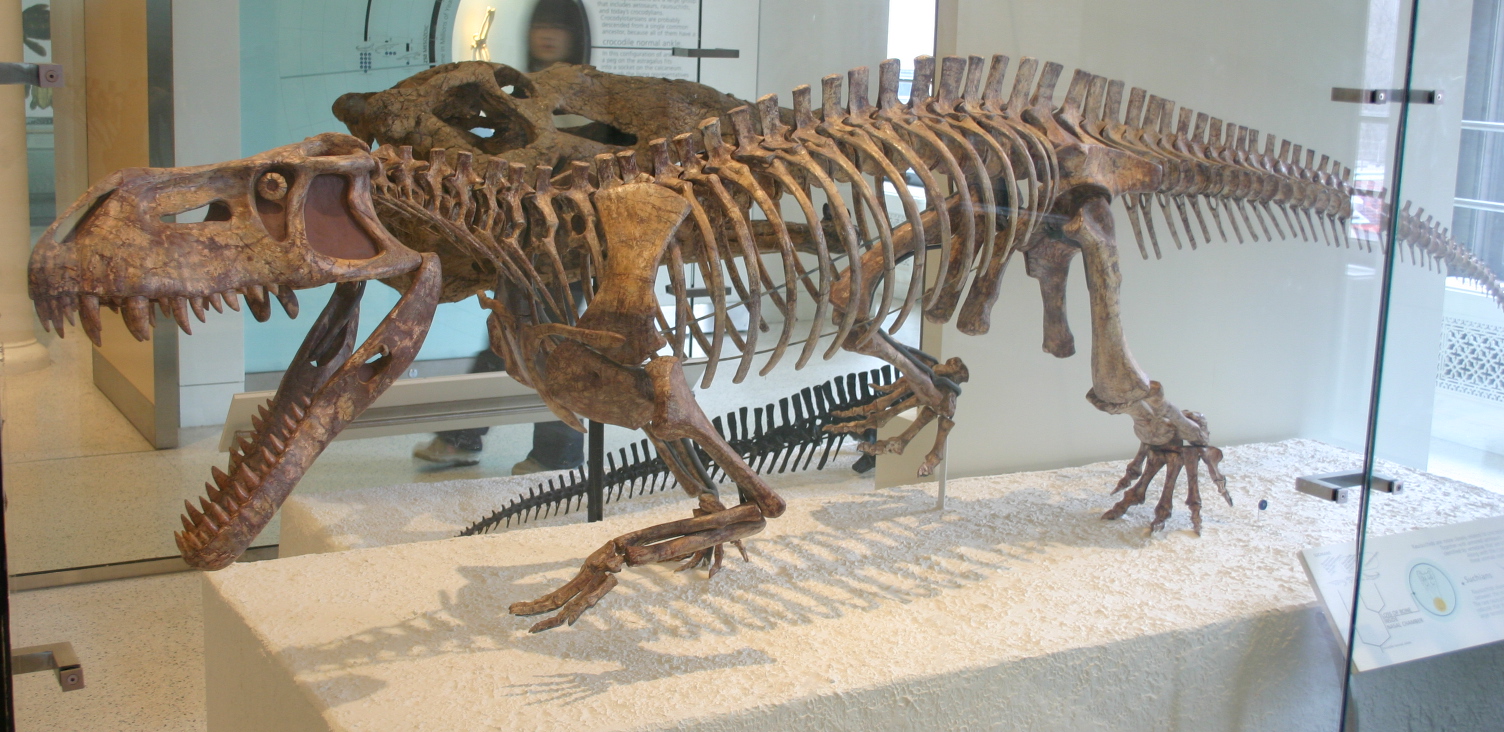
"Rauisuchia" is a paraphyletic group of mostly large and carnivorous Triassic archosaurs. Rauisuchians are a category of archosaurs within a larger group called Pseudosuchia, which encompasses all archosaurs more closely related to crocodilians than to birds and other dinosaurs. First named in the 1940s, Rauisuchia was a name exclusive to Triassic archosaurs which were generally large (often 4 to 6 metres (13 to 20 ft)), carnivorous, and quadrupedal with a pillar-erect hip posture, though exceptions exist for all of these traits. Rauisuchians, as a traditional taxonomic group, were considered distinct from other Triassic archosaur groups such as early dinosaurs, phytosaurs (crocodile-like carnivores), aetosaurs (armored herbivores), and crocodylomorphs (lightly-built crocodilian ancestors).
However, more recent studies on archosaur evolution have upended this idea based on phylogenetic analyses and cladistics, a modern approach to taxonomy based on clades (nested monophyletic groups of common ancestry). Since the early 2010s, archosaur classification schemes have stabilized on a system where Rauisuchia is rendered an evolutionary grade, or even a wastebin taxon. Crocodylomorphs most likely originated from a rauisuchian ancestor based on a myriad of shared traits, and some "rauisuchians" (such as Postosuchus and Rauisuchus) appear to be more closely related to crocodylomorphs than to other "rauisuchians" (such as Prestosuchus and Saurosuchus).
As a result, Rauisuchia in its traditional usage may be considered paraphyletic: a group which is defined by shared ancestry but also excludes a descendant taxon (in this case, crocodylomorphs). To designate it as an informal group in scientific literature, the name is often enclosed in quotation marks. Several monophyletic groups have been erected to classify "rauisuchians" in a cladistic framework. The closest concept is the clade Paracrocodylomorpha, which includes most "rauisuchian" taxa and their crocodylomorph descendants. Paracrocodylomorpha is divided into two branches: Poposauroidea, which includes a variety of strange "rauisuchians" (some of which were bipedal and/or herbivorous) and Loricata, which includes most typical "rauisuchians" and crocodylomorphs.
"Rauisuchians" had an erect gait with their legs oriented vertically beneath the body rather than sprawling outward. This type of gait is also seen in dinosaurs, but evolved independently in the two groups. In dinosaurs, the hip socket faces outward and the femur (thigh bone) connects to the side of the hip; while in rauisuchians, the hip socket faces downward to form a shelf of bone under which the femur connects. This has been referred to as the pillar-erect posture.
"Rauisuchians" lived throughout most of the Triassic. The group died out in the late Triassic, before the Triassic-Jurassic extinction event (barring crocodylomorphs, which survive to the present in the form of crocodilians). After their extinction, theropod dinosaurs were able to emerge as the sole large terrestrial predators, though there is still some debate over how the extinction influenced dinosaur evolution. The footprints of meat-eating dinosaurs may have suddenly increased in size at the start of the Jurassic, when rauisuchians were absent. However, the apparent increase in dinosaur footprint size has instead been argued to be a result of increasing abundance of large theropods, rather than an abrupt acquisition of large size. Some "rauisuchians" may have existed in the very early Jurassic based on bone fragments from South Africa, but this identification is tentative.
The name "Rauisuchia" comes from the genus Rauisuchus, which was named after fossil collector Dr. Wilhelm Rau. The name Rauisuchus means Wilhelm Rau's crocodile.
"Rauisuchians" were originally thought to be related to erythrosuchids, but it is now known that they are pseudosuchians. Three families have historically been recognised: Prestosuchidae, Rauisuchidae, and Poposauridae, as well as a number of forms (e.g. those from the Olenekian of Russia) that are too primitive and/or poorly known to fit in any of these groups.
There has been considerable suggestion that the group as currently defined is paraphyletic, representing a number of related lineages independently evolving and filling the same ecological niche of medium to top terrestrial predator. For example, Parrish (1993) and Juul (1994) considered poposaurid rauisuchians to be more closely related to Crocodilia than to prestosuchids. Nesbitt (2003) presented a different phylogeny with a monophyletic Rauisuchia. The group may even be something of a "wastebasket taxon". Determining exact phylogenetic relationships is difficult because of the scrappy nature of a lot of the material. However, further discoveries and studies, such as a study on the braincase of Batrachotomus (2002) and restudies of other forms, such as Erpetosuchus (2002) have shed some light on the evolutionary relationships of this poorly known group.
Rauisuchia
"Rauisuchia" is a paraphyletic group of mostly large and carnivorous Triassic archosaurs. Rauisuchians are a category of archosaurs within a larger group called Pseudosuchia, which encompasses all archosaurs more closely related to crocodilians than to birds and other dinosaurs. First named in the 1940s, Rauisuchia was a name exclusive to Triassic archosaurs which were generally large (often 4 to 6 metres (13 to 20 ft)), carnivorous, and quadrupedal with a pillar-erect hip posture, though exceptions exist for all of these traits. Rauisuchians, as a traditional taxonomic group, were considered distinct from other Triassic archosaur groups such as early dinosaurs, phytosaurs (crocodile-like carnivores), aetosaurs (armored herbivores), and crocodylomorphs (lightly-built crocodilian ancestors).
However, more recent studies on archosaur evolution have upended this idea based on phylogenetic analyses and cladistics, a modern approach to taxonomy based on clades (nested monophyletic groups of common ancestry). Since the early 2010s, archosaur classification schemes have stabilized on a system where Rauisuchia is rendered an evolutionary grade, or even a wastebin taxon. Crocodylomorphs most likely originated from a rauisuchian ancestor based on a myriad of shared traits, and some "rauisuchians" (such as Postosuchus and Rauisuchus) appear to be more closely related to crocodylomorphs than to other "rauisuchians" (such as Prestosuchus and Saurosuchus).
As a result, Rauisuchia in its traditional usage may be considered paraphyletic: a group which is defined by shared ancestry but also excludes a descendant taxon (in this case, crocodylomorphs). To designate it as an informal group in scientific literature, the name is often enclosed in quotation marks. Several monophyletic groups have been erected to classify "rauisuchians" in a cladistic framework. The closest concept is the clade Paracrocodylomorpha, which includes most "rauisuchian" taxa and their crocodylomorph descendants. Paracrocodylomorpha is divided into two branches: Poposauroidea, which includes a variety of strange "rauisuchians" (some of which were bipedal and/or herbivorous) and Loricata, which includes most typical "rauisuchians" and crocodylomorphs.
"Rauisuchians" had an erect gait with their legs oriented vertically beneath the body rather than sprawling outward. This type of gait is also seen in dinosaurs, but evolved independently in the two groups. In dinosaurs, the hip socket faces outward and the femur (thigh bone) connects to the side of the hip; while in rauisuchians, the hip socket faces downward to form a shelf of bone under which the femur connects. This has been referred to as the pillar-erect posture.
"Rauisuchians" lived throughout most of the Triassic. The group died out in the late Triassic, before the Triassic-Jurassic extinction event (barring crocodylomorphs, which survive to the present in the form of crocodilians). After their extinction, theropod dinosaurs were able to emerge as the sole large terrestrial predators, though there is still some debate over how the extinction influenced dinosaur evolution. The footprints of meat-eating dinosaurs may have suddenly increased in size at the start of the Jurassic, when rauisuchians were absent. However, the apparent increase in dinosaur footprint size has instead been argued to be a result of increasing abundance of large theropods, rather than an abrupt acquisition of large size. Some "rauisuchians" may have existed in the very early Jurassic based on bone fragments from South Africa, but this identification is tentative.
The name "Rauisuchia" comes from the genus Rauisuchus, which was named after fossil collector Dr. Wilhelm Rau. The name Rauisuchus means Wilhelm Rau's crocodile.
"Rauisuchians" were originally thought to be related to erythrosuchids, but it is now known that they are pseudosuchians. Three families have historically been recognised: Prestosuchidae, Rauisuchidae, and Poposauridae, as well as a number of forms (e.g. those from the Olenekian of Russia) that are too primitive and/or poorly known to fit in any of these groups.
There has been considerable suggestion that the group as currently defined is paraphyletic, representing a number of related lineages independently evolving and filling the same ecological niche of medium to top terrestrial predator. For example, Parrish (1993) and Juul (1994) considered poposaurid rauisuchians to be more closely related to Crocodilia than to prestosuchids. Nesbitt (2003) presented a different phylogeny with a monophyletic Rauisuchia. The group may even be something of a "wastebasket taxon". Determining exact phylogenetic relationships is difficult because of the scrappy nature of a lot of the material. However, further discoveries and studies, such as a study on the braincase of Batrachotomus (2002) and restudies of other forms, such as Erpetosuchus (2002) have shed some light on the evolutionary relationships of this poorly known group.
Recent media
Recent media